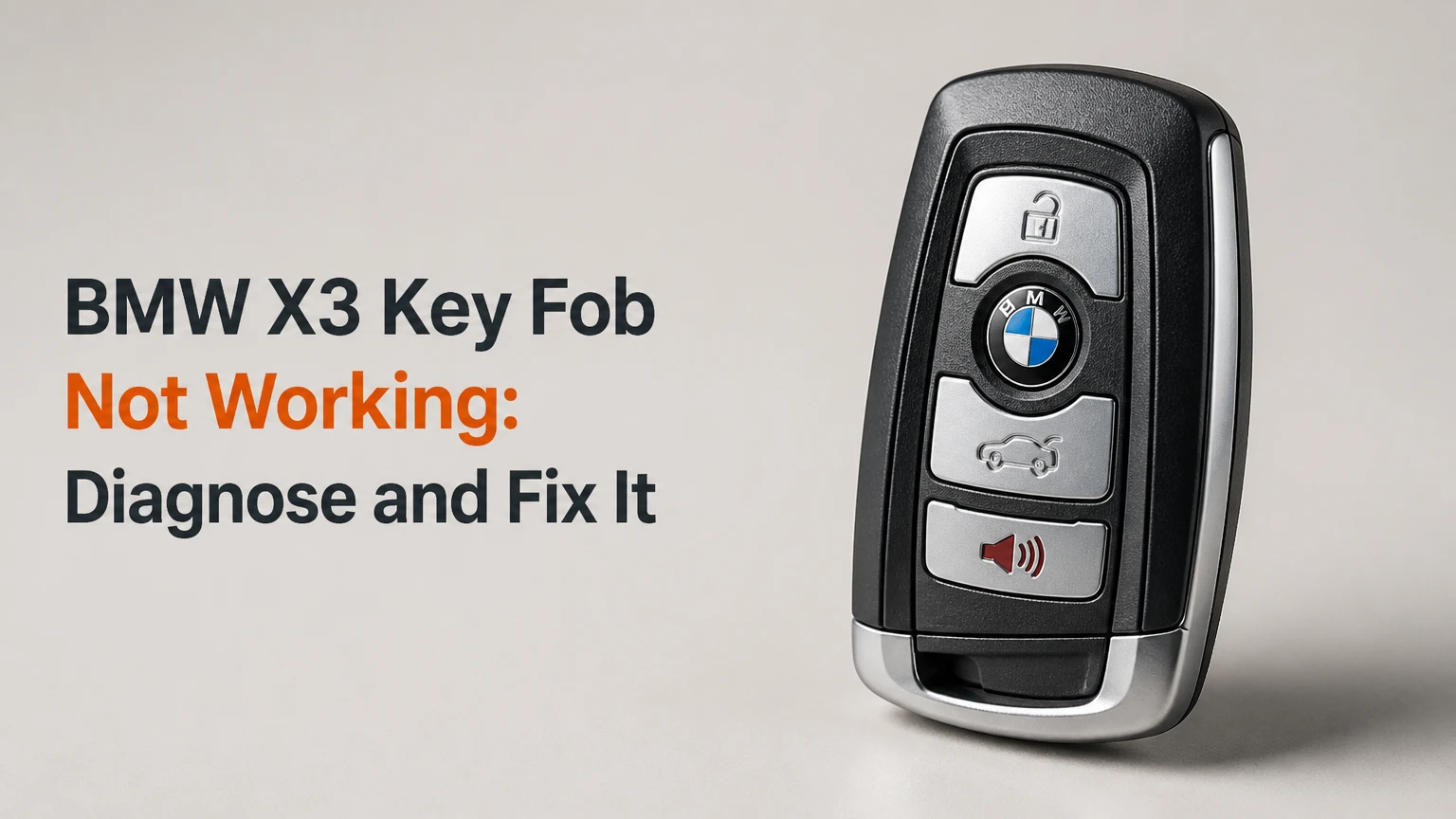
A BMW X3 key fob not working usually results from a depleted battery, lost remote synchronization, damaged fob electronics, or a vehicle-side receiver problem. First determine whether the engine still recognizes the key, then test the correct battery and emergency-start location for the X3 generation before paying for programming or a replacement.
Key Facts
- A dead key-fob battery usually disables buttons and Comfort Access before it disables engine starting.
- The E83 commonly uses a soldered rechargeable VL2020 cell, while many F25 keys use a replaceable CR2450.
- G01 and newer X3 keys can use CR2032 cells or rechargeable lithium-ion systems, depending on equipment.
- Holding the key against the BMW-marked emergency-recognition area can allow starting when the remote battery is depleted.
- If both keys fail at the same time, inspect the X3’s 12-volt battery, receiver, antenna, fuses, and software before replacing both fobs.
- Remote resynchronization does not create a new immobilizer key; replacement keys require BMW or qualified locksmith equipment.
Why Is Your BMW X3 Key Fob Not Working?
A BMW X3 key fob can fail in four separate ways: the buttons may not transmit, Comfort Access may not detect proximity, the car may not recognize the key for starting, or the mechanical blade may not turn the door lock. Those symptoms point to different components, so replacing a battery is not a complete diagnosis.
The remote-locking circuit uses a powered transmitter and a rolling security code. The engine authorization system uses a passive transponder and the vehicle’s immobilizer control unit, identified across BMW generations as EWS, CAS, FEM, or BDC. The passive chip does not depend on the coin-cell battery in the same way the lock buttons do.
A short range, intermittent response, or failure after the key was dropped usually points toward the fob. Two keys failing simultaneously suggest the vehicle. BMW’s official owner manuals and BMW USA support instructions should take priority over generic programming videos because emergency-recognition locations and key procedures vary by equipment and market.
What does the symptom tell you?
The symptom pattern provides the fastest first diagnosis. Test the spare key, try the physical blade, and attempt emergency starting before ordering a replacement.
| Symptom | Most likely area | First check | Typical next action |
|---|---|---|---|
| Buttons fail, engine starts | Fob battery or buttons | Try a fresh specified battery | Replace battery or repair buttons |
| Buttons and Comfort Access fail, engine starts | Battery, synchronization, or RF section | Emergency-start test | Battery replacement, then resync if applicable |
| “Key not detected,” but buttons work | Antenna, receiver, interference, or key transponder | Try spare key and marked start area | Diagnose vehicle receiver or fob |
| Both keys fail together | X3 12-volt system, receiver, fuse, software | Measure vehicle battery | Charge, test, or diagnose vehicle |
| Key starts car but cannot lock doors | Remote initialization or transmitter fault | Perform model-specific resync | Locksmith, dealer, or fob repair |
| Mechanical blade will not unlock | Hidden cylinder, seized lock, incorrect blade | Remove handle cover carefully | Lubricate or obtain lock service |
Which BMW X3 Key Battery Do You Need?
The correct BMW X3 key battery depends on the fob design and production configuration, not solely on the badge or model year. Read the marking on the old cell, inspect the replacement-key compartment, or confirm the part number in the owner’s manual before installing a battery.
| X3 generation | Common production period | Typical key power system | Replacement guidance |
|---|---|---|---|
| E83 | 2004-2010 | Rechargeable VL2020, usually soldered | Requires careful soldering or fob replacement |
| F25 | 2011-2017 | Commonly replaceable CR2450 | Confirm the old cell and polarity |
| G01 | 2018-2024 | CR2032 on many standard keys; lithium-ion on some systems | Check key version and manual |
| G45 | 2025-present | Configuration-dependent lithium-ion or coin-cell design | Confirm by VIN, manual, or key compartment |
Production dates are useful but not absolute. Imported vehicles, market-specific equipment, Comfort Access packages, and replacement keys can create exceptions. The BMW X3 G45 is a newer generation than the G01, so a generic “2018-present” battery chart can produce the wrong advice.
Do not substitute a VL2020 rechargeable cell with a CR2032 or CR2450. The E83 charging circuit expects a rechargeable battery, while a standard coin cell is designed for replacement rather than repeated charging. Installing the wrong chemistry can damage the key or create leakage and overheating risks.
Is the BMW X3 key fob battery actually dead?
A dead battery is likely when the remote range declined gradually, the buttons work only at close range, or a second key works normally. A battery is less likely when the vehicle cannot recognize either key, the fob suffered water damage, or the engine starts but the remote buttons remain inactive after a correct replacement.
A coin-cell voltage reading is only a screening test. A cell can show close to its rated voltage without supplying adequate current under transmitter load, particularly after storage in heat or cold. A fresh, reputable battery of the correct type is more useful than relying on an inexpensive open-circuit voltage measurement.
Keep the new battery’s positive and negative faces oriented exactly like the original. Avoid touching both battery faces with oily fingers, because contamination can increase contact resistance. The small metal contacts must press firmly against the cell without being bent beyond their original position.
How Do You Enter a BMW X3 With a Dead Key?
A BMW X3 with a dead remote battery can usually be unlocked with the concealed mechanical key. Press the release catch on the fob, pull out the blade, and use the driver’s door cylinder; on many X3 versions, the visible cylinder is behind a removable cap beneath or beside the handle.
Use the blade only in the driver’s lock cylinder and avoid forcing a cover with a screwdriver. Insert the blade into the designated release slot or recess, depending on the handle design, then remove the cap according to the owner’s manual. Gentle pressure matters because painted trim clips and plastic caps can crack in cold weather.
The alarm may sound after manual unlocking. That does not necessarily mean the key is unusable. Enter the vehicle, place the key at the emergency-recognition area, and attempt the normal start procedure; successful immobilizer recognition generally disarms the security system as the vehicle authorizes the key.
How do you start an X3 when the key is not detected?
To start a BMW X3 when the remote battery is depleted, place the fob directly against the vehicle’s marked emergency key-recognition area, press the brake, and press the Start/Stop button. The exact area differs by generation, so follow the dashboard or steering-column icon and the relevant owner’s manual.
On many push-button BMWs, the recognition area is near the steering column, but some vehicles use a marked tray or a different interior location. Do not assume the same position used by another BMW model. Hold the fob steadily against the marked area rather than waving it near the button.
You will know the procedure worked when the “key not detected” message disappears and the engine cranks normally. If the X3 still refuses to start with the fob placed at the marked area, try the spare key, move other keys and wireless devices away, and check the vehicle’s 12-volt battery.
This bypass does not repair the remote transmitter. It uses the passive authorization path so the vehicle can identify the key without relying on normal remote communication.
How Do You Replace the X3 Key Fob Battery?
Replace a replaceable BMW X3 key battery in about 5-10 minutes with the mechanical blade and a small plastic pry tool. Remove the blade, release the rear cover through the molded notch, install the specified cell with the original polarity, and test every button before closing the cover completely.
Before you start
| Requirement | Typical specification | Why it matters |
|---|---|---|
| Work time | 5-10 minutes | Allows removal, installation, and testing |
| Battery | CR2450 or CR2032, as specified | Diameter and chemistry are not interchangeable |
| Tools | Mechanical key and plastic pry tool | Reduces scratches and broken clips |
| Workspace | Dry, clean surface | Prevents lost springs, covers, and contacts |
| Prerequisite | Confirm old battery marking | Prevents installing the wrong cell |
Step 1: Remove the mechanical key
Press the fob’s release button and slide out the metal blade. Set the blade on a clean cloth because it will be used to open the cover on many F25 and G01 designs.
You will know the step worked when the rear-cover release notch is accessible. Do not twist the blade aggressively inside the notch, because the blade is intended to release the cover rather than act as a large screwdriver.
Step 2: Open the battery cover
Insert the blade tip or a plastic pry tool into the molded slot and lift the cover evenly. Older F25 and newer G01 covers can use different clips, so stop if the plastic begins whitening or bending.
You will know the cover is released when it lifts without separating the circuit board or deforming the gasket. A broken cover can allow moisture into the transmitter and turn a battery replacement into an electronics repair.
Step 3: Install the specified cell
Remove the old battery without bending the contacts. Install the new CR2450 or CR2032 with the positive side facing the same direction as the removed cell, unless the key’s molded markings specify otherwise.
You will know the installation is correct when the cell sits flat and the contacts hold it securely. A loose cell can produce intermittent locking that looks like a rolling-code fault.
Step 4: Test before final closure
Press lock, unlock, trunk, and panic functions where equipped, then test the spare key and Comfort Access. If the engine already recognized the key, test starting as well.
You will know the repair worked when the remote responds from a normal distance and the X3 recognizes the key without emergency placement. If the buttons remain dead, inspect the contact pads and circuit board rather than repeatedly buying batteries.
Can You Resynchronize a BMW X3 Remote?
You can resynchronize some E83 remotes and certain early F-series systems, but the procedure is not universal across BMW X3 vehicles. Remote initialization restores button communication after a battery change; it does not program a replacement immobilizer transponder or overcome a locked used key.
A commonly documented E83 initialization sequence is as follows:
- Enter the vehicle and close all doors.
- Insert the key into the ignition and switch to the first position, then return to off within approximately five seconds.
- Remove the key.
- Hold the unlock button.
- While holding unlock, press the lock button three times quickly.
- Release unlock and watch for the locks to cycle.
- Repeat the button sequence for additional keys within the vehicle’s stated time window.
The sequence must be performed for every remote that should continue operating, because some BMW systems clear previously initialized remote entries when a new initialization session begins. This procedure is not a substitute for dealer or locksmith programming on a lost, replacement, or immobilizer-locked key.
For F25, G01, and G45 vehicles, do not assume the E83 sequence applies. Some remote faults require vehicle diagnostics, a new key matched to the VIN, or a software procedure available only through BMW or an appropriately equipped automotive locksmith.
Why Did Both BMW X3 Keys Stop Working?
When both BMW X3 keys stop working at the same time, the vehicle is more likely to have the fault than both fobs. A weak 12-volt battery, blown fuse, receiver or diversity antenna failure, water intrusion, software fault, or disabled Comfort Access module can affect every key simultaneously.
Check whether the X3 starts with either key at the emergency-recognition area. Then compare the following patterns:
| Observation | Likely vehicle-side cause | Diagnostic priority | Practical test |
|---|---|---|---|
| Neither key locks or starts | Low 12-volt supply or security module issue | High | Battery test and diagnostic scan |
| Keys work inside but not outside | Receiver or antenna range issue | High | Test range at several vehicle positions |
| Remote works near rear glass only | Diversity antenna or amplifier fault | High | Inspect antenna module and water entry |
| Comfort Access fails, buttons work | Door-handle antenna or Comfort Access fault | Medium | Test each handle separately |
| Failure began after water exposure | Wet antenna, connector, or module | High | Inspect cargo-area and hatch wiring |
| Failure follows a discharged car battery | Module undervoltage or lost settings | Medium | Charge battery and scan fault memory |
A weak vehicle battery can cause control units to shut down convenience functions while lights and basic electronics still appear normal. Measure the battery with a suitable tester rather than judging it by dashboard brightness. BMW battery registration may be required after replacement, especially when battery type or capacity changes.
Radio interference is another possibility, but moving the fob away from phones, wireless charging pads, laptops, and other transmitters should be a short diagnostic test, not a permanent explanation. Interference does not usually damage rolling codes or permanently scramble a key.
Which X3 Key Problem Needs a Dealer or Locksmith?
Choose a battery replacement for a replaceable-cell fob, a qualified automotive locksmith for many lost-key and remote-electronics cases, and a BMW dealer when the vehicle requires factory ordering, immobilizer authorization, complex module diagnosis, or warranty support. The cheapest route depends on whether a working key remains.
| Repair option | Typical price in the United States | Typical time | Best use |
|---|---|---|---|
| CR2032 or CR2450 DIY replacement | $5-$15 | 5-10 minutes | Replaceable-cell fob with no damage |
| E83 rechargeable-cell repair | $50-$120 | 1-3 hours | Soldered VL2020 replacement |
| Fob button or board repair | $60-$180 | 1-3 days | Damaged switch or solder joint |
| Automotive locksmith replacement | $200-$450 | Same day to 2 days | Lost key or compatible replacement |
| BMW dealer replacement key | $350-$750 or more | 2-10 business days | VIN-matched factory key |
| Receiver or antenna diagnosis | $150-$400 diagnostic labor | 1-4 hours | Both keys fail or range collapses |
These are typical service ranges, not BMW price guarantees. Dealer pricing varies by country, vehicle security system, key type, programming policy, and emergency shipping. Ask whether the quote includes the key, cutting, immobilizer authorization, coding, labor, and disposal of a lost key.
A used BMW electronic key is generally a poor replacement choice because the immobilizer component is paired to its original vehicle and may not be reusable through ordinary programming. A used outer shell can be useful if the circuit board and transponder are transferred correctly, but that is different from buying a fully used electronic key and expecting it to pair.
Bring proof of ownership and identification to a dealer or locksmith. BMW security procedures are designed to prevent unauthorized key creation, and reputable providers should not bypass those controls.
What Other Faults Mimic a Dead Key Battery?
A damaged button, broken solder joint, moisture contamination, battery-contact failure, incorrect cell polarity, and vehicle receiver fault can all mimic a dead BMW X3 key battery. A new battery that produces no improvement is evidence to expand the diagnosis, not a reason to install several more batteries.
Inspect the fob for a cracked housing, liquid residue, corrosion, or a button that feels loose or sinks below the case. A key that works only when squeezed may have a displaced battery contact or fractured board connection. Do not wash the fob or apply household contact cleaner unless the product is specifically safe for electronics and plastics.
Comfort Access failures require separate testing. The lock buttons may work normally while door-handle touch sensors or antenna modules fail. Test each handle, the tailgate, and the buttons independently, because one failed handle does not prove that the key is defective.
Cold weather can reduce battery performance and expose a marginal contact. Warm the key naturally indoors, never with a direct heat source, then retest with a fresh battery. If the failure returns in normal temperatures, the fob needs inspection.
What should you avoid?
- Do not pry an E83 diamond key open as though it contains a standard removable coin cell.
- Do not fit a non-rechargeable coin cell where the key’s charging circuit expects a VL2020.
- Do not repeatedly perform an initialization sequence while leaving other working keys unpaired.
- Do not buy a used electronic key without confirming whether its immobilizer hardware can be legally and technically reused.
- Do not force the hidden door-lock cover or blade when ice, corrosion, or a seized cylinder may be present.
- Do not diagnose both failed keys as battery problems before checking the X3’s 12-volt battery.
One practitioner rule is especially useful: if both keys fail on the same day, stop working on the keys and test the car. A simultaneous independent battery failure is possible, but a shared receiver or power problem is usually the more efficient first hypothesis.
How Can You Prevent Another X3 Key Failure?
Prevent recurring BMW X3 key failures by replacing aging coin cells before they become intermittent, keeping the fob dry, avoiding heavy key-ring impact, and storing a working spare away from moisture and extreme heat. Keep the spare accessible outside the vehicle, but do not leave it permanently inside the cabin.
Replace a coin cell when range becomes inconsistent or the vehicle reports a low-key-battery warning. Store the fob away from repeated heat exposure, such as a sunny dashboard, because heat accelerates battery aging and can deform plastic cases.
A rechargeable E83 key requires a different maintenance approach. Regular ignition use may recharge the internal cell, but a weak or failed VL2020 eventually needs professional opening and soldering. Replacing only the outer shell does not restore a depleted rechargeable cell.
Keep the mechanical blade with the correct key and verify that it turns the lock before an emergency occurs. A blade that has never been used can reveal a stiff cylinder or damaged handle cap at the worst possible time.
Frequently Asked Questions
Will a dead BMW X3 key battery stop the engine from starting?
Usually, no. The X3’s passive transponder can authorize starting even when the remote battery cannot transmit lock or Comfort Access commands. Place the fob against the marked emergency-recognition area and press the brake and Start/Stop button. A failed start there points toward the key, vehicle battery, receiver, or immobilizer system.
Why does my BMW X3 key work only when close to the car?
A very short operating range usually indicates a weak battery, poor battery contact, damaged transmitter, or vehicle antenna problem. Test a fresh correct battery first, then compare the spare key. If both keys have short range, inspect the X3 receiver, diversity antenna, wiring, and vehicle 12-volt supply.
Can a BMW X3 key be programmed at home?
Some older remote buttons can be initialized at home, particularly on E83 vehicles, but a replacement immobilizer key generally cannot be created by a simple button sequence. F25, G01, and G45 procedures vary. A VIN-matched dealer key or qualified locksmith equipment may be required.
Why does the BMW X3 say key not detected?
The message means the vehicle did not receive an acceptable key signal through its normal detection path. Causes include a depleted fob battery, radio interference, failed interior antenna, low vehicle voltage, damaged transponder, or an unrecognized key. Use the emergency-recognition area, then test the spare key.
Is a BMW X3 key covered by warranty?
A vehicle warranty may cover an electronic key defect when the key was supplied with the vehicle and the failure meets warranty terms, but ordinary battery depletion, loss, physical damage, and accidental water exposure are often excluded. Check the written BMW warranty and dealer policy for the vehicle’s market.
How long does a BMW X3 key battery last?
A replaceable coin cell commonly lasts about one to three years, depending on button use, Comfort Access activity, temperature, and storage conditions. A rechargeable E83 cell has a different service life and may degrade over many years. Intermittent range is a better replacement signal than age alone.
The Bottom Line
A BMW X3 key fob not working should be diagnosed by separating remote locking, Comfort Access, passive engine authorization, and mechanical entry. Confirm the generation and battery type, try the emergency-start location, and compare the spare key before attempting synchronization or ordering a replacement.
Use a CR2450 or CR2032 only when the key is designed for that replaceable cell. Treat E83 VL2020 repairs as soldering work, and treat both failed keys as a possible vehicle-side fault involving the 12-volt battery, receiver, antenna, fuse, or security module. That sequence prevents the most expensive mistake: replacing a working key when the X3 is the real problem.