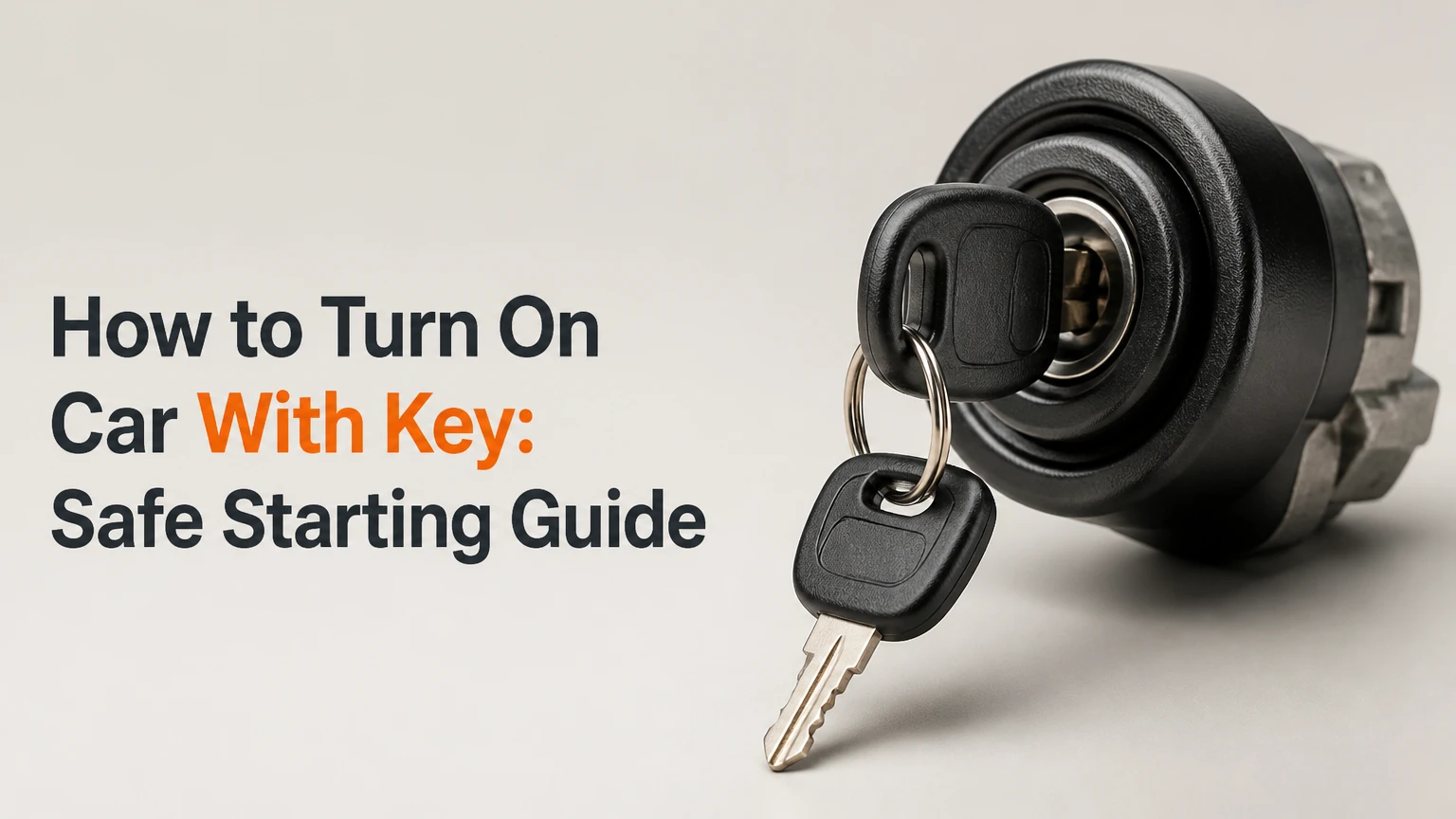
To turn on a car with a key, secure the vehicle, select Park or Neutral, press the brake or clutch, insert the key, turn it to ON/RUN, then twist it briefly to START and release it when the engine runs. The ignition switch, starter motor, battery, fuel system, and immobilizer must all operate correctly.
Key Facts at a Glance
- An automatic car normally requires the selector in Park or Neutral and the brake pedal depressed before cranking.
- A manual car normally requires Neutral, the parking brake engaged, and the clutch pedal fully depressed.
- ACC powers selected accessories; ON/RUN powers control systems; START operates the starter motor.
- A transponder key can turn the ignition mechanically while the immobilizer still prevents the engine from running.
- A healthy engine commonly starts within 1-3 seconds, but exact cranking limits vary by manufacturer.
- Repeated rapid clicks usually indicate low battery voltage, poor battery connections, or a starter-circuit fault.
Before You Start the Car
Starting a keyed car usually takes less than one minute and requires no tool, but the vehicle must be stationary, correctly secured, and in the manufacturer-specified gear. The main success factor is the interlock system: automatic vehicles monitor the brake and gear position, while manual vehicles commonly monitor clutch-pedal position.
Pre-start checklist
- Sit in the driver’s seat and confirm that the parking area is clear.
- Adjust the seat and mirrors before starting if the vehicle is unfamiliar.
- Engage the parking brake, whether it is a lever, pedal, or electronic switch.
- Put an automatic transmission in P, or use N if the vehicle’s manual permits starting there.
- Put a manual transmission in Neutral and keep the clutch pedal fully depressed.
- Switch off high-load accessories such as the blower fan, heated seats, and rear defroster.
- Keep the key away from other transponder keys, large metal objects, and damaged electronic fobs.
Turning off accessories is not mandatory on every modern vehicle because many cars disconnect them during cranking. It is still useful when the battery is weak, especially in cold weather. Do not start an enclosed vehicle in a garage, because carbon monoxide can accumulate rapidly even when the garage door is open.
What do you need?
| Requirement | Typical value | Why it matters |
|---|---|---|
| Starting time | 20-60 seconds | Covers seating, gear selection, and ignition |
| Tools | 0 tools | Normal starting needs only the vehicle key |
| Brake pressure | Firm, continuous | Satisfies the automatic-transmission interlock |
| Clutch position | Fully depressed | Satisfies the manual-transmission interlock |
| Parking brake | Fully engaged | Prevents unintended vehicle movement |
A vehicle with a remote key fob may still have a physical emergency blade, but that blade often unlocks the door rather than starting the engine. Starting authorization may depend on a separate transponder chip inside the fob.
How to Turn On Car With Key
The correct sequence is to insert the key, move through ACC and ON/RUN, then hold the spring-loaded START position only until the engine catches. Do not force the key, pump the accelerator on a modern fuel-injected car, or continue cranking after the engine starts.
Step 1: Insert the correct key
Insert the key fully into the ignition cylinder on the steering column, dashboard, or center console. Use the key cut for that vehicle, not a similar-looking spare, valet key, or key blank that has not been cut and programmed.
You will know the key is seated when it enters smoothly and reaches the LOCK position without unusual resistance. Keep the steering wheel still while inserting it. A bent blade, worn edge, or damaged key head can prevent both mechanical rotation and electronic recognition.
Common mistake: forcing a key that is only partly inserted. Remove it, inspect the blade, and try the spare key if available.
Step 2: Turn the key to ACC
Turn the key one position forward to ACC, or Accessory. This position commonly powers the radio, infotainment system, and selected electrical accessories without operating the starter or fully enabling the engine-control system.
ACC is optional for starting. If you are ready to drive, do not leave the key in ACC for several minutes with the engine off, because the battery can discharge while powering accessories.
Success checkpoint: selected accessories and some dashboard functions operate, but the starter does not turn.
Step 3: Turn the key to ON or RUN
Turn the key another position to ON, also called RUN. The instrument cluster should illuminate warning lamps, including battery, oil-pressure, and check-engine indicators that normally remain lit until the engine starts.
The fuel pump may run briefly, often for about 1-3 seconds, although the sound and duration depend on the vehicle. A security or key-shaped lamp may also appear briefly during the immobilizer self-check.
Common mistake: interpreting every illuminated warning lamp as a fault before the engine runs. Many lamps are expected with the ignition ON and should switch off after successful starting, except warnings that indicate a continuing problem.
Step 4: Press the brake or clutch
Press the brake pedal firmly in an automatic vehicle. In a manual vehicle, depress the clutch pedal fully and confirm that the transmission is in Neutral, even if the clutch switch normally permits starting in another gear.
Some vehicles require the brake pedal for an automatic transmission, while others permit cranking in Neutral. The owner’s manual controls where the manufacturer differs from the general procedure.
Success checkpoint: the brake-light circuit or clutch interlock responds, and the key can move to START without an interlock-related silence.
Step 5: Turn to START and release
Twist the key fully forward to START against spring resistance. Hold it only until the engine starts, commonly 1-3 seconds, then release the key immediately so it returns to ON/RUN.
The starter motor should rotate the engine at a steady speed. Once combustion begins, the engine speed rises and the starter disengages. Continuing to hold START after the engine is running can damage the starter drive or flywheel ring gear.
If the engine does not start after about 5-10 seconds of continuous cranking, release the key and wait at least 30 seconds before another attempt. Several short attempts are safer than one long attempt, but repeated attempts can still discharge the battery or flood some gasoline engines.
What Happens Inside the Ignition System?
A keyed ignition system has two separate jobs: mechanical control of the lock cylinder and electrical authorization of the starting circuit. The ignition switch sends power through circuits that operate the starter relay, engine-control module, ignition system, fuel system, and accessory circuits.
The typical sequence is:
- The key rotates the lock cylinder.
- The ignition switch closes the ACC, RUN, and START circuits.
- The starter relay sends high-current battery power to the starter solenoid.
- The starter motor turns the crankshaft.
- The engine-control module checks immobilizer authorization and sensor signals.
- The fuel injectors, ignition coils, and engine controls permit combustion.
- The engine runs, and releasing the key removes power from the starter circuit.
A transponder key does not usually transmit power to the starter. Its chip exchanges an identification code with the immobilizer antenna, often located around the ignition cylinder. If the code is rejected, the engine may crank normally but fail to continue running, or the vehicle may block cranking depending on its design.
Key positions and functions
| Position | Main function | Typical electrical state | Engine operation |
|---|---|---|---|
| LOCK | Locks cylinder and steering | Most systems off | Engine stopped |
| ACC | Powers accessories | Radio and selected circuits on | Engine stopped |
| ON/RUN | Powers control systems | Dash, ECU, fuel and ignition circuits active | Engine stopped or running |
| START | Operates starter | Starter circuit active temporarily | Engine cranking |
| Return to RUN | Normal driving state | Starter disengaged, engine systems active | Engine running |
Which Type of Car Key Do You Have?
The key’s physical appearance does not always reveal its security function. A metal blade may operate the lock cylinder while a hidden transponder chip determines whether the engine can run.
| Key system | Identifying feature | Programming requirement | Typical replacement cost |
|---|---|---|---|
| Mechanical key | Cut metal blade with no chip | None for basic operation | $5-$30 |
| Transponder key | Plastic head with coded chip | Usually required | $75-$250 |
| Laser-cut key | Sidewinder groove and high-security blade | Usually required | $150-$400 |
| Switchblade key | Folding blade inside remote head | Cutting and programming often required | $150-$500 |
These are typical U.S. replacement ranges, not fixed prices. Dealer pricing, vehicle year, key count, immobilizer generation, regional labor rates, and whether all keys are lost can change the total substantially.
A mechanical key may unlock and start an older vehicle without electronic authorization, but many vehicles that look traditional still use an immobilizer chip. A switchblade key is a form factor, not a distinct security protocol. Its remote buttons, blade, and transponder can fail independently.
Why Will the Key Not Turn?
A key that will not turn usually results from steering-wheel lock tension, an incorrect gear position, a worn key, or a damaged ignition cylinder. Gently move the steering wheel left and right while applying light turning pressure to the key, and stop if the blade bends or the cylinder remains locked.
Try these checks in order:
- Confirm the vehicle is in Park or Neutral.
- Move the steering wheel several inches left and right while gently turning the key.
- Remove the key and inspect it for cracks, heavy wear, or bending.
- Try the spare key without forcing it.
- Check whether a foreign object, ice, or debris is obstructing the cylinder.
- Stop if the key rotates only partway, feels gritty, or becomes difficult to remove.
Do not use excessive force. A broken key inside the cylinder can turn a simple steering-lock issue into a lock-cylinder extraction and replacement job.
Liquid spray lubricants can attract dirt or damage electrical components. Use only a lubricant specified for automotive lock cylinders, such as a manufacturer-approved dry product, and follow the vehicle manual. Some modern ignition cylinders should not be lubricated by the owner.
Why Does the Car Crank but Not Start?
A cranking engine is receiving at least some starter power, but successful combustion still requires fuel, air, ignition, compression, correct timing, and immobilizer authorization. A flashing security lamp, unusual fuel-pump sound, empty tank, or missing ignition signal can separate these causes.
| Symptom | Most likely areas | Safe first check | Escalate when |
|---|---|---|---|
| Engine cranks normally, will not fire | Fuel, spark, immobilizer, sensors | Check fuel level and security lamp | Engine remains dead after one or two attempts |
| Engine starts, then stops | Immobilizer, fuel delivery | Try the programmed spare key | Security lamp continues flashing |
| Rapid cranking speed | Low compression or timing fault | Stop repeated attempts | Engine sounds much faster than normal |
| Slow cranking | Battery, terminals, starter | Inspect terminals and lights | Jump-start does not improve speed |
| No crank, dash works | Interlock, relay, starter, ignition switch | Recheck Park, Neutral, brake, or clutch | Selector and pedals make no difference |
| One heavy click | Battery, cable, solenoid, starter | Try a correctly rated jump-start | Battery voltage is normal but click remains |
Do not keep cranking to “clear” an immobilizer fault. A transponder problem requires the correct programmed key, a recognized emergency procedure from the owner’s manual, or professional diagnosis.
What If the Car Makes Clicking Sounds?
Rapid clicking with dashboard flicker usually indicates insufficient battery voltage or high resistance at a battery terminal. One solid click with no crank more often points toward a starter solenoid, starter motor, cable, relay, or weak battery that still has enough power to operate the dashboard.
Before attempting a jump-start, check the battery terminals for looseness, corrosion, or a damaged cable. Follow the vehicle and donor-car instructions precisely. Some hybrids, electric vehicles, and vehicles with sensitive electronics have special jump-start points and restrictions.
A jump-start may restore enough voltage to crank the engine, but it does not repair a failing battery. If the vehicle starts and later stalls, the charging system may also need testing. Do not disconnect the battery while the engine runs to test the alternator, because voltage spikes can damage control modules.
How Should You Start an Automatic or Manual Car?
Automatic and manual vehicles share the key sequence, but their safety interlocks differ. An automatic normally needs Park or Neutral plus the brake pedal, while a manual normally needs Neutral plus the clutch pedal fully depressed, with the parking brake engaged in both cases.
| Vehicle type | Gear position | Pedal requirement | Main movement risk |
|---|---|---|---|
| Automatic transmission | Park, sometimes Neutral | Brake depressed | Vehicle can move if not secured |
| Manual transmission | Neutral | Clutch fully depressed | Vehicle can lurch if gear is selected |
| Manual on an incline | Neutral | Clutch fully depressed | Rollaway if parking brake is absent |
| Hybrid with key ignition | Park or manufacturer setting | Brake usually depressed | Engine may remain silent after READY |
A hybrid can be operating normally even when the gasoline engine is not audibly running. Look for a READY indicator rather than relying on engine noise. Keep the brake depressed until the vehicle is confirmed ready and the transmission is selected.
Do not test a manual car by starting it in gear unless the manufacturer explicitly permits that procedure. The clutch interlock exists to reduce unintended movement, not to replace the parking brake.
What Mistakes Damage the Car?
The most expensive starting mistakes involve excessive starter operation, forcing the lock cylinder, and attempting to restart an already running engine. Correct technique uses brief cranking, gentle key movement, and a pause between failed attempts.
Avoid these failures:
- Over-cranking: Limit one attempt to the manufacturer’s specified duration; where no specification is available, stop around 10 seconds and allow a 30-second cooling pause.
- Releasing the clutch suddenly: A manual car can lurch if the transmission is not in Neutral.
- Forcing a locked wheel: Relieve steering-lock tension with gentle wheel movement rather than torque on the key.
- Restarting a running engine: Do not turn the key back to START after the engine catches.
- Using a heavy keychain: Excess weight can accelerate wear in the ignition cylinder over time.
- Pumping the accelerator: Modern fuel injection generally controls starting fuel automatically; pumping can worsen a flooded condition on some engines.
An important practitioner rule is to diagnose the sound before trying again. A slow crank, rapid click, single click, and normal crank indicate different fault families, so repeated blind attempts add battery drain without adding information.
How Much Do Key Repairs and Replacement Cost?
A basic duplicate mechanical key commonly costs $5-$30 and takes 5-15 minutes, while a programmed transponder or smart-fob replacement often costs $75-$500 and takes 30-120 minutes. The exact price depends on the vehicle’s immobilizer system, key availability, programming access, and whether a working key remains.
| Service | Typical price | Typical time | Main price variable |
|---|---|---|---|
| Mechanical duplicate | $5-$30 | 5-15 minutes | Blade profile and local labor |
| Transponder duplicate | $75-$250 | 30-90 minutes | Programming method and vehicle year |
| Laser-cut key | $150-$400 | 45-120 minutes | High-security blade and immobilizer |
| Lost-all-keys service | $200-$800 | 1-4 hours | Vehicle security reset and towing |
| Ignition-cylinder replacement | $200-$900 | 2-6 hours | Parts, key matching, and labor |
A dealership may charge more but can usually verify vehicle ownership and access manufacturer-specific programming. An automotive locksmith may cost less or provide mobile service, but qualifications and equipment vary.
Bring the vehicle identification number, registration or title, photo identification, and any surviving keys. A replacement blade that turns the cylinder may still need programming before the engine will run.
When Should You Stop and Call for Help?
Stop troubleshooting and arrange roadside or professional assistance when the key is bent, the cylinder binds, the battery is swollen or leaking, fuel is suspected to be leaking, or the engine will not start after basic checks. A flashing immobilizer light, damaged wiring, and repeated no-crank faults usually require vehicle-specific diagnosis.
Call roadside assistance for a flat battery, unsafe roadside position, or a jump-start you cannot perform safely. Call an automotive locksmith for a lost, broken, or unprogrammed key. Call a repair shop for persistent starter, ignition-switch, charging-system, fuel, or immobilizer problems.
Do not bypass the immobilizer, hotwire the vehicle, or bridge starter terminals. Those actions can cause injury, vehicle movement, electrical damage, or an alarm-system lockout, and they are unnecessary when legitimate key programming or diagnosis is available.
FAQ
Can you start a car with only the metal key?
A metal key can start a car only when the vehicle does not require electronic immobilizer authorization or when the metal blade contains or accompanies a recognized transponder. If the car has a coded immobilizer, a newly cut blade may unlock the door and turn the cylinder but still fail to run the engine.
Why does the key turn but nothing happens?
A key that turns with no crank can indicate Park or Neutral interlock failure, a depressed-brake or clutch switch problem, a weak battery, failed starter relay, worn ignition switch, or starter-motor fault. Check gear position and battery symptoms first, then stop repeated attempts if the dashboard dims or the starter remains silent.
Should the car be in Park or Neutral when starting?
An automatic car should normally be started in Park, with Neutral used only when the owner’s manual allows it or when diagnosing a selector interlock. A manual car should normally be in Neutral with the clutch fully depressed. Engage the parking brake before either starting procedure.
Can a dead key-fob battery stop a keyed car from starting?
A dead remote-control battery does not always prevent a keyed car from starting because many transponder chips receive power through the vehicle’s immobilizer antenna. A damaged fob, failed transponder, or vehicle-specific key-recognition fault can still block starting, so use the emergency key location described in the manual.
How long can you hold the key in START?
Hold the key in START only while the engine is cranking and release it as soon as the engine catches. If no manufacturer limit is available, avoid exceeding about 10 seconds per attempt and wait at least 30 seconds between attempts to reduce starter and battery heat.
Is it safe to start a car in a closed garage?
No. Never run a gasoline or diesel vehicle in a closed garage because carbon monoxide can reach dangerous concentrations without a reliable warning smell. Move the vehicle outdoors before starting it, and never use engine operation as a way to heat an enclosed space.
The Bottom Line
To turn on a car with a key, engage the parking brake, select the correct gear, press the brake or clutch, turn the key through ACC and ON/RUN, then use START briefly and release it when the engine catches. If the key will not turn, relieve steering-wheel tension without force; if the car clicks or cranks without starting, diagnose the sound, security lamp, battery, and gear interlock before trying again.