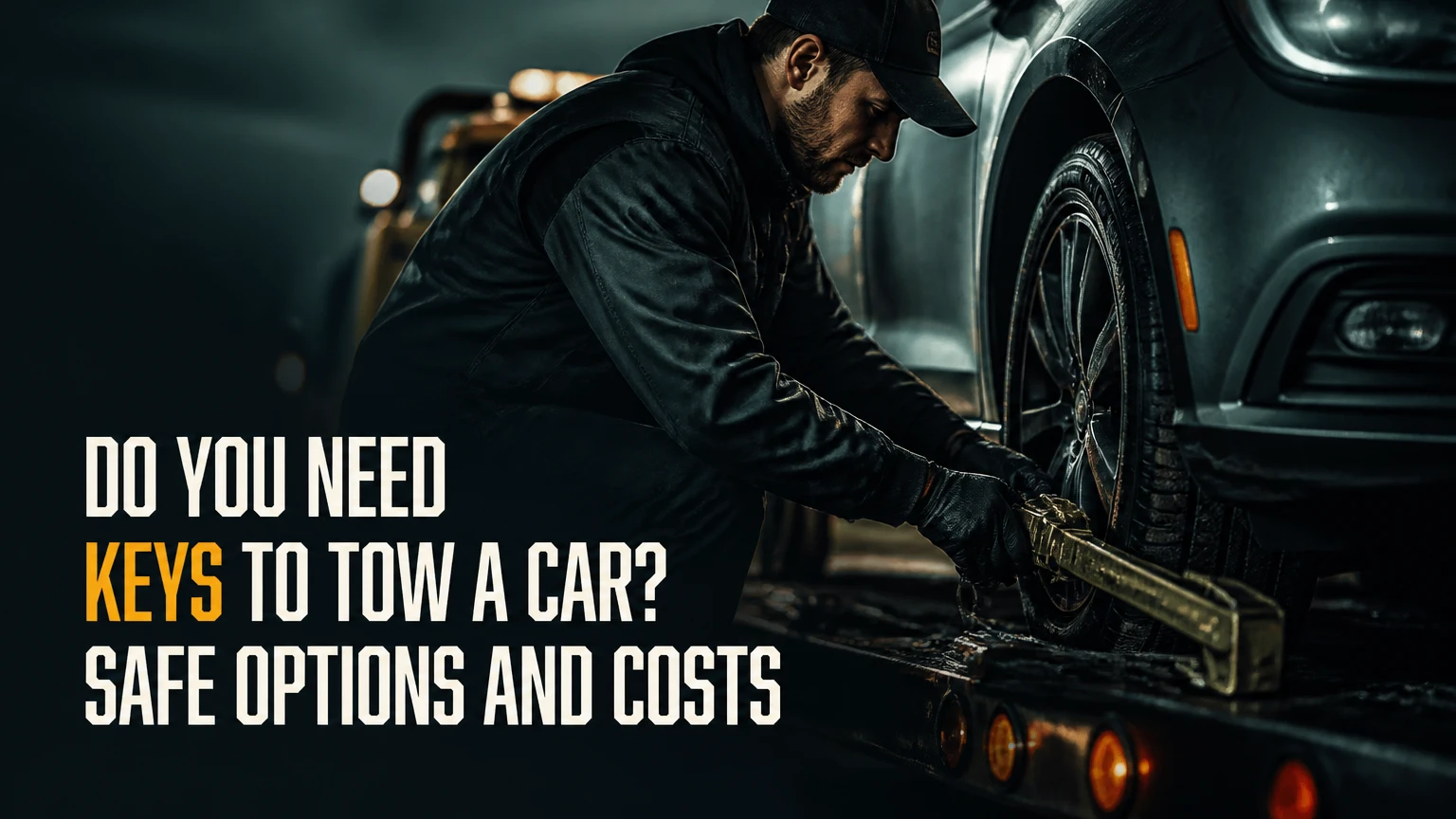
No, you do not always need keys to tow a car, but the vehicle must be moved with equipment that prevents locked drive wheels, the transmission, and steering system from being damaged. A flatbed with wheel skates or dollies is usually safest, while a wheel-lift may work when the correct axle is raised and the remaining wheels can roll freely.
Key Facts at a Glance
A tow company can usually move a locked car without keys by using a flatbed, wheel skates, dollies, or a suitable wheel-lift.
Keys are valuable because they may unlock the steering column, release the transmission from Park, disengage the parking brake, and simplify loading.
An automatic vehicle in Park must not have its driven wheels dragged along the road.
AWD, four-wheel-drive, electric, and hybrid vehicles generally require a flatbed or the exact procedure specified by the manufacturer.
A typical no-key local tow costs about $150-$300 and takes 25-45 minutes to load, although location and equipment can change both figures.
Tell the dispatcher that the car is locked, whether keys are available, the drivetrain, the parking-brake status, and the vehicle’s location.
Do You Need Keys to Tow a Car?
A tow operator does not strictly need car keys when specialized equipment can keep the vehicle’s locked wheels from rotating. Keys remain useful because they may unlock the steering wheel, select Neutral, release a parking brake, and allow the operator to load the vehicle without extra dollies or skates.
The answer depends less on the key itself than on four mechanical conditions: whether the steering is locked, whether the parking brake is engaged, whether the transmission is in Park or gear, and whether all four wheels must remain on the ground. A locked FWD car may be manageable with a front wheel-lift, while a locked AWD vehicle normally needs a flatbed or four-wheel dollies.
A tow truck driver also needs legal authority to move the vehicle. An owner’s request, roadside-assistance dispatch, police authorization, lender repossession order, property-owner authorization, or impound documentation may establish that authority. A missing key does not authorize someone to open or move a vehicle without permission.
What do keys change during a tow?
Keys can reduce setup time and equipment needs. A working key may let the operator unlock the steering, place an automatic transmission in Neutral, release a mechanical parking brake, or use the vehicle’s electronic controls.
A key does not automatically make every towing method safe. The owner’s manual may prohibit certain wheel-lift arrangements, especially for AWD systems, four-wheel drive, dual-clutch transmissions, hybrids, and EVs. The vehicle’s drivetrain and manufacturer instructions still control the method.
Why Is Towing a Locked Car Mechanically Difficult?
A locked car is difficult to tow because its steering, parking brake, and transmission may all resist movement at the same time. The tow operator must move the vehicle without forcing a locked axle to rotate or allowing the car to steer unpredictably.
The steering-wheel lock prevents the front wheels from following a tow truck’s direction during loading or turns. The parking brake holds either the rear wheels or brake calipers, depending on the design. An automatic transmission in Park uses a parking pawl to prevent the transmission output from turning, while a manual vehicle left in gear uses drivetrain resistance and engine compression.
How does the parking pawl affect towing?
The parking pawl is a mechanical component inside an automatic transmission that locks the output shaft when the selector is in Park. Dragging the driven wheels while the pawl remains engaged can damage the pawl, transmission gears, differential components, or related driveline parts.
The risk is concentrated on the driven wheels. A FWD vehicle has its front wheels connected to the transaxle, while a typical RWD vehicle has its rear wheels connected to the driveshaft and differential. A wheel-lift must raise the driven axle, or an appropriate dolly system must keep it from rotating.
Why does a parking brake matter?
A mechanical parking brake can prevent a wheel from rolling even when the transmission is in Neutral. An electronic parking brake may remain applied when the battery is dead, the key is unavailable, or a control module detects a fault.
Dragging a locked wheel can damage the tire, brake rotor, caliper, hub, or suspension. Tow operators commonly place a skate or dolly beneath a wheel that cannot roll rather than forcing that wheel across pavement.
Which Towing Method Is Safest Without Keys?
A flatbed is usually the safest no-key towing method because the vehicle’s tires do not rotate during transport. Wheel skates or dollies allow a winch to pull a locked vehicle onto the bed without relying on the steering, transmission, or parking brake to function normally.
Flatbeds are especially appropriate for AWD vehicles, many EVs and hybrids, luxury vehicles with low ground clearance, vehicles with severe tire damage, and cars whose electronic parking brake cannot be released. The limitation is access: a full-size flatbed may not fit in a parking garage, narrow alley, or underground loading area.
Flatbed, wheel-lift, and dolly comparison
| Method | Typical setup time | Appropriate vehicle condition | Main limitation |
|---|---|---|---|
| Flatbed with skates | 25-45 minutes | Locked wheels, AWD, EV, damaged vehicle | Truck height and access |
| Front wheel-lift | 10-20 minutes | FWD with free-rolling rear wheels | Wrong axle can damage drivetrain |
| Rear wheel-lift | 10-20 minutes | RWD with straight, free-rolling front wheels | Steering lock can cause side loading |
| Four-wheel dollies | 25-50 minutes | AWD, locked parking brake, confined access | Slower installation and handling |
A wheel-lift is faster when the correct axle can be raised and the remaining wheels roll freely. A dolly set supports wheels that cannot safely rotate, but it adds setup time, clearance considerations, and more points that must be secured.
Can a wheel-lift tow a car without keys?
A wheel-lift can tow some cars without keys if it lifts the driven wheels and the wheels remaining on the pavement roll freely. A FWD car is commonly lifted at the front, while a conventional RWD car is commonly lifted at the rear.
The arrangement is not universally safe. The front wheels of an RWD vehicle may be locked at an angle, causing the vehicle to veer during transport. A steering-wheel strap can hold the steering straight when the operator can safely access and secure the cabin, but the operator should use a flatbed or dollies when steering cannot be controlled.
How Should the Truck Match the Drivetrain?
The truck must match the drivetrain because the drivetrain determines which wheels connect to the transmission or differential. Before dispatching a truck, identify whether the car is FWD, RWD, AWD, or four-wheel drive, then verify the vehicle-specific towing instructions.
| Drivetrain | Common driven wheels | Typical no-key method | Important condition |
|---|---|---|---|
| FWD | Front wheels | Front wheel-lift or flatbed | Rear wheels and parking brake must roll |
| RWD | Rear wheels | Rear wheel-lift or flatbed | Front steering must remain straight |
| AWD | All four wheels | Flatbed or four-wheel dollies | Follow the owner’s manual |
| 4WD truck | Front and rear when engaged | Flatbed or approved dolly method | Transfer-case position matters |
Is AWD towing without keys safe?
AWD towing without keys is generally safest on a flatbed or with all four wheels supported by dollies. The broad statement that every AWD vehicle will be destroyed immediately by two-wheel towing is too absolute, because systems differ and some manufacturers specify limited emergency procedures.
The practical rule remains conservative: do not tow an AWD vehicle with two wheels on the ground unless the owner’s manual or manufacturer service procedure specifically permits that configuration. AWD couplings, center differentials, transfer cases, and electric axle motors can be damaged when wheel speeds differ during transport.
An operator may need the key or a service procedure to place a transfer case in Neutral. If that cannot be done, a flatbed eliminates most drivetrain rotation.
What about EVs and hybrids?
Many EVs and hybrids should be transported on a flatbed, although the exact rule varies by model. A disabled EV may have regenerative braking, electrically controlled parking brakes, powered axle motors, and high-voltage safety systems that make improvised towing inappropriate.
Tesla, Ford, Hyundai, Kia, General Motors, and other manufacturers publish model-specific towing instructions. Some permit short-distance movement at very low speeds with the drive wheels lifted; others require all wheels off the ground. The tow operator should consult the model’s emergency response guide or owner’s manual rather than rely on a generic drivetrain label.
How Does a Tow Company Move the Vehicle?
A professional no-key tow begins with authorization and a vehicle assessment, then uses a winch, wheel-lift, skates, or dollies to prevent unsafe wheel rotation. The operator should confirm the vehicle’s condition before loading and secure the car at approved attachment points.
- Verify authority and identity. Provide registration, insurance details, photo identification, roadside-assistance information, or the documentation required by the property owner or jurisdiction.
- Describe the vehicle accurately. Give the year, make, model, drivetrain, approximate weight, wheel size if known, and whether the vehicle is an EV, hybrid, lowered car, or four-wheel-drive truck.
- Report the key status. State whether keys are missing, locked inside, available but nonfunctional, or present without a working battery.
- Describe the location. Mention a basement garage, steep driveway, curb, narrow gate, soft shoulder, traffic lane, or blocked access route.
- Assess the locks and brakes. The operator checks whether the steering wheel is locked, tires are inflated, the parking brake is engaged, and the wheels can roll.
- Choose the equipment. The operator selects a flatbed, wheel-lift, skates, or dollies based on the drivetrain and physical access.
- Load without forcing the vehicle. A winch pulls the car gradually, while skates or dollies support wheels that cannot roll.
- Secure the vehicle. Wheel straps or manufacturer-approved tie-down points hold the vehicle for transport; chains should not be placed over vulnerable suspension or body parts.
- Confirm transport restrictions. The driver checks speed, route, clearance, and any special instructions for EVs, hybrids, or damaged suspension.
You will know the setup is appropriate when the car loads without tire scrubbing, steering-side loading, brake dragging, or abnormal drivetrain resistance. A vehicle that must be forced onto the bed is not ready for transport.
Is a shift-lock release the same as starting the car?
A shift-lock release is not the same as an ignition or immobilizer bypass. The manual release near an automatic shifter may allow the selector to move from Park to Neutral, but it does not create a key, disable the steering lock, or authorize entry.
A tow operator may use a manufacturer-provided access procedure when the vehicle owner has authorized the work. Generic lockout tools can damage weather seals, wiring, airbags, or door frames, and instructions for bypassing a locked vehicle should not be treated as a DIY theft-prevention workaround.
How Much Does a No-Key Tow Cost?
A typical local no-key tow in the United States costs about $150-$300 for a distance under 10 miles, compared with roughly $75-$125 for a basic hookup before mileage and special equipment. A no-key surcharge commonly adds $50-$150 for skates, dollies, extra labor, or difficult access.
These are practitioner ranges, not regulated national prices. Urban labor rates, after-hours dispatch, tolls, storage, vehicle weight, private-property rules, and the required truck can move the final invoice substantially.
| Service component | Typical price range | Typical time | Main price variable |
|---|---|---|---|
| Basic hookup | $75-$125 | 10-15 minutes | Region and truck type |
| Mileage | $3-$5 per mile | 5-10 minutes per 10 miles | Route and company policy |
| No-key equipment surcharge | $50-$150 | 15-35 minutes | Skates, dollies, labor |
| Local no-key total | $150-$300 | 25-45 minutes | Access and drivetrain |
| Vehicle storage | $25-$75 per day | Starts after arrival | Yard and jurisdiction |
Ask whether the quote includes the hookup, mileage, dolly or skate fee, winching, after-hours labor, storage, and sales tax. A low phone quote may exclude the equipment charge that becomes necessary after the operator sees a locked wheel or a confined garage.
How long does towing without keys take?
A no-key tow typically takes 25-45 minutes to load when the vehicle is accessible and the correct truck arrives. A standard tow with working keys may take 10-15 minutes, while a basement garage, flat tire, locked steering wheel, or four-wheel dolly setup can extend the job beyond one hour.
The loading time is usually longer than the driving time for a short local recovery. Send photographs of the parking space and vehicle position when requesting service.
What Should You Tell Roadside Assistance?
Tell roadside assistance that the vehicle is locked, the keys are unavailable, the drivetrain type, and the exact location. Those details help the dispatcher send a truck equipped with a winch, skates, dollies, or a low-clearance wheel-lift instead of a standard vehicle that cannot complete the hookup.
Use a statement such as: “The car is locked, I do not have the keys, it is a 2020 AWD SUV, the electronic parking brake may be on, and it is in a one-level underground garage.” Include whether the car is on flat pavement, has flat tires, faces a wall, or has damage affecting the wheels.
What documents may be required?
Requirements vary by state, municipality, property owner, and towing purpose. An owner-requested roadside tow often requires identification and vehicle information, while an impound or repossession may require a specific authorization record.
Keep the following available:
- Government-issued identification
- Registration or title, when accessible
- Insurance or roadside-assistance membership details
- Lender or fleet authorization, if applicable
- Police report number for a crash or theft recovery
- Destination address and contact person
What Are the Most Common No-Key Towing Mistakes?
The most common mistakes are lifting the wrong axle, dragging a locked wheel, assuming Neutral solves every problem, and using equipment that cannot fit the recovery location. Each error can convert a routine tow into transmission, tire, brake, steering, or body damage.
Mistake 1: Towing AWD on two wheels
Two-wheel towing can create unequal wheel speeds and unwanted rotation in AWD components. Use a flatbed or four-wheel support unless the manufacturer expressly permits another method for that model.
Mistake 2: Forcing the steering
A locked steering wheel can transmit high loads into tie rods, steering racks, tires, and the loading equipment. Use skates or dollies and keep the vehicle’s steering geometry from being dragged sideways.
Mistake 3: Treating Neutral as a complete solution
Neutral may release the parking pawl but leave the steering locked or the electronic parking brake applied. The operator must verify all three conditions independently: steering, transmission, and brakes.
Mistake 4: Dragging a car with an engaged parking brake
Dragging rear wheels with the parking brake on can overheat or damage brake components and destroy tires. If the brake cannot be released, support the affected wheels with skates or dollies.
Mistake 5: Sending the wrong truck to a garage
A standard flatbed may be too tall or too long for a basement entrance. Request a low-clearance wheel-lift with dollies when the garage height, turning radius, and ramp angle prevent flatbed access.
Mistake 6: Assuming a dead battery only affects the starter
A dead 12-volt battery can prevent electronic gear selection, release an EPB, open powered systems, or activate an EV’s tow mode. It does not prove that the vehicle can safely roll after a jump-start.
What Changes in Difficult Situations?
A difficult location changes the equipment choice more than the missing key does. A tow company may need a low-clearance truck, a winch extension, wheel skates, a four-wheel dolly set, or a recovery vehicle before the car can be moved safely.
| Situation | Recommended equipment | Typical complication | Safer decision |
|---|---|---|---|
| Underground garage | Low-clearance wheel-lift and dollies | Height and turning radius | Measure entrance clearance |
| Steep driveway | Winch-equipped truck and skates | Gravity and tire loading | Keep the vehicle aligned |
| Flat tire or missing wheel | Skates, dollies, or tire support | Wheel cannot roll normally | Do not drag the hub |
| Locked EPB | Flatbed with skates | Calipers remain applied | Support the braked axle |
| EV with dead battery | Model-approved flatbed procedure | Electronic systems inactive | Follow manufacturer guide |
Can a car be towed if the keys are locked inside?
Yes, a car with keys locked inside can usually be towed without opening the vehicle. The operator can select equipment that avoids the need for Neutral or steering access, although retrieving the keys through a legitimate lockout service may reduce the cost.
Do not leave keys hidden on or inside the vehicle unless the tow company specifically instructs you to do so. A key left in an unsafe location can create theft and liability problems, especially on a public street or unsecured property.
Can a car be towed with a dead battery?
Yes, but a dead battery may prevent the gear selector and electronic parking brake from operating. A flatbed, skates, or dollies can move the vehicle without relying on the battery, while a jump-start should be used only when the operator confirms that the vehicle’s system and manufacturer procedure permit it.
EVs require additional care because high-voltage isolation, tow mode, and powered axle systems vary by model. Never attach recovery equipment to orange high-voltage cables or components.
Can you tow a car yourself without keys?
DIY towing without keys is usually appropriate only for controlled movement with the correct rated equipment, a legal connection, and a vehicle-specific procedure. A tow strap behind another vehicle is not a safe substitute for a professional flatbed when the steering, transmission, or parking brake is locked.
A trailer or properly rated car dolly can work for some two-wheel-drive vehicles, but loading still requires wheel control, adequate ramps, safety chains, lighting, load-rated straps, and sufficient tow capacity. Public-road towing also involves licensing, insurance, braking, and local legal requirements.
How Do You Choose Between a Flatbed and Wheel-Lift?
Choose a flatbed when the vehicle is AWD, an EV, immobilized, damaged, low-clearance, or affected by an electronic parking brake that cannot be released. Choose a wheel-lift for a healthy two-wheel-drive car when the correct axle can be raised and the remaining wheels roll straight without transmission or brake resistance.
| Vehicle or condition | First choice | Acceptable alternative | Avoid |
|---|---|---|---|
| FWD, wheels free | Front wheel-lift | Flatbed | Rear lift with front drive wheels rolling |
| RWD, steering free | Rear wheel-lift | Flatbed | Front lift with rear drive wheels rolling |
| AWD or 4WD | Flatbed | Four-wheel dollies | Two wheels on pavement |
| Locked steering | Flatbed with skates | Dollies | Forced wheel-lift loading |
| Applied EPB | Flatbed with support | Full dolly set | Dragging braked wheels |
The safest selection is not always the cheapest or fastest. A $50 equipment saving is insignificant compared with a damaged transmission, tire, steering rack, or AWD coupling.
What is the practitioner rule for a no-key tow?
The practical rule is simple: if the operator cannot confirm free steering, free rolling, and a safe drivetrain position, all four wheels should be supported. That rule sacrifices some loading speed but prevents uncertainty from becoming mechanical damage.
Manufacturers may publish exceptions, particularly for emergency movement. Those exceptions should be checked by model and transmission, not inferred from the vehicle’s badge or wheel count.
Frequently Asked Questions
Will towing without keys damage the car?
Towing without keys will not necessarily damage a vehicle when the operator uses equipment that prevents locked or driven wheels from rotating. Damage becomes likely when an automatic transmission remains in Park, an AWD system is partially dragged, a parking brake holds a wheel, or a locked steering system is forced sideways.
Do tow truck drivers need the key to put a car in Neutral?
Tow truck drivers do not always need the key to move a vehicle, but they may need authorized physical access to use a manufacturer-provided shift-lock release. That release can select Neutral on some automatic vehicles, yet it does not unlock the steering wheel or disengage an electronic parking brake.
Can a locksmith make towing cheaper?
A locksmith may make towing cheaper when unlocking the vehicle allows the operator to select Neutral, release the parking brake, and control the steering. The saving depends on the locksmith fee, the tow company’s equipment charge, the vehicle location, and whether the manufacturer’s procedure permits those actions.
Should you leave the keys for the tow truck?
Leave keys only through a method approved by the tow company, roadside-assistance provider, property manager, or repair facility. Avoid placing keys on a tire, under a mat, or in an unsecured cabin unless the responsible company has documented the instruction and destination.
Does a tow company need proof that you own the vehicle?
A tow company may require proof of ownership or other legal authority, especially for private-property removal, impound release, repossession, or a vehicle that is not registered to the caller. Requirements differ by jurisdiction, so ask the dispatcher what documents the driver must inspect before hookup.
The Bottom Line
Do you need keys to tow a car? Usually, no. A professional can move a locked vehicle with a flatbed, wheel skates, dollies, or a correctly configured wheel-lift, but the safest method depends on drivetrain, steering-lock status, parking brake, vehicle damage, and access conditions. Give the dispatcher those facts before the truck arrives, and request a flatbed for AWD, EV, hybrid, or uncertain cases.