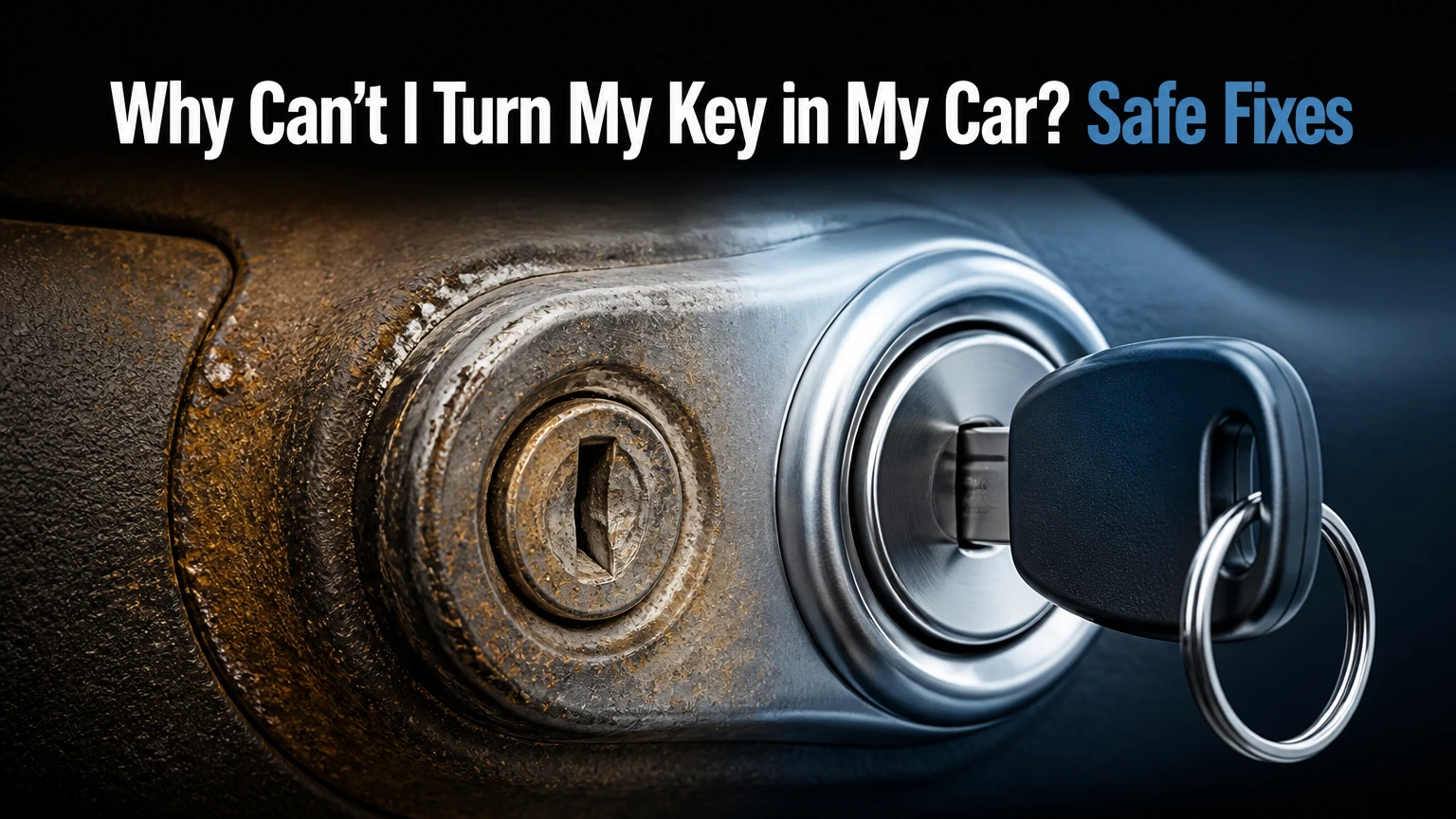
A car key usually will not turn because the steering-column lock is under pressure, the transmission interlock has not recognized Park, or the key and ignition lock cylinder are worn or damaged. Release wheel tension first, confirm the shifter position, and test a clean spare key without forcing the blade.
Key facts at a glance
Steering-wheel tension is the fastest common cause of a key that will not rotate.
An automatic vehicle may reject the key unless the shifter position sensor recognizes Park.
A spare key that works points toward a worn original key, while two failing keys point toward the cylinder or vehicle mechanism.
A transponder chip controls engine authorization after the key turns; it usually does not cause a mechanically stuck key.
Typical mobile locksmith service costs range from $50-$150 for key cutting and $150-$400 for ignition-cylinder replacement.
Pliers, excessive twisting, and unsuitable lubricant can turn a minor jam into a broken-key or replacement-cylinder repair.
Why Can’t I Turn My Key in My Car?
The ignition lock cylinder is a mechanical and electrical control at the steering column. The key must match the cylinder’s internal wafers or pins, the steering lock must release, and the transmission or clutch safety system must permit the ignition position before the cylinder can rotate.
A steering lock commonly binds after the wheel moves against the locked column while the key is removed. The cylinder then feels completely frozen even though the key and ignition switch may be undamaged. Parking with the wheels turned against a curb or leaving the vehicle on a slope increases the chance of this load.
Worn keys and worn lock cylinders create a different pattern. The key may insert fully but turn only after jiggling, or it may work intermittently before refusing to rotate. A key copied from a worn key can preserve the same inaccurate cuts, so a factory key code or locksmith-generated code cut is preferable.
What happens inside the ignition lock?
A conventional lock cylinder uses spring-loaded wafers or pins that correspond to the key profile. Correct key cuts align the moving components at the cylinder’s shear line, allowing the plug to rotate and command the ignition switch.
Vehicle designs differ. Some use wafer systems, some use pin-tumbler arrangements, and newer vehicles may combine a mechanical blade with an electronic steering lock or immobilizer. The key must therefore fit mechanically before the vehicle can evaluate its transponder signal.
The ignition switch is a separate component behind or beside the lock cylinder on many vehicles. A cylinder can fail to rotate while the electrical switch remains functional, and an electrical switch can fail after the cylinder rotates normally. The distinction matters because replacing the wrong part wastes money.
What should you try first?
Use the following sequence before buying parts or arranging a tow. The sequence takes about 2-5 minutes, requires no tools, and begins with the most reversible causes.
- Set the parking brake. Keep the vehicle stationary, especially if you are testing Neutral.
- Remove pressure from the steering lock. Insert the key fully. Pull the steering wheel firmly toward the side with slight movement while gently turning the key toward the accessory or ignition position. Do not twist the key harder than normal hand pressure.
- Confirm the transmission position. Press the brake and move the automatic shifter firmly into Park. If the vehicle manual permits it, test Neutral with the brake applied. Neutral is a diagnostic position on many vehicles, not a universal override.
- Inspect the key. Look for a bent blade, rounded cuts, cracks, heavy burrs, or debris in the grooves. Wipe it with a clean, dry cloth.
- Test a known-good spare. A spare that turns normally strongly suggests key wear or damage.
- Stop if the blade bends, the cylinder grinds, or the key begins to crack. Arrange a locksmith or qualified repair shop instead.
You will know the steering-lock release worked when the wheel gains normal movement and the key rotates smoothly through the first position. A key that turns only while pressure is held against the wheel indicates the underlying parking load may recur, so avoid leaving the wheels hard against a curb.
Why does the steering wheel lock the key?
The steering-column lock uses a locking bolt that engages the column when the key is removed. When the wheel moves after parking, the column can press the bolt against its stop, transferring force into the ignition cylinder and preventing rotation.
Pulling the wheel toward the side with a small amount of movement relieves that load. Pulling both directions at once or repeatedly jerking the wheel usually adds no benefit and can make the key harder to control.
Can a shifter problem prevent key rotation?
Yes. An automatic vehicle’s shift interlock or park-position switch can prevent the ignition from leaving the lock position when the vehicle computer or switch does not detect Park. A stretched shift cable, obstructed shifter, failed range sensor, or low-voltage event can create the same symptom.
Pressing the brake and reseating the lever in Park is a safe first check. Testing Neutral can help isolate the park switch, but vehicle behavior varies by make, model, year, and transmission. Never leave a vehicle unattended in Neutral, and never bypass an interlock without the manufacturer’s service procedure.
Which cause matches your symptoms?
The symptom pattern often separates a steering-lock problem from a worn key, cylinder failure, or electrical fault. The table below is a diagnostic guide, not a substitute for the vehicle’s service manual.
| Symptom | Most likely area | Safe test | Typical next action |
|---|---|---|---|
| Key will not turn, wheel is rigid | Steering-column lock | Pull wheel toward its free side while turning gently | Release load; inspect if repeated |
| Key turns with a spare only | Original key blade | Compare both keys in the cylinder | Cut a code-based replacement |
| Both keys catch or stop halfway | Lock cylinder or debris | Inspect keyway; avoid metal probes | Locksmith inspection |
| Key turns, engine does not start | Immobilizer, battery, starter, or ignition switch | Observe security light and dashboard | Electrical or diagnostic testing |
| Key will not turn when shifter is in Park | Park switch or shift cable | Reseat Park, then test permitted Neutral position | Interlock or range-sensor diagnosis |
| Key will not enter fully | Debris, damaged keyway, wrong key, or frozen lock | Compare with spare; use light and inspection | Locksmith, no forced insertion |
| Key is stuck after engine shutdown | Park recognition or cylinder wear | Press brake, reseat Park, gently turn toward lock | Diagnose before removing by force |
A key that turns but does not produce dashboard power points away from the mechanical lock itself. That condition can involve the ignition switch, battery connection, fuse, or vehicle network, and repeated key cycling will not repair it.
Is the key worn, or is the ignition cylinder worn?
A spare-key comparison is the most useful low-cost distinction. If the spare works smoothly while the daily key fails, the daily key is likely worn, bent, or damaged. If both keys behave identically, suspicion shifts toward the cylinder, steering lock, shifter interlock, or a shared vehicle fault.
How key wear creates a no-turn condition
Repeated insertion rounds the edges of key cuts and can reduce the profile that lifts each wafer to its required position. The problem is not a universal 2- or 3-millimeter threshold; tolerances differ by key design, cylinder wear, and manufacturer. A visibly worn key can fail, while a key that looks acceptable can still be dimensionally inaccurate.
A hardware-store duplicate made from a worn original may fail immediately. A locksmith can cut from the vehicle key code, manufacturer data, or a sufficiently accurate original, subject to ownership verification and local rules.
How cylinder wear creates a no-turn condition
Cylinder wear affects the wafers, springs, plug, housing, or steering-lock interface. Common signs include a key that works only at a particular angle, a cylinder that requires repeated jiggling, metal particles around the keyway, or a worsening pattern affecting every available key.
Lubrication can temporarily reduce friction caused by dust or light contamination. It cannot restore worn metal, a broken spring, a collapsed wafer, or a damaged steering-lock bolt.
Are transponder and laser-cut keys different?
Transponder keys still require a mechanically correct blade or insert before the ignition can rotate. The immobilizer reads the chip after the vehicle reaches an authorized ignition position, so a dead remote battery usually affects remote locking rather than the physical rotation of a conventional key.
| Key or start system | Mechanical turning requirement | Electronic requirement | Typical failure clue |
|---|---|---|---|
| Standard metal key | Correct blade cuts | None or separate immobilizer | Key wear or cylinder sticking |
| Transponder key | Correct blade cuts | Matched chip and immobilizer | Key turns, engine remains disabled |
| Laser-cut key | Correct side-milled or center-track profile | Often integrated transponder | Key catches in track or will not enter |
| Push-button start | Electronic key detection, model dependent | Valid fob signal and vehicle battery | Button says key not detected |
| Electronic steering lock | No conventional rotating cylinder on some models | Steering-lock module authorization | Wheel remains locked with valid fob |
High-security keys have narrow tracks and side cuts that collect debris more readily than simple edge-cut blades. A locksmith should inspect the profile with the correct machine rather than widening the groove with a knife or pick.
Can a dead car battery or key-fob battery stop the key turning?
A dead vehicle battery usually does not prevent a purely mechanical key cylinder from rotating, although some vehicles use electronic steering locks that require electrical power. A dead key-fob battery commonly prevents remote functions, but many vehicles provide an emergency fob position or backup start procedure.
A dashboard that remains completely dark after the key turns suggests a vehicle electrical issue. A key that cannot rotate at all suggests the mechanical lock, steering lock, or interlock first. Newer models can blur that distinction, so the owner’s manual and model-specific service information matter.
Push-button vehicles require different diagnosis. Hold the fob against the manufacturer-specified backup location, use the emergency key only for the door lock, and follow the manual’s starting procedure. Do not insert an emergency blade into a decorative slot unless the vehicle was designed for that operation.
Should you lubricate the ignition keyway?
Use only a lubricant approved for automotive lock cylinders or specified by the vehicle manufacturer, and apply a small amount. Dry PTFE or a product intended for locks can help with contamination, while some manufacturers prefer a different formulation for their cylinder design.
Remove loose debris first. Apply a brief, controlled amount, insert and remove the key several times, and test gentle rotation. If the cylinder still binds, stop rather than flooding the keyway.
Standard WD-40 is primarily a water-displacing penetrant and cleaner, not a universal long-term lock lubricant. It may provide short-term movement in some situations, but residue can attract dirt or interfere with a finely fitted cylinder. Never use engine oil, grease, penetrating oil in large amounts, or household spray lubricants without confirming compatibility.
What if the key is frozen, bent, or stuck?
Cold weather can freeze moisture inside the keyway, especially after a wash or thaw-freeze cycle. Warm the key and lock gradually with a vehicle-safe lock de-icer or gentle ambient heat; never use an open flame, boiling water, or a heat gun near plastic trim, wiring, or fuel vapors.
A bent key should not be straightened inside the cylinder. Remove it if it comes out without force and compare it with a spare. If the key is stuck, keep the blade aligned, avoid pliers, and call a mobile automotive locksmith before the blade snaps.
If the key breaks, do not push the fragment deeper or insert a second key behind it. A locksmith has extraction tools designed to remove fragments while reducing damage to the cylinder. A broken fragment can also obstruct the shear line and make later diagnosis less reliable.
Which repair option is best?
The best repair depends on the failed component. A code-cut key is the least invasive solution for a worn blade, while cylinder replacement is appropriate when multiple keys fail or internal components are damaged. A dealer may be necessary for certain electronic modules, but a qualified automotive locksmith often handles mechanical keys and cylinders at the vehicle.
| Repair option | Typical cost in the USA | Typical time | Best use |
|---|---|---|---|
| Duplicate from a working spare | $5-$30 | 5-20 minutes | Backup key with no chip programming |
| Code-cut mechanical key | $50-$150 | 20-60 minutes | Worn or lost key with verified ownership |
| Transponder key cut and programmed | $80-$250 | 30-90 minutes | Blade and immobilizer replacement |
| Ignition-cylinder replacement | $150-$400 | 1-3 hours | Worn, damaged, or failed cylinder |
| Dealer electronic diagnosis | $120-$250 diagnostic fee | 1-3 hours | Electronic steering lock or immobilizer fault |
| Tow to a repair facility | $75-$200 locally | 30-120 minutes | Unsafe location or immobilized vehicle |
Prices vary with vehicle age, key technology, location, labor access, and whether the replacement cylinder must be keyed to match the doors. A mobile locksmith may reduce towing expense, but verify licensing, identification requirements, warranty terms, and the complete quoted price before authorizing work.
New key or new ignition cylinder?
Choose a new code-cut key when one key fails and another works, because the cylinder remains mechanically consistent with the working spare. Choose cylinder replacement when every key catches, the cylinder has excessive play, wafers are damaged, or the key turns only after repeated manipulation.
A replacement cylinder can create two-key inconvenience if it is not rekeyed to match the door locks. Ask whether the shop can rekey the replacement cylinder and whether new transponder programming is included. A cheaper part can cost more overall if programming, trim removal, or rekeying is excluded.
Locksmith or dealer?
A mobile automotive locksmith is often the practical first call for a conventional keyed ignition, broken key, code-cut key, or cylinder replacement at the vehicle. A dealer is more appropriate when the repair involves a vehicle-specific electronic steering lock, immobilizer module, security authorization, warranty documentation, or a key system the locksmith cannot program.
Do not choose solely by the lowest advertised service fee. Confirm the technician can service your exact make, model, year, key type, and steering-lock system before dispatch.
How do you prevent the problem from returning?
Replace a visibly worn key before it becomes the only available key. Store the spare separately, keep keys free of heavy key rings that strain the ignition, and avoid parking with the steering wheel loaded hard against a curb.
Use the key gently and keep the blade clean. If the key starts requiring a special angle, wiggling, or repeated attempts, treat that behavior as an early cylinder warning rather than a technique to continue indefinitely.
What are the most common mistakes?
- Using pliers: A metal tool can twist the blade beyond its designed load and snap it inside the cylinder.
- Copying a failing key: A duplicate made from inaccurate cuts reproduces the original defect.
- Forcing the steering wheel: Pulling away from the side with free movement increases bolt load.
- Bypassing the shifter interlock: Improvised bypasses create rollaway and electrical risks.
- Replacing the ignition switch first: The switch may be healthy when the cylinder cannot rotate.
- Continuing after intermittent failure: Repeated jiggling accelerates wear and can leave the vehicle stranded.
One practitioner rule is especially useful: test a spare key before spraying anything. That single comparison often separates a low-cost key problem from a cylinder repair without disassembling the steering column.
When should you stop troubleshooting?
Stop immediately when the key bends, cracks, grinds, remains trapped, or requires force beyond normal finger pressure. Stop also when the vehicle is parked in traffic, on an unstable slope, or in a location where repeated testing creates a safety hazard.
A locked steering wheel alone is usually inconvenient rather than evidence of a failed steering system. A locked wheel combined with a damaged column, warning lights, collision damage, or an electronic steering-lock fault requires professional diagnosis and may require towing.
Roadside assistance, a mobile locksmith, or a repair shop should handle a vehicle that cannot be safely shifted, has a broken key fragment, or needs immobilizer programming. The correct service depends on whether the failure is mechanical, electrical, or security-related.
FAQ
Can I turn the key if my automatic car is in Neutral?
Many automatic vehicles permit ignition operation in Neutral, but not all systems behave identically. Apply the brake, keep the parking brake engaged, and use Neutral only as a brief diagnostic test. If the key turns in Neutral but not Park, inspect the range sensor, shift cable, or Park-position switch.
Why does my key turn but the car still not start?
A key that turns proves only that the mechanical cylinder can rotate. The engine may still fail because of a discharged battery, starter fault, fuel problem, ignition-switch failure, or immobilizer authorization issue. Observe dashboard power and security-light behavior before replacing the key or cylinder.
Will a valet key turn the ignition?
A valet key may turn the ignition if its blade is correctly cut, although some valet keys restrict trunk or glovebox access. Test it gently. A valet key with a missing or incompatible transponder may rotate the cylinder but still fail to authorize engine starting.
Can I use graphite powder in a car ignition?
Graphite can be unsuitable for some modern automotive cylinders because excess powder can collect with debris and interfere with small wafers or electrical components. Use the vehicle manufacturer’s recommendation or a lubricant labeled for automotive lock cylinders. A cylinder that remains stiff after one careful application needs diagnosis, not more lubricant.
How long does an ignition-cylinder replacement take?
A conventional ignition-cylinder replacement typically takes about 1-3 hours, depending on trim access, steering-column design, immobilizer programming, and whether the new cylinder must be rekeyed. A mobile locksmith may complete a straightforward job on-site in roughly 30-90 minutes, while electronic steering-lock repairs can take longer.
Is it safe to drive with a key that needs wiggling?
Driving with a key that needs wiggling is unsafe because the cylinder can fail in a parking lot or prevent the vehicle from starting after shutdown. Arrange a replacement key or professional inspection while the key still comes out normally. Do not wait for a complete lockout.
The Bottom Line
Why cant i turn my key in my car? Start with steering-wheel tension, verify Park, and test a clean spare key. Those checks distinguish the most common temporary binding from a worn blade or failing ignition cylinder. If both keys fail, the keyway is damaged, or the blade needs force, stop and call a qualified automotive locksmith or repair shop before the problem becomes a broken-key repair.