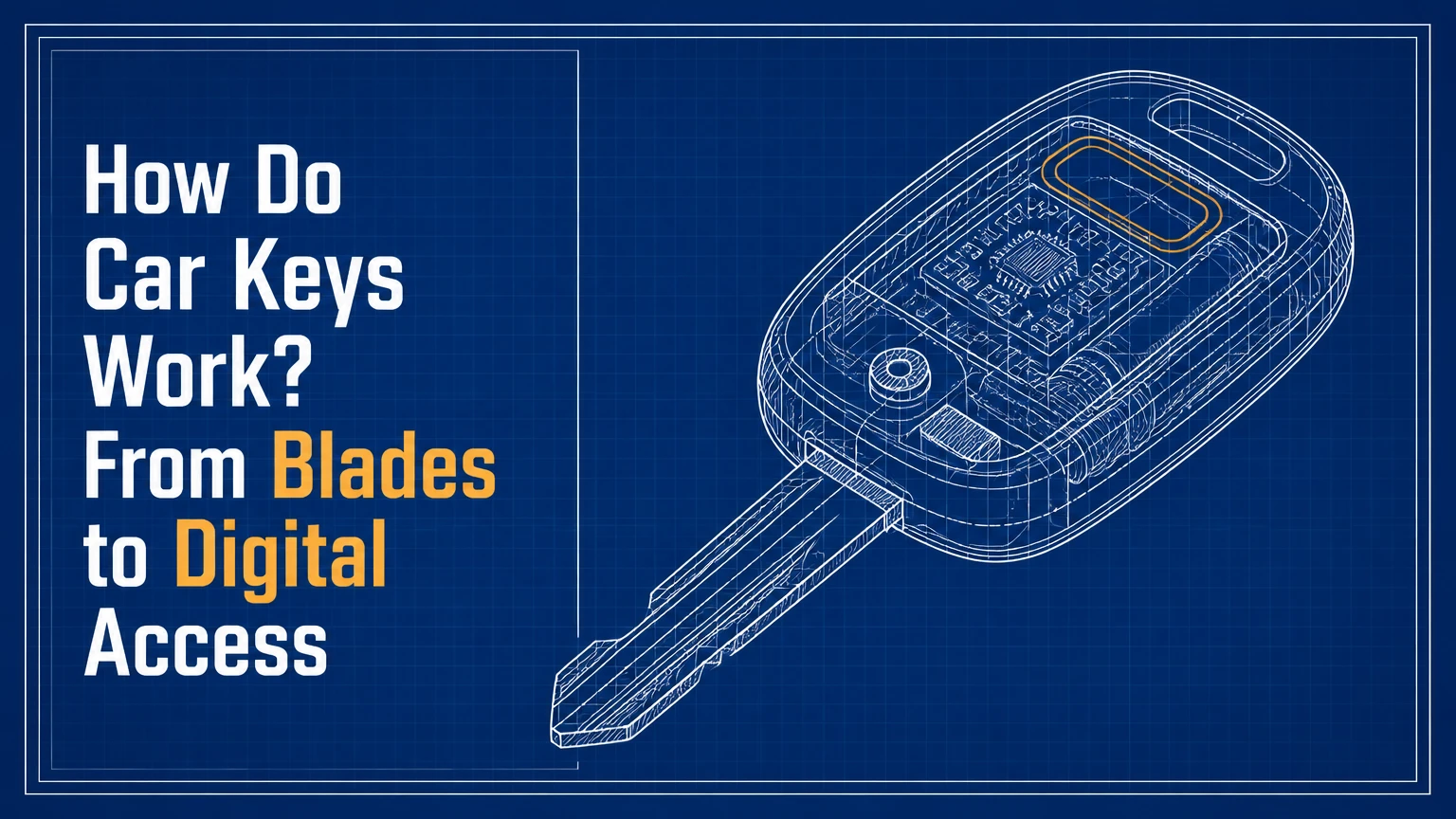
Car keys work through mechanical alignment, electronic authentication, or both. A blade opens or turns a lock, while a transponder or remote fob exchanges an identity with the vehicle’s body controller and immobilizer. Modern proximity systems add location checks, cryptographic messages, and push-button authorization before the starter and engine controls are enabled.
Key Facts at a Glance
- A metal key blade and an electronic transponder perform different security jobs.
- A passive transponder can authenticate an ignition key without the coin-cell battery used by remote buttons.
- Remote locking, engine immobilization, and keyless starting are separate functions that may share one fob.
- Smart keys commonly use low-frequency vehicle antennas and a higher-frequency radio or Bluetooth response, but exact protocols vary by manufacturer.
- A rolling code can limit replay attacks, but it does not automatically prevent relay attacks.
- A replacement key may require cutting, remote synchronization, immobilizer programming, or all three.
What Parts Make Up a Car Key?
A modern car key may contain a blade, lock buttons, a transponder, a printed circuit board, antennas, a battery, and a housing. The vehicle contains matching components, including door cylinders, radio receivers, low-frequency antennas, a body control module, an immobilizer, and engine-control software.
The key’s physical and electronic layers are related but independent. A key can fit the door yet fail to start the engine because its transponder is absent or unregistered. Conversely, a damaged blade can prevent entry even when the electronic credential remains valid.
Mechanical Blade and Lock Cylinder
The blade is a precisely cut metal profile. Its notches or side-milled track position pins, wafers, or sliders inside a door lock or ignition cylinder. When the correct profile aligns those components at the shear line, the cylinder can rotate.
Older vehicles often use the same blade to unlock the door and rotate the ignition switch. Some newer vehicles retain a hidden emergency blade only for the driver’s door. Push-button vehicles may have no mechanical ignition cylinder at all.
A key code or vehicle record can identify the required blade cuts, but the code does not replace electronic programming. A locksmith normally verifies vehicle ownership before retrieving security information from manufacturer or professional databases.
Transponder Chip and Immobilizer
A transponder is a small radio-frequency identification chip that stores or calculates a vehicle-specific credential. In many ignition systems, an antenna ring around the cylinder creates an electromagnetic field that powers the passive chip when the key is inserted.
The chip returns an identification response or cryptographic calculation. The immobilizer control system compares that response with enrolled credentials. If authorization succeeds, the powertrain control system permits the relevant start sequence; if it fails, the engine may crank without starting, start briefly and stop, or refuse to crank.
A transponder is not the same as a remote-control transmitter. The transponder can authorize starting without operating door-lock buttons, while the remote transmitter can lock doors without being accepted by the immobilizer.
Remote Fob Electronics
A remote fob contains buttons, a microcontroller, a radio transmitter, and usually a replaceable coin cell such as a CR2032 or CR2025. Pressing a button sends a vehicle-specific command to the receiver, which then asks the body control module to lock, unlock, release the trunk, or trigger an alarm function.
Remote systems often use a synchronized counter or challenge-response protocol. The exact algorithm, frequency, modulation, and resynchronization process differ by vehicle. A fob with the correct shell and blade can still be incompatible if its radio region, chip family, or software credential does not match the vehicle.
How Do Car Keys Work When You Start the Engine?
A conventional transponder start usually takes place in four stages: the driver inserts or presents the key, the vehicle energizes the antenna, the chip authenticates, and the immobilizer authorizes engine operation. Push-button systems add fob-location checks and a separate start-button command.
Step 1: The Vehicle Detects the Key
An ignition antenna detects a nearby transponder when the key enters the cylinder. A proximity vehicle uses one or more low-frequency antennas around the exterior, cabin, center console, trunk, or rear cargo area.
The vehicle does not necessarily broadcast continuously. Some systems wake antennas only after a door-handle touch, button press, door opening, or start-button request. Typical passive-entry systems use approximately 125 kHz for short-range localization, but the actual frequency and antenna arrangement depend on the manufacturer.
Step 2: The Key Responds
A passive transponder receives energy inductively from the vehicle’s antenna and responds through the same near-field coupling or a related radio channel. The battery in a remote fob usually powers button transmission and longer-range functions, not the passive immobilizer response.
This distinction explains a common symptom: a vehicle may still start even when the remote buttons stop working. A weak coin cell can disable remote locking while leaving the passive transponder functional.
Step 3: The Vehicle Authenticates the Credential
The vehicle and key exchange data that may include an identifier, a challenge, a response, a counter, or cryptographic material. Older immobilizers used simpler fixed identifiers, while later systems use stronger challenge-response protocols and protected key storage.
The phrase “rolling code” is often used broadly. A rolling code mainly prevents a previously captured button message from being reused, whereas encryption and challenge-response protect the contents and prove possession of the credential. These are related protections, not identical technologies.
Step 4: The Immobilizer Releases the Start Permission
The immobilizer communicates an approved state to the body or powertrain control system. The vehicle then permits the starter, fuel injection, ignition, or high-voltage drive system according to its design.
A successful remote unlock does not prove that the vehicle will start. Door access and engine authorization can use separate credentials, receivers, and checks.
How Does a Smart Key Know the Fob Is Inside?
A smart-key vehicle estimates whether the fob is inside the cabin by comparing responses from multiple low-frequency antenna zones. Interior antennas produce a different detection pattern from exterior antennas, so the body control module can reject a start request when the credential remains outside.
The result is a location decision, not GPS precision. Metal body panels, a phone, another fob, electromagnetic interference, or a fob left near a window can produce unexpected behavior. A vehicle may warn that the key is not detected even when the fob is physically nearby.
The sequence typically looks like this:
- A door-handle sensor or start button wakes the access system.
- An exterior or interior antenna sends a low-frequency challenge.
- The fob wakes and returns an authenticated response.
- The vehicle evaluates the antenna zone and credential.
- The brake pedal, clutch switch, transmission position, or start button provides the driver-input condition.
- The immobilizer authorizes the start if every required condition passes.
Many systems send the final command over a radio link around 315 MHz, 433 MHz, 868 MHz, or another regional allocation. North American and European examples often differ, but “315 MHz in North America and 433 MHz everywhere else” is not a universal rule.
What Are the Main Types of Car Keys?
Car-key types differ by physical construction, electronic credential, power source, and vehicle capability. A key can belong to more than one category, such as a laser-cut transponder key with remote buttons or a smart fob containing an emergency blade.
| Key type | Main components | Power source | Typical functions | Main limitation |
|---|---|---|---|---|
| Mechanical key | Cut steel or brass blade | None | Door and ignition operation | No electronic immobilizer authentication |
| Transponder key | Blade, passive chip, antenna-readable credential | Inductive vehicle field | Manual entry and engine authorization | Requires programming to the immobilizer |
| Laser-cut key | Side-milled blade, often transponder chip | Passive chip, optional fob battery | Precise mechanical operation and starting | Needs suitable milling equipment and chip enrollment |
| Remote-head or flip key | Foldable or fixed blade, buttons, transponder | Coin cell for buttons, induction for chip | Locking, unlocking, trunk release, starting | One damaged housing can affect several functions |
| Smart proximity fob | Credential chip, LF/UHF or BLE electronics, emergency blade | Coin cell, vehicle field, or both | Passive entry and push-button start | Vulnerable to battery failure and some relay attacks |
| Digital key | Smartphone, smart card, BLE, NFC, or UWB credential | Phone or card battery, NFC backup | Entry, starting, sharing, and user management | Depends on device security, software, and vehicle support |
Traditional Mechanical Keys
A mechanical key depends entirely on its cut profile and the condition of the lock. Duplicating the blade can produce a working door or ignition key when no electronic immobilizer exists.
Mechanical keys provide little defense against unauthorized duplication compared with encrypted credentials. They remain useful as emergency keys because they do not depend on a fob battery or vehicle electronics.
Transponder and Laser-Cut Keys
A transponder key can turn the ignition while still failing to start the vehicle if the chip is unprogrammed. Laser-cut, sidewinder, or high-security blades use a groove or complex track milled into the blade rather than simple edge notches.
Laser cutting improves duplication precision and can make casual copying harder, but it is not the source of electronic security. The transponder credential, immobilizer design, and protected programming process matter more than the blade’s appearance.
Remote-Head and Flip Keys
Remote-head keys combine a conventional blade with a button transmitter. Flip keys store the blade inside the fob and release it with a spring-loaded mechanism.
A replacement requires matching the blade, transponder, radio frequency, button layout, and vehicle-specific programming. Buying a shell alone may solve a cracked case but does not provide a new credential or circuit board.
Smart and Proximity Keys
A proximity fob allows passive unlock when the vehicle detects a credential near the door handle. Push-button start then checks the cabin zone and driver controls before enabling the powertrain.
Smart fobs normally include an emergency blade. The blade opens a concealed mechanical cylinder, while a marked location in the cabin allows the vehicle to read the fob’s passive credential during a depleted-battery event.
Phone-Based Digital Keys
Digital keys place the vehicle credential in a smartphone secure element, wallet application, or manufacturer account. Bluetooth Low Energy supports discovery and communication, NFC can provide short-range backup access, and Ultra-Wideband can improve distance and direction awareness on compatible hardware.
Digital keys are convenient for sharing temporary access, but account recovery becomes part of vehicle access. A dead phone, revoked account, changed device, or expired subscription can matter as much as a physical key problem.
Which Car-Key Technology Is Most Secure?
Smart and digital keys generally provide stronger electronic control than a purely mechanical key, but security depends on implementation. A proximity system with encrypted challenge-response, motion sensing, UWB distance verification, and strong theft monitoring is better protected against relay attacks than a basic passive-entry system using only signal strength.
| Technology | Primary attack resistance | User convenience | Typical failure mode | Best protection |
|---|---|---|---|---|
| Mechanical blade | Low against duplication and picking | Low | Bent blade or worn cylinder | Physical key control |
| Fixed-code remote | Low against replay | Medium | Captured or desynchronized command | Replace with secure paired fob |
| Rolling-code remote | Medium against replay | High | Counter mismatch or interference | Re-pair according to manual |
| Passive smart key | Medium, varies by design | Very high | Relay attack or dead battery | Store fob away from exterior walls |
| UWB digital key | Higher distance-awareness potential | Very high | Phone, account, or battery failure | Device lock, account recovery, NFC backup |
A rolling code does not make a vehicle immune to theft. A relay attack forwards a legitimate live exchange between a key inside a home and a vehicle outside, so the car may accept the response without the attacker ever learning the permanent credential.
How Can You Reduce Keyless-Entry Risk?
Store a proximity fob away from doors, windows, and exterior walls. A tested Faraday pouch or metal container can reduce radio leakage, but users should verify that the pouch blocks the fob’s relevant frequencies and does not prevent emergency access when needed.
Use the vehicle’s passive-entry disable setting if the owner’s manual provides one. Keep software updated, remove lost keys from the vehicle’s enrolled list, and use a steering-wheel lock or other visible physical measure when theft risk is elevated.
How Much Does a Replacement Car Key Cost?
Typical replacement pricing ranges from about $50-$150 for a simple mechanical key, $100-$300 for a programmed transponder or remote key, and $200-$800 or more for a smart fob. Luxury vehicles, all-keys-lost work, immobilizer security resets, towing, and emergency service can increase the total.
| Replacement situation | Typical price range | Typical time | Work included |
|---|---|---|---|
| Mechanical duplicate | $5-$50 | 5-20 minutes | Blade cutting only |
| Transponder duplicate | $100-$250 | 20-60 minutes | Cutting and immobilizer programming |
| Remote-head key | $125-$350 | 30-90 minutes | Blade, remote pairing, chip enrollment |
| Smart proximity fob | $200-$600 | 30-120 minutes | Fob registration and emergency blade |
| Luxury or restricted-system fob | $400-$1,000+ | 1-10 business days | OEM supply, identity checks, specialized programming |
These are typical North American service ranges, not fixed prices. A dealer may charge more but provide guaranteed OEM compatibility, while an automotive locksmith may offer mobile service and lower labor costs. Some newer vehicles require manufacturer servers or security credentials that independent professionals cannot access.
What Information Is Needed for a Replacement?
A professional normally needs the vehicle identification number, registration or title, government identification, the make, model, year, trim, and information about every remaining key. The VIN identifies the vehicle, but it does not always reveal the exact key hardware without additional configuration data.
A key code describes blade cuts. A transponder type identifies the electronic protocol. The vehicle’s market, production date, frequency region, and immobilizer generation can determine whether an apparently identical online key is compatible.
What Happens When a Car Key Fails?
Car-key failures usually affect one layer first: the battery-powered remote, the blade, the passive transponder, the vehicle battery, or the programming record. Identifying the failed layer prevents replacing an expensive fob when a coin cell or worn button is the real problem.
| Symptom | Likely cause | Safe first check | Likely repair |
|---|---|---|---|
| Buttons fail, engine still starts | Dead coin cell or worn contacts | Replace the specified battery | Battery or fob housing repair |
| Blade will not turn | Wrong cut, worn cylinder, damaged blade | Try the spare key without force | Rec cut, cylinder service, or lock repair |
| Key turns, engine will not start | Unprogrammed or damaged transponder | Check immobilizer warning icon | Key programming or immobilizer diagnosis |
| Smart key says not detected | Dead fob battery, interference, vehicle 12-volt failure | Use the emergency detection location | Battery replacement or vehicle electrical repair |
| Remote works inconsistently | Weak battery, range interference, counter mismatch | Test close to the vehicle | Battery replacement or resynchronization |
| Vehicle unlocks but will not crank | Start condition, brake switch, gear position, immobilizer fault | Confirm Park and brake input | Diagnostic scan and system repair |
How Do You Start a Car With a Dead Fob Battery?
Use the emergency blade to unlock the vehicle, then place the fob at the manufacturer-specified backup reader location, often against the start button, inside a marked console pocket, or in a cupholder. Press the brake or clutch and follow the owner’s manual because backup locations differ substantially between vehicles.
A depleted fob battery does not always erase the passive credential. The vehicle may still read the chip through an induction coil, allowing one emergency start. If the car’s 12-volt battery is also discharged, a fob cannot authorize a start until the vehicle electronics receive power.
Why Does the Key Turn but the Engine Not Start?
A key that turns but does not start the engine often has a mechanical match without electronic authorization. The immobilizer warning lamp, a “key not detected” message, or a start-then-stop event points toward a transponder, antenna, programming, or control-module issue.
Remove unnecessary electronic devices from the keyring, try the spare key, and check the vehicle battery voltage if appropriate. Do not repeatedly force the ignition or attempt undocumented programming sequences, since some vehicles can erase synchronized keys or trigger a security lockout.
Can You Program a Car Key Yourself?
Some older vehicles support owner-performed remote synchronization when one or two working keys are available, but immobilizer programming is usually vehicle-specific and may require a diagnostic tool, a security PIN, or an online manufacturer authorization. A button remote can be paired without programming the transponder that starts the engine.
Before buying a blank key, confirm all of these details:
- The exact make, model, year, and market.
- The blade profile and number of cuts.
- The transponder family and operating frequency.
- The remote button layout and circuit-board part number.
- Whether the vehicle requires one existing key.
- Whether the key is new, reusable, locked, or previously assigned.
A compatible aftermarket key can work, but low-cost listings often omit regional frequency, chip, or firmware differences. A professional locksmith or dealer can confirm compatibility before cutting or enrolling the credential.
How Should You Choose Between a Locksmith and Dealer?
Choose a mobile automotive locksmith when you need a common replacement quickly, have at least one working key, or need roadside service. Choose a dealer when the vehicle uses restricted security infrastructure, requires an OEM-only credential, or has a warranty or software issue that needs factory access.
A locksmith may complete a standard duplicate in 20-60 minutes and avoid towing. A dealer commonly requires an appointment, vehicle identification checks, and one to several business days, especially when the fob must be ordered.
All-keys-lost work is more complex than copying a functioning key. The professional may need to retrieve security data, erase missing credentials, program a new key, cut a blade, and verify that no unauthorized key remains enrolled.
What Do Valet Keys and Emergency Keys Do?
A valet key is designed to limit access, not necessarily to provide a second full-featured electronic credential. Depending on the vehicle, it may operate the ignition while blocking the trunk, glovebox, cargo area, or configurable drive modes.
An emergency blade usually unlocks a door manually. It may not operate the ignition or replace the transponder credential. Owners should test the emergency blade before an emergency, because concealed cylinders can seize from years without use.
Expert Rules for Avoiding Expensive Key Problems
- Make a spare before the last key disappears. Programming a duplicate from a working key is often simpler and cheaper than recovering an all-keys-lost vehicle.
- Treat remote range and start authorization separately. A working lock button proves that the receiver heard a command, not that the immobilizer accepts the chip.
- Do not store every key together. Losing one ring can remove all enrolled credentials, and a damaged ring can make diagnosis harder.
- Record the emergency start location. The correct reader may be behind the start button, in a console pocket, or beside a steering column, depending on the model.
- Replace fob batteries preventively. A coin cell that still unlocks the car from close range may fail during cold weather or after repeated transmissions.
- Keep the vehicle’s 12-volt battery healthy. A smart-key system cannot respond to a valid fob when the body control module has no usable power.
Frequently Asked Questions
Does a car key battery charge while driving?
Most conventional coin-cell fobs do not recharge while driving. Passive transponders can receive inductive energy from the vehicle, but that energy does not normally recharge the remote battery. Some specialized systems use rechargeable batteries or wireless charging, so the owner’s manual determines the correct replacement method.
Can a car start without the key fob battery?
A vehicle can often start with a dead fob battery if its passive backup reader detects the transponder. The fob must be placed at a specific location, and the vehicle’s 12-volt battery must still be functional. A fully damaged or unprogrammed fob will not start the car through this procedure.
Is a VIN enough to make a new car key?
A VIN identifies the vehicle but is not always sufficient to produce a complete key immediately. The professional may also need proof of ownership, the exact trim and market, blade information, transponder type, and access to manufacturer security data. VIN-based key services should verify identity before releasing security information.
Why does my spare key unlock the car but not start it?
The spare key may contain a correctly cut blade and a paired remote but lack a programmed immobilizer transponder. It may also use an incompatible chip, frequency, or previously locked credential. A diagnostic scan and comparison with the working key can identify which electronic layer is missing.
Can a locksmith copy a smart key?
A qualified automotive locksmith can copy or program many smart keys, but coverage varies by vehicle, model year, market, and security system. Some manufacturers restrict credential programming to authorized systems. The locksmith should confirm compatibility and total cost before cutting the emergency blade or attempting enrollment.
Should a key fob be kept in a Faraday pouch?
A Faraday pouch can reduce the risk of a relay attack by blocking radio communication when the fob is stored. It cannot protect a vehicle from every theft method, and a poor-quality pouch may leak signals. Test the pouch by checking whether the vehicle still detects or unlocks the enclosed fob.
The Bottom Line
Car keys work by combining a physical key profile with one or more electronic credentials. Mechanical cuts operate locks, transponders authorize the immobilizer, remote radios control access, and smart or digital systems add proximity and device authentication. Understanding which layer has failed helps you choose the right battery, key programming service, locksmith, or dealer. When asking how do car keys work, the shortest accurate answer is that a vehicle verifies both the key’s permitted identity and, on many models, its physical location before allowing access or engine operation.