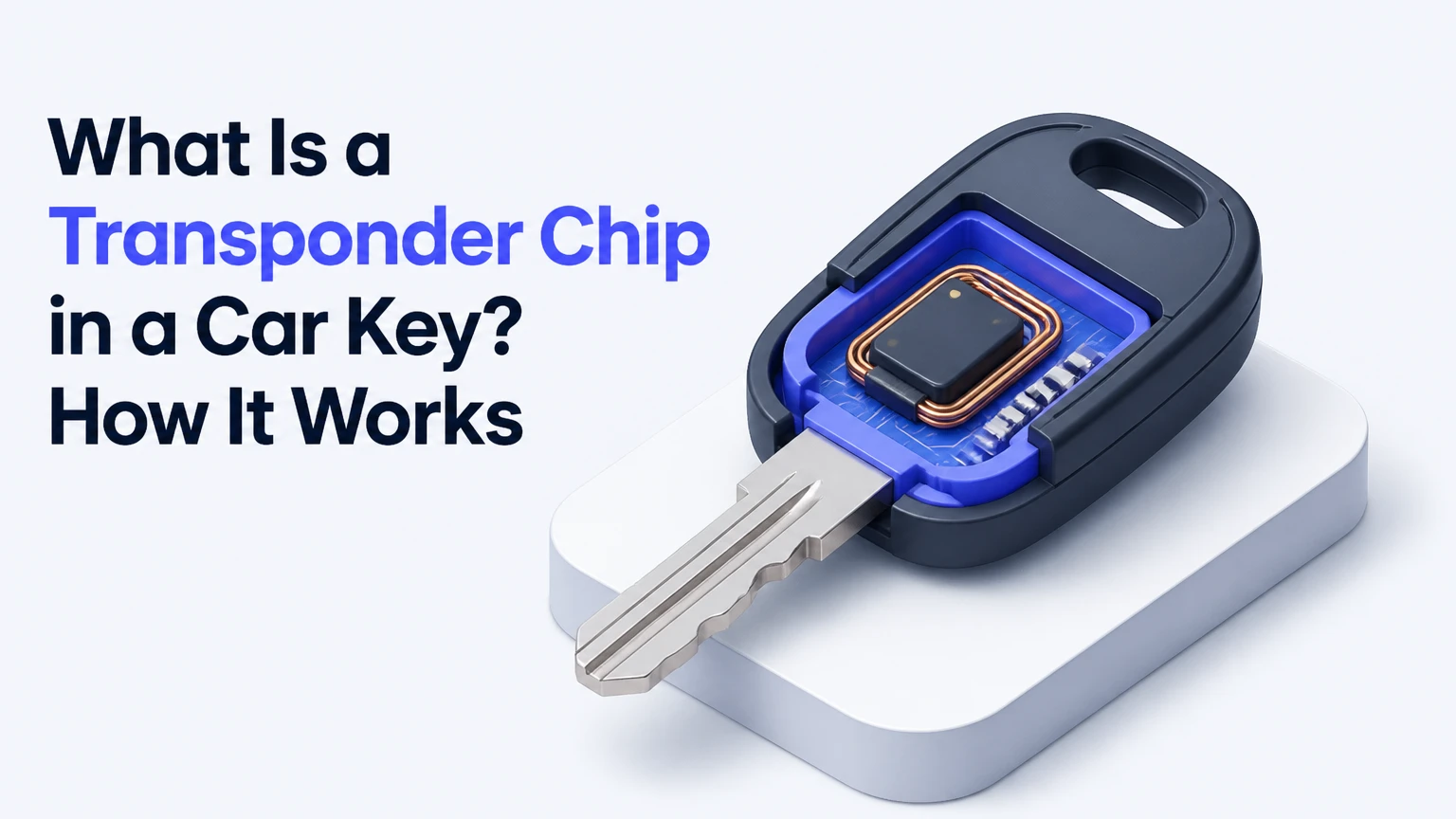
A transponder chip in a car key is a small electronic identifier that communicates with the vehicle’s immobilizer. The passive chip normally has no battery; an antenna near the ignition or inside the vehicle supplies energy and checks its coded response before allowing the engine to run.
Key Facts at a Glance
- A transponder chip authenticates a car key; the metal blade only operates the lock and ignition mechanism.
- A conventional immobilizer transponder usually works without the coin-cell battery used by a key-fob remote.
- A correctly cut key can unlock a door yet fail to start the engine if its chip is missing or unprogrammed.
- The vehicle compares the chip’s response with authorized key data stored in an immobilizer or engine-control system.
- Typical US replacement costs range from $70-$150 for a locksmith duplicate to $200-$500 or more through a dealership.
- Push-to-start vehicles use a related smart-key system that combines immobilizer authentication with proximity detection.
What Is a Transponder Chip in a Car Key?
A transponder chip in a car key is an electronic security component that identifies an authorized key to the vehicle immobilizer. “Transponder” combines transmitter and responder: the vehicle energizes the chip, and the chip returns coded data that the immobilizer evaluates before enabling engine operation.
The chip is commonly a glass capsule, ceramic package, or integrated circuit embedded in the plastic key head. It may be smaller than a fingernail, so its presence is not obvious when a key has no buttons or visible electronics.
The immobilizer is the larger security system. Depending on the vehicle, relevant components can include an antenna ring, immobilizer control unit, body control module, engine control unit, and steering-column electronics. The transponder is only one part of that authentication chain.
A useful distinction is simple:
- The metal blade engages the lock cylinder.
- The remote transmitter locks and unlocks doors.
- The transponder authorizes engine operation.
- The immobilizer decides whether the vehicle accepts that authorization.
A transponder key is therefore not necessarily a remote key. A plain valet key may contain a transponder, while a remote fob may contain separate circuits for door controls and engine authorization.
How Does the Chip Communicate With the Car?
A conventional passive transponder communicates through a short-range radio-frequency system powered by an antenna coil near the ignition cylinder. The exchange usually completes in a fraction of a second, but the exact frequency, protocol, encryption, and control modules vary by manufacturer and model year.
The operating sequence is:
- Key insertion: The driver inserts and turns the mechanical key.
- Field generation: The antenna coil around the ignition lock produces a low-frequency electromagnetic field.
- Chip activation: The field induces enough electrical energy in the passive transponder to operate its circuit.
- Data response: The chip sends an identifier or cryptographic response through the antenna.
- Authentication: The immobilizer control system checks the response against permitted key data.
- Engine authorization: If accepted, the vehicle permits functions such as fuel injection, ignition, starter operation, or engine control.
- Failure response: If rejected, the engine may crank without starting, start and stop quickly, or remain disabled.
The exact engine response depends on the vehicle architecture. Some systems interrupt fuel delivery; others inhibit spark, injector operation, starter control, or communication between the immobilizer and engine computer.
Does the Chip Have a Battery?
A standard ignition-key transponder normally does not have a battery. The antenna field supplies temporary power, so replacing the remote’s coin-cell battery will not usually repair a damaged or unprogrammed immobilizer chip.
Remote functions are different. Lock and unlock buttons commonly use a CR2032 or CR2025 battery, while the immobilizer capsule can remain passive. A key may therefore lock the doors poorly because of a weak fob battery while still authorizing the engine, or it may operate the locks normally while failing authentication because the transponder has been damaged.
Smart keys are more complicated. Their proximity electronics generally use a battery for normal hands-free communication, but many vehicles include a passive backup method, such as placing the fob against a marked sensing area or holding it near the start button.
Where Is the Transponder Chip Located?
The transponder chip is usually inside the plastic head of an ignition key or inside the electronic housing of a remote-head key. On some designs, the capsule sits beside the blade shaft; on others, it is molded into a sealed cavity that cannot be removed without opening or damaging the housing.
Common locations include:
| Key design | Typical chip location | Visible battery | Starting implication |
|---|---|---|---|
| Plain metal key with plastic head | Molded capsule in the head | No | Cut blade alone may not start vehicle |
| Remote-head key | Circuit-board or separate capsule area | Yes, often CR2032 | Remote battery and immobilizer are separate |
| Flip key | Hinged plastic body near blade pivot | Yes, often CR2032 | Broken housing can dislodge capsule |
| Push-to-start fob | Internal immobilizer electronics | Yes, often CR2032 | Emergency backup method may exist |
| Valet key | Small plastic head or integrated blade section | No | Limited doors or trunk access may still allow starting |
Opening a key housing can be risky because the capsule is easy to lose and circuit boards can be damaged by static discharge, prying, or moisture. A locksmith can identify the transponder with a key programmer or chip reader without guessing from the exterior shape.
What Are the Main Transponder Technologies?
Automotive transponders generally fall into fixed-code, cryptographic, and proximity-based families. Chip labels such as 4C, 4D, ID46, and ID48 identify technology families or data formats, but they do not prove that a key fits a particular vehicle.
| Technology family | Example identifiers | Code behavior | Typical security characteristic |
|---|---|---|---|
| Fixed or static | Texas Instruments 4C, T5 | Same identifier each use | Easier to read and duplicate |
| Cryptographic | Philips Crypto ID46 | Authentication uses secret algorithm data | Requires compatible equipment and vehicle data |
| Megamos crypto | ID48 | Encrypted challenge-response behavior | Common in various European applications |
| Texas crypto | 4D, 4D-60 series | Vehicle-specific cryptographic exchange | Compatibility depends on system generation |
| Proximity smart key | Manufacturer-specific systems | Encrypted presence and authorization exchange | Adds hands-free access and start authorization |
Fixed-Code Transponders
A fixed-code chip returns the same identifier each time the vehicle reads it. Older immobilizer designs can be simpler to duplicate because a compatible tool may read the chip and write equivalent data to another programmable device.
“Easier to clone” does not mean “universally cloneable.” The key still needs the correct physical blade, transponder family, frequency where applicable, and vehicle compatibility. A generic 4C label cannot substitute for model-specific verification.
Crypto and Rolling-Code Systems
Cryptographic immobilizers use a challenge-response exchange or another protected authentication method rather than relying only on a plainly repeated identifier. The vehicle and key use related secret information to produce an accepted response, which makes simple interception less useful than it would be against a basic static system.
The phrase “rolling code” is used broadly in the key industry. Some systems change values during authentication, while others use encrypted challenge-response protocols without behaving like a simple sequential rolling counter. A technician should identify the actual vehicle system instead of assuming every encrypted key uses the same method.
Proximity Smart Keys
A proximity key fob communicates with low-frequency antennas around or inside the vehicle and higher-frequency radio communication for longer-distance signaling. The vehicle checks whether an authorized fob is present before unlocking doors or enabling the start system.
Smart keys improve convenience, not absolute theft prevention. Relay attacks can exploit the communication distance of some passive-entry systems, while a stolen authenticated fob can provide direct access. The immobilizer remains an important barrier, but owners should also use the vehicle’s physical security features and keep fobs away from unauthorized access.
How Is a Transponder Key Different From a Regular Key?
A regular mechanical key supplies only the correct physical shape, while a transponder key supplies both mechanical operation and electronic authorization. The difference matters when a replacement blade fits the lock but the engine computer does not recognize the key.
| Feature | Mechanical key | Transponder key | Smart key |
|---|---|---|---|
| Door lock operation | Metal blade | Metal blade | Button, proximity, or emergency blade |
| Engine authorization | None | Passive coded chip | Proximity authentication |
| Internal battery | No | Usually no chip battery | Usually coin-cell battery |
| Programming required | No | Usually yes | Usually yes |
| Typical failure | Worn or incorrect blade | Unrecognized chip | Dead battery, lost synchronization, or failed fob |
| Common replacement route | Key cutter | Automotive locksmith or dealer | Specialized locksmith or dealer |
A transponder does not replace the need for a correctly cut blade on an ignition-key vehicle. The blade must still turn the cylinder, and the chip must still pass immobilizer authentication.
Why Can a Cut Key Unlock the Car but Not Start It?
A cut key can unlock a vehicle without starting it because the door lock tests the blade mechanically, while the immobilizer tests the electronic transponder separately. The most common causes are a missing chip, an incompatible chip, failed programming, damage to the capsule, or a fault in the vehicle’s antenna or immobilizer system.
A replacement key purchased online may look identical to the original yet contain the wrong transponder family. Other compatibility variables include:
- Vehicle make, model, year, and market
- Original-equipment or aftermarket part number
- Transponder type and generation
- Remote frequency, such as 315 MHz or 433.92 MHz
- FCC ID or regional certification
- Blade profile and cut
- Number of existing keys
- Programming procedure and security access requirements
Remote frequency alone does not identify the immobilizer chip. A key can use the correct radio frequency for door buttons and still contain an incompatible engine-authorizing transponder.
What Happens if the Chip Is Removed?
Removing or losing the chip usually leaves the metal key able to operate the lock but unable to authorize engine operation. A cracked plastic head can also separate the capsule from the key, creating an intermittent no-start condition when the chip moves away from the antenna’s effective position.
Do not discard a broken key head before checking it. A locksmith may transfer a working capsule into a replacement housing, although a physically cracked, water-damaged, or electronically failed chip may require programming a new key.
How Are Replacement Keys Programmed?
A replacement transponder key is programmed by pairing its chip data with the vehicle’s immobilizer system. The process may involve cloning an existing key, adding a new key through the vehicle’s diagnostic port, or using manufacturer-specific security access when no recognized key remains.
| Situation | Typical US price | Typical time | Main requirement |
|---|---|---|---|
| Duplicate with one working key | $70-$150 | 5-20 minutes | Compatible blank and readable original |
| New key, programming required | $100-$250 | 15-45 minutes | Vehicle access and security procedure |
| All keys lost, common vehicle | $150-$300 | 30-90 minutes | Ownership proof and immobilizer access |
| Dealership replacement | $200-$500+ | Same day to 2-5 business days | VIN verification and available part |
| European high-security system | $300-$800+ | 1-7 days | Specialized equipment or factory ordering |
These are typical practitioner ranges, not universal prices. Labor rates, regional taxes, key availability, vehicle security generation, towing, and whether the locksmith must decode or replace a module can change the final bill.
Cloning copies authorized data from an existing key to a compatible key in some systems. Programming adds or registers a key through the vehicle, and all-keys-lost work may erase prior keys or require secure authorization. The terms are not interchangeable.
Can You Program a Transponder Key Yourself?
Some vehicles support onboard procedures that let an owner add a key when two already-programmed keys are present, but many newer systems require diagnostic equipment, security credentials, or manufacturer software. The owner’s manual is the authoritative source for any model-specific procedure.
A blank key must also be cut correctly and contain the right chip. Repeatedly attempting an incompatible procedure can waste time, lock out a module temporarily, or erase keys on systems designed for an all-keys-lost routine. Never begin a procedure without confirming whether it adds a key or deletes existing key registrations.
What Does a Transponder Key Replacement Cost?
A typical replacement costs $70-$150 through an independent automotive locksmith when one working key is available, $150-$300 in many all-keys-lost situations, and $200-$500 or more through a dealership. Smart keys, luxury vehicles, and imported models can exceed those ranges because the fob and security access are more expensive.
The largest price drivers are:
- Key type: A plain transponder blank costs less than a proximity fob.
- Vehicle security generation: Encrypted and secure-gateway systems need advanced equipment.
- Existing key availability: Adding a spare is usually cheaper than recovering from total key loss.
- Part source: Original-equipment keys typically cost more than compatible aftermarket units.
- Location: Mobile service, after-hours work, towing, and regional labor rates add charges.
- Ordering requirements: Some dealers must obtain a VIN-matched key before cutting or programming.
A practical cost-control rule is to make a spare while one working key remains. The spare often requires less diagnostic recovery than an all-keys-lost replacement.
What Are the Common Failure Symptoms?
An immobilizer or transponder problem commonly produces a flashing security indicator, a key-shaped warning symbol, an engine that cranks but does not start, or an engine that starts and stops after one or two seconds. These symptoms can also come from fuel, ignition, battery, starter, antenna, wiring, or control-module faults, so the warning light is evidence rather than proof.
Use this diagnostic sequence:
- Try the spare key. If the spare starts the vehicle, the primary key or its programming is the leading suspect.
- Inspect the key housing. Look for a cracked head, missing capsule, water intrusion, or a loose circuit board.
- Remove nearby keys. Another transponder key pressed against the ignition can create read interference on some systems.
- Check the vehicle battery. Low voltage can disrupt immobilizer communication during cranking.
- Observe the security light. Compare its behavior with the owner’s manual rather than relying on a generic dashboard interpretation.
- Have the system scanned. A qualified technician can test antenna-ring output, immobilizer data, key status, and related communication faults.
Disconnecting the vehicle battery for 15 minutes is not a universal immobilizer reset. Some vehicles retain security data, some require relearn procedures afterward, and battery disconnection can erase radio settings or create additional module faults. Use the manufacturer procedure or a professional scan tool instead.
What If the Smart-Key Battery Dies?
A dead smart-key battery usually prevents normal hands-free detection but does not always prevent emergency starting. Many manufacturers provide a designated backup method, such as holding the fob against the start button, placing it in a marked console slot, or touching it to a specific sensing area.
The location differs by vehicle. Read the owner’s manual, and replace the fob battery with the specified type and polarity. A dead fob battery is different from a failed immobilizer transponder, so a backup start method that works confirms that the vehicle can still read the fob’s passive emergency circuit.
Which Replacement Option Is Best?
An independent automotive locksmith is usually the best value for an older vehicle or a duplicate made while one working key remains. A dealership is often the safer choice for a newer secure-gateway vehicle, a factory-ordered smart key, or a high-security European system that requires manufacturer authorization.
| Owner situation | Preferred provider | Typical reason | Expected trade-off |
|---|---|---|---|
| 2000s vehicle, working spare available | Automotive locksmith | Fast cloning or addition | Equipment coverage varies |
| One key, wants a backup | Locksmith or dealer | Lower-risk spare creation | Aftermarket quality differs |
| All keys lost, ordinary vehicle | Mobile locksmith | On-site recovery and lower labor | Some models require towing |
| New push-to-start vehicle | Dealer or specialist locksmith | Secure programming access | Higher parts and labor cost |
| BMW, Audi, or Mercedes system | Dealer or verified Euro specialist | Factory or specialist authorization | Ordering may take 1-7 days |
Ask for a total quote that separates the key, cutting, programming, travel, emergency labor, and taxes. Provide the vehicle identification number only through a verified provider, and expect ownership documentation before security work.
What Are the Most Important Mistakes to Avoid?
The most expensive mistake is buying a visually matching key without confirming the complete compatibility chain. A correct-looking blade can be cut perfectly and still fail because the transponder generation, FCC ID, frequency, circuit board, or programming method is wrong.
Avoid these errors:
- Assuming buttons prove chip presence: A buttonless valet key may contain a passive transponder.
- Confusing remote failure with immobilizer failure: A dead CR2032 does not normally disable a passive ignition chip.
- Discarding a broken head: The original capsule may still be usable.
- Using a random RFID-blocking case: Shielding can prevent normal detection, although it does not permanently damage the chip.
- Keeping multiple chipped keys at the ignition: Nearby signals can complicate diagnosis.
- Waiting until every key is lost: All-keys-lost service generally costs more and takes longer.
- Treating chip numbers as universal: 4C, 4D, ID46, and ID48 still require vehicle-specific confirmation.
A key programmer can identify a chip family, but identification is not the same as authorization. The vehicle may reject a readable chip because it has not been registered, because its data belongs to another car, or because the immobilizer module has reached a key limit.
How Much Security Does a Transponder Provide?
A transponder immobilizer prevents many straightforward hot-wiring and lock-bypass attempts because starting requires an electronically authorized key response. It does not prevent theft through an actual stolen key, relay attacks against some proximity systems, key programming attacks, towing, or attacks against vulnerable vehicle networks.
The system’s security depends on more than the capsule. Encryption design, key-management practices, diagnostic-port protection, software security, physical access, and the vehicle’s model-specific weaknesses all matter.
The British government’s 2017 vehicle-theft research review described electronic immobilizers as an important theft-reduction technology while also noting that theft methods evolve as vehicle electronics change. That qualification matters: an immobilizer is an engine authorization barrier, not a complete vehicle-security strategy.
A transponder is also not designed to store personal information, track a vehicle, or power a remote over long distances. Its normal role is short-range authentication.
The Bottom Line
A transponder chip in a car key is a passive electronic identifier that the vehicle’s immobilizer reads before permitting engine operation. The metal blade can turn a lock without proving electronic authorization, which explains why a newly cut key may unlock the car yet fail to start it.
Check the vehicle’s make, model, year, key type, and existing-key status before buying a replacement. A locksmith duplicate typically costs $70-$150, while all-keys-lost and dealership work can cost $150-$500 or more. Make a spare before the last working key fails.
Frequently Asked Questions
Can a car run without a transponder chip?
A vehicle equipped with an active immobilizer generally cannot run normally without an authorized transponder or smart-key authentication. Older vehicles without electronic immobilizers may start with a correctly cut mechanical key, but the owner’s manual, model year, and dashboard security system determine which design is installed.
Can a locksmith tell whether my key has a chip?
An automotive locksmith can usually identify a key’s transponder with a chip tester, programmer, key database, or inspection of the housing. Exterior appearance is unreliable because plain valet keys, remote-head keys, and several manufacturer generations can look similar while using different electronic systems.
Does a transponder chip wear out?
The electronic code does not normally wear out through ordinary key use, but the capsule can crack, detach, suffer water damage, or lose reliable antenna coupling after physical abuse. A worn blade creates a mechanical problem, while a damaged capsule creates an immobilizer authentication problem.
Will a new car battery program the key?
Installing a new vehicle battery does not normally program or register a transponder key. Low vehicle voltage can cause communication faults, but key authorization remains stored in the immobilizer system and requires the specified onboard or diagnostic programming procedure.
Is a transponder key the same as an RFID key?
A car transponder uses a related radio-frequency identification principle, but automotive immobilizer systems add vehicle-specific authentication, antenna design, and control-module authorization. Calling a key “RFID” does not identify its chip family or prove that a generic RFID copier can duplicate it.
Should I buy an OEM or aftermarket key?
An OEM key offers the strongest certainty for fit and system compatibility, while a reputable aftermarket key can reduce cost when its part number, chip type, frequency, FCC ID, and programming support match the vehicle. The cheapest listing is a poor choice when compatibility information is incomplete.