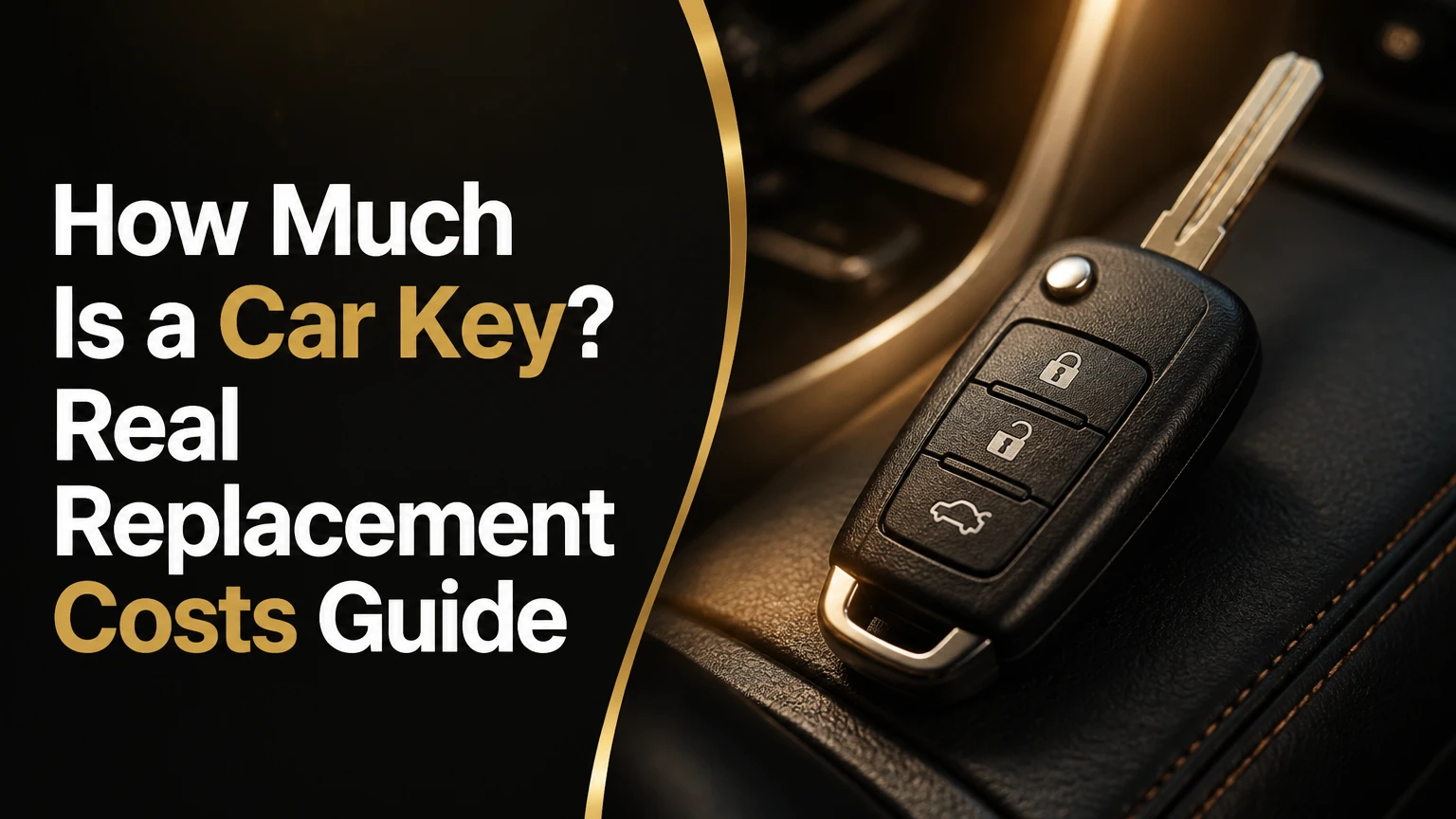
A car key costs about $10-$50 for a basic mechanical key, $80-$250 for a transponder key, $150-$350 for a remote-head key, or $250-$800-plus for a smart key. The final price depends on the vehicle’s year, make, security system, programming requirement, provider, and whether one working key remains.
Key Facts at a Glance
- A basic mechanical car key typically costs $10-$50 when no electronic programming is required.
- A transponder key commonly costs $80-$250, including cutting and immobilizer programming.
- A push-button-start smart key usually costs $250-$800 or more, especially for luxury vehicles.
- A duplicate made while one working key remains often costs 30%-60% less than an all-keys-lost replacement.
- A key-fob battery commonly costs $5-$15 and may solve button failures without replacing the fob.
- An automotive locksmith often charges less than a dealership, but some encrypted systems require authorized dealer access.
How Much Is a Car Key?
A car key usually costs $10-$800 or more in the United States, with the key’s technology creating the largest price difference. A metal-only key is inexpensive, while a smart proximity fob may require a costly OEM part, security authorization, diagnostic programming, emergency labor, and vehicle-specific software.
Typical prices vary because “car key” can describe several different devices. A 1998 compact car may use a cut blade and a separate immobilizer chip, while a current luxury SUV may use a proximity fob that communicates continuously with multiple antennas and control modules.
The following figures are typical consumer prices, not fixed national rates. Rural service calls, after-hours work, imported vehicles, dealer parts policies, and local labor rates can move the total substantially.
What does each key type cost?
| Key type | Typical total price | Typical service time | Main cost driver |
|---|---|---|---|
| Mechanical metal key | $10-$50 | 5-15 minutes | Cutting the blade |
| Transponder key | $80-$250 | 20-45 minutes | Chip and immobilizer programming |
| Remote-head or flip key | $150-$350 | 30-60 minutes | Remote buttons, blade, and coding |
| Smart proximity fob | $250-$800+ | 30-90 minutes | OEM fob and secure programming |
| Luxury European smart key | $400-$1,200+ | 1-3 hours or dealer order | Restricted software and factory part |
A replacement quote should identify the part, cutting, programming, labor, travel, tax, and emergency surcharge separately. A $120 online listing may represent only an uncut, unprogrammed shell, not a functioning replacement.
Why do modern car keys cost so much?
Modern car keys cost more because they combine physical access with electronic authorization. The blade can open a lock, but the vehicle may still refuse to start until an immobilizer recognizes the key’s transponder identity.
A passive transponder chip receives energy from the vehicle’s antenna and returns an encoded identification signal. The engine control module or immobilizer control unit checks that signal before enabling fuel injection, ignition, or starter operation.
Remote buttons perform a different job. They transmit commands for locking, unlocking, trunk release, or panic functions, usually through radio-frequency communication. A key can therefore have working door buttons while its immobilizer function remains unaffected.
Many vehicles use changing or rolling codes for remote commands, but the exact security architecture varies by manufacturer. Rolling codes help prevent simple replay attacks, yet they do not mean every key uses the same encryption method or that every replacement can be paired through a generic OBD-II tool.
What does a car key actually contain?
| Component | Function | Common failure | Replacement implication |
|---|---|---|---|
| Metal blade | Turns a lock cylinder or provides emergency entry | Bent or worn cuts | Requires cutting or blade replacement |
| Transponder chip | Authorizes engine start | Damaged or unrecognized chip | Requires immobilizer pairing |
| Button circuit board | Sends lock and trunk commands | Broken switches or water damage | May require a new fob |
| Coin-cell battery | Powers buttons and some proximity functions | Low voltage | Often costs $5-$15 to replace |
| Proximity antenna | Communicates without button presses | Range loss or module fault | Requires vehicle diagnosis |
| Fob housing | Protects electronics and blade | Cracks, broken hinge, missing buttons | A shell replacement may be sufficient |
An expert pricing rule is simple: diagnose the failed function before buying the whole assembly. If the vehicle starts normally but the buttons stopped working, a battery or damaged switch is more likely than a failed transponder.
What is the difference between a key, fob, and transponder?
A mechanical key is a cut metal blade. A transponder key contains an electronic immobilizer chip, while a key fob usually refers to a remote-control device that operates locks and may or may not contain a start-authorizing transponder.
The terms overlap in everyday speech, which creates ordering mistakes. Some manufacturers sell one integrated remote-head key; others use a separate metal emergency blade inside a smart fob. The vehicle’s exact year and trim determine which component is compatible.
Mechanical keys
Mechanical keys are the least expensive option because they require no electronic pairing. They remain common on older vehicles, work vehicles, trailers, and some fleet models.
A basic duplicate can often be cut at a hardware store, automotive parts retailer, or locksmith. The limitation is security: a metal copy may unlock the door but cannot start a vehicle equipped with an immobilizer chip.
Transponder keys
Transponder keys contain a chip embedded in the plastic head. The chip does not usually need a replaceable battery because the vehicle’s antenna energizes it during the start authorization sequence.
A transponder key must match the vehicle’s immobilizer system. Cutting the blade alone is insufficient, and some vehicles require two recognized keys before onboard programming is permitted.
Remote-head and flip keys
Remote-head keys combine a physical blade, transponder, and lock-control buttons. Flip keys add a spring-loaded hinge that stores the blade inside the casing.
These keys are practical for older vehicles with key ignition and factory remote locking. Their common failure points are worn buttons, cracked housings, failed hinges, and water-damaged circuit boards.
Smart proximity fobs
Smart keys allow passive entry and push-button starting when the fob is within a defined range. The fob may contain several antennas, a battery, a transponder function, and an emergency blade.
Smart fobs are expensive because the vehicle must authenticate them, and the replacement may be tied to manufacturer-specific security credentials. A generic shell can repair physical damage but cannot replace missing electronic identity data.
Is a locksmith cheaper than a dealership?
An automotive locksmith is typically cheaper for standard transponder and remote-head keys, while a dealership is often necessary for restricted smart-key systems or vehicles that require factory-issued credentials. The best choice depends on compatibility, programming access, location, warranty, and whether the vehicle can be driven.
| Service route | Typical total price | Typical time | Best fit |
|---|---|---|---|
| Hardware store, mechanical copy | $10-$30 | 5-15 minutes | Metal-only key |
| Automotive locksmith, duplicate | $80-$300 | 20-60 minutes | Transponder or remote key |
| Mobile locksmith, all keys lost | $180-$600 | 45-120 minutes | Stranded vehicle |
| Main dealership, duplicate | $150-$500 | 1-3 days if ordered | OEM key and documented service |
| Main dealership, smart or luxury key | $400-$1,200+ | 1-7 days | Restricted or factory-coded systems |
| Emergency after-hours service | Base price plus $50-$200 | 30-150 minutes | Nights, weekends, roadside calls |
A locksmith quote should confirm the vehicle identification number, exact year and trim, number of working keys, key type, service location, and whether programming is included. A dealership quote should clarify whether towing, key ordering, cutting, and software registration are separate charges.
The practical advantage of a mobile locksmith is that the technician can often work at the vehicle. That can eliminate towing, but a locksmith cannot legitimately program every make and model. Security access varies by brand, market, and vehicle generation.
How is a replacement car key made?
A replacement car key is made by identifying the vehicle, selecting a compatible blank or fob, cutting the blade if present, and pairing the electronic identity with the immobilizer or remote-control system. The process commonly takes 20-90 minutes when a suitable part and programming access are available.
Step 1: Confirm the vehicle and key system
Provide the technician with the VIN, year, make, model, trim, ignition type, and whether the vehicle has push-button start. Two cars with the same model name can use different fobs across adjacent production years.
The technician may verify ownership through registration, title, driver’s license, or another accepted document. Security verification protects against unauthorized key creation.
Step 2: Decode or identify the blade
When a metal blade exists, the technician uses an existing key, a lock-cylinder code, or a manufacturer database associated with the VIN. A laser-cut, side-milled blade requires different equipment from a conventional edge-cut blade.
A key can be cut accurately and still fail to start the car. Cutting controls mechanical access; programming controls electronic authorization.
Step 3: Program the remote and immobilizer
The technician connects a manufacturer-capable diagnostic device through the OBD-II port or uses an approved alternative procedure. The device may add the new key, synchronize remote buttons, or register the transponder with the immobilizer control unit.
The exact memory location is not universal. Some systems store key data in an immobilizer module, body control module, or gateway rather than directly in engine-control EEPROM. That distinction matters because generic instructions can damage modules or erase valid keys.
Step 4: Test every function
The final test should include lock, unlock, trunk release, panic button, mechanical blade operation, ignition authorization, push-button start, and emergency-start behavior when applicable.
You know the replacement works when the vehicle starts reliably, the remote operates at normal distance, and the emergency blade fits both the door and ignition or backup cylinder.
Can you get a car key without the original?
A car key can usually be made without the original, but an all-keys-lost job costs more and may require VIN verification, lock decoding, immobilizer access, towing, or dealer involvement. The technician does not need to copy the old blade if the key code or lock can be decoded.
Without an original key, the provider may obtain the mechanical code from a manufacturer database, decode the door lock, or create a new blade from the vehicle’s lock pattern. Electronic programming still requires a compatible blank or fob and access to the vehicle’s security system.
Typical all-keys-lost pricing is $180-$600 for many mainstream vehicles and $400-$1,200 or more for restricted luxury systems. Emergency access, damaged locks, missing registration, and a dead vehicle battery can raise the total.
An important security question is what happens to the missing key. Ask whether the technician can delete lost keys from the vehicle’s authorized-key list. On some systems, deleting a key from the immobilizer does not necessarily disable every mechanical door blade, so a stolen key may still require lock-cylinder replacement.
Should you buy a car key online?
Buying a car key online can reduce the part price, but it is worthwhile only when the exact part number, frequency, chip type, button layout, blade profile, and vehicle compatibility are confirmed. A cheap fob that cannot be programmed becomes an additional expense.
| Online purchase type | Typical price | Programming status | Main risk |
|---|---|---|---|
| Mechanical blank | $5-$20 | Not applicable | Incorrect blade profile |
| Transponder blank | $15-$80 | Usually unprogrammed | Wrong chip or locked chip |
| Aftermarket remote-head key | $30-$120 | Usually unprogrammed | Incorrect frequency or firmware |
| OEM used fob | $50-$250 | Often previously paired | May be non-reusable |
| New OEM smart fob | $150-$500 | Requires vehicle pairing | Incorrect part number |
Check the FCC ID or manufacturer part number where applicable, but do not rely on appearance alone. A 315 MHz fob and a 433 MHz fob may look identical while operating on incompatible radio systems.
Ask the locksmith before purchasing. Some technicians refuse customer-supplied parts because counterfeit, previously programmed, or low-quality components create programming failures and warranty disputes.
How much does a spare key cost?
A spare car key commonly costs 30%-60% less than an all-keys-lost replacement because the technician can copy or validate an existing key and usually avoids vehicle decoding. Typical spare-key pricing is $10-$50 for mechanical keys, $80-$200 for transponder keys, and $180-$500 for smart fobs.
A spare is easiest to make while the original key starts the vehicle. Certain vehicles also allow owner programming when two valid keys are already present, although the procedure and eligibility depend on the manufacturer.
The best time to create a spare is before the last key fails. A duplicate made during routine business hours avoids emergency travel charges, towing, and the higher diagnostic burden associated with an immobilizer that has no recognized key.
Store the spare separately from the primary key. A second key kept on the same ring does not help when both disappear together.
What should you do if the only key is lost?
If the only car key is lost, secure the vehicle, collect proof of ownership, identify the VIN, and request an all-keys-lost quote from an automotive locksmith or dealership. Ask whether the missing key can be removed from the authorized-key memory before approving the work.
Use this sequence:
- Check the vehicle, clothing, workplace, parking area, and recent destinations.
- Photograph or record the VIN, usually visible through the windshield or on registration documents.
- Call roadside assistance, an insurer, an automobile club, or a mobile locksmith.
- Confirm total price, arrival fee, programming, replacement part, tax, and payment terms.
- Ask whether the quote includes key deletion and testing of every function.
- Keep registration and identification available for security verification.
Do not buy a random fob while stranded. The correct part may still require a locksmith’s diagnostic equipment, and a wrong part can delay recovery.
What problems look like a failed car key?
A failed car key may have a dead battery, damaged buttons, a broken transponder, a desynchronized remote, vehicle-side antenna failure, or an immobilizer fault. The symptom that matters most is whether the vehicle starts, locks, unlocks, or performs proximity functions.
| Symptom | Likely cause | First action | Typical cost |
|---|---|---|---|
| Buttons fail, car starts | Dead coin-cell battery | Replace CR2032 or CR2016 | $5-$15 |
| Car starts, range is short | Weak battery or damaged antenna | Test battery voltage and casing | $5-$80 |
| Key turns, engine will not start | Unrecognized transponder | Try spare, then diagnose immobilizer | $80-$300 |
| Smart fob works intermittently | Low battery, water, interference | Replace battery and inspect contacts | $5-$250 |
| Blade will not turn | Wrong cut or worn cylinder | Stop forcing it; verify blade | $10-$200 |
| No keys operate vehicle | Vehicle-side electrical or security fault | Test battery and diagnostic modules | $100-$600+ |
A dead fob battery does not always prevent the car from starting. Many push-button vehicles include a designated backup position where the fob can be held against the start button or placed in a marked console slot.
Do not repeatedly press buttons beside aftermarket radar detectors, wireless chargers, or other transmitters while diagnosing range problems. Interference is less common than a weak battery or damaged fob, but a controlled test away from accessories is fast and free.
Can you program a car key yourself?
Some older vehicles permit owner programming, but many modern cars require a professional scan tool, security PIN, online authorization, or manufacturer-specific subscription. DIY programming is safest only when the owner’s manual explicitly describes the procedure for that exact vehicle.
Owner programming may add remote button functions without programming the immobilizer. A remote that locks the doors is therefore not proof that the key can start the engine.
Avoid cheap OBD-II devices that promise universal key programming. The main risk is not merely an unsuccessful attempt. An incorrect procedure can erase registered keys, interrupt module communication, or leave the vehicle requiring dealer recovery.
A professional should provide a written compatibility check before connecting equipment. The technician should also confirm whether existing keys will remain authorized and whether the vehicle battery has adequate voltage.
Does insurance cover replacement car keys?
Insurance coverage for a lost or stolen car key depends on the policy, deductible, roadside benefits, and cause of loss. Comprehensive coverage may apply after theft or vandalism, while ordinary accidental loss is often excluded unless a specific key-replacement benefit exists.
Check these sources before paying:
- Comprehensive auto policy, especially theft-related claims
- Roadside-assistance membership
- New-car warranty or prepaid maintenance plan
- Credit-card purchase protection
- Manufacturer connected-services or roadside plan
- Home or renters insurance, where personal-property terms may apply
A $250 claim may not be sensible under a $500 deductible. A $700 smart-fob replacement may justify a claim if the policy covers the event and does not increase future premiums.
Ask the insurer whether it covers programming, mobile labor, towing, rekeying, and deletion of the missing fob. Coverage for the replacement part alone may leave the largest labor charge unpaid.
Which replacement option is best for your situation?
The best replacement route depends on the vehicle’s security system, urgency, and access to a working key. A hardware store suits a metal-only key, an automotive locksmith suits many mainstream electronic keys, and a dealership is safer when the manufacturer restricts smart-key programming.
Older vehicle with a metal key
Choose a local hardware store or locksmith if the key contains no chip. Confirm that the copied blade turns the door and ignition smoothly before leaving.
Mainstream vehicle with one working transponder key
Choose an automotive locksmith and request a spare during normal hours. Bring the working key, registration, and identification; the provider may cut and program the duplicate in one visit.
Push-button-start vehicle
Obtain the exact smart-fob part number first. Compare a mobile locksmith’s complete price with the dealership’s part, programming, and towing charges, because the cheapest advertised fob may exclude secure registration.
Luxury European vehicle
Start with an authorized dealer or a locksmith who explicitly supports the brand’s current immobilizer system. Factory ordering, ownership verification, and encrypted authorization can make unofficial parts unusable.
Stolen rather than misplaced key
Request deletion of the missing key from the vehicle’s authorized list and ask whether the door locks should be rekeyed. Electronic deletion may not prevent entry with a compatible mechanical blade.
Common mistakes that increase the price
Most unnecessary car-key expense comes from ordering the wrong part, delaying a spare until all keys are gone, or treating a battery symptom as a complete key failure. The following practitioner checks prevent the most common avoidable charges.
- Ordering by appearance: Match the part number, FCC ID, frequency, chip type, and vehicle production year.
- Ignoring the trim level: Push-button start, remote start, and passive entry may change the required fob.
- Leaving programming out of the quote: Ask for a complete installed price, not a parts-only figure.
- Using a damaged original as the template: A worn blade can transfer inaccurate cuts to the duplicate.
- Attempting DIY programming without a backup: Confirm that existing keys will not be erased.
- Forcing a wrong emergency blade: A jammed blade can damage the lock cylinder and add $150-$500 in repairs.
- Failing to test every button: Discovering a defective trunk or panic function after payment complicates warranty service.
One counterintuitive fact is that a used OEM fob is not automatically a bargain. Some vehicles permanently bind a fob to its first car, so the lower purchase price can produce a part that no technician can reuse.
The Bottom Line
How much is a car key? Budget $10-$50 for a mechanical copy, $80-$250 for a transponder key, $150-$350 for a remote-head key, and $250-$800 or more for a smart proximity fob. Confirm the complete installed price, including cutting, programming, labor, travel, tax, and any all-keys-lost surcharge.
Create a spare while one working key remains. That single timing decision usually reduces diagnostic work, avoids towing, and preserves more replacement options.
Frequently Asked Questions
Can a dealership cut a car key from the VIN?
A dealership can usually order or cut a vehicle-specific key using the VIN after verifying ownership, but the VIN alone does not guarantee immediate service. The dealer may need to order an OEM fob, schedule programming, and require the vehicle on site. Mechanical key-code availability varies by manufacturer and model year.
How long does a replacement car key take?
A standard duplicate often takes 20-60 minutes when the correct blank or fob is available. Dealer-ordered smart keys may take one to seven days because the part must arrive before programming. All-keys-lost jobs can take 45-120 minutes at the vehicle if software access and parts are ready.
Can a locksmith make a key for a leased car?
A locksmith can often make a replacement key for a leased vehicle, but the driver still needs to prove lawful possession. Lease agreements may require an OEM part or notification after a lost key, particularly when the vehicle uses a restricted smart-key system.
Does a new car key come with a battery?
Most remote and smart keys include a battery when sold new, but online aftermarket listings vary. Confirm whether the listing includes the coin cell, blade, circuit board, transponder, and programming. A replacement battery is usually inexpensive, commonly $5-$15, compared with replacing the entire fob.
Will a spare key lower my insurance cost?
A spare key normally does not lower an auto-insurance premium. A functioning spare can reduce future replacement costs and downtime, while a documented immobilizer or factory anti-theft system may affect eligibility or underwriting separately. Ask the insurer about security discounts rather than assuming a duplicate key qualifies.
What information should you give a key replacement company?
Give the company the vehicle year, make, model, trim, VIN, ignition type, key count, symptoms, location, and whether the vehicle starts. Also state whether the key is lost, stolen, broken, or merely has failed buttons. These details allow a provider to quote the correct part and programming service.