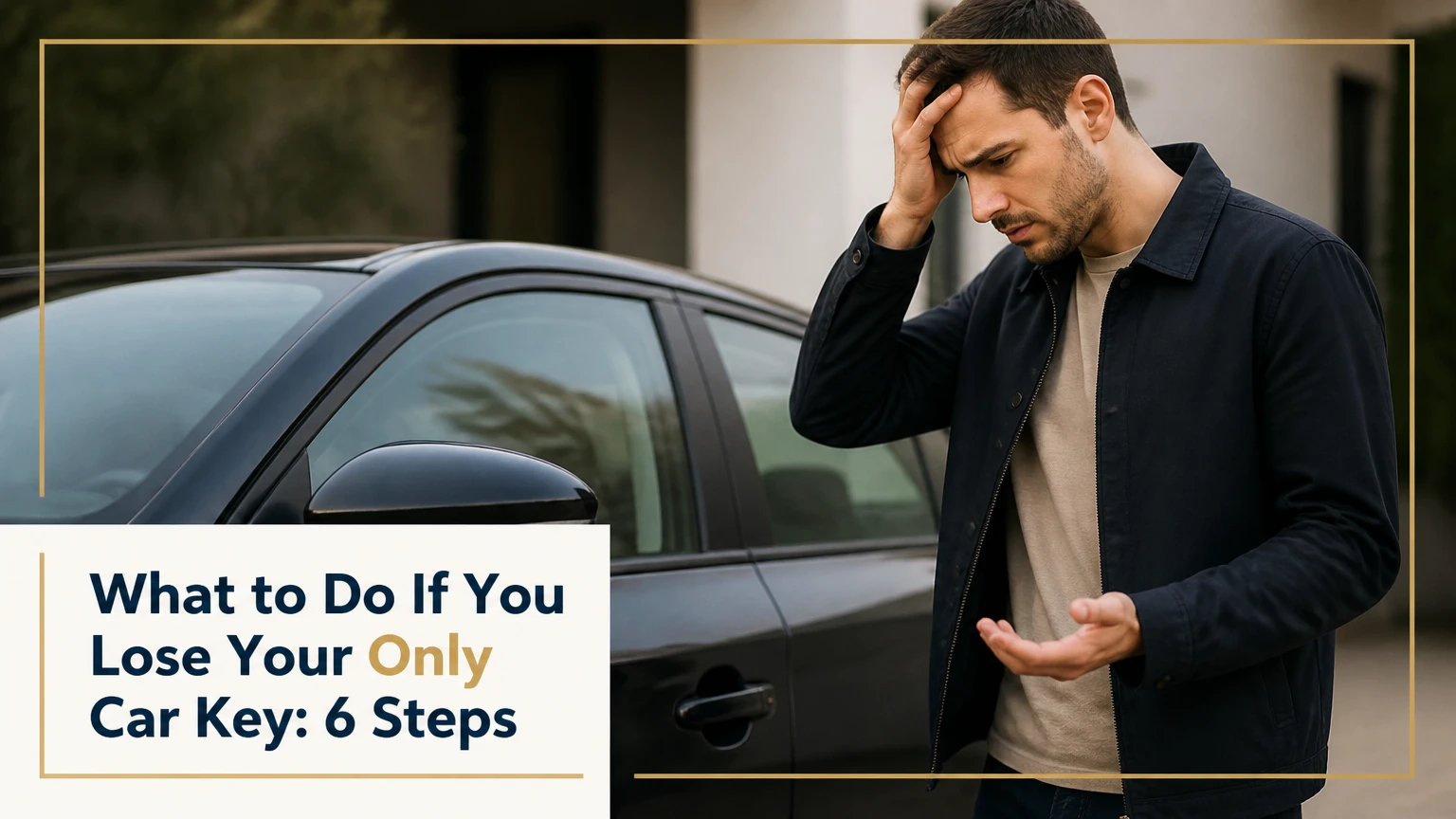
If you lose your only car key, secure yourself and the vehicle, confirm the key is truly missing, then contact a mobile automotive locksmith or the vehicle dealership with your VIN, identification, and proof of ownership. A replacement usually requires both a mechanical key cut and electronic programming, with typical US costs ranging from $10 to more than $600.
Key Facts at a Glance
A replacement key may require cutting, transponder programming, remote synchronization, or all three.
A mobile automotive locksmith often replaces an ordinary lost key at the vehicle’s location, avoiding dealership towing.
Typical replacement costs range from $10-$50 for a basic metal key to $250-$600 or more for a smart key.
A VIN identifies the vehicle, but it does not automatically prove that the caller owns it.
A key locked inside the car is a lockout problem, while a genuinely lost key is a replacement and security problem.
If theft is possible, ask whether the missing key can be removed from the vehicle’s authorized-key memory.
What to Do If You Lose Your Only Car Key First
The first priority after losing a car key is personal safety, followed by confirming the vehicle’s location and security status. Move away from traffic, extreme weather, or unsafe surroundings before searching, and call emergency services if a child, pet, medical device, or immediate hazard is involved.
Step 1: Make the Vehicle Safe
If the car is parked on a road shoulder, turn on hazard lights if possible and move behind a barrier or well away from traffic. Do not spend twenty minutes searching beside fast-moving vehicles. A locked car can wait; a roadside injury cannot.
If the key was lost in a public place, note the time and route you took. Photograph the parking space, check with the venue’s lost-and-found desk, and search bags, clothing, shopping carts, workplace drawers, and the ground around the vehicle. Look through the windows with a flashlight, including the floor and cargo area.
If the key may have been stolen, do not leave the vehicle unattended in an exposed location. Ask a trusted person to remain nearby, or arrange a tow to a secure location.
Step 2: Confirm Whether the Key Is Lost or Locked Inside
A key visible inside the cabin is not the same problem as an absent key. Roadside assistance or a licensed automotive lockout technician can usually open a vehicle without creating a replacement key, while an all-keys-lost service must identify, cut, and program a new key.
Do not insert coat hangers, pry the door frame, or force an air wedge into a modern vehicle without training. Those methods can damage weather seals, side-curtain airbags, wiring, paint, or the door lock. If the key is in the trunk and the trunk is separately locked, tell the technician before arrival.
Step 3: Gather the Information a Technician Needs
Prepare the following information before requesting a quote:
- Exact year, make, model, body style, and trim.
- Vehicle identification number, usually visible through the lower driver-side windshield or printed on registration and insurance documents.
- Your government-issued identification.
- Registration, title, lease paperwork, or another accepted ownership document.
- Current vehicle location and whether the car is accessible to a service van.
- Key style, such as metal blade, transponder key, remote-head key, or push-button smart fob.
- Whether the missing key may have been stolen.
- Any key code or original key tag found in the owner’s manual packet.
A technician may accept a registration in another person’s name when you can document lawful possession, such as a rental agreement, company authorization, or lease record. Requirements vary by provider and jurisdiction, so ask what documents are acceptable before the appointment.
Never post the full VIN, registration, title, or driver’s-license image in a public forum. Send sensitive documents only through a verified business channel.
What Kind of Replacement Key Does Your Car Need?
A vehicle key can contain four separate functions: a mechanical blade, a remote transmitter, a transponder immobilizer chip, and a proximity system. The year of the vehicle provides a clue, but the exact trim and ignition system determine the replacement part and programming method.
| Key type | Typical vehicle examples | Typical US replacement cost | Typical service time |
|---|---|---|---|
| Basic metal key | Older vehicles with no immobilizer chip | $10-$50 | 10-20 minutes |
| Transponder key | Many 1996-2015 cars with keyed ignition | $80-$250 | 30-60 minutes |
| Laser or side-milled key | Vehicles using a thicker, precisely milled blade | $150-$350 | 30-75 minutes |
| Remote-head or switchblade key | Foldable blade with lock, unlock, and panic buttons | $150-$400 | 45-90 minutes |
| Smart or proximity fob | Push-button-start vehicles | $250-$600+ | 45-120 minutes |
A transponder chip does not necessarily provide remote locking. Some cars use a chip only to authorize engine starting, while a separate battery-powered remote controls the locks. A smart fob may have an emergency mechanical insert for the door but still require electronic authorization to start the car.
Modern proximity systems also do not all work through “continuous” rolling-code transmission. The vehicle and fob communicate using manufacturer-specific radio protocols, challenge-response authentication, low-frequency detection, and encrypted credentials. The practical consequence is simple: a physically correct-looking fob may still be electronically incompatible.
How Do You Replace a Car Key Without the Original?
A locksmith or dealer can often create a replacement without the original by using the VIN, a manufacturer key code, a decoded lock, or vehicle-specific programming data. The professional cuts the physical blade when necessary, supplies a compatible electronic key, programs it to the vehicle, and tests every required function.
The Replacement Process
- Verify ownership and vehicle identity.
The technician checks your documents and confirms the VIN, model, year, and key system. - Identify the required blank or fob.
The correct part depends on frequency, immobilizer generation, blade profile, buttons, market, trim, and whether the fob is new, used, or refurbished. - Generate the mechanical cut.
A code-cut machine may produce a blade from a key code. Some technicians can decode a door or ignition lock, although disassembly may increase labor time. - Access the vehicle’s programming system.
The technician may use an onboard diagnostic port, a manufacturer-specific interface, a bench procedure, or an immobilizer module process. The method is not identical across brands. - Authorize the new key.
The transponder or smart fob is paired with the immobilizer system. Some vehicles require a security PIN, online credentials, a timed security procedure, or two already-authorized keys. - Test the completed key.
Check door locks, trunk release, panic alarm, remote range, emergency blade operation, dashboard warnings, and repeated engine starts.
Programming a new key does not always erase every missing key. Some vehicles support an “all keys lost” procedure, some require a separate erase-and-relearn operation, and some systems retain a missing credential unless a dealer-level reset is performed. Ask the technician exactly what will happen to the lost key before authorizing work.
How Much Does a Replacement Car Key Cost?
A typical replacement car key costs $10-$600 or more in the United States, depending on the key technology, vehicle brand, location, service hour, part source, and whether the vehicle must be towed. The quoted price should identify parts, cutting, programming, travel, emergency labor, taxes, and any failed-programming charge.
| Cost factor | Typical range | When it applies | How to reduce surprises |
|---|---|---|---|
| Basic key cutting | $10-$50 | Metal blade without electronics | Confirm whether ignition and door locks use the same cut |
| Transponder key and programming | $80-$250 | Chipped keyed-ignition vehicle | Ask whether programming is included |
| Smart-fob replacement | $250-$600+ | Push-button-start vehicle | Confirm OEM, aftermarket, or refurbished part |
| Mobile service or travel | $0-$150 | Technician comes to the vehicle | Request a total, not an arrival fee only |
| Emergency or after-hours labor | $50-$200 | Nights, weekends, holidays | Ask for the final price before dispatch |
| Dealership tow | $100-$250+ | Vehicle must reach the dealer | Check flatbed requirements and roadside benefits |
Dealership pricing is often higher because the invoice may include an OEM fob, proprietary software access, diagnostic labor, programming, and a separate towing charge. A locksmith’s lower price may reflect an aftermarket or refurbished fob, mobile labor, or access to a different programming platform.
The cheapest quote is not automatically the lowest cost. A failed aftermarket fob can require another part, another programming attempt, and a second service visit. Obtain at least two itemized quotes when the vehicle is safely parked.
Should You Call a Locksmith or a Dealership?
A reputable mobile automotive locksmith is usually the better first call for an older or common vehicle, especially when the car is stranded away from home. A dealership is the safer choice when the vehicle is very new, rare, luxury-branded, under a key warranty, or supported by a security system that independent equipment cannot access.
| Decision factor | Mobile automotive locksmith | Authorized dealership |
|---|---|---|
| Vehicle location | Comes to a parked vehicle | Usually requires vehicle transport |
| Common older vehicle | Often same-day service | Appointment may be required |
| New or restricted security system | Capability varies by model | Factory system access is expected |
| Part selection | OEM, aftermarket, or refurbished | Usually OEM |
| Typical total cost | $80-$500, vehicle dependent | $200-$800+, plus possible towing |
| Programming access | Professional aftermarket tools | Manufacturer-specific software |
| Best use case | Fast on-site replacement | Complex, rare, or warranty-covered work |
Choose a locksmith that specifically advertises automotive key cutting and immobilizer programming. A residential locksmith may open doors but lack the equipment, credentials, or software needed to create a starting key.
When calling, ask five questions:
- Can you handle an all-keys-lost situation for my exact year, make, model, and trim?
- Is the quoted price the total, including travel, cutting, programming, and tax?
- Will you supply OEM, aftermarket, or refurbished equipment?
- Can you disable or erase the missing key if theft is possible?
- What ownership documents must I show?
A technician who refuses to provide a clear price structure or avoids ownership verification is a poor security choice.
Can You Program the Key Yourself?
DIY programming works on a limited number of older vehicles and remote transmitters, but all-keys-lost immobilizer programming commonly requires specialized equipment, security credentials, or a diagnostic procedure. Cutting a blade and pairing a door-lock remote does not guarantee that the engine-start transponder will work.
Owner manuals sometimes describe a procedure for adding a second key when one programmed key remains. That procedure is different from replacing the only key. Some vehicles require two working keys, while others permit a scan tool procedure with a security delay.
Online key fobs can be legitimate, but compatibility must match the vehicle’s part number, frequency, transponder type, regional specification, button layout, and immobilizer generation. A used fob may remain locked to another vehicle, and a generic shell may contain no usable electronics.
Do not attempt programming while the vehicle battery is weak. Voltage loss during immobilizer registration can interrupt the process and create a second diagnostic problem. A professional should verify battery voltage and use stable power support when the manufacturer procedure requires it.
What If the Lost Key Was Stolen?
If the key may have been stolen, tell the locksmith or dealer before programming and request a security review. The recommended response may include deleting the missing key from authorized-key memory, changing mechanical lock cylinders, reprogramming remote functions, and securing connected vehicle accounts.
Deleting a credential does not always prevent physical entry if the stolen key still matches the door locks. A thief with the original blade may be able to unlock the door even after engine-start authorization is removed. Some vehicles also use separate systems for passive entry, remote buttons, and immobilizer starting.
Take these additional steps:
- Move the vehicle to a locked garage or monitored location.
- Remove the vehicle from public listing or social posts that reveal its location.
- Change the connected-app password and enable multifactor authentication.
- Report suspected theft to police and retain the incident number.
- Ask the insurer whether key reprogramming, lock replacement, or theft protection is covered.
- Check whether the stolen key could also identify your home address, especially if registration documents were lost with it.
If the lost key was attached to a tag showing your address, treat the incident as a broader home-security concern rather than a simple replacement.
What Payment Options Can Reduce the Bill?
Roadside assistance, comprehensive insurance, dealer key-protection plans, manufacturer warranties, lease agreements, and credit-card benefits may contribute to replacement costs, but coverage limits and exclusions differ. Verify coverage before authorizing work because a $100 benefit may not justify a claim when the policy deductible is $500.
| Coverage source | Possible benefit | Common limitation | What to verify |
|---|---|---|---|
| Roadside membership | $50-$150 toward lockout or locksmith labor | Replacement fob may be excluded | Lockout versus lost-key coverage |
| Comprehensive auto insurance | Policy-specific reimbursement | Deductible may exceed the bill | Deductible, claim effect, covered parts |
| New-car warranty | Key repair or replacement in limited plans | Lost keys often excluded | Warranty booklet and expiration |
| Dealer key-protection plan | Fob, cutting, programming, or towing | Enrollment and model restrictions | Per-claim and lifetime limits |
| Credit-card benefit | Emergency roadside assistance | Often service-only, not parts | Benefit administrator and payment rules |
Ask the service provider for a detailed receipt with the VIN, labor, part number, programming, and tax. Insurers and benefit administrators commonly require documentation, and a generic card receipt may not establish what work was performed.
Rental-car companies and fleet operators may have separate procedures. Do not order a replacement independently for a leased or rented vehicle until the contract owner gives permission, because the approved supplier or required OEM part may be specified.
What Problems Can Happen During Replacement?
The most common replacement failures involve an incorrect fob, incompatible frequency, insufficient battery voltage, restricted security access, or incomplete key registration. The correct recovery is to stop repeated programming attempts, document the error, and have the provider verify the part number and vehicle security system.
Common Failure Modes
- Wrong model or trim: A 2020 vehicle may use different fobs across trim levels. Compare the original part number if available, not merely the vehicle name.
- Aftermarket fob failure: A low-cost fob may have the wrong chip or radio frequency. Request a tested replacement before paying for repeated labor.
- Dead vehicle battery: A low-voltage vehicle may not complete immobilizer enrollment. Charge or replace the battery before diagnosing the key.
- Dealer-only security access: Some newer systems require authenticated manufacturer software. A locksmith may need to refer the job to the dealer.
- Remote works, engine does not start: Lock buttons can pair successfully while the transponder remains unprogrammed.
- Key starts the engine, buttons fail: The mechanical and immobilizer functions work, but remote synchronization, battery condition, or frequency is wrong.
- Lost key remains active: Ask for a documented key-memory check and confirm whether the platform supports deleting it.
Do not accept “the key is programmed” as the only test result. The final check should include starting the car twice, locking and unlocking every relevant entry point, opening the trunk, testing the panic function when safe, and confirming that no immobilizer warning remains.
Which Situations Need a Different Response?
The service route changes when the vehicle is leased, financed, rented, inaccessible, damaged, or equipped with a restricted security system. Explain the situation before dispatch so the provider brings the correct equipment and does not quote a simple lockout for an all-keys-lost job.
If You Are Stranded at Night
Use a well-lit public location, remain inside a staffed building when possible, and request roadside assistance or a 24-hour mobile automotive locksmith. Tell dispatch whether the vehicle is on a highway shoulder, in a parking garage, behind a locked gate, or in a location where a van cannot reach it.
If the Vehicle Is in a Parking Garage
Confirm the garage’s clearance height, access hours, and towing rules. A tall locksmith van may not enter a low-clearance structure, and a dealer tow truck may need to retrieve the vehicle from a restricted level.
If the Car Has Push-Button Start
Do not assume a metal emergency blade will start the car. The blade generally opens a lock, while the smart fob’s electronic credential authorizes starting. Ask for the exact proximity-fob part and confirm the emergency-start location described in the owner’s manual.
If the Vehicle Is a Luxury or Current-Year Model
Call the authorized dealer and a specialist automotive locksmith for quotes. BMW, Mercedes-Benz, Audi, Jaguar, Land Rover, and newer electric vehicles can involve encrypted modules, online authorization, or replacement procedures that vary significantly by market and production date.
If the Vehicle Is Financed or Leased
Have the contract holder’s authorization available if the registration is not in your name. A provider may refuse service when identity, possession, and authorization cannot be reconciled.
How Can You Avoid Losing the Only Key Again?
Make a spare key before an emergency, because duplicating a working key is usually faster and less expensive than an all-keys-lost replacement. Store the spare outside the vehicle in a secure, accessible location and record its part number and programming status.
After receiving the replacement:
- Test the new key before the technician leaves.
- Label the spare without writing the vehicle address.
- Keep the emergency blade and fob battery information together.
- Register a second key with the vehicle if the system supports it.
- Add a Bluetooth tracker to the key ring, but do not treat tracking as theft prevention.
- Ask the dealer or locksmith whether the vehicle supports a key-memory audit.
- Record the service invoice and replacement part number.
- Replace a weak coin-cell battery using the battery type specified by the manufacturer.
A tracker can help locate a misplaced key, but it cannot recover a key left outside its Bluetooth range, and it does not disable the vehicle. Physical redundancy remains the most reliable prevention.
Frequently Asked Questions
Can a locksmith make a car key from the VIN alone?
A VIN can help an authorized provider identify the vehicle’s key code, but the VIN alone does not physically prove ownership or guarantee that a key can be made. The locksmith or dealer may also require identification, registration, title, a security PIN, or a decoded lock, depending on the vehicle.
How long does it take to replace the only car key?
A basic metal key may take 10-20 minutes, while a transponder or smart-fob replacement commonly takes 30-120 minutes after the technician arrives. Dealer work can take longer when the vehicle needs towing, an appointment, factory authorization, or a backordered OEM fob.
Is a replacement key covered by comprehensive insurance?
Comprehensive insurance may cover lost or stolen keys under some policies, but many policies exclude ordinary loss or apply a deductible. Roadside coverage may pay for a lockout without paying for a replacement fob. Confirm the benefit, deductible, claim process, and reimbursement limit first.
Can I drive the car if the only key is missing?
You cannot normally start the vehicle without an authorized key, even if the doors are unlocked. A remote-start feature may start the engine in limited circumstances, but driving generally requires the recognized transponder or smart fob, and using remote start does not solve the missing-key security problem.
Should I replace the car locks after losing a key?
Replace or rekey the locks when theft is possible, the key identifies your address, or the vehicle has exposed mechanical locks. Ordinary accidental loss usually requires key-memory review and a replacement key rather than new cylinders, but the correct decision depends on the risk and vehicle design.
What should I do if the new key works intermittently?
Stop relying on the intermittent key and return to the installer for testing. The cause may be a weak fob battery, damaged transponder, incorrect part, low vehicle voltage, antenna fault, or incomplete programming. Request a written diagnosis before paying for another replacement.
The Bottom Line
If you lose your only car key, first protect yourself and determine whether the key is lost, locked inside, or possibly stolen. Then gather the VIN and ownership documents, compare a qualified mobile automotive locksmith with the dealership, obtain an itemized quote, and confirm that every starting, locking, trunk, and security function works before leaving. The right response to what to do if you lose your only car key depends mainly on the vehicle’s key technology, location, urgency, and theft risk.