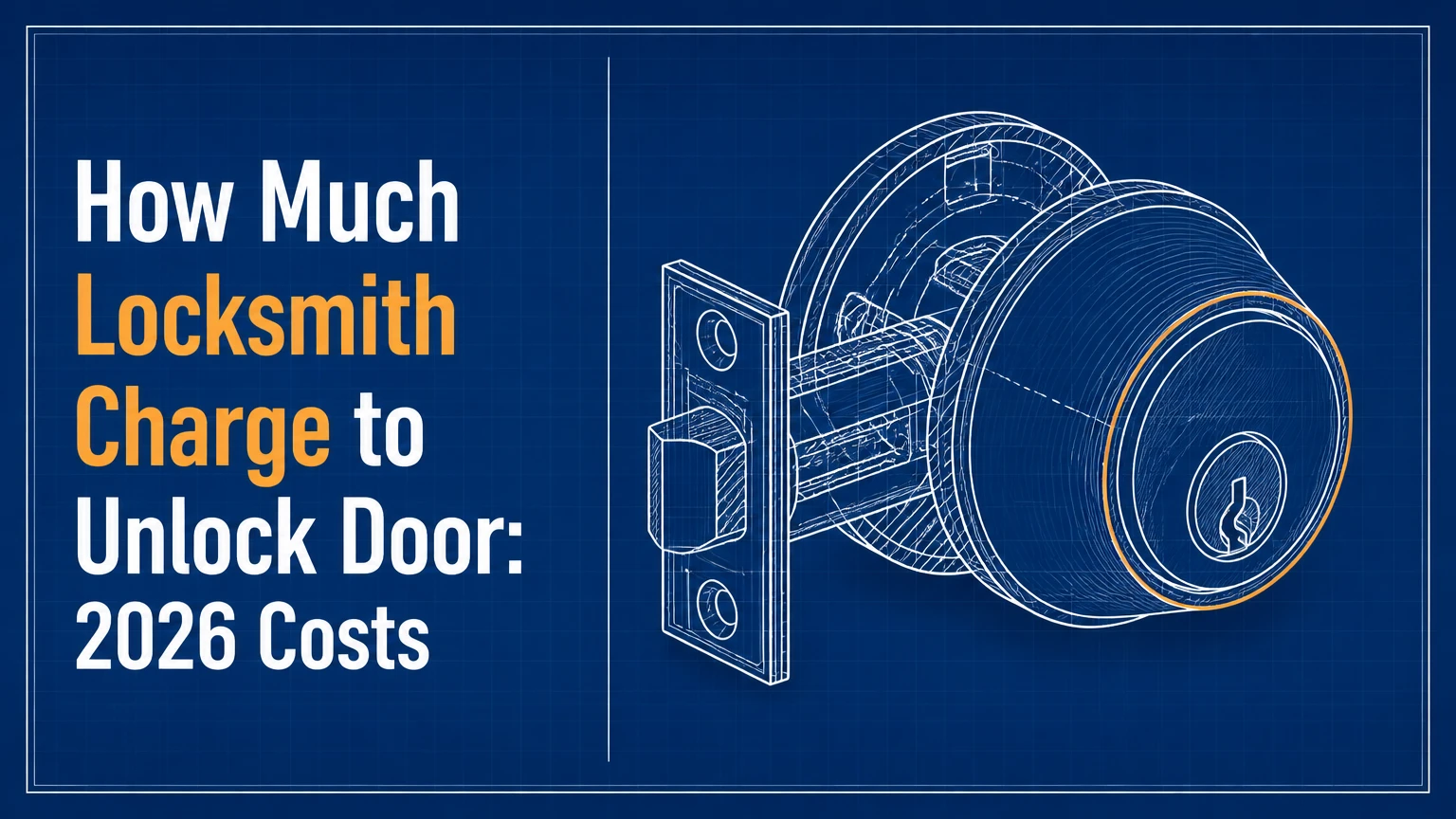
A professional locksmith typically charges $75-$150 to unlock a standard residential door during normal U.S. business hours. The final bill usually includes a $50-$100 service call or minimum labor charge, while nights, weekends, complex locks, travel, taxes, and replacement hardware can raise the total to $125-$500 or more.
Key Facts at a Glance
- A standard house lockout typically costs $75-$150 during regular daytime hours.
- Emergency, overnight, weekend, and holiday service commonly costs $125-$295 for a basic residential entry.
- A locksmith may charge a $50-$100 trip or service fee, even when entry takes only a few minutes.
- Drilling, broken-key extraction, smart-lock diagnosis, and replacement hardware can add $50-$300 or more.
- A legitimate locksmith should identify the customer, confirm authorization, and disclose the maximum price before substantial work begins.
- A $15-$29 advertised service price is often a dispatch fee rather than the complete cost.
The figures above are typical consumer prices in the United States, not a regulated national tariff. Metropolitan labor markets, local licensing rules, travel distance, lock complexity, and the company’s pricing model can move the quote substantially.
How Much Does a Locksmith Charge to Unlock a Door?
A locksmith charges about $75-$150 for a standard residential door, including a routine service call and non-destructive entry attempt. A simple spring-latch lock may take 5-15 minutes on site, but the customer still pays for dispatch, insurance, tools, travel, and professional availability.
| Situation | Typical U.S. price | Typical on-site time | Main price driver |
|---|---|---|---|
| Standard house lockout, daytime | $75-$150 | 5-20 minutes | Service call and entry labor |
| House lockout, evening or weekend | $125-$225 | 10-30 minutes | Emergency premium |
| Overnight or holiday house lockout | $175-$295 | 10-45 minutes | Scarce technician availability |
| High-security or restricted cylinder | $150-$300 | 20-60 minutes | Hardware and entry complexity |
| Smart-lock failure | $100-$250 | 20-60 minutes | Battery, electronics, or override diagnosis |
| Commercial door lockout | $100-$250 | 15-60 minutes | Mortise, panic, access-control hardware |
A locksmith’s advertised hourly rate can be misleading when the company applies a two-hour minimum or a separate mobile-service charge. Ask whether the quoted amount includes dispatch, labor, sales tax, emergency fees, and any replacement part before authorizing work.
What Is Included in a Locksmith’s Quote?
A complete quote should identify the dispatch charge, the entry labor, the emergency surcharge, and the maximum expected total before work starts. The quote should also state whether drilling, lock replacement, key cutting, electronic diagnosis, tax, and payment fees are excluded.
Typical invoices use one of four structures:
- Flat-rate entry: One price covers travel and ordinary unlocking.
- Service call plus labor: A trip charge is combined with a fixed or hourly labor fee.
- Hourly billing: The customer pays for time, often subject to a minimum.
- Diagnostic and replacement billing: The company charges to inspect a failed lock, then adds authorized parts and installation.
A five-minute entry can therefore cost $100, while a 40-minute repair may cost $250. Time is only one billing variable.
Do Nights, Weekends, and Holidays Cost More?
After-hours locksmith service commonly adds $50-$150 to a normal residential lockout, placing many overnight or holiday visits between $125 and $295. The premium compensates for on-call staffing, reduced technician availability, and increased travel or security risk.
| Service window | Standard residential total | Common surcharge | Typical response |
|---|---|---|---|
| Weekday, 8 a.m.-5 p.m. | $75-$150 | $0-$25 | 15-30 minutes |
| Weekday, 5 p.m.-10 p.m. | $100-$200 | $25-$75 | 20-45 minutes |
| Overnight, 10 p.m.-8 a.m. | $150-$295 | $75-$150 | 30-60 minutes |
| Saturday or Sunday | $125-$250 | $50-$125 | 20-60 minutes |
| Major holiday | $175-$350 | $75-$200 | 30-90 minutes |
These are planning ranges rather than guarantees. A rural customer may pay more for distance, while a dense city may have several competing mobile locksmiths nearby. Severe weather, large events, and simultaneous emergency calls can also extend arrival times.
How Does Lock Type Change the Bill?
Lock type changes the bill because a basic pin-tumbler cylinder, a mortise lock, a multipoint door, and a smart lock require different tools, time, and replacement decisions. Standard residential hardware is usually cheapest; restricted, damaged, or electronically failed hardware costs more.
| Lock or door type | Typical unlock price | Likely resolution time | Possible added charge |
|---|---|---|---|
| Basic knob lock | $75-$125 | 5-15 minutes | $0-$50 for a new cylinder |
| Residential deadbolt | $85-$150 | 5-20 minutes | $50-$200 if replacement is needed |
| Mortise lock | $125-$250 | 20-60 minutes | $100-$300 for specialized hardware |
| Multipoint patio or entry lock | $150-$300 | 30-90 minutes | $100-$400 for mechanism repair |
| Smart keypad lock | $100-$250 | 20-60 minutes | $0-$350 for electronic replacement |
| Restricted keyway or high-security lock | $150-$350 | 30-90 minutes | Brand-specific cylinder cost |
A pin-tumbler cylinder contains driver pins and key pins that align at a shear line when the correct key is inserted. A locksmith assesses the cylinder and door condition, then selects an authorized entry method that aims to preserve the door, frame, and usable hardware.
The practical distinction is important: gaining entry is not the same as repairing the cause of the lockout. A locksmith may open a door successfully and still recommend replacing a worn cylinder, repairing a misaligned strike plate, or changing a smart-lock battery system.
How Much Does a Smart-Lock Lockout Cost?
A smart-lock lockout typically costs $100-$250, depending on whether the failure involves depleted batteries, a disconnected hub, a damaged keypad, or a mechanically jammed override cylinder. A locksmith may need to restore mechanical access first, then diagnose the electronics separately.
Do not assume a smart lock eliminates locksmith costs. Keypad models can lose power, Bluetooth models can fail to authenticate, and retrofit devices can bind against a poorly aligned deadbolt. Manufacturer warranty support may cover a failed unit, but it rarely covers emergency labor from an independent technician.
Will a Locksmith Damage the Lock?
A locksmith normally attempts non-destructive entry first, so a routine lockout does not require drilling or lock replacement. Damage becomes more likely when the cylinder is seized, the key has broken inside, the mechanism has failed internally, or the lock uses high-security components that resist ordinary entry methods.
A professional assessment considers:
- Whether the door is merely locked or also dead-latched.
- Whether the keyway accepts a key and rotates normally.
- Whether the cylinder, latch, or internal gearbox has failed.
- Whether the door frame is distorted or the hinges are inaccessible.
- Whether the customer has authorized destructive entry and its replacement cost.
Lock drilling is a last-resort repair action, not the default solution for every lockout. If drilling is necessary, the customer may pay $180-$300 or more, including labor and a replacement cylinder. Ask for the exact hardware price before drilling begins.
A locksmith should explain the consequence of destructive entry in plain language: the original cylinder may become unusable, the replacement may not match existing keys, and a multipoint or commercial lock may require additional repair. A technician who proposes drilling immediately without inspecting the lock deserves a second opinion unless a genuine safety emergency exists.
How Long Does a Locksmith Take?
A locksmith often completes a standard residential entry in 5-20 minutes after arrival, with a typical response time of 15-30 minutes during business hours. Complex commercial, smart, multipoint, or damaged-lock jobs can take 30-90 minutes and may require a second visit for parts.
The shortest jobs involve a functional lock and an accessible door. The longest jobs involve a broken mechanism, restricted keyway, security glass, a damaged frame, or a replacement part that the mobile technician does not carry.
Ask two separate timing questions:
- When will the technician arrive?
- How long will the work take after arrival?
A dispatcher who gives only “15 minutes” may be quoting travel time rather than completion time. Request the technician’s current location or a realistic arrival window, especially when children, medication, pets, weather exposure, or a vulnerable adult is involved.
Can Roadside Assistance or Insurance Cover the Cost?
Roadside assistance often covers automotive vehicle entry, while homeowners, renters, and credit-card policies may reimburse residential locksmith costs only under specific conditions. Coverage limits commonly range from $50-$200, and many plans require the customer to pay first and submit an itemized receipt.
| Coverage source | Common covered situation | Typical limit or condition | What to verify |
|---|---|---|---|
| AAA-style roadside plan | Car door or trunk lockout | $50-$150 per event | Membership status and vehicle location |
| Auto insurance endorsement | Vehicle lockout | $50-$200 | Deductible and roadside enrollment |
| Renters insurance | Covered theft, vandalism, or damaged lock | Policy-specific | Whether accidental lockout qualifies |
| Homeowners insurance | Damage after a covered incident | Policy-specific | Deductible versus repair cost |
| Landlord or property manager | Rental access or building hardware failure | Lease-specific | Authorization and after-hours procedure |
| Credit-card benefit | Occasional emergency assistance | Card-specific | Eligible provider and claim deadline |
Calling the insurer or membership provider before hiring a locksmith can reduce the final bill, but waiting may be unreasonable if a child is trapped, a stove is on, or a medical emergency exists. In immediate danger, contact emergency services first.
What Should You Do Before Calling a Locksmith?
Before calling, spend two to five minutes checking safe, authorized options: verify that the correct key is being used, test the property manager or landlord’s emergency number, and check whether a trusted person has a spare. Do not force the door, drill the cylinder, or insert improvised objects into the keyway.
Safe checks include:
- Confirming that the key belongs to that exact door rather than a similar unit.
- Removing pressure from the door by gently pushing or pulling while turning the key.
- Checking whether a smart lock has visible battery contacts or a manufacturer-approved external power point.
- Calling a landlord, building manager, hotel desk, or vehicle assistance plan.
- Looking for a documented spare-key arrangement, such as a secured lockbox.
Do not climb through windows, break glass, or enter another person’s property without clear authorization. A failed DIY attempt can turn a routine $100 entry into a lock replacement, frame repair, or emergency-glass bill.
Lubrication requires caution. A dry lock lubricant intended for cylinders may help a stiff keyway, but forcing a key or flooding the mechanism with an unsuitable oily spray can worsen contamination. If the key bends, snaps, or will not rotate, stop applying torque.
What Are the Safest Alternatives to a Locksmith?
The safest lower-cost alternatives are an authorized spare key, a landlord or building manager, a roadside plan for a vehicle, or manufacturer support for a smart lock, while safe lockout options without tools help avoid improvised manipulation. DIY picking, shimming, drilling, and credit-card attempts are poor choices because they can damage property and create legal or security problems.
| Alternative | Typical cost | Typical time | Best use |
|---|---|---|---|
| Trusted person with spare key | $0-$20 | 10-60 minutes | Planned residential access |
| Landlord or property manager | $0-$100 | 15-120 minutes | Rental property |
| Roadside assistance | $0-$150 | 20-90 minutes | Vehicle lockout |
| Smart-lock manufacturer support | $0-$100 | 15-120 minutes | App, battery, or warranty issue |
| Locksmith | $75-$350 | 15-90 minutes | Immediate professional entry |
| DIY forced entry | $25-$500+ | 10-180 minutes | Not recommended |
A credit card may affect only certain spring-latch configurations, and it does not solve a deadbolt, locked multipoint mechanism, or failed cylinder. Publicly described techniques also vary by jurisdiction and property context, so online instructions are not a substitute for authorization or professional judgment.
How Can You Avoid Locksmith Scams?
Avoid locksmith scams by obtaining a maximum price, confirming the business identity, and refusing unexplained charges before work starts. A legitimate operator should identify the company, provide a clear estimate, inspect the lock, verify your right to enter, and issue an itemized receipt.
Use this pre-dispatch checklist:
- Ask for the complete maximum price for ordinary entry.
- Ask whether the quote includes the service call, labor, tax, and after-hours fee.
- Ask how much drilling or replacement would cost if non-destructive entry fails.
- Confirm the business name, technician name, vehicle markings, and payment options.
- Search the exact company name, phone number, and local address.
- Request a written or texted estimate before the technician begins.
- Refuse work that expands beyond the approved scope without a new price.
WTHR’s 13 Investigates reported locksmith bait-and-switch complaints in Indiana in which very low advertised prices became much larger on-site demands. The warning applies broadly: an unusually cheap dispatch price may represent only the trip, not the complete lockout service.
The Associated Locksmiths of America recommends using a qualified professional and checking applicable licensing requirements, although licensing rules differ by state and municipality. A license check is useful, but it does not replace a written price and a clear explanation of the proposed work.
What Should Tenants, Landlords, and Businesses Know?
Tenants should contact the landlord or property manager before authorizing work unless delay creates a safety risk, because the lease may assign lockout costs and the owner may require a specific locksmith. Businesses should confirm the employee’s authorization and avoid changing restricted hardware without the facility manager’s approval.
Residential and commercial access creates distinct issues:
- Tenant lockout: Keep the lease, identification, and current address available. The locksmith may call the landlord if the address cannot be verified.
- Eviction or disputed access: A locksmith should not decide who has legal possession. Obtain a landlord, court, or law-enforcement determination where required.
- Shared office: The technician may need written authorization from an owner, manager, or security administrator.
- Access-control door: A replacement cylinder may not restore credentials, fobs, schedules, or audit logs.
- Apartment common area: Building management may control the hardware, even when the tenant pays for a private unit lockout.
A locksmith’s identity check protects the property owner and the technician. Acceptable proof may include government identification, a lease, a utility account, a vehicle registration, or confirmation from a property manager, depending on the situation.
What Happens After the Door Opens?
After entry, the locksmith should determine whether the lockout resulted from a missing key, a damaged key, misalignment, a worn cylinder, a failed latch, or an electronic problem. The lowest-cost resolution is often a new key or alignment adjustment, while a failed cylinder may require rekeying or replacement.
| Post-entry service | Typical price | Typical time | Result |
|---|---|---|---|
| Duplicate standard key | $3-$15 | 5-10 minutes | Spare physical key |
| Rekey one residential cylinder | $20-$50 | 15-30 minutes | Existing lock uses a new key |
| Replace basic deadbolt | $100-$250 | 30-60 minutes | New cylinder and hardware |
| Broken-key extraction | $50-$200 | 15-45 minutes | Key removed, lock assessed |
| Smart-lock replacement | $150-$450 | 45-120 minutes | New electronic access unit |
| Commercial restricted-cylinder replacement | $200-$600+ | 60-180 minutes | Controlled key or access hardware |
Rekeying is usually preferable to replacement when the hardware remains mechanically sound and the customer wants old keys invalidated. Replacement makes more sense when the cylinder is worn, the lock grade is inadequate, the mechanism has failed, or the owner wants a different security feature.
A counterintuitive cost rule applies here: the cheapest entry method is not always the cheapest completed job. Paying $125 for careful entry and rekeying can cost less than forcing a door and repairing a damaged frame.
Is a Locksmith Worth the Cost?
A locksmith is usually worth the cost when immediate access, property protection, or safety matters more than the $75-$150 service charge. Professional entry is especially sensible when the door has a deadbolt, smart lock, broken key, restricted cylinder, or evidence of internal failure.
Professional service has a clear advantage when the customer cannot verify the lock type or legal access conditions. The technician can also identify an unsafe latch, a failed strike plate, or a security weakness that a rushed DIY attempt would leave unresolved.
Professional service is less urgent when a verified spare key, property manager, or covered roadside plan can arrive within the same practical timeframe. Compare the alternative’s delay and coverage limit against the locksmith’s complete maximum price, not just the advertised dispatch fee.
The Bottom Line
For a standard residential lockout, expect $75-$150 during normal daytime hours and $125-$295 after hours. Confirm the complete maximum price before dispatch, ask whether drilling or replacement is excluded, and verify the locksmith’s identity and authorization process.
The final bill rises with distance, timing, damaged hardware, smart-lock diagnosis, commercial access systems, and replacement parts. A careful technician normally attempts non-destructive entry first, explains any destructive option before proceeding, and provides an itemized invoice.
If you are comparing how much locksmith charge to unlock door against a spare key, landlord, roadside plan, or manufacturer support, compare total cost, arrival time, coverage, and the risk of property damage.
Frequently Asked Questions
Can a locksmith open a door without a key?
Yes, a locksmith can often open a residential door without the original key by using an authorized entry method suited to the lock and door condition. The technician should verify your right to enter and attempt to preserve usable hardware where practical. A failed or high-security cylinder may require replacement.
How much does it cost to unlock a car door?
A vehicle lockout typically costs $89-$150 during ordinary hours and about $95-$195 after hours, although roadside plans may cover part or all of the service. Make, model, keyless-entry design, location, and whether the key is locked in the trunk can change the quote.
Should I replace my lock after a lockout?
Replace or rekey a lock when the key is missing, the cylinder is damaged, the mechanism repeatedly jams, or unauthorized copies may exist. If the lock opened normally and the key was simply misplaced, rekeying one cylinder for roughly $20-$50 may provide adequate security without full hardware replacement.
Can a landlord charge a tenant for a locksmith?
A landlord may charge a tenant for a tenant-caused lockout or lost-key service when the lease and local law permit that charge. The allocation differs by jurisdiction and lease language. Contact the property manager first, keep the invoice, and do not change building-controlled hardware without written authorization.
Why is a locksmith quote higher than the advertised price?
The advertised figure may cover only a dispatch fee, while the final invoice adds labor, travel, emergency timing, tax, or replacement hardware. Ask for a complete maximum price and the cost of drilling before work begins. A price that changes without a documented scope change is a warning sign.
Can roadside assistance unlock a house door?
Most roadside assistance plans cover vehicles, not residential doors. Some membership organizations offer separate home-lockout benefits, but eligibility, reimbursement limits, and provider requirements vary. Check the plan before dispatch when practical, and retain the locksmith’s itemized receipt for any claim.