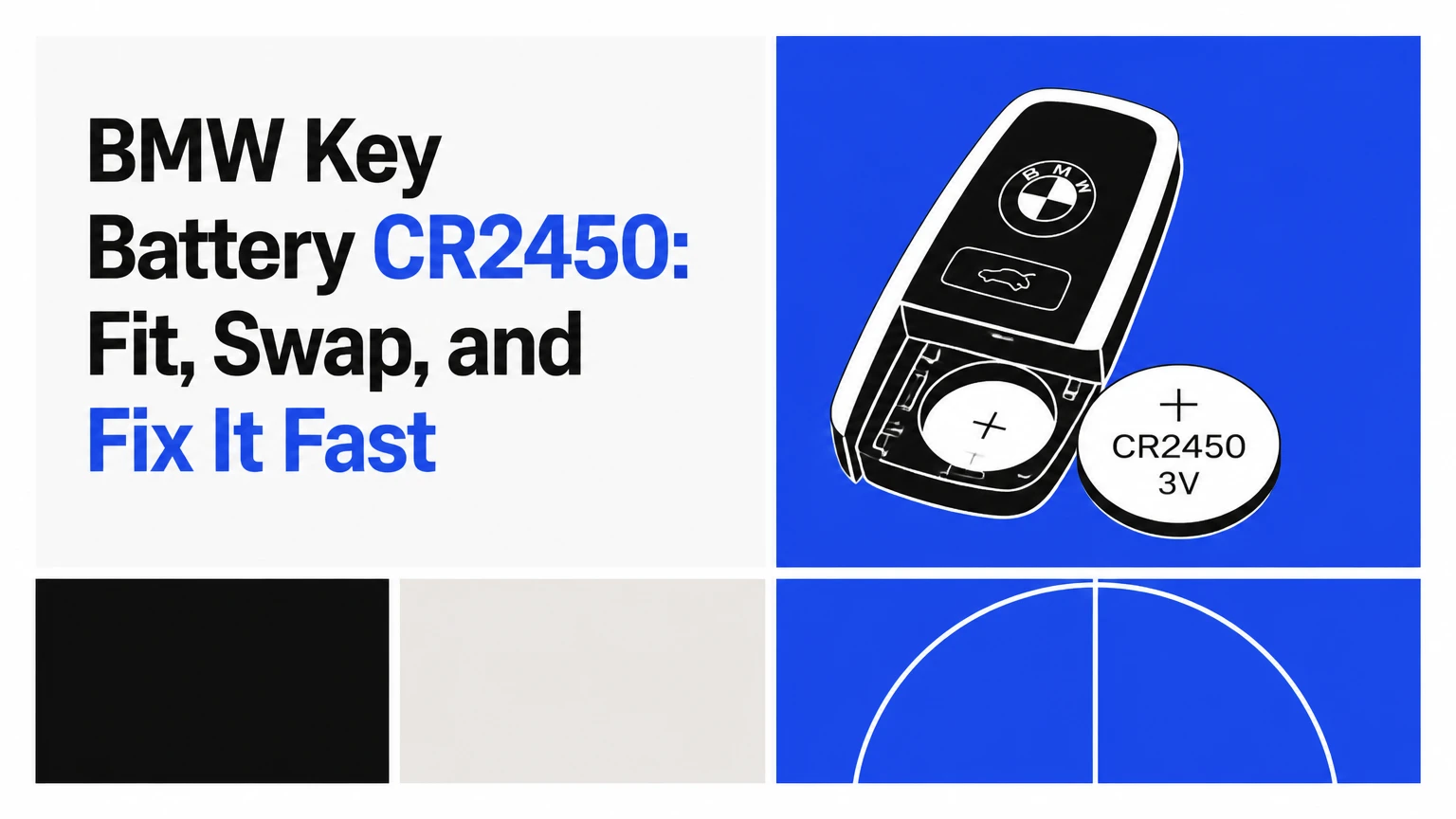
The BMW key battery CR2450 is a 3-volt lithium coin cell used in certain BMW remote keys, especially fobs with Comfort Access. Replace it by removing the mechanical key, opening the rear cover, installing the cell with the positive side outward, and testing the buttons and passive entry. Confirm the marking and battery-holder shape on your exact fob before buying.
Key Facts at a Glance
A CR2450 has a nominal voltage of 3.0 volts and measures approximately 24.5 mm wide by 5.0 mm thick.
The correct BMW replacement battery is determined by the fob’s existing cell and holder, not by the BMW badge or model name alone.
Most replaceable BMW fobs do not need programming after a battery-only change.
A typical replacement takes 2-5 minutes and costs about $3-$8 for a quality multi-pack.
CR2450 and CR2450N are not automatically interchangeable because the terminal profile can differ.
A dead remote battery usually does not prevent emergency starting when the key is placed at BMW’s backup detection point.
What Is the BMW Key Battery CR2450?
The BMW key battery CR2450 is a round, non-rechargeable lithium-manganese-dioxide coin cell with 3.0 volts nominal output. The “24” identifies the approximate 24.5 mm diameter, while “50” identifies an approximately 5.0 mm thickness; the cell is physically thicker and usually higher-capacity than a CR2032.
The cell powers the fob’s radio transmitter, buttons, indicator electronics, and, on compatible Comfort Access keys, proximity-related functions. BMW fob architecture differs across generations, so a CR2450 is not a universal replacement for every BMW key. A 2009-2018 vehicle range may contain different key designs depending on market, equipment, and replacement-key history.
The most reliable identification method is simple: remove the existing cell or inspect its printed marking before ordering. A VIN lookup from a BMW dealer or parts catalog can confirm the original part, but the physical marking inside the fob remains the final check when a previous owner has replaced the key or housing.
Why Does BMW Use a CR2450 Instead of a CR2032?
A BMW key uses a CR2450 when its electronic design and battery holder require the larger cell’s dimensions and available energy. The CR2450 is approximately 2.5 mm thicker than a CR2032 and commonly has a manufacturer-rated capacity around 500-620 mAh, compared with roughly 200-240 mAh for many CR2032 cells.
Comfort Access can increase consumption because the key participates in proximity detection rather than transmitting only after a button press. Actual battery life depends on how often the key is near the car, how frequently the buttons are pressed, temperature, cell quality, and the fob’s standby current.
The larger capacity does not mean every CR2450 lasts a fixed number of years. A typical lifespan is about 1.5-3 years for regular use, although a key kept close to the vehicle constantly may drain sooner. A CR2032 is not a safe substitute merely because both cells are 3-volt lithium batteries. Its smaller thickness can create unreliable contact, and forcing a thicker cell into the wrong housing can damage the cover or terminals.
CR2450 specifications that matter
| Attribute | CR2450 value | Practical BMW meaning |
|---|---|---|
| Chemistry | Lithium manganese dioxide, Li-MnO₂ | Non-rechargeable primary cell |
| Nominal voltage | 3.0 V | Matches the intended coin-cell circuit |
| Typical open-circuit reading | About 3.1-3.3 V | A meter reading alone does not prove load performance |
| Diameter | Approximately 24.5 mm | Must fit the circular holder |
| Thickness | Approximately 5.0 mm | Determines cover clearance and terminal pressure |
| Typical capacity | About 500-620 mAh | Varies by manufacturer and discharge test |
| Operating limitation | Reduced output in severe cold | Range and Comfort Access can decline temporarily |
| Battery type | Primary, not rechargeable | Never connect to a charger |
Manufacturer capacity figures are not directly interchangeable because Panasonic, Energizer, Renata, VARTA, and Duracell can use different discharge currents and cutoff voltages. Compare the cell’s dimensions, expiration date, packaging integrity, and manufacturer specification rather than choosing solely by the largest mAh number.
Before You Start: Confirm the Fob and Gather Tools
Before changing a BMW key battery, allow 5 minutes, prepare one new cell, and use the mechanical key or a plastic pry tool. The only prerequisite is access to the fob and a replacement with the same printed designation and terminal profile. A small flat screwdriver is optional, but a sharp blade is a poor choice because it can gouge the housing or slip into the circuit board.
| Preparation item | Required amount | Typical value or specification |
|---|---|---|
| Replacement battery | 1 | CR2450, 3.0 V lithium, in-date |
| Mechanical key | 1 | Built into the BMW fob |
| Plastic pick | 1 | Preferred tool, 1-2 mm tip |
| Small flat screwdriver | 1 | Optional, 2-3 mm tip |
| Clean work surface | 1 | Dry, well-lit area |
| Estimated time | 1 job | 2-5 minutes |
| Typical DIY cost | 1 cell | $3-$8 for a branded multi-pack |
Check the fob before opening it. Look for a battery door, a seam around the rear panel, and the silver release button that frees the emergency key. Some BMW keys use a removable cover, while other designs are sealed or have a different service procedure. Do not assume that a CR2450 fits because an online listing says “BMW compatible.”
Work away from loose metal objects. Coin cells can discharge rapidly if their positive and negative surfaces bridge through keys, tools, or a metal table. Energizer’s lithium coin-cell safety guidance states, “Do not recharge, crush, disassemble, heat above 100°C or incinerate,” which applies to a BMW key battery as well.
How Do You Replace a BMW Key Battery CR2450?
Replacing a BMW key battery CR2450 normally requires five actions: remove the mechanical key, release the rear cover, take out the old cell, install the new cell with correct polarity, and test the fob. The physical holder profile determines success more than the tool used, because a wrong-size or wrong-profile battery can prevent reliable contact.
Step 1: Remove the mechanical key
Press the small release button on the side or rear of the BMW fob, then pull the internal metal emergency key completely out. The key slot often exposes the notch needed to separate the rear cover.
Success checkpoint: The metal key is fully removed, and the slot or recess is visible.
Common mistake: Pulling on the cover before releasing the mechanical key can leave the panel locked in place. Do not twist the metal key as a lever at this stage.
Step 2: Open the rear cover
Insert the tip of the mechanical key into the release notch exposed inside the empty key slot. Twist gently but firmly to lift the battery cover. If the notch is tight, use a plastic pick or a 2-3 mm flat screwdriver with the tip covered by thin tape.
Success checkpoint: The rear battery panel separates along its seam without bending or cracking.
Common mistake: Inserting the tool deep into the housing can contact the circuit board or battery terminals. Pry only at the molded notch, and use several small movements instead of one aggressive twist.
Step 3: Remove the old coin cell
Identify the retaining lip and metal contact points before lifting the old battery. Pry from the accessible edge with a fingernail or plastic pick, keeping the tool away from the spring contacts.
Success checkpoint: The old cell comes out without a bent terminal, broken plastic lip, or scraped circuit board.
Common mistake: Levering directly against a contact tab can flatten it. A flattened tab may produce intermittent operation even with a new cell.
Place the old battery in a non-metal container while working. Do not stack loose coin cells together, and do not carry them in a pocket with keys.
Step 4: Install the new CR2450
Orient the replacement so the positive “+” side faces outward or upward, unless the markings inside your specific fob state otherwise. Slide one edge under the plastic retaining lip first, then press the opposite edge down until the cell is held firmly.
Success checkpoint: The cell sits flat, the cover has clearance, and the battery cannot rattle when the fob is moved.
Common mistake: Installing the cell upside down can stop every function immediately. Forcing a CR2450N into a holder designed for a flat-edge cell can also distort the terminal.
Handle the cell by its edge. Fingerprints do not automatically destroy a lithium coin cell, but clean, dry handling reduces contamination on low-pressure contacts. Never solder directly to a standard consumer coin cell.
Step 5: Close the housing and test the key
Align the cover’s upper tabs first, then press the panel down around its perimeter until every clip engages. Reinsert the mechanical key and test lock, unlock, trunk, panic, and any Comfort Access function fitted to the vehicle.
Success checkpoint: The cover is flush, buttons feel normal, and the car responds from several metres away.
Common mistake: Testing only one button can hide a weak contact or a damaged switch. Test the remote functions, passive entry, and starting backup separately.
Which CR2450 Variant Fits a BMW Key?
The correct variant is the one whose marking, diameter, thickness, and terminal shape match the original BMW holder. Standard CR2450 cells have a conventional flat perimeter, while some CR2450N cells have a stepped or modified edge; the suffix is not a universal BMW compatibility code and does not prove that a cell is electrically superior.
The AI Overview claim that standard cells fit a fixed percentage of BMW fobs is not dependable. BMW has used multiple fob suppliers and housing designs, and aftermarket replacement housings can change the holder shape. Renata, Panasonic, VARTA, Energizer, Sony, and Duracell products can differ in terminal geometry, coating, packaging, and specified discharge performance even when the basic CR2450 designation matches.
| Battery option | Nominal voltage | Approximate thickness | BMW fitment decision |
|---|---|---|---|
| Standard CR2450 | 3.0 V | 5.0 mm | Use when the original cell and holder have a flat profile |
| CR2450N | 3.0 V | About 5.0 mm | Use only when the holder is shaped for its stepped edge |
| CR2450HR | Usually 3.0 V | Approximately 5.0 mm | Confirm the manufacturer drawing before purchase |
| CR2032 | 3.0 V | 3.2 mm | Not a direct mechanical substitute for CR2450 |
| Rechargeable LIR2450 | About 3.6 V | Similar nominal size | Do not use in a CR2450 circuit |
“HR” commonly identifies a high-temperature or industrial construction in a manufacturer’s catalog, but the label does not make a cell universally backward-compatible with BMW fobs. A specialist cell still must match the holder, voltage, terminal arrangement, and safety requirements.
Standard CR2450 versus CR2450N
A standard CR2450 is the safer choice when the original battery is marked only CR2450 and the holder accepts a flat-edge cell. A CR2450N should be selected when the old cell carries the N suffix or the holder visibly includes the matching step.
Do not file, bend, or compress either version to make it fit. A battery that requires force is the wrong battery, even if the cover eventually closes. The immediate risk is poor contact; the longer-term risk is a terminal that no longer presses against any replacement cell.
How Much Does a BMW Key Battery Cost and How Long Does It Last?
A DIY BMW CR2450 replacement typically costs $3-$8 for a branded multi-pack and takes 2-5 minutes. A dealer or locksmith may charge about $20-$50 when installation, inspection, or a broader key-service visit is included. Battery life commonly falls between 1.5 and 3 years, but Comfort Access usage and storage conditions can move the result outside that range.
| Replacement route | Typical cost | Typical time | Best use case |
|---|---|---|---|
| Branded multi-pack | $3-$8 | 2-5 minutes | Routine home replacement |
| Single retail cell | $2-$6 | 2-5 minutes | Immediate local purchase |
| Independent locksmith | $10-$30 | 5-15 minutes | Damaged cover or uncertain fit |
| BMW dealer parts counter | $5-$15 for cell | 5-20 minutes | OEM identification assistance |
| Dealer service visit | $20-$50 | 15-45 minutes | Battery plus key inspection |
Battery longevity depends on proximity behavior more than button use alone. A Comfort Access key stored near the garage door, vehicle, or exterior wall can communicate more often than a key kept farther away. If two keys are used equally, replace only the depleted cell in the affected fob and record the date for comparison.
Does a BMW Key Need Programming After Battery Replacement?
A BMW key does not normally need programming after replacing only its battery because the immobilizer identity and remote pairing data remain stored in the key electronics. Programming becomes relevant when a new key is cut, a lost key is replaced, or the vehicle and fob have lost synchronization for a separate reason.
If the buttons do not work after installation, first check polarity, cell profile, seating, and terminal pressure. Do not begin with a coding procedure. A battery swap cannot repair a failed tactile switch, water-damaged circuit board, cracked solder joint, or depleted replacement cell.
Some older BMW remotes have a manual initialization sequence, but the sequence varies by generation and market. Follow the owner’s manual for the exact vehicle rather than applying a generic ignition-and-button routine to a Comfort Access fob.
Why Does the BMW Key Battery Warning Remain?
A persistent “Key battery empty” warning usually indicates a weak cell, poor contact, incorrect battery orientation, or a vehicle status message that has not yet updated. Drive and use the key normally after replacement, then inspect the cell again if the warning remains after several lock and unlock cycles.
Use this diagnostic order:
- Confirm the printed marking is CR2450 or the exact original variant.
- Check that the positive side faces outward.
- Install a fresh cell from a sealed, in-date package.
- Inspect the holder for flattened or contaminated contacts.
- Test the second key to distinguish a vehicle issue from a fob issue.
- Check remote range outdoors, away from strong radio interference.
- Seek BMW diagnostic help if the warning persists with two known-good cells.
A multimeter reading near 3.2 volts is useful but incomplete. Coin cells can show normal open-circuit voltage while failing under the fob’s current demand, especially after storage in heat or after a long period of intermittent contact.
Can You Start a BMW With a Dead Key Battery?
A BMW can usually be started with a dead remote battery by placing the fob at the vehicle’s designated backup detection point and pressing the brake or clutch with the Start/Stop button. The passive immobilizer function and the remote battery are separate systems, but the exact backup location varies by BMW generation.
Common locations include a marked area near the steering column, a recess in the center console, or a specific position identified in the owner’s manual. Hold the entire key against the marked symbol rather than presenting only its logo. If the vehicle still does not recognize the key, try the spare key and check whether the vehicle battery is also discharged.
A dead fob battery can disable remote locking and passive entry while leaving emergency starting available. That distinction prevents an unnecessary tow when the vehicle’s main battery and immobilizer system are functioning.
What Mistakes Damage a BMW Key Fob?
The most expensive mistakes involve the housing and terminal contacts, not the coin cell itself. A wrong-profile battery, deep screwdriver insertion, bent contact, or forced cover can turn a two-minute replacement into a housing or electronics repair.
Mistake 1: Choosing by vehicle model alone
A BMW 3 Series, X5, or 5 Series can have multiple key designs across years and equipment levels. Read the old cell, inspect the holder, or verify through a BMW parts department using the VIN.
Mistake 2: Substituting a CR2032
A CR2032 is thinner and has lower typical capacity. It may sit loosely, lose contact during movement, or fail to power a holder designed for the thicker CR2450.
Mistake 3: Treating bitter coating as an automatic failure
Some child-resistant coin cells use a bitter coating. The coating is not proof that the battery is electrically unusable, but residue on the contact face can interfere with a low-pressure holder. Follow the battery manufacturer’s handling guidance rather than scraping or aggressively wiping the cell.
Mistake 4: Buying old or counterfeit stock
A low price is not useful if the cell has been stored for years or has unclear packaging. Buy sealed cells from a reputable retailer, check the expiration or production information where provided, and avoid loose batteries without traceable branding.
Mistake 5: Mixing cells
Never place two coin cells together in a BMW key or combine a partly used cell with a new one. The fob requires one correctly seated primary cell.
How Do Heat, Cold, and Storage Affect the Cell?
High cabin heat accelerates aging, while severe cold temporarily reduces the current available from a lithium coin cell. A key left on a dashboard, in direct summer sun, or outside overnight in sub-zero weather may show shorter range or intermittent Comfort Access even when the cell is not fully depleted.
Store spare CR2450 cells in their original package at normal indoor temperature, away from moisture and metal objects. Do not freeze them, heat them, puncture them, or leave them loose in a vehicle. An industrial or high-temperature variant may be useful in specialized equipment, but it does not remove the need to match BMW’s holder and electrical requirements.
Cold-weather symptoms often improve when the key warms. If the same symptom appears indoors with a fresh cell, inspect contacts and housing damage instead of assuming temperature is the cause.
How Should You Dispose of the Old BMW Coin Cell?
Recycle the old lithium coin cell through a local battery-recycling program, household hazardous-waste facility, or retailer that accepts small batteries. Cover the positive and negative faces with non-conductive tape before transport, especially when several loose cells are being collected.
Do not place loose lithium coin cells in household recycling or incinerate them. Keep them away from children and pets because swallowed button and coin batteries can cause severe internal injury. The U.S. Consumer Product Safety Commission and local waste authorities provide current disposal guidance by jurisdiction, so follow local rules rather than relying on a general bin label.
FAQ
Can I use any brand of CR2450 in a BMW key?
You can use a reputable brand when the cell is a genuine CR2450, has a 3.0-volt nominal rating, and matches the original holder profile. Panasonic, Energizer, Renata, VARTA, Sony, and Duracell cells may all be suitable, but brand compatibility is not a substitute for checking dimensions, polarity, packaging, and the fob’s terminal shape.
Why does my BMW key work only near the car?
A BMW key that works only at short range usually has a weak cell, poor contact, radio interference, or a damaged antenna. Install a fresh correctly oriented battery first, then test outdoors with the key away from a phone, metal case, and other transmitters. If range remains poor, the fob may need electronic inspection.
Will replacing the battery erase my BMW key?
Replacing the battery should not erase the BMW key’s immobilizer identity or vehicle pairing because those data remain in nonvolatile electronics. If the key stops working after the change, inspect polarity and contacts before attempting initialization. A genuinely lost pairing or failed circuit requires model-specific diagnosis.
Should I replace the battery in both BMW keys?
Replace the second BMW key battery only if it shows similar age, reduced range, or a warning. Proactively changing both cells can be sensible when both were purchased and used at the same time, but a key stored separately may have substantially more remaining capacity.
What if the BMW key cover will not snap shut?
A cover that will not close usually indicates the wrong thickness, an incorrectly seated cell, a displaced retaining tab, or a swollen or damaged housing. Remove the battery, compare it with the original, inspect the plastic lip, and never force the cover. A forced panel can crack clips or press against the circuit board.
Is a rechargeable LIR2450 a replacement for CR2450?
A rechargeable LIR2450 is not a direct replacement for a CR2450 because its nominal voltage is typically about 3.6 volts rather than 3.0 volts. The higher voltage and different charging requirements can damage electronics or create a safety hazard. Use the non-rechargeable CR2450 specification required by the BMW fob.
The Bottom Line
The BMW key battery CR2450 is the correct replacement only when the existing fob and holder call for that 24.5 mm by 5.0 mm, 3.0-volt lithium cell. Confirm the exact marking, use the matching standard or stepped profile, install the positive side outward, and test every function before discarding the old battery. A careful DIY replacement normally costs $3-$8 and takes less than five minutes.