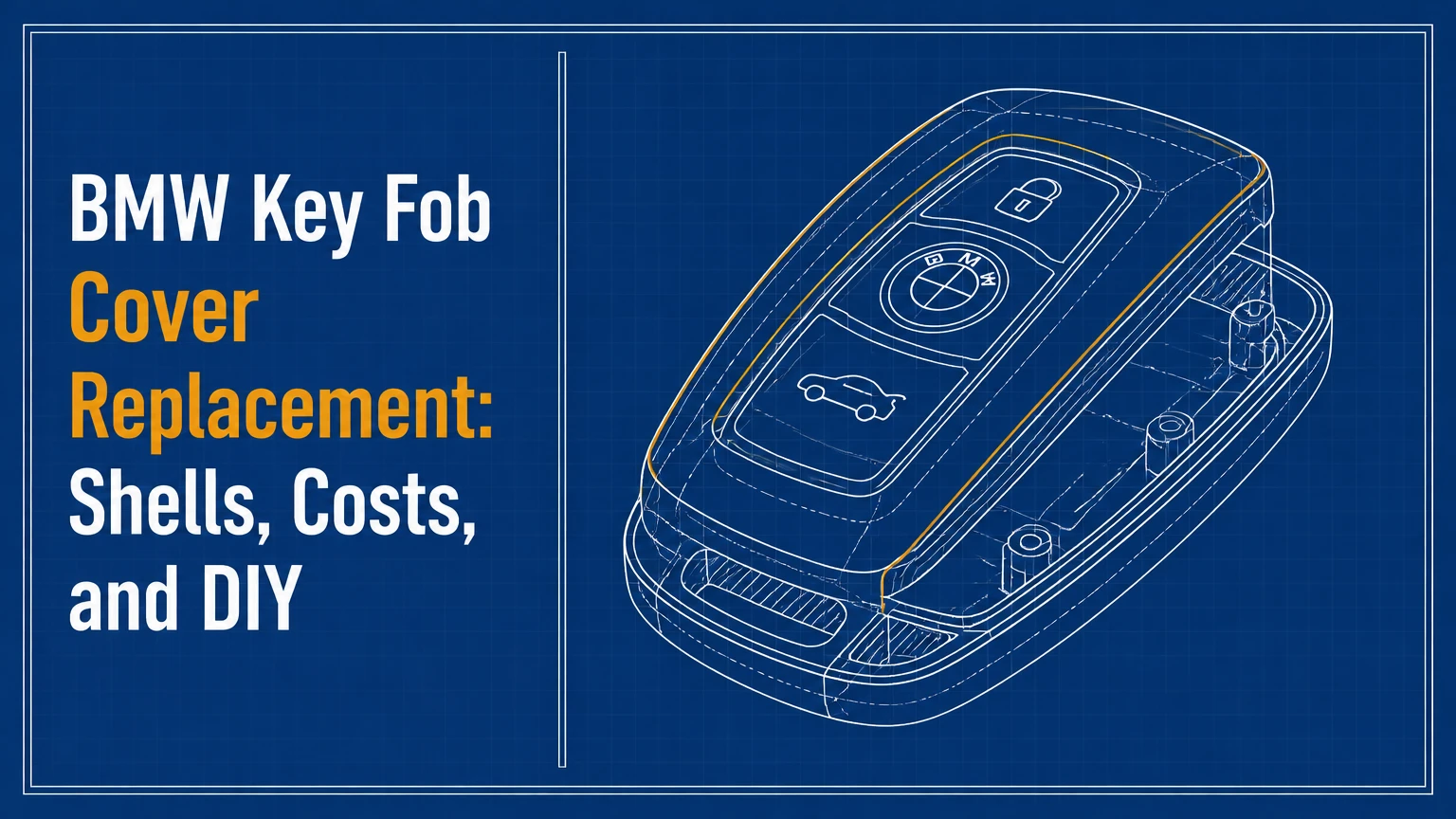
BMW key fob cover replacement usually means either fitting a protective sleeve over an intact remote or transferring the electronics into a replacement housing. A sleeve takes less than a minute, while a shell swap typically takes 10-30 minutes. Neither requires programming when the original PCB and immobilizer components remain intact.
Key Facts at a Glance
- A silicone or TPU cover protects an intact BMW remote without opening the key.
- A replacement shell restores cracked plastic, worn buttons, and damaged outer housing.
- A shell swap normally preserves the original coding because the vehicle electronics stay unchanged.
- BMW key shapes differ by chassis generation, button layout, battery access, and emergency-blade design.
- A metal housing can reduce Comfort Access range if it shields the antenna.
- Older BMW keys may contain a separate immobilizer transponder that must remain with the original electronics.
What Does BMW Key Fob Cover Replacement Mean?
BMW key fob cover replacement has two distinct meanings: an external protective case and a replacement shell. The external case slips over the factory remote, whereas the replacement shell requires the internal circuit board, buttons, battery, and immobilizer parts to move into a new housing.
A sleeve is the lower-risk choice when the original key still closes properly and its buttons work. It hides cosmetic wear, limits impact damage, and can be removed before a lease inspection. A shell is appropriate when the factory plastic has split, the button membrane has fallen out, or the key ring mount has broken.
The distinction matters because a sleeve cannot repair a broken hinge, missing button, or separated housing. A shell cannot repair a failed PCB, dead antenna, water-corroded circuit, or lost transponder. The shell changes the container, not the vehicle identity stored in the electronics.
BMW remote keys combine several components that perform different jobs:
- The PCB sends lock, unlock, trunk, and panic commands.
- The coin cell powers remote-locking and Comfort Access functions.
- The immobilizer transponder authorizes engine starting.
- The emergency blade opens the door if the battery or remote fails.
- The housing aligns buttons, battery contacts, blade storage, and antenna areas.
That separation explains why a cosmetic replacement usually does not need coding. The car continues communicating with the same original key electronics.
How Do You Match the Correct BMW Key Shape?
Match a BMW replacement cover by physical shape, button layout, blade slot, battery door, and internal PCB cavity, not by the vehicle name alone. A cover advertised for “BMW 3 Series” can still be wrong because E90, F30, and G20 keys use different housings.
Check the following before ordering:
- Chassis and production period: Record the exact model, generation, and build year.
- Button count: Count lock, unlock, trunk, panic, and dedicated alarm buttons.
- Profile: Compare the key’s width, thickness, corners, chrome trim, and side contours.
- Emergency blade: Confirm whether the blade slides from the rear, side, or lower edge.
- Battery access: Identify a removable battery door or a permanently joined older shell.
- Markings: Photograph the rear label, FCC identifier, BMW part number, and key frequency where visible.
- PCB cavity: For a shell, compare internal posts and switch positions with the listing photographs.
Do not rely on a listing that only says “fits BMW X5.” X5 keys vary across E53, E70, F15, and G05 generations. The same warning applies to 3 Series, 5 Series, X3, and 7 Series vehicles.
BMW’s official owner information and BMW FAQ material are more reliable for emergency starting and key recognition than third-party marketplace descriptions. A product listing can identify an outward shape but cannot confirm immobilizer-chip placement or electronic compatibility.
Common BMW Key Families
| Key family | Typical examples | Identifying features | Replacement concern |
|---|---|---|---|
| Diamond-style E-series | E39, E46, E53, some E83 | Rounded diamond body, integrated blade, older glued case | Separate transponder and soldered battery may be present |
| F-series standard | F20, F30, F10, F25 | Slim rectangular body, removable rear battery panel | Internal posts and button pad must match |
| G-series standard | G20, G30, G05, G11 | Wider sculpted body, newer button layouts | Similar-looking shells may have different PCB cavities |
| BMW Display Key | Selected G-series vehicles | Touchscreen, large rectangular body, rechargeable battery | Requires screen protection or specialized display housing |
| BMW motorcycle-style remote | Selected Motorrad models | Compact motorcycle remote profile | Automotive covers generally do not fit |
The family labels are useful starting points, not purchasing proof. The physical key is the final reference.
Which Material Should You Choose?
TPU is the strongest all-purpose choice for most BMW owners because it combines low bulk, flexible impact protection, and better abrasion resistance than soft silicone. Silicone is cheaper and grippier, leather prioritizes appearance, and metal cases require an RF-range test before permanent use.
| Cover material | Typical price | Typical thickness or bulk | Best use | Main limitation |
|---|---|---|---|---|
| Silicone | $8-$15 | 1-2 mm added thickness | Drop protection and low cost | Collects lint and can retain moisture |
| TPU | $10-$25 | 1-2.5 mm added thickness | Daily use and scratch resistance | Harder fit can stress thin edges |
| Leather | $20-$50 | 2-4 mm added thickness | Interior-matching appearance | Buttons may feel less direct |
| Alcantara | $25-$60 | 2-3 mm added thickness | M Performance styling | Absorbs oils and needs careful cleaning |
| Carbon-fiber composite | $30-$80 | 2-4 mm added thickness | Rigid premium finish | Conductive or metal-backed designs may affect range |
| Zinc alloy or aluminum | $20-$60 | 3-6 mm added thickness | Maximum case rigidity | Can reduce RF and Comfort Access performance |
Silicone makes sense for a key that frequently falls from a workbench, driveway, or motorcycle pocket. TPU is easier to slide in and out of a trouser pocket and usually resists surface tearing better. Leather provides less impact cushioning because its protection depends on stitching, lining, and the amount of exposed shell.
Metal is the material that deserves the most caution. A metal enclosure can surround the antenna area and reduce the signal received by the vehicle, especially when the fob is inside a bag or pocket. Test the key with the case installed, then remove the case and repeat the same lock, unlock, and Comfort Access test from the same location.
A cover is not waterproof simply because the material itself does not absorb water. Openings around buttons, seams, and the emergency blade can admit moisture. A sleeve also traps condensation against a dirty key, so remove it monthly and wipe both surfaces dry.
How Does a Shell Swap Work?
A BMW shell swap transfers the original remote electronics into a new housing, so the vehicle generally continues recognizing the same key. The process changes the plastic enclosure, not the key’s immobilizer identity, provided the original PCB and transponder remain undamaged and correctly positioned.
A standard modern shell contains no new coding data. The replacement may include a blank emergency blade, rubber button pad, battery contacts, and front and rear plastic halves, but those parts do not automatically become a programmed BMW key.
The PCB must align with the new case’s guides. If the rubber membrane sits even slightly off-center, the external button can press beside the micro-switch rather than on it. The result may be a stiff button, intermittent locking, or a button that remains pressed continuously.
The immobilizer transponder is a separate concern. Some older BMW designs use a discrete chip that can remain in an old shell or sit in a small recess near the blade area. Before discarding the damaged case, inspect every cavity and compare the new housing with the old one under bright light.
A new complete fob is different. It may require vehicle-specific initialization, immobilizer matching, or dealer or locksmith programming. BMW’s process varies by vehicle generation and market, so a shell replacement should never be confused with ordering another active key.
How Do You Replace a BMW Key Shell?
Replace a BMW key shell by removing the emergency blade, opening the battery area, separating the housing, transferring the PCB and transponder, and testing every function before final closure. Set aside 15-30 minutes for a modern key and stop if the case is welded, heavily glued, or the PCB begins flexing.
Before You Start
| Requirement | Typical specification |
|---|---|
| Time | 15-30 minutes for F-series or G-series shells |
| Difficulty | Moderate, with high risk if the old case is glued |
| Tools | Plastic pry pick, 1 small flat plastic tool, lint-free cloth |
| Battery | CR2032 or CR2450 only if the existing type matches |
| Work area | Clean table, bright light, 20-25 cm clear workspace |
| Prerequisite | Correct shell with matching button layout and PCB cavity |
Do not use a kitchen knife or large screwdriver as the primary pry tool. A sharp metal edge can cut antenna traces, lift surface components, or puncture a battery.
Step 1: Remove the Emergency Blade
Press the release button and slide the mechanical blade from the fob. Place the blade beside the new shell instead of leaving it on the work surface where it can be mistaken for the replacement blade.
You will know it worked when the blade separates without cracking the rear latch. The common mistake is pulling at an angle, which can damage the retaining spring or distort the slot.
Step 2: Open the Battery Compartment
Use the blade or a plastic pick at the manufacturer-provided opening. Lift the battery cover gradually around the edge rather than twisting one corner sharply.
Record the battery orientation before removal. Most BMW coin-cell arrangements place the positive side toward the marked face, but the correct orientation is determined by the contacts in that specific fob.
Step 3: Remove and Inspect the Battery
Lift out the CR2032 or CR2450 with a plastic tool. Inspect the contacts for white residue, green corrosion, or a loose spring.
A battery below its normal operating voltage can create symptoms that look like shell damage, including short remote range and failed Comfort Access. If the battery is more than two or three years old, replacing it during the shell swap is practical, but use the same specified size.
Step 4: Separate the Old Housing
Work around the seam with a plastic pick. Open a few millimeters at a time and keep the tool shallow so it does not reach the PCB or antenna path.
Some E-series diamond keys are bonded rather than clipped. A bonded shell may require careful cutting around the perimeter, and the old housing is often sacrificed. The PCB is the valuable part, not the damaged plastic.
Step 5: Transfer the PCB and Transponder
Lift the PCB by its edges with clean, dry hands. Do not press on the micro-switches, antenna components, crystal, or battery contacts.
Compare the old and replacement interiors before placing the board. Move any loose rubber button pad, transponder chip, blade insert, or contact plate individually, and photograph the arrangement if several small parts are present.
You will know the transfer is correct when the PCB lies flat without pressure and every switch is centered under its matching button. The common mistake is forcing a board into a shell with different internal posts.
Step 6: Close the New Shell
Install the front button pad, PCB, battery, and rear cover in the order required by the shell design. Press the halves together evenly until each clip engages.
Do not add household glue. Adhesive can migrate onto switches, prevent future battery access, and make a later repair more destructive. If the new halves do not close without force, the PCB, pad, battery contact, or blade carrier is probably misaligned.
Step 7: Test Before Final Handling
Test lock, unlock, trunk release, panic or alarm functions, remote range, Comfort Access, and engine starting where applicable. Test the emergency blade in the door before relying on the new housing.
You will know the shell swap worked when the buttons have consistent travel, the vehicle responds at the former distance, and the engine recognizes the key normally. A shell swap should not create a new need for programming.
How Much Does Replacement Cost?
A BMW protective cover typically costs $8-$60, a replacement shell costs $12-$40, and a professional shell transfer commonly costs $40-$100. A complete dealer-supplied key can cost $300-$800 or more, depending on the BMW model, market, key type, programming, and inventory.
| Replacement route | Typical parts cost | Typical labor or total | Typical time |
|---|---|---|---|
| Silicone sleeve | $8-$15 | $8-$15 total | Under 1 minute |
| TPU or leather case | $10-$60 | $10-$60 total | 1-5 minutes |
| DIY replacement shell | $12-$40 | $12-$40 total | 15-30 minutes |
| Automotive locksmith shell transfer | $20-$50 parts | $40-$100 total | 20-45 minutes |
| BMW dealer complete fob | $250-$600 parts | $300-$800 total | 1-3 days |
| Dealer or locksmith programming | $50-$200 added | $350-$1,000 with key | 30 minutes to several days |
Prices are typical US consumer ranges, not fixed BMW pricing. A Display Key, unusual older key, lost-key situation, or immobilizer diagnosis can exceed these amounts.
The cheapest option is not always the lowest-risk option. A $15 shell that requires cutting a glued E-series case may create a $300 electronics problem if the PCB or transponder is damaged. Pay for locksmith labor when the original housing is bonded, the key starts the vehicle intermittently, or only one working key remains.
What Can Go Wrong With Metal Cases?
Metal BMW key cases can reduce radio-frequency performance when the enclosure surrounds the fob antenna. The fastest diagnosis is to remove the case and compare lock, unlock, and Comfort Access range from the same position.
| Symptom | Likely cause | First test | Corrective action |
|---|---|---|---|
| Remote works only nearby | Metal case shielding or weak battery | Remove case, test at 5-10 m | Use TPU, silicone, or an antenna-clear case |
| Comfort Access fails | RF attenuation or misaligned PCB | Touch handle with case removed | Replace case and install a fresh battery |
| Buttons feel hard | Misaligned membrane | Open housing and inspect pad | Center pad over each switch |
| Engine will not start | Transponder displaced or shielded | Hold key at marked steering-column area | Re-seat chip or remove metal housing |
| Trunk button does nothing | Wrong button pad or PCB position | Compare pad and switch locations | Fit the correct shell generation |
| Key opens but will not close | Battery or PCB obstructing clips | Reopen without force | Remove obstruction and reassemble |
A metal case that improves drop resistance but prevents reliable passive entry is a poor fit for a Comfort Access vehicle. Signal problems can also be intermittent, which makes them easy to misdiagnose as a failing car antenna.
Why Does the BMW Not Recognize the Key?
A BMW may fail to recognize a key after a shell transfer because the immobilizer transponder moved out of position, the battery is incorrect, the PCB is damaged, or a metal housing is shielding the signal. Hold the key against the vehicle’s designated key-recognition area and retry the start procedure described in the owner’s manual.
Use this diagnosis order:
- Remove any metal cover or decorative insert.
- Confirm the coin-cell type and polarity.
- Check that the PCB is fully seated and not flexed.
- Inspect the transponder recess in the old and new shells.
- Try the spare key to separate vehicle faults from fob faults.
- Test starting at the BMW-marked recognition location.
- Seek professional diagnosis if both keys fail.
A remote-locking failure and an engine-start failure are not identical. The remote uses battery-powered radio functions, while the immobilizer system can use a passive transponder. A key may unlock the vehicle but still fail authorization if the transponder is missing or damaged.
BMW’s official FAQ guidance for an unrecognized key directs owners toward the vehicle’s marked key-recognition area and the owner’s manual procedure. That guidance is more useful than repeatedly pressing the lock button, because remote synchronization does not replace a missing immobilizer component.
Which Mistakes Damage BMW Keys?
The most expensive BMW key-cover mistakes involve buying the wrong generation, prying into the PCB, discarding a separate transponder, and sealing moisture or debris inside a new case. Avoiding those errors matters more than choosing a premium material.
- Ordering by model name only: Verify the physical profile, button count, and PCB cavity.
- Using a sharp steel tool: Start with a plastic pick and keep it away from the board.
- Forcing a bonded E-series case: Use a locksmith when the seam does not separate cleanly.
- Discarding the old shell immediately: Search for a loose transponder, blade carrier, and contact parts.
- Installing the battery backward: Confirm polarity from the actual contact design.
- Closing over a displaced rubber pad: Center every button before snapping the halves together.
- Adding glue to a clipped case: Glue complicates battery service and contaminates electronics.
- Leaving dirt under a sleeve: Remove the cover periodically to prevent abrasion and trapped moisture.
One practitioner rule is worth remembering: if a shell does not close with light, even pressure, do not increase the pressure. Plastic clips are signaling that a component is out of position.
What Are the Alternatives for a Damaged Fob?
A BMW owner has four practical alternatives to a shell swap: use a protective sleeve, refurbish the original housing, buy a complete programmed key, or have a locksmith diagnose and rebuild the existing remote. The correct choice depends on whether the electronics, transponder, and buttons still function.
| Condition | Best alternative | Typical cost | Why |
|---|---|---|---|
| Scratches only | TPU or silicone sleeve | $8-$25 | No opening or programming required |
| Cracked shell, working key | Replacement housing | $12-$100 | Preserves original coding |
| Broken buttons, clean PCB | Shell plus new pad | $20-$120 | Restores physical actuation |
| Water-corroded PCB | Locksmith or electronics repair | $75-$250 | Housing alone will not restore circuitry |
| Lost only key | Dealer or qualified locksmith | $350-$1,000 | New key authorization may be required |
| Display Key screen damage | Specialist repair or case | $50-$300 | Standard shells do not fit the touchscreen design |
A complete replacement is necessary when the original PCB is dead, the immobilizer chip is lost, or no usable key remains. A cover is insufficient for water damage because it protects the outside while corrosion continues inside.
When Should You Use a Locksmith or Dealer?
Use a locksmith for a difficult shell transfer, damaged electronics, or an urgent replacement, and use a BMW dealer when the key is lost, no functioning key remains, or vehicle-specific authorization is required. A dealer is not automatically necessary for a cosmetic housing swap.
Choose DIY when the key is a modern clipped shell, the spare key works, the replacement has verified dimensions, and you can work carefully. Choose a locksmith when the key is an older glued design, a transponder may be separate, or the shell must be cut open.
Ask a locksmith whether the quoted price covers only housing transfer or also diagnostics, battery replacement, blade cutting, and programming. Ask a dealer whether the estimate includes the complete key, coding, taxes, and delivery time.
A professional cannot make an incompatible shell compatible through programming. Programming addresses electronic identity, while a poor shell fit remains a mechanical problem.
How Do You Protect the New Housing?
Protect the new BMW housing by keeping the key away from loose metal objects, removing the cover for monthly cleaning, and checking the battery door and blade latch every few months. A cover reduces impact and abrasion, but it cannot compensate for a loose key ring or a cracked internal clip.
Use a closed split ring or low-load tether instead of attaching heavy tools to the fob. Repeated side loading can break the key-ring mount even when the outer shell appears intact.
For leather or Alcantara, use a dry microfiber cloth and avoid saturating the material. For silicone and TPU, remove the cover, clean both surfaces with mild soapy water, and dry them fully before refitting.
Do not store the fob against a smartphone charger, strong magnet, or hot dashboard for long periods. Heat accelerates battery degradation, while pressure and contamination increase the chance of button or seam damage.
FAQ
Does a BMW key fob cover need programming?
A slip-on cover never needs programming. A replacement shell normally needs no programming when the original PCB and immobilizer transponder move into the new housing unchanged. Programming may be necessary only when replacing the complete electronic key, adding a new key, or repairing a failed identity component.
How do I know whether my BMW key uses a CR2032 or CR2450?
Open the battery compartment and read the marking on the installed coin cell, then compare its diameter and thickness with the replacement specification. Do not assume every BMW key uses CR2032. Installing the wrong thickness can prevent the cover from closing or damage the battery contacts.
Can I wash a silicone BMW key cover?
Remove the silicone cover from the fob before washing it. Clean the cover with mild soap and water, rinse away residue, and dry it completely before reinstalling. Water trapped between the sleeve and key can promote corrosion around button openings and battery seams.
Will a BMW shell replacement include a cut emergency blade?
Many aftermarket shells include a blank blade, but the blade may require cutting to match the vehicle door lock. Some products exclude the blade entirely. Confirm whether the listing includes a blank, cut, or reusable blade before ordering.
Why does my replacement key case fit but the buttons do not work?
The replacement case may have a different PCB cavity, button pad, or micro-switch alignment despite matching the external shape. Reopen it and check that the pad is centered, the board lies flat, and the battery contacts are not lifting the PCB. If the old shell works, reinstall it to isolate the new case.
Is a BMW Display Key compatible with a normal TPU cover?
A BMW Display Key requires a case designed around its touchscreen, charging arrangement, dimensions, and side controls. A standard F-series or G-series TPU cover will not protect the display correctly and may obstruct charging or touch input.
The Bottom Line
BMW key fob cover replacement is usually a low-cost cosmetic repair, but the correct method depends on the damage. Use silicone or TPU for protection, a verified replacement shell for broken plastic, and a locksmith or dealer when the PCB, transponder, or complete key must be replaced.
For a shell transfer, identify the exact BMW key generation, preserve every electronic and transponder component, avoid metal cases that reduce RF performance, and test all functions before discarding the old housing. The safest replacement is the one that matches the physical key precisely while leaving the original coded electronics undisturbed.