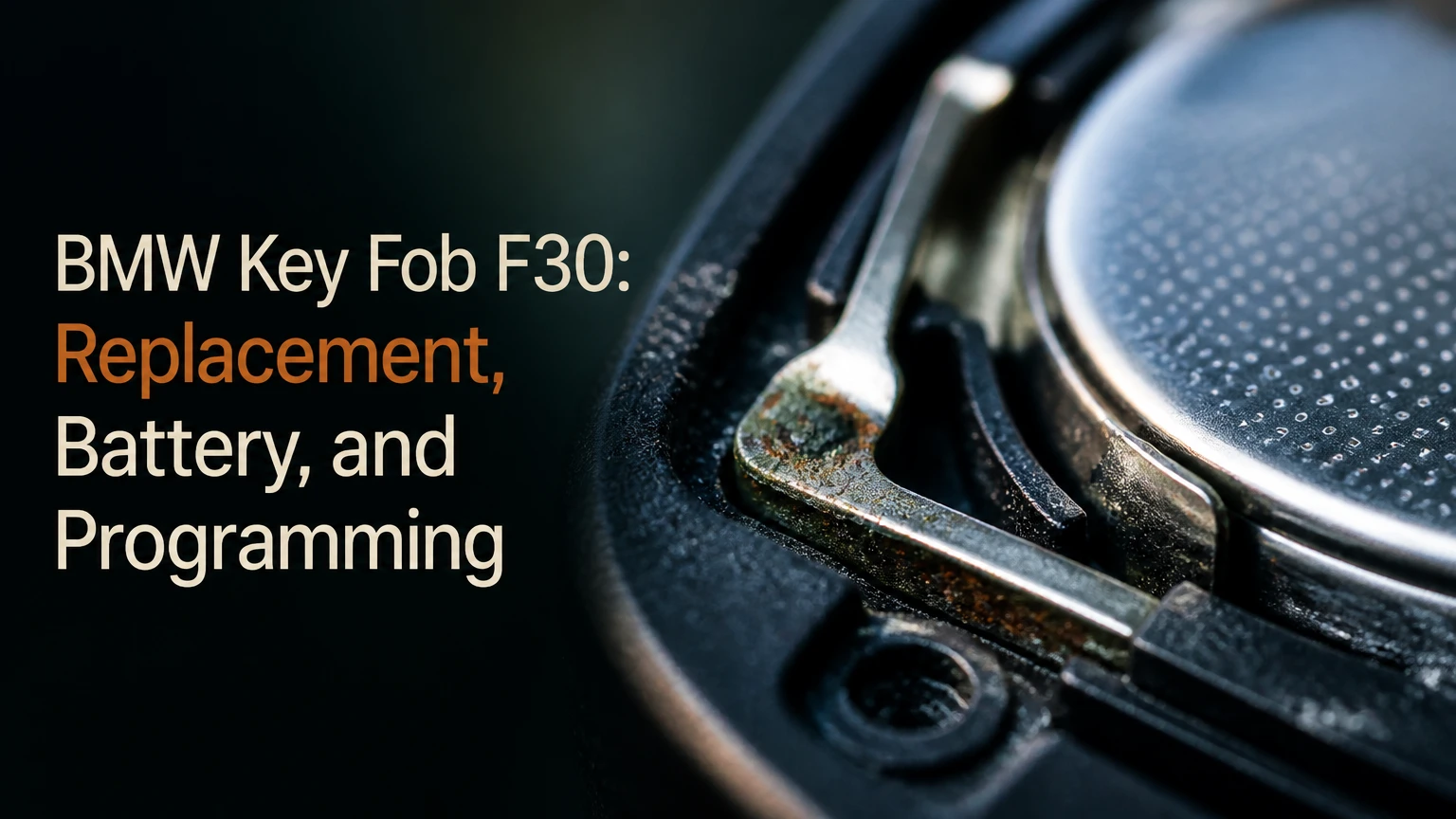
The BMW F30 key fob is the remote transmitter and immobilizer credential used by the sixth-generation 3 Series, including the 2012-2018 sedan and related F31, F34, and F80 variants. It controls locking, unlocking, the trunk, and engine authorization, while Comfort Access adds passive entry and, on equipped cars, hands-free trunk access.
Key Facts at a Glance
- A BMW F30 key fob must match the vehicle’s market, frequency, electronics, and immobilizer system, not merely its exterior shape.
- Most F30 replacement keys require professional coding to the vehicle’s FEM, or Front Electronic Module.
- A dead key battery usually prevents remote-button operation but does not erase the key’s immobilizer pairing.
- F30 remote frequencies commonly include 315 MHz in North America and approximately 433 or 434 MHz in many other markets; some European applications use approximately 868 MHz.
- A typical replacement costs $200-$350 through an independent automotive locksmith or $400-$650 through a BMW dealer.
- A used F30 key is usually locked to its original vehicle and is generally unsuitable as a complete plug-and-play replacement.
What Is a BMW F30 Key Fob?
A BMW F30 key fob is a radio remote control combined with a vehicle-specific electronic immobilizer key. The remote portion sends commands to the car’s access system, while the immobilizer portion proves that an authorized key is present before the engine control system permits starting.
The F30 designation identifies BMW’s sixth-generation 3 Series platform. The core sedan is commonly described as 2012-2018 in North America, although production and registration dates vary by country. The F31 Touring, F34 Gran Turismo, F35 long-wheelbase sedan, and F80 M3 use related F-series key technology, but a key from one chassis should never be assumed compatible with another.
The key stores driver-linked preferences in the vehicle and profile system rather than functioning as a simple metal key. Depending on equipment and coding, unlocking with a particular remote can recall seat, mirror, climate, and audio preferences. The exact behavior depends on the vehicle’s options, software, and driver-profile configuration.
BMW’s F30 owner documentation describes Comfort Access as a system that can unlock the vehicle without pressing the remote-control button. That statement applies only to cars equipped with option S322A and does not mean every F30 key supports passive entry.
How Does the F30 Key Communicate With the Car?
The F30 key uses short-range radio for remote commands, low-frequency vehicle antennas for proximity detection, and a cryptographic immobilizer exchange for engine authorization. These functions overlap physically inside one fob but perform different jobs and fail in different ways.
Pressing lock or unlock sends a coded RF transmission to the vehicle’s receiver and body electronics. The transmission uses changing or authenticated code data rather than a permanently repeated button code, which limits the usefulness of a basic recorded transmission. The exact security implementation is BMW-specific and should not be reduced to a simple “rolling code” description for every communication channel.
Comfort Access adds low-frequency antennas around the doors and cabin. When the handle sensor detects a touch, the car challenges a nearby key, and the key answers through its short-range radio channel. The vehicle therefore checks proximity rather than responding to every remote signal from a distance.
The immobilizer exchange is separate from ordinary locking. A key can unlock the doors yet fail to authorize starting, and a car can start with a weak remote battery if the immobilizer circuit still receives enough energy through the emergency-start location.
Remote, Immobilizer, and Profile Functions
| Function | Communication or storage | Typical symptom when faulty | First check |
|---|---|---|---|
| Lock and unlock | RF transmitter, vehicle receiver | Buttons do nothing | Key battery, frequency, fuses |
| Engine authorization | Coded transponder and FEM | “Key not detected,” no start | Emergency-start position |
| Comfort Access | Door antennas, handle sensors, LF/RF exchange | Touch entry fails | Feature equipment and antenna |
| Trunk release | Remote button or Comfort Access sensor | Trunk button fails | Button, vehicle battery, actuator |
| Driver settings | Vehicle profile association | Seat or mirrors do not recall | Profile and key assignment |
Which F30 Key Fob Do You Need?
The correct F30 key is identified by VIN, original key data, market frequency, button layout, and Comfort Access equipment. Exterior color, a three-button layout, or a marketplace listing that says “F30” is not enough to establish compatibility.
BMW used several F-series remote variations. Some have a silver accent, some have colored trim associated with the vehicle line, and some differ in internal electronics despite looking nearly identical. The trim stripe can help identify the original style, but it is not a reliable parts-compatibility test.
Standard and Comfort Access Comparison
| Attribute | Standard remote | Comfort Access remote |
|---|---|---|
| Manual lock and unlock | Yes, button required | Yes, buttons remain available |
| Touch-to-unlock | No | Yes, if S322A is installed |
| Engine starting | Key inside cabin | Key inside cabin |
| Hands-free trunk | Usually unavailable | Available only with matching vehicle equipment |
| Battery construction | Often sealed rechargeable design | Varies by key revision and market |
| Identification method | VIN and key data | VIN, S322A, key data, frequency |
The AI Overview’s claim that the standard F30 fob has a non-removable battery while the Comfort Access version normally uses a CR2450 is too broad. F-series keys vary by market, supplier, revision, and internal board design. Many original BMW keys use a rechargeable cell that is not intended for routine owner replacement, while some replacement or aftermarket designs use a replaceable coin cell.
How Can You Tell if the Car Has Comfort Access?
An F30 has Comfort Access if touching the outside door-handle ridges locks the car and touching the inside handle unlocks it while the key remains in close proximity. The vehicle may also provide a hands-free trunk feature, but the presence of a trunk button alone does not prove that Comfort Access is installed.
Check the vehicle’s build sheet for S322A when possible. A VIN lookup is more dependable than visual inspection because a previous owner may have replaced a door handle, changed a key shell, or installed aftermarket equipment.
What Frequency and Part Number Should You Buy?
F30 key frequency is market-specific, and the replacement must match the vehicle’s original radio configuration. North American cars commonly use 315 MHz, while many European and Asian applications use approximately 433 or 434 MHz; certain European BMW applications use approximately 868 MHz.
The number printed in an online listing may describe a shell, transmitter, or complete coded assembly. Frequently referenced F-series numbers include 61319240899, 61319313927, and 61319240891, but applicability changes by VIN, body style, market, Comfort Access, and production date. A part number without a VIN check is only a preliminary clue.
| Purchase detail | North American example | European or Asian example | Why it matters |
|---|---|---|---|
| Common RF band | 315 MHz | 433/434 MHz or 868 MHz | Wrong band can disable remote functions |
| Market approval | FCC-oriented design | CE or regional approval | Electronics and antennas can differ |
| Vehicle module | FEM-based F-series system | FEM-based F-series system | Coding data remains vehicle-specific |
| Key blade | BMW emergency blade | BMW emergency blade | Profile and cutting pattern must match |
| Verification method | VIN plus original key | VIN plus original key | Listing title is insufficient |
A frequency match still does not guarantee operation. Two keys can share 315 MHz yet use different board revisions, encryption data, button layouts, or Comfort Access support. The reliable buying sequence is VIN lookup, equipment confirmation, frequency confirmation, and supplier verification.
How Much Does an F30 Key Replacement Cost?
A typical F30 replacement costs $200-$350 through a reputable automotive locksmith and $400-$650 through a BMW dealer, while a shell-only repair can cost approximately $15-$60. The final price changes with location, whether a key is lost, whether a blade must be cut, and whether the vehicle can be reached for programming.
| Replacement route | Typical total cost | Typical time | Best fit |
|---|---|---|---|
| BMW dealer, ordered by VIN | $400-$650 | 2-5 business days | OEM key and formal documentation |
| Mobile automotive locksmith | $200-$350 | 1-3 hours | Same-day spare or replacement |
| Shell-only transfer | $15-$60 | 30-90 minutes | Damaged casing with working electronics |
| Aftermarket complete key | $40-$150 before coding | 1-7 days plus coding | Verified compatible hardware |
| Dealer emergency appointment | $450-$750 | Same day to 5 days | No working key and high security priority |
Dealer pricing generally includes an OEM key ordered against the VIN, but cutting and programming policies differ. A locksmith may charge separately for travel, key generation, blade cutting, and deletion of a missing key, so request an itemized quote.
DIY hardware looks inexpensive because a blank shell or transmitter may cost $40-$100. The real cost includes an immobilizer programmer, compatible software, power protection, and the risk of corrupting FEM data. For one vehicle, DIY programming rarely beats a qualified locksmith on total risk-adjusted cost.
How Is a New F30 Key Programmed?
A new F30 key is programmed by matching its immobilizer and remote data to the vehicle’s FEM using professional BMW-capable equipment. The owner normally does not complete the process through an ignition-turn or brake-pedal sequence.
A legitimate technician first verifies ownership, VIN, vehicle communication, key type, frequency, and the number of functioning keys. The technician then connects a supported diagnostic and key-generation platform, maintains stable vehicle voltage, reads the required vehicle data, prepares the key, and writes it into an available key position.
BMW F-series immobilizer work is security-sensitive. Exact ISN extraction, EEPROM manipulation, and FEM repair procedures depend on the hardware and software version, and publishing operational bypass instructions would create unnecessary theft risk. A professional should explain the process without handing over vehicle security data.
Professional Programming Workflow
- Verify ownership and vehicle identity. Provide registration, title, government identification, and the VIN.
- Confirm the key specification. Match market, frequency, button count, Comfort Access, and chassis.
- Protect vehicle voltage. Use a regulated battery support unit because interrupted FEM programming can create module faults.
- Read the vehicle with an approved tool. The technician identifies the FEM and available key positions.
- Prepare and code the key. The key’s authorized data is matched to the vehicle’s security system.
- Test every function. Check lock, unlock, trunk, engine authorization, Comfort Access, and the emergency blade.
- Delete a lost key if necessary. Removing its authorization from the vehicle reduces the risk of continued use, although it does not physically destroy the missing remote.
The number of key positions is commonly described as eight on BMW systems, but the technician should confirm the applicable vehicle module and software rather than relying on a generic internet procedure.
Can You Reuse a Used F30 Key?
A used F30 key generally cannot be reused as a complete replacement because its immobilizer identity is paired with the original vehicle. Some specialists can perform advanced board-level work on specific revisions, but the result is not guaranteed and may cost more than a new compatible key.
Used marketplace listings often confuse three different products:
- Shell: plastic housing, buttons, and emergency blade.
- Uncoded hardware: electronic key that may require specialized preparation.
- Used coded key: key already associated with another vehicle.
A shell can be useful when the original electronics still work. Move the original board and, where applicable, the original rechargeable cell into a quality housing, then test the buttons and blade. Do not buy a used coded key merely because its FCC ID, part number, or appearance resembles the original.
Can You Replace the F30 Key Battery Yourself?
You can replace a battery only when the key design provides a serviceable battery compartment or when you are prepared for delicate shell opening and board work. Many original F30 keys use a sealed rechargeable battery, so cutting the case and soldering a replacement is more complex than changing a CR2450 in a conventional remote.
A dead remote battery usually causes reduced range or button failure. It normally does not erase the immobilizer authorization, so replacing the battery should not require full key programming in the ordinary case.
| Key condition | Likely battery situation | Owner-level action | Programming usually needed |
|---|---|---|---|
| Remote range gradually declines | Weak rechargeable or coin cell | Test or replace approved battery | No |
| Buttons stop after water exposure | Board or battery damage | Drying may not restore board | Often diagnostic repair |
| Car starts, remote does not work | Remote power fault | Inspect battery and contacts | Usually no |
| Car says key not detected | Key, antenna, or vehicle battery issue | Use emergency-start position | Not from battery alone |
| New blank key does not start car | Uncoded immobilizer data | Professional key coding | Yes |
Do not install a CR2450 solely because an online listing names that cell. Confirm the cell fitted to the specific key, including voltage, polarity, physical dimensions, and whether the board expects a rechargeable battery.
How Do You Start an F30 With a Dead Key Battery?
Place the F30 key against the designated steering-column marking or emergency-detection area, then press the brake and the Start/Stop button. The exact marking and sequence can vary by production version, so the owner’s manual is the final authority for the vehicle.
The emergency-start location allows the car to detect the immobilizer credential at close range even when the remote transmitter has insufficient power. This procedure does not repair the battery, restore Comfort Access, or pair a new key.
The commonly repeated instruction to hold the key against the column and press Start for 10 seconds without the brake is not a universal F30 synchronization procedure. A battery change generally does not unpair an authorized F-series key. If the car still refuses to start at the emergency location, investigate the vehicle’s 12-volt battery, key damage, antenna system, or immobilizer fault instead of repeatedly attempting remote pairing.
Why Does the F30 Say “Key Not Detected”?
The F30 “key not detected” warning most often results from a weak or damaged key, a discharged vehicle battery, an obstructed emergency-detection area, or a fault in the cabin antenna system. Holding the key at the emergency-start location separates a weak remote-transmitter problem from a larger authorization problem.
Use this diagnostic order:
- Try the spare key, if available.
- Hold the suspect key at the marked emergency-start location.
- Check whether the engine starts and whether the remote buttons work.
- Test the vehicle’s 12-volt battery and charging voltage.
- Inspect the key for water damage, cracked housing, or loose buttons.
- Scan the FEM and antenna modules for stored faults.
If the emergency procedure starts the engine but the buttons remain dead, the key transmitter or battery is the leading suspect. If neither key works and the car has low system voltage, repair the vehicle battery before condemning both keys.
Why Does the Remote Have Short Range?
Short F30 remote range usually indicates a weak key battery, damaged key electronics, RF interference, or a vehicle receiver or diversity-antenna problem. A range that deteriorates gradually points toward key power; a sudden failure affecting multiple keys points toward the vehicle.
The rear-window diversity antenna and related receiver wiring can be affected by water intrusion, damaged trim, aftermarket electronics, or metallic window film. Fuse locations vary by equipment and fuse-box revision, so generic references to fuse 104 or 150 should be verified against the vehicle’s fuse chart rather than treated as universal F30 instructions.
Test one key at several distances, then test the spare. If both keys fail near the car, inspect the receiver and antenna system. If one key fails while the spare works normally, repair or replace the individual key.
What Should You Do if the F30 Key Is Lost?
If an F30 key is lost, arrange replacement and request deletion of the missing key from the vehicle’s authorized-key memory. Move the vehicle to a secure location, remove personal identification from the car, and tell the dealer or locksmith whether the missing key was stolen or simply misplaced.
A missing key may still operate the vehicle if it remains authorized and is physically nearby. Deleting its authorization prevents engine starting through that key, but it does not guarantee that every remote function becomes unusable in every scenario. If theft is suspected, also review insurance requirements and consider changing the vehicle’s physical security plan.
A dealer is preferable when documentation, OEM provenance, or formal security records matter most. A qualified automotive locksmith is usually faster and less expensive when the vehicle is accessible and the technician supports the exact F30 FEM system.
Dealer, Locksmith, or DIY: Which Route Is Best?
The best route depends on whether the key is lost, whether a working spare exists, and whether the owner values OEM sourcing over speed and price. A locksmith is usually the practical choice for a same-day replacement, while a dealer offers the most controlled OEM ordering process.
| Owner situation | Recommended route | Typical spend | Main reason |
|---|---|---|---|
| Working key, damaged shell | Shell transfer | $15-$60 | Preserves coded electronics |
| One working key, need a spare | BMW-capable locksmith | $200-$350 | Fast duplicate and testing |
| All keys lost | Dealer or specialist locksmith | $300-$750 | Security verification and mobile access |
| Comfort Access failure | Diagnostic specialist | $100-$250 diagnosis | May be antenna or handle fault |
| Rural owner without local service | VIN-ordered dealer key | $400-$650 | Less dependence on local equipment |
The dealer route is not automatically necessary for every F30. A locksmith with documented BMW F-series experience can often generate and test a key on site, but cheap aftermarket electronics and incomplete quotes create avoidable failures.
DIY programming is appropriate only for a technician who already understands BMW module backup, stable power supply, immobilizer security, and recovery procedures. It is a poor bargain for an owner seeking one spare key.
Expert Rules That Prevent Expensive Mistakes
Rule 1: Diagnose before buying. If the car starts but the buttons fail, a new coded key may be unnecessary. Battery, shell, button, or receiver repair could solve the problem.
Rule 2: Never identify compatibility from the shell alone. The same three-button appearance can conceal different frequencies, board revisions, and Comfort Access configurations.
Rule 3: Preserve the original electronics whenever possible. A damaged housing is often a shell problem, and transferring the original board avoids a second immobilizer-coding job.
Rule 4: Treat vehicle voltage as part of the programming job. FEM communication during low voltage is a module-risk event, not a harmless inconvenience.
Rule 5: Ask for function testing before payment. The technician should demonstrate manual locking, unlocking, trunk release, engine start, emergency-blade operation, and passive entry when equipped.
Frequently Asked Questions
Does every 2012-2019 BMW 3 Series use the same key?
No. The F30 sedan, F31 Touring, F34 Gran Turismo, F35, and F80 share related technology, but keys vary by market, production date, frequency, Comfort Access, and vehicle module. The 2019 3 Series may be a G20 rather than an F30, so VIN verification is necessary before ordering.
Does a new BMW key come already programmed?
A dealer-supplied key is ordered for the vehicle and may arrive prepared for that VIN, but local procedures still determine whether registration, initialization, or testing is required. An aftermarket blank or locksmith-supplied key normally requires professional preparation and coding before it can start the car.
Can a dead F30 key battery prevent the engine from starting?
A dead remote battery can prevent button operation and cause a key-not-detected warning, but the immobilizer may still work through the emergency-start location. If the car will not start with the key held there, check the vehicle battery, key damage, antenna system, and immobilizer faults.
Is the F30 emergency key blade enough to drive the car?
No. The mechanical blade can unlock the driver’s door when the remote is unavailable, but it does not authorize the electronic ignition by itself. The vehicle still requires a recognized immobilizer key for engine starting.
How many BMW keys should an F30 owner keep?
Two working keys are the practical minimum for most owners, because a spare avoids a lockout and reduces the cost of recovering an all-keys-lost vehicle. Store the spare away from the car and test its remote and emergency-start functions twice each year.
The Bottom Line
The BMW key fob F30 is a vehicle-specific security device, not a generic three-button remote. Match the replacement by VIN, market frequency, electronics, and Comfort Access equipment; use a shell transfer when the original board works; choose a qualified locksmith or dealer for immobilizer coding; and diagnose the vehicle before assuming that a new key is required.