To open a car door without a key, first use the vehicle’s hidden mechanical key, connected-car app, spare key, or roadside-assistance service. If those options fail, a licensed automotive locksmith can verify ownership and unlock the vehicle with purpose-built equipment. Do not pry the door, damage a window, or manipulate the latch yourself.
Key facts
A key-fob battery failure does not usually prevent the hidden mechanical key from opening the driver’s door.
A connected-car app can unlock only a vehicle that was previously enrolled and has cellular service.
Typical automotive locksmith service costs about $75-$200 before unusual access, programming, travel, or after-hours charges.
A dead vehicle battery can disable remote unlocking, but it does not necessarily disable the exterior mechanical lock.
A child, vulnerable adult, or animal in immediate danger requires emergency services before ordinary lockout assistance.
Slim Jims, coat hangers, screwdrivers, and inflated gaps can damage wiring, airbags, weather seals, glass, and door alignment.
What Is the Safest Way to Open a Car Door Without a Key?
The safest way to open a car door without a key is to use an authorized access method in this order: hidden key blade, spare key, manufacturer app, roadside assistance, and then an automotive locksmith. The best choice depends on whether the fob is missing, the fob battery is dead, the vehicle battery is dead, or the keys are locked inside.
Start by moving to a safe location away from traffic. Confirm that the vehicle is yours or that you have permission to access it, because a locksmith may request government identification, registration, insurance documents, or another ownership record.
Use the lowest-risk option first
- Check every door and the trunk. Some vehicles remain unlocked at one entry point after an incomplete locking cycle.
- Find the spare key. A household member, employer, fleet manager, or rental company may hold one.
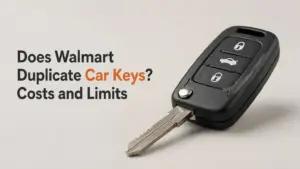
- Try the hidden key blade. Most modern fobs contain a removable metal blade.
- Use the connected-car application. Sign in through the manufacturer’s official app, not a third-party unlocking service.
- Call roadside assistance. Check your auto insurer, motor club, vehicle warranty, credit-card benefits, or rental agreement.
- Contact an automotive locksmith. Ask for non-destructive entry and a complete price before dispatch.
A professional should not need to break glass for an ordinary lockout. A broken window creates weather, security, injury, and replacement-cost problems that usually exceed the original service call.
How Does the Hidden Mechanical Key Work?
The hidden mechanical key is a removable metal blade inside many remote fobs, and it can operate a concealed lock cylinder even when the fob battery or vehicle battery is dead. The blade generally unlocks the driver’s door only; it may not disarm the alarm or provide a way to start a vehicle with a missing transponder.
Look for a small release slider, latch, or button on the side or rear of the fob. Pull the blade out without twisting the plastic housing. The vehicle owner’s manual normally shows the release location and the concealed cylinder cover.
Steps for using the emergency key
- Remove the blade from the fob. Keep the fob close to the vehicle because some cars require it inside the cabin for starting.
- Locate the driver’s-door key cylinder. It may be visible in the handle or hidden beneath a painted plastic cap.
- Remove the cover only as the manual describes. Improvised prying can break retaining clips and scratch the handle.
- Insert and turn the blade gently. Resistance can indicate a frozen, corroded, or damaged cylinder.
- Relock the cover afterward. A loose cap can admit water and create later corrosion.
A mechanical key may trigger the alarm when the door opens. That behavior is normal on some models. Place the fob in its emergency starting position, press the vehicle’s start control as specified by the manual, or use the manufacturer’s documented alarm-disarm procedure.
Can a Connected-Car App Unlock a Locked Car?
A connected-car app can unlock a locked car when the owner completed enrollment, the subscription is active, the phone can authenticate the account, and the vehicle has cellular communication. Examples include FordPass, myChevrolet, mySubaru, Hyundai Bluelink, Kia Access, Toyota, Lexus, Mercedes-Benz, and Tesla applications, although availability varies by model and market.
Open the official application, authenticate with the registered account, select the vehicle, and choose the lock or unlock command. The server may take several seconds to confirm the request. A screen showing “pending” does not prove that the door opened, so verify the status or try the command once more after checking cellular coverage.
Why remote unlocking can fail
| Failure condition | Typical symptom | Safer response |
|---|---|---|
| Vehicle cellular modem has no signal | Command remains pending for 30-120 seconds | Move to coverage, then call roadside help |
| App account is not enrolled | Vehicle does not appear in the account | Contact the manufacturer or registered owner |
| Subscription expired | Unlock control is unavailable | Renew service or use a locksmith |
| Vehicle battery is fully discharged | App reports no response | Use the mechanical cylinder or request professional entry |
| Phone or account is locked | Login, PIN, or biometric failure | Use official account recovery, not shared credentials |
Never give an unknown caller your manufacturer-app password or security PIN. If another household member has legitimate account access, that person can send the command without disclosing credentials.
What If the Car Battery or Key-Fob Battery Is Dead?
A dead key-fob battery usually affects remote buttons, while a dead vehicle battery can disable central locking, alarm functions, and telematics. Neither condition automatically removes the exterior mechanical key option, so the hidden lock cylinder is the first documented solution.
Replace a coin-cell fob battery with the exact type listed in the owner’s manual. Common examples include CR2032 and CR2025, but the numbers are not interchangeable in every housing. Keep the old battery away from children because button cells can cause severe internal injury if swallowed.
Dead-battery decision table
| Situation | What may still work | Recommended action |
|---|---|---|
| Fob battery dead, vehicle battery healthy | Mechanical blade and vehicle receiver | Use the blade, then replace the fob cell |
| Vehicle battery dead, fob battery healthy | Mechanical blade, but not remote unlock | Use the exterior cylinder or call a locksmith |
| Both batteries dead | Mechanical blade only | Use the blade, then arrange a battery service |
| Mechanical cylinder seized | No reliable owner-operated method | Request a locksmith and specify the seized cylinder |
| Fob lost, vehicle locked | App or spare key if enrolled | Use account access, spare key, or professional help |
Do not connect a booster battery by reaching through a forced door gap. Incorrect polarity can damage electronic control modules, and improvised access can disturb side-impact wiring.
Why Should You Avoid Slim Jims, Coat Hangers, and Screwdrivers?
Untrained use of Slim Jims, coat hangers, wedges, or screwdrivers can damage modern vehicle wiring, side-curtain airbag circuits, window mechanisms, paint, weather seals, and door-frame alignment. Older vehicles may have simpler mechanical linkages, but the vehicle’s age alone does not make blind manipulation safe.
Modern doors may contain plastic shields, electronic latch modules, speakers, window regulators, proximity antennas, and airbag harnesses. A metal tool inserted into an unseen cavity can catch a component that has no relationship to the lock. A bent upper frame may still close, but wind noise and water intrusion can appear after the lockout is over.
Practitioner rules that prevent expensive damage
- Do not widen the upper door frame with a household object. Even a small permanent deformation can prevent correct weather sealing.
- Do not insert metal beside the glass. The window regulator and wiring commonly occupy that path.
- Do not break a side window unless emergency responders direct it. Tempered glass can scatter fragments into seats and door cavities.
- Do not assume an unlocked interior button will open every door. Deadlocking and child-safety configurations differ by vehicle.
- Do not use a locksmith tool without training and authorization. Specialized entry tools are designed around vehicle-specific access points and damage controls.
Professional entry is not the same as copying a generic internet technique. A trained technician identifies the model, lock system, airbag locations, glass type, and ownership status before selecting an approach.
How Much Does Vehicle Lockout Help Cost?
Typical vehicle lockout help costs about $75-$200 during ordinary hours, while after-hours, holiday, long-distance, luxury-vehicle, and difficult-access calls can reach $150-$300 or more. The final price depends on location, vehicle security system, travel distance, proof-of-ownership requirements, and whether key cutting or programming is also needed.
Prices vary by country and city. Treat the figures below as typical planning ranges, not a guaranteed quote.
| Service | Typical price | Typical arrival or service time | Usually includes |
|---|---|---|---|
| Roadside-assistance lockout | $0-$100 member cost | 30-90 minutes | One covered entry attempt |
| Automotive locksmith, standard car | $75-$200 | 20-60 minutes after dispatch | Non-destructive entry |
| After-hours locksmith | $150-$300+ | 20-90 minutes | Entry with an evening or holiday surcharge |
| Replacement mechanical key | $20-$80 | 15-45 minutes | Cut blade without transponder programming |
| Transponder or smart-key replacement | $150-$600+ | 1-3 hours | Key, cutting, and vehicle programming |
| Broken-window replacement | $200-$600+ | Same day to several days | Glass, cleanup, and installation |
Ask these questions before agreeing to service:
- What is the total price, including dispatch, labor, tax, and after-hours fees?
- Is the quote for entry only, or does it include a replacement key?
- Will the technician provide an invoice and identify the business?
- What proof of ownership should you prepare?
- What happens if the vehicle cannot be opened without damage?
A low advertised callout price may exclude labor or travel. Written confirmation reduces disputes, especially during overnight emergencies.
Will Insurance or AAA Cover the Lockout?
Auto insurance, AAA, manufacturer warranties, fleet programs, and some credit-card benefits may cover a vehicle lockout, but coverage limits, membership rules, service caps, and reimbursement procedures differ. Check the assistance number on your insurance card or membership account before hiring an independent provider.
Coverage often applies to unlocking the vehicle but not to replacing a lost key, cutting a transponder key, programming a smart key, repairing a damaged lock, or replacing broken glass. Some plans limit the number of service calls per policy period.
What to verify with the provider
| Question | Why the answer matters |
|---|---|
| Is lockout service included? | Some policies cover towing but exclude entry |
| Is the vehicle within the service area? | Rural or cross-border calls may have different rules |
| Is there a dollar limit? | A premium locksmith may exceed the reimbursement cap |
| Is key replacement covered? | Entry and key creation are often separate benefits |
| Must you use an approved vendor? | Out-of-network work may require receipts or preapproval |
Rental vehicles require special handling. Call the rental company first because unauthorized entry or key replacement can create contractual charges.
What If a Child, Vulnerable Adult, or Animal Is Locked Inside?
Call emergency services immediately when a child, vulnerable adult, or animal is locked inside a vehicle and faces heat, cold, breathing difficulty, injury, or another immediate threat. Tell the dispatcher the exact location, vehicle color, license plate, occupant condition, and whether the engine is running.
Do not spend several minutes searching for a locksmith in an acute emergency. Police, fire, and emergency medical responders have authority, training, and equipment for urgent access. The National Highway Traffic Safety Administration warns that vehicle interiors can heat rapidly, even when outdoor temperatures do not seem extreme.
Stay nearby and keep the dispatcher updated. Do not leave an endangered person or animal unattended to retrieve tools. A passerby should not break glass unless emergency responders or local law enforcement direct that action, because glass fragments and door airbags create additional hazards.
What If the Keys Are Locked in the Trunk?
If the keys are in the trunk, try the manufacturer app, spare key, or roadside service rather than forcing a passenger door. Many vehicles disable trunk release controls while locked, and some models use separate luggage-compartment deadlocking.
Check whether the rear seats fold from inside the cabin, but do not assume that an external trunk release remains active. A locksmith can often unlock the passenger compartment without creating a trunk or trim problem, then retrieve the keys through the normal cabin access route.
For fleet, rental, and employer-owned vehicles, call the controlling organization first. A replacement key or forced entry may require authorization from the registered owner.
How Do You Choose a Safe Automotive Locksmith?
Choose a locksmith who provides a fixed or itemized quote, confirms the vehicle make and model, requests proof of authorization, and states that the goal is non-destructive entry. A verifiable business address, local telephone number, invoice, and identifiable technician are stronger signals than a large “lowest price” advertisement.
Before dispatch, provide:
- Vehicle make, model, and year
- Exact location and parking conditions
- Whether the keys are inside, lost, broken, or stolen
- Whether the fob battery or vehicle battery is dead
- Whether a child, animal, or vulnerable person is involved
- Whether the vehicle has an aftermarket alarm or immobilizer
A reputable technician may decline service if ownership cannot be established. That safeguard protects both the vehicle owner and the technician.
How Can You Prevent Another Lockout?
Prevent future lockouts by enrolling the manufacturer app, keeping a tested spare key, replacing weak fob batteries, and confirming roadside coverage before travel. A prevention plan costs less than one emergency night call and avoids improvised entry damage.
Use this maintenance schedule:
| Prevention measure | Recommended interval | Practical detail |
|---|---|---|
| Test spare key | Every 6 months | Confirm it unlocks the door and starts the vehicle if applicable |
| Check fob battery | Every 6-12 months | Replace when range decreases or buttons respond slowly |
| Verify app access | Every 3 months | Sign in before an emergency, not during one |
| Review roadside coverage | At policy renewal | Record the assistance phone number offline |
| Store an emergency key | Ongoing | Keep it with an authorized person, not exposed under the car |
Do not hide a spare key in an obvious magnetic box beneath the vehicle. Thieves know common hiding locations, and road salt, heat, water, and vibration can damage the key. A trusted household member or secure home location is safer.
Frequently Asked Questions
Can I unlock my car with a shoelace?
A shoelace is not a reliable or safe universal method for unlocking a vehicle, and attempting to manipulate a door seal can damage the weatherstrip or lock mechanism. Use the hidden key, an authorized app, roadside assistance, or a locksmith instead. Older lock designs and modern electronic systems behave differently.
Can police unlock a car for me?
Police departments may assist with an urgent safety emergency, but many do not perform ordinary vehicle lockouts because of liability, staffing, or policy restrictions. Call the non-emergency number for local guidance, or call emergency services when a person faces immediate danger.
Can a dealership open my locked car?
A dealership can usually help verify ownership, order a replacement key, and program transponder or smart keys, but it may not provide rapid roadside entry. Dealership key services commonly take longer and cost more than a covered lockout service, especially when the vehicle must be towed.
Will unlocking a car trigger the alarm?
Unlocking a vehicle with the mechanical blade can trigger the alarm on some models because the security system expects a recognized fob signal. Keep the fob available, follow the owner’s manual, and avoid repeatedly opening and closing the door while the alarm is active.
Can I open a car door if the key is broken in the lock?
A broken key in the cylinder requires careful extraction, and forcing another object into the lock can push the fragment deeper or damage the cylinder. A locksmith can remove the fragment, test the cylinder, and cut or program a replacement key if necessary.
Is it cheaper to replace the key or call a locksmith?
Calling roadside assistance or a locksmith for entry is usually cheaper than replacing a smart key, but a lost-key situation may require both services. A basic mechanical blade can cost $20-$80, while transponder and smart-key replacement commonly costs $150-$600 or more.
The Bottom Line
To open a car door without a key, use the hidden mechanical key, spare key, official connected-car app, roadside assistance, or a qualified automotive locksmith. Avoid Slim Jims, coat hangers, wedges, screwdrivers, and broken windows because vehicle frames, airbags, wiring, and weather seals are easy to damage. Call emergency services first when a person or animal is in immediate danger.