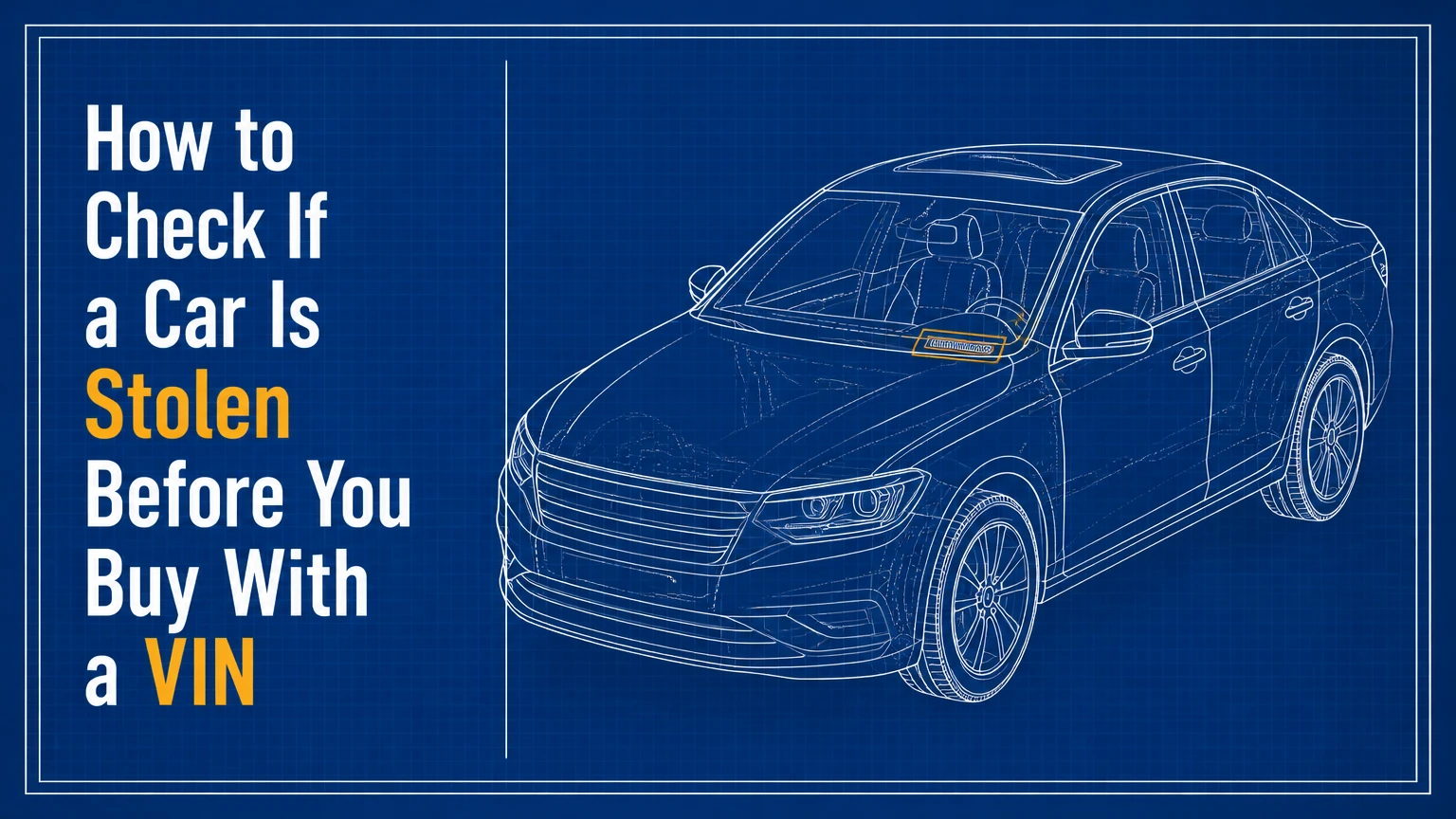
To check if a car is stolen, record the vehicle identification number (VIN), compare it with the car and ownership documents, search official and insurance databases, and have law enforcement confirm any alert. Complete the checks before paying, because authorities may seize a stolen vehicle and a good-faith buyer may still lose the purchase price.
Key Facts at a Glance
- A modern standardized VIN normally contains 17 characters and identifies one specific vehicle.
- NICB VINCheck is free, but it does not search every police report or every insurer.
- A clean VIN report does not prove that a vehicle is legitimate, especially when VIN cloning is involved.
- The dashboard VIN, door-jamb label, title, registration, and seller identity should agree.
- Police and motor-vehicle agencies control access to many live stolen-vehicle databases.
- Never take possession, move, sell, or confront anyone after finding a suspected stolen vehicle; contact police first.
What Does a Stolen-Car Check Actually Prove?
A stolen-car check determines whether a vehicle identifier appears in available theft, insurance, title, registration, or police records. The result is evidence about the vehicle’s recorded history, not an absolute guarantee that the car is legally owned or free from fraud.
A vehicle can be absent from a database for several legitimate reasons; the VIN and proof of ownership can also help obtain a replacement car key without the original. The theft may have been reported minutes earlier, the insurer may not participate in a particular service, the vehicle may be registered in another country, or a criminal may have installed a cloned VIN from a similar legal car.
The National Insurance Crime Bureau (NICB) describes VINCheck as a consumer service that helps determine whether a vehicle has been reported stolen or declared a salvage vehicle by participating insurers. That wording matters: NICB VINCheck is not the same as a live, unrestricted query of the FBI’s National Crime Information Center (NCIC).
What Is a VIN?
A VIN is a manufacturer-assigned identifier containing 17 letters and numbers on most road vehicles manufactured for the United States market since the 1981 model year. The VIN identifies attributes such as manufacturer, vehicle type, model year, assembly plant, and production sequence.
The VIN is usually visible through the lower driver-side windshield and on a certification label inside the driver’s door or door frame. Other locations vary by manufacturer. A stamped chassis number, frame marking, body label, or electronic module may provide supporting evidence, but not every vehicle exposes a matching VIN in every location.
A 16-character VIN is not automatically forged. Older vehicles, vehicles manufactured before the 1981 standard, motorcycles, imports, and vehicles governed by different national rules can follow other formats. Treat a nonstandard VIN as a reason to verify the vehicle’s jurisdiction and manufacturer records, not as conclusive proof of theft.
What Is the Difference Between Theft, Salvage, and a Lien?
Theft status, salvage status, and lien status are separate attributes that require separate checks. A stolen vehicle may have a clean-looking title, while a legally owned salvage vehicle may never have been stolen.
| Record type | What it indicates | What it does not prove | Typical action |
|---|---|---|---|
| Active theft report | Police or insurer recorded the vehicle as missing | The current seller caused the theft | Stop the transaction and call police |
| Recovered theft | Vehicle was previously reported stolen and later found | Current mechanical condition or title quality | Inspect title brand and repair history |
| Salvage or total loss | Insurer or authority classified severe damage | That the car is stolen | Check rebuilt inspection and insurance availability |
| Lien | A lender or finance company may retain an interest | That the vehicle is stolen | Obtain a lien release before payment |
| VIN discrepancy | Identifiers do not consistently describe one vehicle | Exact cause of the mismatch | Do not buy until an authority resolves it |
How to Check If a Car Is Stolen: Five Steps
The safest process takes about 20-45 minutes for an initial buyer check, plus extra time for a paid report or police appointment. The physical VIN comparison determines success more than any single online result, because a database can return a clean record for a cloned identity.
Before You Start
| Requirement | Typical amount or range | Why it matters |
|---|---|---|
| Time for initial screening | 20-45 minutes | Covers VIN capture, document comparison, and free searches |
| Free-check cost | $0 | NICB and some government portals charge no search fee |
| Paid history report | Typically $10-$45 | Adds title, mileage, insurance, and jurisdictional records |
| Required tools | Phone camera, flashlight, internet access | Captures identifiers and preserves evidence |
| Documents to request | Title, registration, seller ID, service records | Tests ownership consistency |
| Safe meeting location | Seller’s home or police safe-exchange site | Makes identity and jurisdiction easier to verify |
Step 1: Record the VIN Directly From the Vehicle
Photograph the dashboard VIN through the windshield and the manufacturer label on the driver-side door frame. Transcribe the characters separately, then compare the transcription with the title and registration instead of copying only the number supplied by the seller.
Use all 17 characters, including letters and numbers that look similar. The letters I, O, and Q are generally excluded from standardized VINs to reduce confusion with 1 and 0, but transcription errors still occur with B, 8, S, and 5.
You’ll know it worked when: the dashboard VIN, door label, title, registration, and seller’s listing show the same sequence.
Common mistake: accepting a photograph of a VIN from the seller as proof. Ask to see the identifier on the actual vehicle, because a legitimate VIN image can be reused in a fraudulent listing.
Step 2: Compare Every VIN and Inspect for Tampering
Compare the dashboard plate, door label, title, registration, and any additional manufacturer markings without removing panels or dismantling the vehicle. Look for uneven spacing, fresh adhesive, mismatched fonts, damaged surrounding trim, nonfactory rivets, scratches, weld marks, paint differences, or a plate that sits crookedly.
A cloned vehicle carries the VIN of a similar legitimate vehicle, so the number may produce a clean report; if the car’s key is missing, an automotive locksmith can usually make a car key without the original. Compare the reported make, model, body style, color, engine specification, wheelbase, and model year with the physical car.
An OBD scan can support the investigation on some newer vehicles, but it is not definitive. Electronic control modules can be replaced, reprogrammed, or inaccessible, and a scanner may display a programmed identity rather than the vehicle’s original legal identity.
You’ll know it worked when: the VIN describes the vehicle in front of you and no identifier shows physical alteration.
Common mistake: searching only the VIN printed on the paperwork. A forged title can reproduce the identity of a real car, while the physical vehicle carries evidence of a different origin.
Step 3: Run Free Theft and Title Checks
Enter the VIN into NICB VINCheck at nicb.org/vincheck and record the result with a screenshot or downloaded report. NICB says its search uses data supplied by participating insurance companies, so a no-record result is useful screening evidence but not a universal clearance.
Next, use the official vehicle-history system for the vehicle’s jurisdiction. In the United States, NMVTIS-approved providers can report title brands, odometer information, salvage history, and certain theft records, while a state department of motor vehicles may hold the current title and registration record.
| Location | First official or established route | Main information | Typical access |
|---|---|---|---|
| United States | NICB VINCheck plus NMVTIS-approved provider | Participating-insurer theft, title brands, salvage, odometer | Free NICB search; paid NMVTIS report |
| United Kingdom | Police stolen-vehicle check or reputable history provider | Stolen marker, write-off, finance, registration history | Provider fees vary; police access is restricted |
| Canada | Provincial registry and insurer or history provider | Registration, branding, claims, lien information | Province-specific; paid reports are common |
| Australia | PPSR search plus state registration check | Finance interest, written-off status, registration | PPSR search fee; state portals vary |
| India | VAHAN or Parivahan records, regional RTO | Registration, vehicle details, transfer history | Government portal and regional office procedures |
A government transport portal may confirm registration without confirming an active theft alert. A vehicle can therefore pass a registration search and still require police or insurer verification.
You’ll know it worked when: the free results, jurisdictional record, vehicle specifications, and seller documents agree.
Common mistake: treating a commercial report as an official legal determination. Commercial providers aggregate available records and can be incomplete, delayed, or wrong.
Step 4: Order a Comprehensive History Report
Buy one reputable vehicle-history report when the free screening is clear and the transaction remains plausible. Compare the report’s title history, mileage readings, insurance claims, auction images, registration states or provinces, and theft markers against the seller’s explanation.
A paid report is most useful when the vehicle has crossed jurisdictions, changed ownership repeatedly, carries a salvage or rebuilt title, or has a suspiciously low price. It is less useful as a substitute for inspecting the physical VIN, because a cloned car can inherit the legitimate vehicle’s clean record.
| Check method | Typical cost | Typical time | Strongest use | Important limitation |
|---|---|---|---|---|
| NICB VINCheck | $0 | 1-3 minutes | Participating-insurer theft and salvage screening | Does not cover every theft report |
| State or provincial record | $0-$25 | 5-30 minutes | Current registration and title status | Access and fields vary by jurisdiction |
| NMVTIS-approved report | About $4-$15 | 5-10 minutes | Title brands and odometer history | Not a complete repair or theft history |
| Commercial history report | About $10-$45 | 2-10 minutes | Multi-state claims, mileage, auctions | Aggregated data can contain gaps |
| Police verification | Usually $0 | Same day to several days | Suspected active theft confirmation | Buyers may not receive unrestricted database access |
You’ll know it worked when: the paid report adds records that explain the ownership timeline rather than merely repeating the seller’s listing.
Common mistake: purchasing several reports from one provider and assuming repetition equals confirmation. A second source with different data, such as a state record or insurer, adds more value.
Step 5: Confirm a Suspicious Result With Authorities
Call the local police department or the relevant motor-vehicle authority if a database returns an active theft alert, the VIN does not match, or the seller refuses ownership documents. Give the agency the VIN, location, seller details, listing, photographs, and report reference number.
Law-enforcement systems such as NCIC are restricted systems, and officers may not disclose every record detail to a private buyer. Police may need to inspect the vehicle, contact the recorded owner, or coordinate with another jurisdiction before confirming what can legally be shared.
Do not drive a suspected stolen vehicle to a police station unless an officer instructs you to do so. Do not confront the seller, alter the vehicle, negotiate a refund in person, or attempt to recover personal property from it.
You’ll know it worked when: an agency gives you instructions and a case or incident number, not merely an informal opinion from an online forum.
Common mistake: assuming a seller’s claim that “the police cleared it” is sufficient. Ask for the agency name, date, incident number, and written direction, then verify those details independently.
Which Database Should You Use?
Use multiple records in sequence: NICB for a free insurance-based screen, a government or NMVTIS-linked record for title information, a commercial report for broader history, and police verification for an active alert. No single public tool covers every theft, lien, title, insurer, and jurisdiction.
NICB is the best first check for a United States buyer because it costs nothing and takes minutes. NMVTIS is better for title brands and odometer information. A state DMV is better for current registration and title questions. A police department is the correct escalation point for a possible active theft.
What Does a Clean Search Mean?
A clean search means the searched source found no matching record under that VIN at that time. It does not establish lawful ownership, because delayed reporting, nonparticipating insurers, imported vehicles, database errors, and VIN cloning can all produce false reassurance.
The highest-risk combination is a clean report plus a physical mismatch. The physical mismatch should control the decision, because an authentic record attached to the wrong vehicle is evidence of identity fraud rather than evidence of a safe purchase.
How Much Does Verification Cost and Take?
A basic check costs $0 and usually takes 20-45 minutes, while a broader buyer investigation typically costs $10-$45 and can take one hour when title offices, inspections, or police appointments are involved. Fees and database limits vary by country, provider, and vehicle type.
NICB has historically limited repeated searches to reduce automated scraping, with the site displaying its current allowance. Do not build a purchase decision around a supposed permanent number such as five searches per IP address, because service rules can change and multiple users may share one network address.
When Should You Walk Away?
Walk away before paying when the physical VIN differs from any document, the seller refuses an inspection, the title owner is absent, the report shows an active theft record, or the price depends on immediate cash and secrecy. A seller who cannot explain a legitimate discrepancy cannot transfer reliable ownership.
A minor spelling error in a service invoice may be fixable. A mismatched VIN, missing title, altered plate, or seller identity conflict requires an authority or title agency to resolve before the transaction proceeds.
What If the VIN Is Unreadable or Missing?
An unreadable or missing VIN is a stop condition until the manufacturer, title authority, or law enforcement verifies the vehicle identity. Do not rely on an engine-bay stamp, ECU scan, or seller-provided photograph as a replacement for an official identity determination.
Ask the seller to obtain a manufacturer VIN verification or an inspection required by the local motor-vehicle agency. Photograph the condition of the identifier, preserve the listing, and record why the number cannot be read.
A damaged dashboard plate may result from collision repair rather than theft, but the buyer cannot safely distinguish those explanations alone. The correct next step is an official inspection, not sanding, replacing, or removing the plate.
What If You Already Bought a Suspected Stolen Vehicle?
Stop using the vehicle and contact local police immediately if you discover that the car may be stolen. Keep the vehicle in its current secure location when possible, preserve the bill of sale, payment records, messages, photographs, keys, title, and advertisements, and notify your insurer and finance company.
Do not sell the car, export it, dismantle it, or return it privately. Police may seize the vehicle and identify the lawful owner, while your financial recovery may depend on payment method, seller identity, insurance coverage, and local consumer or criminal law.
A lawyer or consumer-protection agency can explain recovery options after the report is filed. The buyer’s good faith does not automatically create ownership of stolen property.
Common Scams and Practical Recovery Rules
- VIN cloning: A thief copies the VIN of a comparable legal vehicle. Compare body style, trim, color, production details, and physical plates, not only the number.
- Forged or washed title: A counterfeit or altered title conceals a theft, salvage brand, or out-of-state history. Verify the title through the issuing authority.
- Payment pressure: A seller demands cash, cryptocurrency, wire transfer, or an immediate deposit. Use a traceable payment method only after ownership is verified.
- Identity mismatch: The seller’s ID does not match the titled owner and no documented power of attorney exists. Require the legal transfer chain.
- Remote sale: The vehicle is “located elsewhere” and a courier will deliver it after payment. Inspect it locally before transferring funds.
- Staged documentation: A service history uses a clean VIN but describes a different model or mileage. Match dates, specifications, and photographs.
Meeting at a police safe-exchange location improves personal safety, but the location itself does not verify a car. A police department may provide a monitored exchange area without performing a title, theft, or mechanical inspection.
Expert Rules That Prevent Expensive Errors
A clean report is weaker than a consistent identity. The report describes the record attached to a VIN; the vehicle inspection tests whether the car actually carries that identity. When the two conflict, stop.
The seller’s urgency has no evidentiary value. A low price, an imminent move, or a claimed emergency does not reduce the need for a title and physical inspection. Fraud often succeeds by compressing the buyer’s decision time.
Database freshness varies by event. A recent theft may not appear until a police report, insurer record, and data provider synchronize. Recheck immediately before payment when the transaction occurs days after the first search.
Frequently Asked Questions
Can I check a stolen car using only its license plate?
A license plate can help a police department or registration agency identify a vehicle, but a VIN is the primary identifier for a theft and title search. Plates can be transferred, replaced, expired, or stolen, so record both the plate and VIN and ask the relevant authority to verify them together.
Can a dealership guarantee that a used car is not stolen?
A dealership can perform due diligence and may offer contractual or statutory protections, but no seller can guarantee that every external database is current. Request the dealership’s title documentation, vehicle-history report, inspection record, and written remedy terms before signing, then independently compare the physical VIN.
How do I check a car before buying from a private seller?
Photograph the VIN, compare it with the title and registration, verify the seller’s identity, run NICB and jurisdictional searches, order a history report, and arrange an independent inspection. Complete every step before paying a deposit, because a private sale usually provides fewer recovery options than a regulated dealership transaction.
Can a stolen car have a clean title?
A stolen car can appear to have a clean title when the theft is recent, the title is forged, the vehicle is cloned, or records have not synchronized. A clean title is therefore one data point, not proof of lawful ownership. Physical VIN consistency and authority verification remain necessary.
What should I do if a seller refuses to provide the VIN?
Do not pay a deposit or continue the transaction when a seller refuses to provide the VIN. A legitimate buyer needs the identifier to verify title, theft, recalls, and history. Save the listing and report suspected fraud to the platform or police if the seller uses deceptive documents or threats.
The Bottom Line
To check if a car is stolen, verify the physical VIN against every ownership document, search NICB and the appropriate government records, obtain a broader history report, and ask police to resolve any active alert or identity mismatch before payment. A clean database result cannot overcome an altered VIN, missing title, seller mismatch, or unexplained ownership chain.