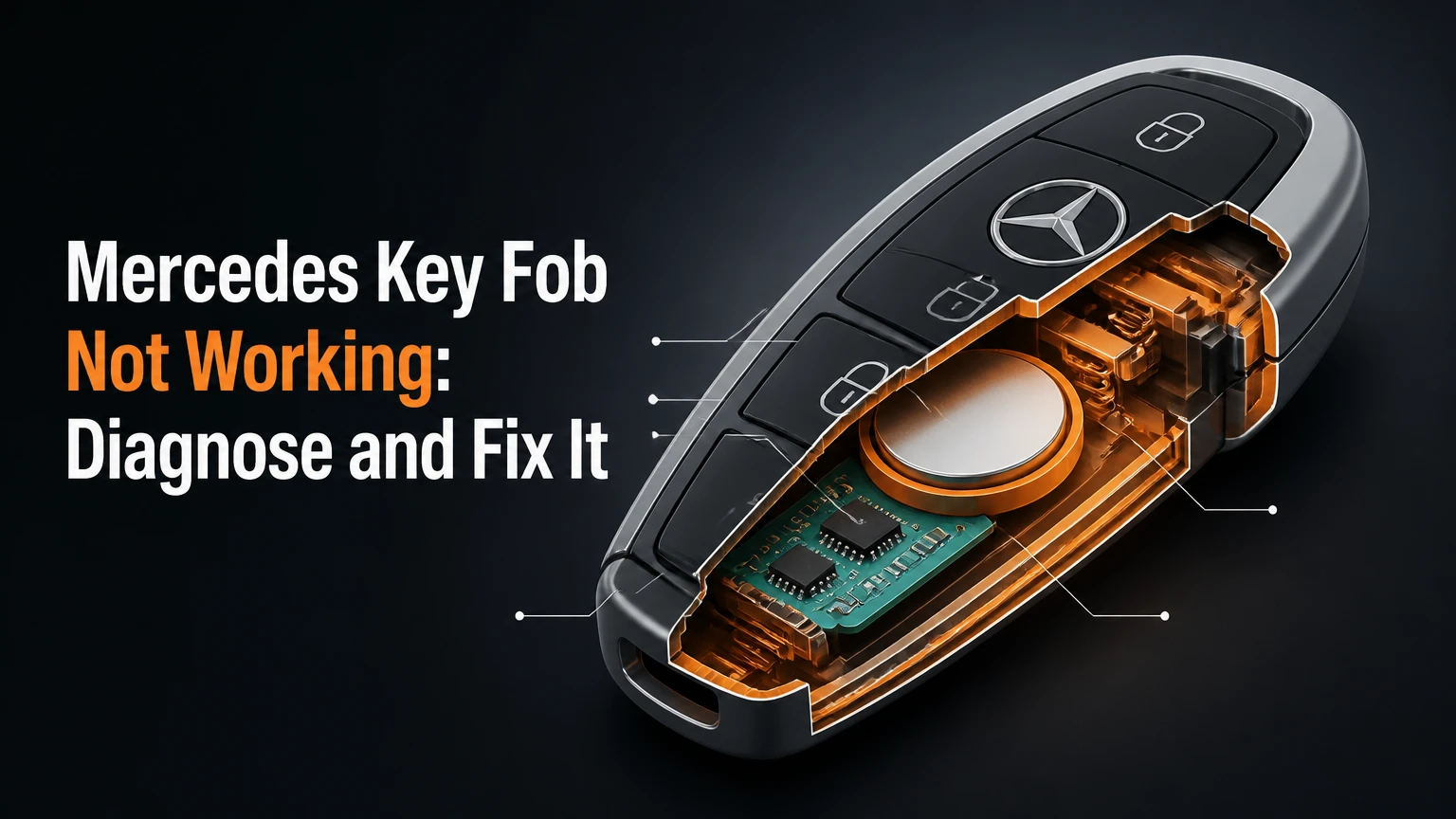
A Mercedes-Benz key fob that is not working usually has a depleted coin-cell battery, poor battery contact, physical damage, radio interference, or a vehicle-side power or receiver fault. Replace the correctly specified battery first, then test the spare key and the emergency-start method; programming is rarely the first repair.
Key Facts at a Glance
Mercedes-Benz remote buttons and immobilizer starting functions can fail independently.
A dead fob battery often stops remote locking but may not prevent engine starting.
The correct battery is determined by the fob and vehicle documentation, not by model year alone.
If two programmed keys fail at the same time, inspect the vehicle battery, fuses, receiver, or antenna before replacing both keys.
A Mercedes-Benz replacement key normally requires vehicle-specific authorization and coding.
Generic resynchronization sequences apply to some older systems, not every Mercedes-Benz model.
What Does a Mercedes Key Fob Control?
A Mercedes-Benz key fob contains separate systems for remote access and immobilizer authorization. The button transmitter sends a coded radio signal for locking, unlocking, trunk release, and panic functions, while a passive transponder or inductive system can authenticate the key when the vehicle reads it at close range.
Remote range depends on the fob battery, antenna orientation, local radio interference, and the vehicle receiver. A weak battery commonly produces shorter range before complete failure. A transponder fault is different: the buttons may work while the instrument cluster reports that the key is not detected.
Mercedes-Benz key designs vary substantially. Older SmartKey units commonly use an Electronic Ignition Switch, or EIS, and newer vehicles may combine a push-button starter with Keyless-Go antennas and a designated emergency detection area. Mercedes-Benz owner manuals specify the exact backup location for each model.
Remote Buttons Versus Engine Authorization
Remote locking is an RF function, but engine authorization is a security function. The distinction explains why a Mercedes can unlock manually, lock with the buttons, or start in an ignition slot while another function remains unavailable.
Infrared components appear on some earlier Mercedes-Benz keys, but the exact technology depends on the key generation and market. Do not assume that every Mercedes-Benz fob uses the same frequency, infrared arrangement, or starting method.
Why Is Your Mercedes Key Fob Not Working?
The most likely cause is a weak battery or failed contact, but symptom patterns narrow the diagnosis; BMW X3 key-fob fault checks can separate battery, synchronization, and receiver problems. A remote that works only beside the door points toward low transmitter power, whereas a key that starts the vehicle but cannot lock it points toward the remote circuit rather than the immobilizer.
Check the simplest variables in order. Remove the fob from a metal-lined bag, move away from other wireless devices, try each button, and compare its behavior with the spare key. If the spare key works normally, the vehicle receiver is less likely to be the cause.
| Symptom | Most likely cause | First diagnostic action | Typical repair |
|---|---|---|---|
| No buttons operate, engine starts | Dead cell or flattened contacts | Replace specified cell | Battery or contact repair |
| Remote works only within 1-2 feet | Weak cell, interference, damaged antenna | Test with a fresh cell outdoors | Battery or fob repair |
| Locks work, display says key not detected | Keyless-Go antenna, low vehicle voltage, fob proximity fault | Use backup detection location | Vehicle diagnosis or key repair |
| One button fails | Membrane, tactile switch, or shell damage | Inspect button travel | Shell, switch, or board repair |
| Key does not turn in EIS | Transponder, EIS, steering lock, or key damage | Test the spare key | Diagnostic service |
| Both keys fail together | Vehicle battery, fuse, receiver, or antenna | Measure vehicle voltage | Vehicle-side electrical repair |
| Failure began after water exposure | Corrosion or shorted circuit board | Stop repeated button presses | Board repair or key replacement |
What Does the Spare Key Tell You?
A working spare key is the fastest practical control test. If the spare locks, unlocks, and starts the Mercedes-Benz normally, repair the faulty fob; if both keys show the same failure, investigate the vehicle before purchasing a replacement.
This test is more valuable than repeatedly changing batteries. Two independent fobs rarely lose their internal transmitters simultaneously, but a discharged vehicle battery, blown central-locking fuse, failed receiver, or antenna fault can affect both.
How Do You Replace a Mercedes Key Fob Battery?
Replace the Mercedes-Benz key battery by confirming the cell designation, removing the emergency blade, opening the shell through its release slot, fitting the cell with the marked polarity, and checking every button before closing the housing. The exact shell-opening direction varies by key generation, so avoid levering against decorative chrome or circuit-board edges.
Before You Start
| Requirement | Typical value | Why it matters |
|---|---|---|
| Work time | 5-15 minutes | Allows careful shell and contact inspection |
| Replacement cell | CR2025 or CR2032, as specified | Thickness and voltage fit the housing |
| Tools | Emergency blade, clean plastic pick, lint-free cloth | Reduces shell and circuit damage |
| Workspace | Dry, well-lit table | Prevents lost springs and contamination |
| Battery handling | One fresh lithium coin cell | A mixed old and new pair can cause failure |
Step 1: Identify the Correct Cell
Read the marking on the existing battery and verify it against the Mercedes-Benz owner manual or fob documentation. Some older fobs use two cells, while many later designs use one; CR2025 and CR2032 cells share a nominal voltage but have different thicknesses.
A CR2032 is approximately 3.2 mm thick, while a CR2025 is approximately 2.5 mm thick. Do not force a CR2032 into a holder designed for a CR2025 because excessive pressure can deform the retainer or damage the circuit board.
You will know the selection is correct when the cell fits flat without bowing the cover or requiring force. The common mistake is buying by Mercedes model name alone, even though mid-year key revisions can use different housings.
Step 2: Remove the Emergency Blade and Open the Housing
Slide the release latch, pull out the mechanical blade, and use the blade or a suitable plastic tool in the shell’s release opening. Apply controlled pressure at the designed seam rather than twisting the shell around the buttons.
Do not insert a screwdriver deeply into the housing. A sharp metal tool can cut a conductive track, puncture the cell, or mark the chrome frame. The success checkpoint is a clean separation of the rear cover with the board and button membrane still seated.
Step 3: Inspect Contacts and Polarity
Remove the old cell and photograph the compartment before installation. Install the replacement with the positive side facing the same direction shown by the holder, usually upward, then inspect the spring contacts for flattening, contamination, or green-white corrosion.
Contacts should press firmly against the cell without scraping across its surface. Clean light contamination with a dry lint-free cloth or electronics-safe contact cleaner used sparingly. Do not bend contacts repeatedly because fatigued metal can break away from the board.
Step 4: Reassemble and Test Every Function
Snap the housing together evenly, reinstall the emergency blade, and test lock, unlock, trunk, panic, and vehicle starting functions. Test from several distances, because a fob can operate beside the driver’s door while still having inadequate range.
You will know the battery repair worked when the remote operates consistently from the normal parking distance and the vehicle no longer displays a low-key warning. If the engine starts but the buttons remain dead, inspect the transmitter board, switch membrane, or antenna rather than assuming programming failed.
Can You Start a Mercedes With a Dead Key Fob Battery?
A Mercedes-Benz can often be started with a dead fob battery because the passive immobilizer system may still read the key at close range. The correct method depends on whether the vehicle uses an EIS ignition slot, a Keyless-Go emergency pocket, or a push-button backup detection position.
EIS Ignition-Slot Models
Remove the mechanical blade only if manual door entry is needed, then insert the complete electronic key into the dashboard ignition slot. Turn it through the normal ignition positions and start the vehicle according to the owner manual.
Do not pry off a push-button starter cap unless the Mercedes-Benz manual specifically identifies a removable cover and an underlying slot. Some internet instructions combine procedures from unrelated key generations.
Keyless-Go and Push-Button Models
Place the fob in the vehicle’s documented emergency detection area, which may be inside the center console, a cup-holder tray, or another marked compartment. On some models, holding the fob directly against the Start/Stop button while pressing the brake allows the vehicle to read the passive transponder.
The location is not universal. If the cluster says “Key Not Detected,” move the fob away from phones, other keys, and metal objects, then use the backup location shown in the manual.
Manual Door Entry
Slide the latch and remove the emergency blade. If the driver’s door cylinder is hidden beneath a trim cap, use the blade at the specified release point and lift the cap carefully.
The mechanical key may unlock the door while triggering the alarm. Keep the electronic fob inside the cabin and switch on the ignition or start the vehicle promptly, because alarm behavior varies by model and security configuration.
How Do You Resynchronize the Remote?
Some older Mercedes-Benz remotes can resynchronize after a battery change, but there is no single sequence that applies to every Mercedes-Benz. A commonly published older procedure involves switching the ignition on, removing the key, holding Lock, and pressing Unlock repeatedly, but the owner manual for the exact model takes priority.
Use this procedure only when the key still starts the vehicle and the battery is correctly installed:
- Insert the key into the ignition slot.
- Turn it to the normal ignition-on position without cranking.
- Switch the ignition off and remove the key.
- Hold the Lock button.
- Press the Unlock button several times, commonly five presses.
- Release the buttons and test the remote.
The sequence may fail on vehicles with different electronic control units, Keyless-Go architecture, or a key that was never authorized to the car. A new or replacement key cannot usually be created by pressing buttons at home. It requires security authorization, diagnostic equipment, or factory-linked programming.
Is the Car or the Key Causing the Failure?
The vehicle is the stronger suspect when both programmed keys fail, the interior lights are weak, the central locking behaves abnormally, or the car has recently needed a jump-start. Measure the vehicle battery before ordering a fob because low system voltage can disable comfort and access functions.
| Test | Healthy or expected result | Fault indication | Next action |
|---|---|---|---|
| Fob battery at rest | About 3.0-3.3 V for a fresh cell | Below about 2.8 V | Replace cell |
| Vehicle battery at rest | About 12.4-12.7 V after resting | Below about 12.0 V | Charge and load-test |
| Spare-key remote | Same locks and range | Both keys fail | Inspect vehicle system |
| Mechanical blade | Unlocks cylinder smoothly | Cylinder binds or will not turn | Lubrication or lock repair |
| Door-lock response | Consistent lock and unlock | One door or all doors fail | Fuse, actuator, or receiver diagnosis |
| Keyless-Go detection | Recognizes fob in backup area | No detection from either key | Antenna, voltage, or control-unit diagnosis |
Check the fuse chart in the vehicle manual rather than relying on a fixed fuse number. Fuse locations and ratings differ across Mercedes-Benz chassis, and replacing a fuse with a higher-rated part creates a wiring hazard.
Which Mercedes Key Repair Option Should You Choose?
Choose a battery or contact repair for a working key with a remote fault, a specialist automotive locksmith for many older replacement keys, and a Mercedes-Benz retailer when the key is lost, security authorization is required, or the vehicle uses newer factory-controlled systems. The correct option depends on key availability, model generation, and whether the car itself has passed electrical tests.
| Option | Typical cost | Typical time | Best use case | Main limitation |
|---|---|---|---|---|
| DIY battery replacement | $5-$20 | 5-15 minutes | Remote range or low-battery warning | Does not repair board damage |
| Key shell replacement | $20-$80 | 30-90 minutes | Broken housing with working board | Button layout must match |
| Automotive locksmith | $150-$400 | 1-3 hours | Many older programmed-key replacements | Coverage varies by chassis |
| Mercedes-Benz retailer | $400-$1,200+ | 2-5 business days | Newer, lost, or security-controlled keys | Highest price and documentation |
| Board-level key repair | $80-$250 | 1-7 days | Water or switch damage | Not available for every board |
| Used online key | $30-$150 | 3-10 days | Rarely suitable for security replacement | Used chips may be locked |
Prices are typical U.S. ranges, not quotations. A retailer or locksmith may require the vehicle identification number, registration, photo identification, and proof of ownership before ordering or coding a key.
When Is a Locksmith Better Than a Dealer?
A qualified automotive locksmith can be faster and less expensive for supported older Mercedes-Benz systems, particularly when the owner still has one working key. A Mercedes-Benz retailer is the safer choice for a newer vehicle, all-keys-lost situation, warranty concern, or system that requires factory authorization.
Ask the locksmith which Mercedes-Benz chassis and key system their equipment supports. Avoid a seller who promises universal self-programming, because many Mercedes-Benz keys contain security data that consumer button sequences cannot overwrite.
What Problems Need More Than a Battery?
Battery replacement will not correct a cracked circuit board, failed tactile switch, corroded transponder coil, broken shell retainer, vehicle receiver fault, or immobilizer control-unit problem. A key that has been submerged, washed, or exposed to battery leakage should be opened and inspected promptly rather than repeatedly activated.
Intermittent Buttons After a Drop
A dropped fob can flatten battery contacts or fracture solder joints. If pressing the housing changes the result, the shell or board has mechanical displacement; a new cell alone is unlikely to provide a durable repair.
Keyless-Go Works Inconsistently
Passive entry can fail while the buttons continue operating. Test the fob in the backup detection area, replace the fob cell, move away from wireless interference, and check vehicle voltage before replacing the key.
Cold Weather and Long Storage
Low temperatures reduce coin-cell output temporarily, while a vehicle stored for weeks can develop a low starter battery. Warm the fob naturally, never with a flame or high-heat source, then repeat the battery and spare-key tests.
The Vehicle Was Recently Jump-Started
A voltage event can reset comfort systems or expose a weak vehicle battery. Confirm charging voltage and scan relevant control modules if both keys stopped working immediately afterward.
Common Mistakes That Increase Repair Cost
- Installing the wrong thickness battery: A CR2032 is not an automatic upgrade for a CR2025 holder.
- Bending contacts aggressively: Slight tension correction is possible, but repeated bending can break soldered contact mounts.
- Using a fixed fuse number from another model: Mercedes-Benz fuse assignments vary by chassis, equipment, and production year.
- Buying a used coded key: A previously authorized key may not be reusable in another vehicle.
- Assuming remote failure means immobilizer failure: Button transmission and passive starting authorization are separate functions.
- Opening the fob beside water or loose parts: Springs, blades, membranes, and small retainers are easy to misplace.
A practical rule is to perform one controlled variable at a time. Change the battery, test the same key, test the spare, and only then investigate programming or vehicle electronics.
FAQ
Will a Mercedes-Benz key fob work after the battery is removed?
A Mercedes-Benz key may still start the vehicle after its coin cell is removed if the passive transponder and vehicle detection system remain functional. Remote lock and unlock buttons will not operate without transmitter power. Use the documented EIS slot or emergency detection area for the specific vehicle.
How long does a Mercedes key fob battery last?
A Mercedes-Benz coin-cell battery typically lasts 1-3 years, although heavy Keyless-Go use, frequent button presses, temperature extremes, and prolonged storage can shorten that range. Shorter remote range is an earlier warning than complete failure, so replace the cell before the remote becomes unreliable.
Why does my Mercedes lock but not unlock?
A Mercedes-Benz fob that locks but does not unlock may have a failed unlock switch, damaged button membrane, contaminated circuit board, or a vehicle-side unlock command fault. Test the interior central-locking switch and spare key, then inspect whether the unlock button has normal travel.
Can I program a Mercedes key myself?
Most Mercedes-Benz replacement keys cannot be fully programmed by a simple owner button sequence. Existing remote synchronization may be possible on certain older systems, but immobilizer authorization normally requires compatible diagnostic equipment, security credentials, an automotive locksmith, or a Mercedes-Benz retailer.
Why does my Mercedes say key not detected?
“Key Not Detected” can result from a depleted fob cell, radio interference, low vehicle voltage, a failed Keyless-Go antenna, or a damaged passive transponder. Place the fob in the emergency detection area listed in the owner manual and test the spare key before replacing parts.
Should I keep a Mercedes key in a Faraday pouch?
A Faraday pouch can reduce passive-entry relay risk and prevent unwanted wireless communication when the key is stored at home. It does not repair a dead battery, damaged transmitter, or failed vehicle antenna. Remove the fob from the pouch before testing normal proximity functions.
The Bottom Line
A Mercedes key fob not working does not automatically require a replacement key. Verify the correct battery, inspect its contacts, test the remote away from interference, compare the spare key, and measure vehicle voltage before paying for programming. Use the emergency blade and model-specific backup-start location when immediate access or starting is necessary. If both keys fail, or if the key cannot authorize the engine after these tests, diagnose the vehicle receiver, antenna, EIS, Keyless-Go system, or immobilizer with a qualified Mercedes-Benz technician.