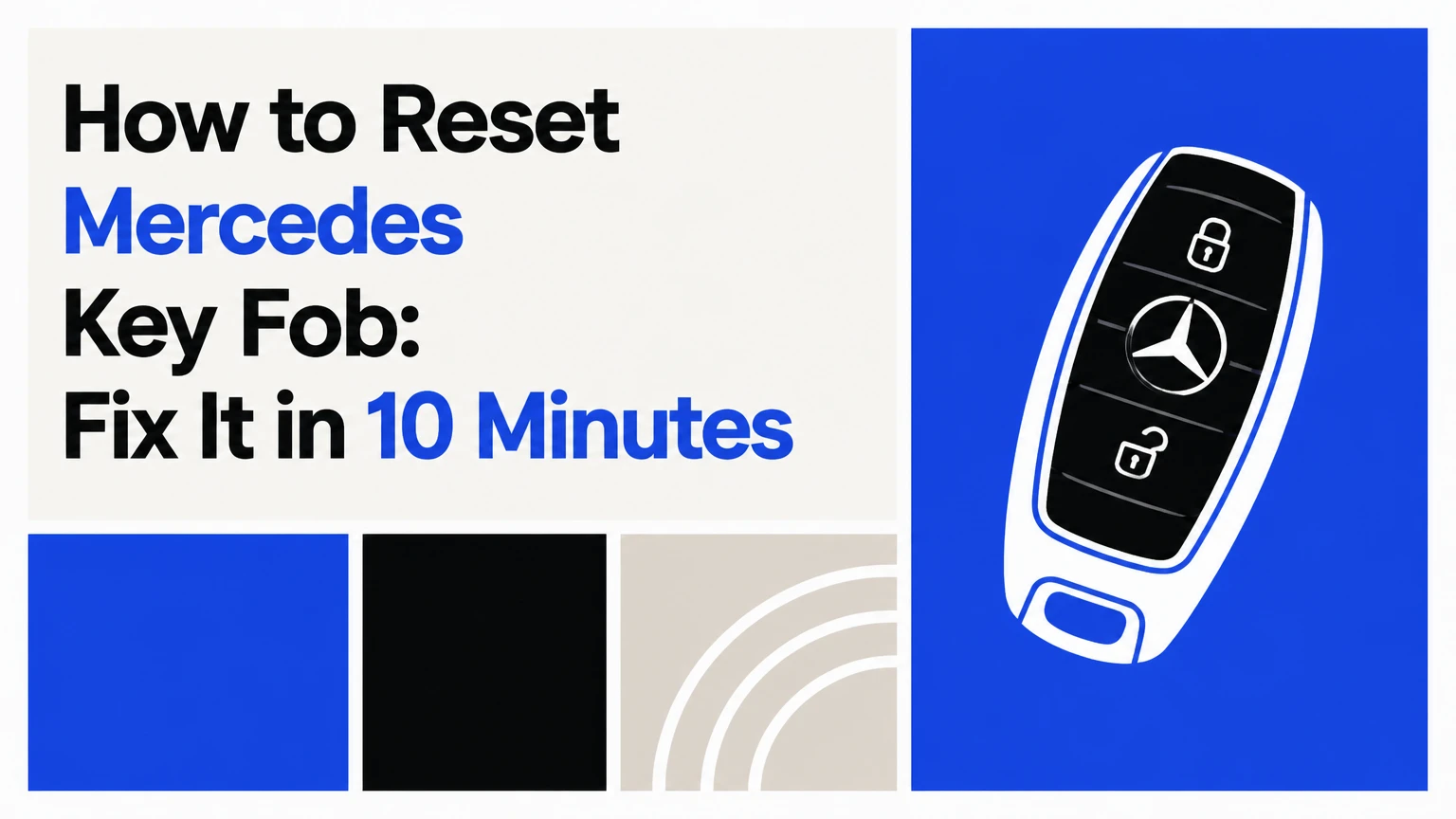
To reset a Mercedes-Benz key fob, first replace its correct battery, then perform the model-specific remote synchronization procedure described in the owner’s manual. Holding the lock and unlock buttons usually changes selective or global unlocking; it does not erase or reprogram the immobilizer key. A key that still will not start the car needs vehicle-side diagnosis or professional programming.
Key Facts at a Glance
- A Mercedes-Benz key fob can operate remote locking while its immobilizer authorization remains a separate function.
- A flashing red LED proves that the fob has electrical power, not that the vehicle receives or accepts its signal.
- Chrome SmartKeys commonly use one CR2032 battery, while many older black SmartKeys use two CR2025 batteries.
- Mercedes-Benz does not provide a universal, owner-performed immobilizer reprogramming sequence for all models.
- The vehicle battery, antenna, EIS/EZS ignition switch, door receiver, and Keyless-Go controller can cause symptoms that resemble a bad key.
- A used Mercedes-Benz key may be permanently paired with another vehicle and may not be reusable.
What Does Resetting a Mercedes-Benz Key Fob Actually Mean?
Resetting a Mercedes-Benz key fob can mean three different actions: changing the unlock mode, restoring remote operation after a battery change, or replacing a key that the vehicle no longer authorizes. These actions are not interchangeable, and confusing them can lead to unnecessary battery purchases or damage to the ignition system.
The lock-and-unlock button combination found on many Mercedes-Benz SmartKeys changes selective unlocking to global unlocking, or reverses that setting. Selective unlocking opens the driver’s door first; global unlocking opens all doors and the trunk with one unlock command. That feature reset does not create a new immobilizer credential.
Remote locking generally uses radio-frequency communication. Older Mercedes-Benz systems may also use infrared communication through the key tip and the vehicle’s receiver. Starting authorization involves the Drive Authorization System, electronic ignition switch, steering-lock electronics, and a transponder or cryptographic credential. A successful door unlock therefore does not prove that the key can authorize engine starting.
Which Mercedes-Benz problems can a reset solve?
A reset can solve a changed unlock mode, temporary remote desynchronization, or loss of button response caused by a depleted battery. It cannot normally repair water-damaged electronics, a broken tactile switch, a failed antenna, a flat vehicle battery, a locked used key, or a defective EIS/EZS module.
Mercedes-Benz owner manuals vary by model, market, and production year. Mercedes-Benz USA manuals and vehicle-specific service information should take priority over a generic online sequence, particularly for Keyless-Go vehicles and newer MBUX-equipped models.
Before You Reset the Mercedes Key Fob
Check the key, vehicle, and replacement battery before pressing any button sequence. The preparation takes about 5-10 minutes, costs approximately $3-$12 for a reputable battery, and avoids treating a vehicle-side fault as a key fault.
| Check | Typical requirement | Why it matters |
|---|---|---|
| Replacement battery | 1 CR2032 or 2 CR2025 cells | Incorrect size can prevent proper contact |
| Small tools | Emergency blade and plastic pry tool | Metal screwdrivers can damage the case |
| Work area | Dry, clean, well-lit surface | Moisture and lost contacts cause repeat faults |
| Vehicle battery | About 12.4-12.7 V at rest | Low voltage can disable receivers and authorization |
| Key distance | Within 1-3 metres during testing | Weak batteries work only at short range |
| Time | 10-20 minutes | Includes battery replacement and testing |
Identify the battery without guessing
Read the marking on the existing cell or the molded specification inside the fob. Many chrome triangular SmartKeys use one CR2032, whereas many older black plastic SmartKeys use two CR2025 cells, but Mercedes-Benz fitted variations across chassis and markets.
Do not substitute a CR2025 for a CR2032 merely because both are 3-volt lithium coin cells. The cells have different thicknesses, and a loose or over-compressed contact can cause intermittent operation. Use a fresh battery from a recognized manufacturer, inspect the expiration date, and keep the positive side oriented exactly as the old cell was installed.
How to Reset Mercedes Key Fob Remote Unlocking
To change the remote between selective and global unlocking, press and hold the lock and unlock buttons together for approximately 5-10 seconds while the key is near the vehicle. On compatible SmartKeys, the red indicator flashes twice, confirming that the convenience setting changed. This procedure does not program the key to the car.
- Stand beside the locked Mercedes-Benz vehicle.
- Press the lock and unlock buttons at the same time.
- Hold both buttons for about 5-10 seconds.
- Watch for two flashes from the key’s red LED.
- Release both buttons.
- Press unlock once and observe whether the driver’s door or all doors open.
The success checkpoint is a changed unlocking behavior, not engine authorization. If one press now unlocks every door, the key changed to global unlocking. If one press opens only the driver’s door, it changed to selective unlocking.
The common mistake is to call this a “reprogramming” procedure. It changes a user preference stored in the remote, while the vehicle’s immobilizer credential remains unchanged.
Does the lock-and-unlock sequence resynchronize the key?
The lock-and-unlock sequence may resynchronize convenience-button behavior on compatible older models, but it is not universal. Some Mercedes-Benz vehicles synchronize a remote after a battery replacement by pressing a button and then inserting or turning the key in the ignition within a specified period; other vehicles use a different procedure or require diagnostic equipment.
If the owner’s manual specifies an ignition synchronization sequence, follow that sequence exactly. Do not repeatedly turn the key or force the ignition when the steering lock does not release. The EIS/EZS and electronic steering-lock system are expensive components, and mechanical force cannot repair a missing electronic authorization.
How to Replace the Mercedes-Benz Key Fob Battery
Replace the battery by removing the emergency blade, opening the battery carrier with the blade or designated slot, installing the exact cell type, and testing every function immediately. Most battery changes take 3-8 minutes, but the case design differs between SmartKey generations.
- Slide the release catch and remove the emergency metal blade.
- Insert the blade into the marked slot, where the design allows it, to release the battery cover.
- Note the battery number, quantity, and positive-side orientation.
- Remove the old cell or cells without bending the contact tabs.
- Inspect the contacts for corrosion, looseness, or flattened spring tension.
- Install the new lithium cell or cells with the correct polarity.
- Refit the cover and return the emergency blade.
- Test lock, unlock, trunk release, panic function, and Keyless-Go if equipped.
You will know the battery installation worked when the LED illuminates consistently and the vehicle responds from a normal distance. A single brief LED flash is normal on many keys; no LED response indicates a battery, contact, switch, or circuit-board problem.
Never pry against the clear infrared lens or force a sealed shell open. Water residue, cracked solder joints, and damaged rubber buttons often require electronic repair rather than another battery.
| Key appearance or system | Common battery arrangement | Identification warning |
|---|---|---|
| Older black SmartKey | 2 x CR2025 | Confirm the markings inside the carrier |
| Chrome-edge SmartKey | 1 x CR2032 | Some versions differ by market and chassis |
| Keyless-Go remote | Often 1 x CR2032 | Passive entry may stop before button functions |
| Newer proximity-style key | Model-specific lithium cell | Use the vehicle manual or key label |
What Should You Test After the Battery Change?
Test the key in a fixed order: LED, remote range, emergency blade, ignition authorization, and passive entry. The order separates a simple power problem from a radio receiver, vehicle battery, immobilizer, or Keyless-Go fault.
| Test result | Most likely area | Next action |
|---|---|---|
| No LED and no buttons work | Cell, polarity, contacts, circuit board | Recheck battery and inspect contacts |
| LED works, short range only | Weak cell, poor contact, RF output | Install a known-good cell and test spare key |
| Doors unlock, engine does not start | Immobilizer, EIS/EZS, vehicle battery | Check vehicle voltage and use the spare key |
| Keyless-Go fails, buttons work | Passive-entry battery or antenna | Test key in backup starting position |
| Both keys fail together | Vehicle battery, receiver, antenna, module | Diagnose the car before replacing keys |
| One door fails to respond | Door lock actuator or receiver wiring | Test other doors and interior switch |
A useful practitioner rule is that two keys failing simultaneously points more strongly to the vehicle than to both fobs. The exception is a vehicle that has been stored for months with both coin cells depleted, but the vehicle battery should still be checked first.
Why Does the Mercedes Key Fob Work but the Car Still Will Not Start?
A Mercedes-Benz key fob can unlock the doors and still fail to start the vehicle because remote locking and immobilizer authorization use different circuits and validation steps. Door operation confirms a functioning button transmitter, while starting also depends on the vehicle battery, EIS/EZS, steering lock, transponder communication, and authorized key data.
Check the following before ordering a replacement:
- Measure the vehicle battery; approximately 12.4-12.7 V at rest is typical for a charged 12-volt battery.
- Try the spare key, if available.
- Remove metal objects and other transponders from the key ring.
- Insert the SmartKey fully without twisting force.
- Confirm whether the steering wheel lock releases.
- Check whether the instrument cluster displays a key, authorization, or steering-lock message.
- Try the manufacturer-specified backup starting position for a Keyless-Go vehicle.
A flat vehicle battery can make a perfectly good key appear defective. If the key turns or is recognized but the starter does not operate, the fault may involve the starter circuit, authorization module, brake-pedal signal, or engine-management system rather than the fob.
Why Does the LED Flash but the Mercedes-Benz Doors Stay Locked?
A flashing LED proves that the key has some electrical power, but it does not prove adequate RF transmission, correct coding, or a working vehicle receiver. Test a fresh cell, the spare key, the emergency blade, and the infrared receiver at close range before concluding that the fob is damaged.
Older Mercedes-Benz vehicles may respond to infrared commands when the key is aimed directly at the driver’s door handle or receiver. This is a diagnostic clue, not a universal operating instruction. If close-range infrared works but normal radio remote operation does not, the fault may involve the RF transmitter, antenna amplifier, receiver module, or regional frequency configuration.
If neither key works, inspect the car’s 12-volt supply and relevant fuses. If one key works and the other does not, the failed key requires battery, contact, switch, circuit-board, or credential diagnosis.
Why Does Keyless-Go Stop Working While the Buttons Still Work?
Keyless-Go can stop working while the lock and unlock buttons continue to operate because passive entry uses separate antennas, proximity detection, and a different power-management state. A working button transmitter therefore does not prove that the passive-entry system is healthy.
Some Mercedes-Benz manuals and technical bulletins describe a key deactivation or reduced-power state that can be toggled through a lock-button action. The exact signal pattern varies by key generation, so the vehicle manual should control the procedure. On compatible keys, pressing the lock button twice quickly may deactivate or reactivate passive operation, while pressing another key button may restore normal activity.
Also test the backup starting method specified for the vehicle. If the key starts the car only when held against a marked area or inserted into a designated slot, the key battery or passive antenna path is suspect. If multiple keys lose Keyless-Go simultaneously, inspect vehicle antennas and the Keyless-Go control system.
Can You Program a Used Mercedes-Benz Key Fob?
Most used Mercedes-Benz key fobs cannot be reliably erased and paired with another vehicle by an owner. Many SmartKeys contain security credentials written during original authorization, and a used key may remain locked to its previous vehicle identification number.
| Replacement route | Typical cost, USD | Typical time | Best use |
|---|---|---|---|
| Mercedes-Benz dealer | $350-$800 or more | 2-5 business days | New OEM key with VIN verification |
| European-car locksmith | $200-$450 | 1-3 hours when supported | Older supported systems and mobile service |
| Key-shell replacement | $20-$80 | 30-60 minutes | Damaged housing with working electronics |
| Used online fob | $30-$200 | Variable | High-risk purchase, often unusable |
| Electronic repair | $80-$250 | 1-7 days | Water damage, switches, or contact faults |
A replacement key normally requires proof of ownership, the VIN, identification, and the vehicle itself or a verified service arrangement. A dealer orders an authorized key through Mercedes-Benz systems. A qualified automotive locksmith may support particular older platforms, but equipment capability varies by chassis, country, and security generation.
The cheapest listing is not the cheapest solution. A used key with the wrong frequency, damaged board, incompatible part number, or locked credential can cost more after shipping and diagnostic fees.
Dealer or Locksmith: Which Replacement Option Is Safer?
A Mercedes-Benz dealer is the most predictable choice for newer or highly integrated vehicles, while a reputable automotive locksmith can be faster and less expensive for supported older models. The correct choice depends on the chassis, key part number, security system, proof of ownership, and whether the problem is a key fault or a vehicle fault.
| Decision factor | Mercedes-Benz dealer | Qualified automotive locksmith |
|---|---|---|
| Typical price | $350-$800+ | $200-$450 |
| Typical appointment | 2-5 business days | Same day, often 1-3 hours |
| New OEM sourcing | Strongest option | Depends on supplier |
| Older Mercedes support | Available | Often strong when properly equipped |
| Newer security support | Usually most predictable | Confirm before payment |
| Vehicle access | Often required | Mobile service may be available |
| Ownership verification | VIN and identification | VIN, identification, and vehicle checks |
Ask the locksmith whether the exact model year, chassis code, key frequency, and Keyless-Go configuration are supported. Avoid any provider promising to bypass immobilizer security without ownership verification. That claim is both a security warning and a practical reason to choose another provider.
When should you use a Mercedes-Benz dealer?
Use a dealer when all keys are lost, the vehicle is a newer model, the electronic steering lock is involved, the key requires factory authorization, or the locksmith cannot confirm compatibility. Dealers may cost more, but the VIN-based ordering process reduces the risk of receiving an incompatible or previously assigned key.
When is an automotive locksmith appropriate?
Use a locksmith when the vehicle has a supported older SmartKey system, you need mobile service, the key shell or buttons are damaged, or you want a second professional diagnosis before paying dealer pricing. Request a written total that includes travel, programming, emergency access, and tax.
Common Reset Mistakes and Their Fixes
Mercedes-Benz key-fob failures often persist because owners reset the wrong component. The following mistakes create predictable recovery paths.
- Installing the wrong coin cell: Check the engraved battery number and polarity; replace cells that are too thin, too thick, or installed upside down.
- Assuming a flashing LED proves the key is good: Compare remote range and test the spare key; the LED does not validate immobilizer authorization.
- Repeatedly holding button combinations: Stop after two or three attempts and consult the model manual; convenience synchronization is not universal.
- Forcing the ignition: Remove pressure immediately if the key does not turn or the steering lock does not release; test vehicle voltage and seek diagnosis.
- Cleaning contacts with liquid: Use a dry lint-free swab or electronics-safe cleaner sparingly, then allow complete evaporation.
- Buying a used fob without the exact part number: Match frequency, button layout, key generation, and compatibility before purchase; a used credential may remain locked.
Mercedes-Benz key fobs are particularly sensitive to water intrusion around the button membrane and infrared lens. A dropped key can look normal externally while suffering cracked solder joints or a displaced contact spring.
Model-Year Limits You Should Not Assume
Mercedes-Benz security architecture cannot be identified reliably by a simple pre-2015 or post-2015 rule. Production overlap, market differences, chassis changes, Keyless-Go options, and software revisions mean that the VIN, key part number, and service documentation provide better evidence than the registration year alone.
Common system labels include DAS2, DAS3, and later security implementations, but those labels do not give owners a universal programming method. Some older systems are supported by specialist locksmith equipment; newer systems may require controlled manufacturer authorization. A locksmith’s ability to cut a mechanical blade does not prove that the provider can create a valid electronic key.
For a precise diagnosis, record the model, model year, chassis code, ignition type, Keyless-Go status, key part number, number of working keys, and the exact dashboard message. That information reduces incorrect battery and replacement-key recommendations.
A Practical Decision Tree for Mercedes-Benz Key Problems
Start with the least invasive test: install the correct battery and test the spare key. If both keys fail, diagnose the vehicle battery and receiver before buying either a key or an EIS/EZS component.
- No LED: inspect battery polarity, cell voltage, contacts, and circuit board.
- LED but no lock response: test range, spare key, close-range infrared behavior, and vehicle battery.
- Locks work but car will not start: test spare key, steering-lock release, vehicle voltage, and authorization messages.
- Keyless-Go alone fails: check key battery, passive-entry mode, backup starting position, and vehicle antennas.
- All keys lost: use a dealer or verified specialist with ownership documentation.
- Water-damaged or cracked key: obtain an electronic repair assessment before attempting more synchronization steps.
Professional diagnostic equipment can read fault codes from Mercedes-Benz control units and identify whether the failure is in the key, antenna system, EIS/EZS, steering lock, or vehicle power supply. Generic code readers often cannot access all body and authorization modules.
Frequently Asked Questions
How long does a Mercedes-Benz key fob battery last?
A Mercedes-Benz key fob battery commonly lasts 1-3 years, depending on button use, passive-entry operation, storage temperature, and battery quality. Keyless-Go vehicles can consume cells faster because the vehicle repeatedly detects the proximity transmitter. Replace the cell when range declines, the LED dims, or the dashboard reports low key-battery voltage.
Can a dead Mercedes-Benz key fob still start the car?
A Mercedes-Benz key fob with a dead coin cell may still start some vehicles because the immobilizer transponder can receive power from the ignition switch or a designated backup reader. Keyless-Go vehicles usually have a specified backup location. Consult the owner’s manual rather than repeatedly pressing the start button.
Why does my Mercedes-Benz key unlock only the driver’s door?
The Mercedes-Benz key is probably set to selective unlocking, which opens the driver’s door on the first command and the remaining doors on a second command. On compatible SmartKeys, holding lock and unlock together for about 5-10 seconds toggles selective and global unlocking.
Can I reset a Mercedes-Benz key without the original key?
A Mercedes-Benz key cannot generally be created or authorized through a user reset when the original keys are missing. A dealer or qualified automotive locksmith must verify ownership and supply an appropriate key. The emergency metal blade can open the vehicle, but it does not contain the electronic authorization needed for starting.
Should I disconnect the Mercedes-Benz car battery to reset the key?
Disconnecting the Mercedes-Benz vehicle battery is not a normal key-fob reset and can create additional issues, including lost settings, alarm activation, window-memory loss, or module faults. Diagnose the vehicle battery with a meter first, then follow the model-specific service procedure if a control module reset is required.
Is a Mercedes-Benz key fob covered by warranty?
Warranty coverage for a Mercedes-Benz key fob depends on the vehicle’s warranty, the market, the key’s failure cause, and whether the damage involves wear, water, impact, or manufacturing defects. A dealer can confirm coverage using the VIN and key order record. Batteries are commonly treated as consumable items.
The Bottom Line
To reset a Mercedes key fob, replace the correct CR2025 or CR2032 battery, test the LED and remote range, then use the owner’s model-specific synchronization instructions. The lock-and-unlock button method usually changes selective or global unlocking rather than reprogramming the immobilizer. If the key still fails, test the vehicle battery and spare key before choosing a dealer or specialist locksmith.