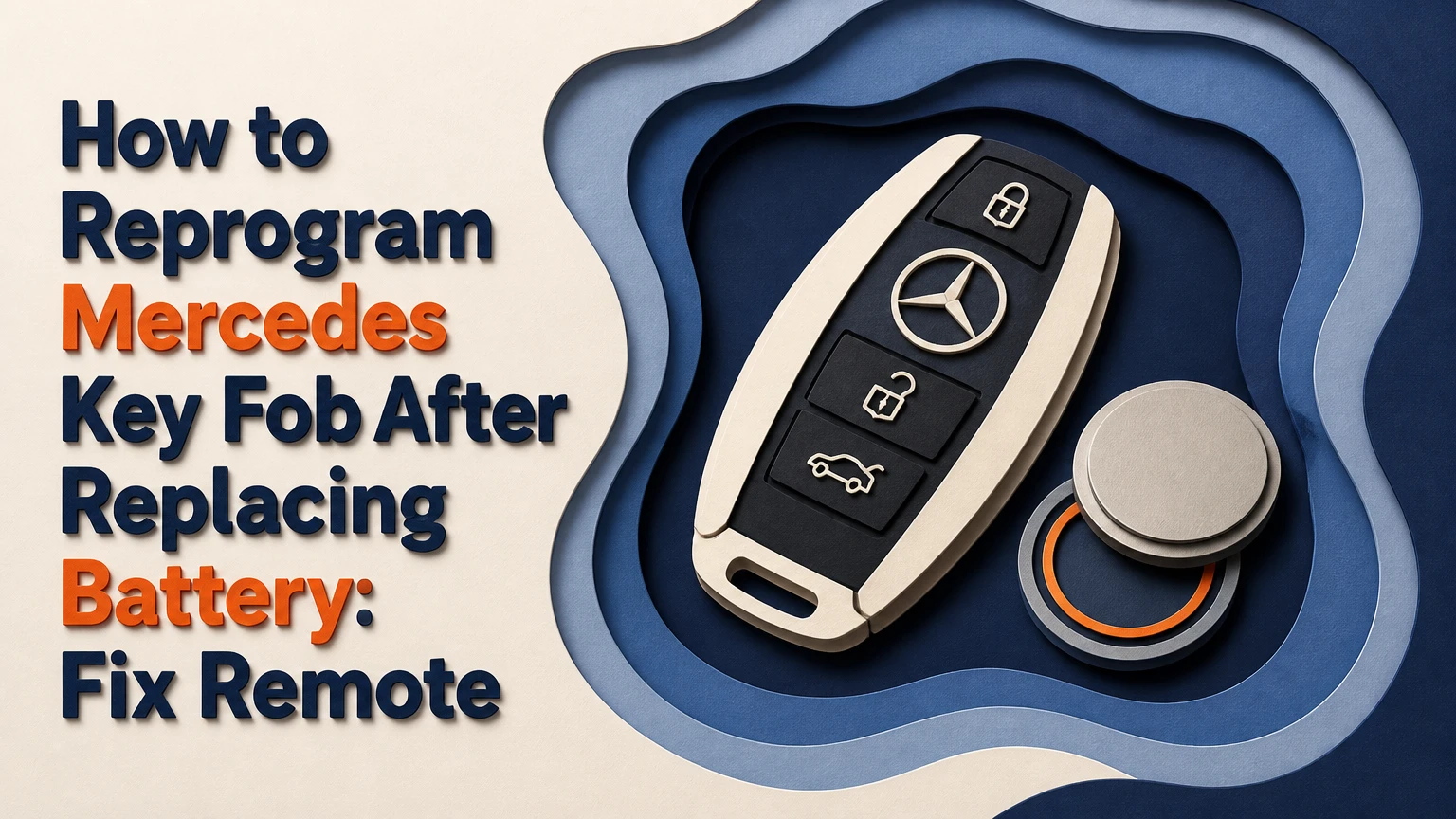
To reprogram a Mercedes key fob after replacing its battery, first install the correct battery with the proper polarity, then resynchronize the remote using the procedure for the vehicle’s chassis. Most battery changes require synchronization, not immobilizer programming. If the remote LED stays dark, the key still cannot start the vehicle, or Keyless-Go reports no key, diagnose the fob and vehicle separately.
Key Facts at a Glance
- A Mercedes-Benz key fob normally retains its immobilizer authorization when its coin-cell battery is removed.
- Remote lock and unlock functions use battery-powered radio or infrared electronics, while engine authorization uses a separate transponder system.
- Mercedes-Benz has no single synchronization sequence that applies to every model year and key generation.
- A red LED that does not flash usually indicates a battery, polarity, contact, or circuit-board problem.
- A key that unlocks the doors but cannot start the engine has a different fault from a remote that will not lock or unlock.
- Used Mercedes electronic keys are commonly vehicle-specific and may not be reusable, even when the case and buttons look identical.
What Does Reprogramming a Mercedes Key Fob Actually Mean?
“Reprogramming” usually means resynchronizing the remote transmitter with the vehicle’s central locking receiver. True key programming is different: a replacement key must receive vehicle-specific authorization for the Drive Authorization System, commonly called DAS or FBS, and that work requires restricted diagnostic equipment or a dealer ordering system.
A Mercedes key contains separate functions. The remote transmitter controls convenience functions such as locking, unlocking, trunk release, and panic operation. A transponder or encrypted key circuit handles starting authorization, and that circuit generally does not depend on the coin-cell battery.
The important correction is that removing a battery for several minutes does not normally erase the key’s immobilizer identity. A remote can still lose synchronization in some older systems, but a completely dead remote is more often caused by an incorrect battery, poor contact, a damaged circuit board, or a failed transmitter.
Mercedes-Benz owner manuals and service procedures differ by model, production date, and equipment package. Treat an Internet button sequence as a model-specific possibility, not a universal factory command.
How Does the Mercedes Key System Work?
The Mercedes-Benz key system combines remote convenience electronics with an anti-theft authorization system. The remote portion may use radio frequency, infrared communication, or both, while the immobilizer portion communicates with the vehicle’s electronic ignition switch and control modules.
Remote locking and starting are separate
A battery-powered transmitter sends a lock or unlock command to the vehicle. The rolling-code system changes its accepted code sequence to prevent a recorded signal from being reused indefinitely. Synchronization aligns the transmitter’s expected sequence with the receiver.
The start authorization circuit has a different job. On older vehicles, the key communicates through the ignition switch or infrared receiver; on newer vehicles, the SmartKey or Keyless-Go system exchanges encrypted data with the vehicle. A dead coin cell can disable proximity unlocking while the vehicle may still recognize the key in a backup location.
What a battery change can and cannot cause
| Symptom after battery replacement | Most likely system | First check | Does remote resync help? |
|---|---|---|---|
| LED flashes, doors do not respond | Remote transmitter | Battery polarity and synchronization | Often |
| LED remains dark | Fob power circuit | Battery voltage and contacts | No, repair power first |
| Doors respond, engine will not start | Immobilizer authorization | Backup slot and dashboard message | Usually no |
| Keyless-Go fails, inserted key starts car | Proximity antenna or remote battery | Backup recognition location | Sometimes |
| One key works, another does not | Individual fob | Compare batteries and LED behavior | Possibly |
| Both keys fail together | Vehicle-side system | Main battery and fuse supply | Rarely |
A practical rule from automotive locksmith diagnostics is to test the fob’s visible behavior before attempting programming. A synchronization procedure cannot repair a cracked solder joint, a corroded battery terminal, or a failed radio transmitter.
What Battery Does a Mercedes Key Fob Use?
The correct battery depends on the key housing and internal tray, not simply the Mercedes model year. Common Mercedes SmartKey batteries include CR2025 and CR2032 coin cells, but some housings use two cells and others use one.
| Key style or common application | Typical battery arrangement | Nominal voltage | Identification check |
|---|---|---|---|
| Early black SmartKey | 2 x CR2025 | 6 volts total | Two stacked or separated trays |
| Chrome SmartKey, narrow tray | 1 x CR2025 | 3 volts | Marking inside the holder |
| Chrome SmartKey, wide tray | 2 x CR2025 | 6 volts total | Two-cell carrier |
| Later flat SmartKey | 1 x CR2032 | 3 volts | Printed tray specification |
| Keyless-Go remote | CR2025 or CR2032, housing-dependent | 3 volts | Existing cell marking and manual |
Use a reputable lithium coin cell from Panasonic, Energizer, Duracell, or another established manufacturer. Do not substitute a CR2032 for a CR2025 because it is thicker; the wrong thickness can bend contacts or prevent the cover from closing.
Install the battery correctly
- Remove the emergency metal key and open the housing only at the intended release point.
- Photograph the old battery orientation before removal.
- Match the new cell to the marking inside the tray.
- Keep fingers off both broad battery faces where possible.
- Confirm that the spring contacts press firmly against the cell.
- Close the case without forcing the infrared window or circuit board.
A coin cell may measure near 3 volts with no load and still collapse under transmitter demand if it is defective. If the LED is weak, intermittent, or absent, test another new cell rather than repeating synchronization.
How to Reprogram Mercedes Key Fob After Replacing Battery
To resynchronize a Mercedes remote, use the ignition-based procedure only when the vehicle has a compatible mechanical ignition slot and the owner’s manual supports that method. The sequence is free and usually takes less than five minutes, but the correct chassis procedure determines success.
Before you start
| Requirement | Typical value | Why it matters |
|---|---|---|
| New coin cell | 1 or 2 cells | Must match the tray and polarity |
| DIY time | 5-10 minutes | Includes testing and a second attempt |
| Tools | None, or plastic pry tool | Avoid metal damage near contacts |
| Vehicle battery | Preferably above 12.2 volts at rest | Low voltage can disable receivers |
| Key position | Position 0, I, or II as specified | Positions differ by vehicle and ignition |
| Required access | Driver door, ignition, or backup slot | Needed for manual recognition |
Step 1: Verify the remote LED
Press and hold Lock for two seconds. A visible flash confirms that the fob has at least some power, although it does not prove that the transmitter is working at full range.
You will know the check passed when the LED flashes consistently on repeated presses. The common mistake is assuming that a tiny or occasional flash proves the cell is correctly installed; intermittent illumination points to weak contacts or a damaged board.
Step 2: Close the vehicle and remove nearby interference
Close all doors, keep the key inside the vehicle, and move other wireless keys, phones, and aftermarket transmitters away from the driver’s seat. Radio interference is uncommon but can make a successful synchronization appear unsuccessful.
You will know the setup is suitable when the instrument cluster wakes normally and no other key is being tested at the same time. Do not perform the procedure while the vehicle battery is being charged by an unstable power supply.
Step 3: Use the ignition-slot synchronization method when supported
Insert the SmartKey into the ignition slot and turn it to the position that powers the dashboard without cranking the engine. On many compatible vehicles, returning the key to Position 0 and pressing Lock immediately afterward resynchronizes the remote.
A commonly reported sequence is:
- Insert the key.
- Turn it to Position II, if the vehicle manual identifies that position.
- Wait approximately 30 seconds only when the model procedure calls for a wait.
- Return the key to Position 0 and remove it.
- Press and hold Lock for one second.
- Press Unlock or Lock once, then test the vehicle.
You will know it worked when the doors respond from close range and then from several metres away. The common mistake is treating the 30-60-second wait as a universal Mercedes requirement. Many systems need only the insert, turn, remove, and button sequence, while other systems synchronize automatically.
Step 4: Try the older five-press sequence on compatible remotes
Selected older Mercedes vehicles use a Lock-and-Unlock sequence after the key is rapidly moved from the first operating position back to Position 0. A commonly used procedure is:
- Insert the key and turn it quickly to Position II.
- Return it to Position 0 and remove it.
- Within 10 seconds, hold Lock.
- Press Unlock five times at roughly one-second intervals.
- Release the buttons.
- Press Lock or Unlock once.
- Test the remote beside the driver’s door.
This procedure is associated with selected older SmartKey systems, including some W163 and W211 vehicles, but it is not guaranteed across every production variant. You will know it worked when the central locking responds without a second battery change. The common mistake is counting five presses too quickly or releasing Lock before the five Unlock presses finish.
Step 5: Test every function separately
Test Lock, Unlock, trunk release, panic operation if fitted, and the mechanical blade. Then test starting authorization with the key in the normal ignition or backup recognition position.
A remote can partially work. For example, the trunk button may respond while the lock button has a worn contact. Record each result because a locksmith can diagnose a partial transmitter fault more quickly from function-by-function symptoms.
Which Mercedes Key Procedure Fits Your Vehicle?
The vehicle’s exact model, production date, ignition type, and key housing determine the correct procedure. A 2010 E-Class with a mechanical SmartKey slot may use a different process from a 2010 E-Class equipped with Keyless-Go, even though both vehicles share a model name.
| Vehicle or key condition | Procedure to try first | Expected result | Escalation point |
|---|---|---|---|
| Older key with metal ignition slot | Older five-press sequence | Remote lock synchronization | Two failed attempts |
| Chrome SmartKey in ignition slot | Insert, operate ignition, press Lock | Remote response returns | LED works but no response |
| Push-button Keyless-Go | Use backup slot or emergency recognition area | Vehicle recognizes key | “Key not detected” remains |
| Flat newer SmartKey | Battery and backup recognition test | Proximity and buttons return | Dealer or qualified specialist |
| No LED after new cell | Contact and polarity inspection | LED flashes steadily | Board repair or key replacement |
| Remote works only beside car | Antenna, interference, or weak transmitter check | Normal range restored | Vehicle-side RF diagnosis |
Do not force a push-start button out of the dashboard unless the owner’s manual identifies it as removable. Some vehicles have a removable start button that reveals an emergency key slot; others use a dedicated receptacle in the centre console or another location.
What If the Keyless-Go Key Is Not Detected?
A Mercedes-Benz Keyless-Go key that is not detected after a battery change should be tested in the vehicle’s backup recognition position. The backup position may be in a centre-console compartment, a cup-holder area, beside the steering column, or within a marked receptacle, depending on the model.
Use the physical emergency blade to unlock the driver’s door if the remote buttons do not work. The alarm may sound after mechanical entry, but inserting the authorized key into the ignition or placing it at the documented backup sensor can disarm the vehicle and permit starting.
| Message or behavior | Likely cause | Immediate action |
|---|---|---|
| Key not detected | Weak fob cell or proximity antenna issue | Place key in backup slot |
| Replace key battery | Low transmitter voltage | Install correct cell |
| Start Error | Authorization or EIS fault | Stop repeated attempts |
| Remote works, proximity fails | Keyless-Go battery or antenna | Test backup recognition |
| No interior electrical power | Vehicle battery fault | Measure vehicle voltage |
A vehicle that starts with the key in the backup slot but not through proximity has a convenience-entry problem, not necessarily a lost immobilizer program.
Why Is the Mercedes Remote Still Not Working?
The most common post-replacement failures are reversed polarity, wrong cell thickness, bent contacts, a poorly closed housing, and a dead vehicle battery. Synchronization should be attempted only after those basic faults are excluded.
Check these failure modes
- Incorrect polarity: Reopen the tray and compare the plus sign with the housing diagram. Some Mercedes housings place the positive face upward, but the tray marking controls.
- Wrong battery type: Replace a CR2032 with the specified CR2025 if the tray requires the thinner cell.
- Dirty contacts: Clean light oxidation with isopropyl alcohol on a lint-free swab, then allow the board to dry completely.
- Damaged housing: Replace a broken shell only if the electronic board and transponder remain undamaged.
- Water intrusion: A wet or corroded board needs electronic inspection, not repeated button sequences.
- Low vehicle voltage: A fully charged 12-volt battery usually measures about 12.6 volts at rest; readings near 12.0 volts indicate a substantially discharged battery.
Expert diagnostic rule: if two correctly installed keys fail at the same time, inspect the vehicle before blaming both fobs. If only one key fails and its LED is dark, inspect that key first.
Can a Dead Mercedes Key Battery Prevent Starting?
A dead Mercedes key battery may prevent remote locking or Keyless-Go proximity detection, but many Mercedes vehicles can still start when the authorized key is inserted into the ignition slot or placed at the emergency recognition position. The exact backup method depends on the vehicle’s equipment and owner’s manual.
The mechanical blade only unlocks the door. It does not itself authorize the engine. Starting requires the electronic key circuit to communicate with the vehicle, so a damaged or unrecognized key will not become functional merely because the door opens.
Do not repeatedly crank the engine while a dashboard message reports “Start Error” or “Key Not Detected.” Repeated attempts can discharge the vehicle battery and obscure the original fault.
Do You Need a Locksmith or Mercedes Dealer?
A locksmith is appropriate for diagnosis, shell replacement, and some older FBS3 key systems. An authorized Mercedes-Benz dealer is usually the safer route for newer FBS4 vehicles, lost-all-key situations, encrypted replacement keys, and cases involving the Electronic Ignition Switch or vehicle authorization data.
| Service path | Typical cost, USD | Typical time | Best use |
|---|---|---|---|
| DIY battery replacement | $3-$15 | 5-10 minutes | Cell, polarity, and contact faults |
| Independent diagnostic locksmith | $50-$150 | 30-90 minutes | Older keys and vehicle-side testing |
| Replacement aftermarket key | $150-$400 | 1-3 hours | Supported older systems |
| Authorized dealer key order | $300-$800 or more | 2-10 business days | Newer encrypted keys |
| Dealer diagnosis and coding | $100-$250 before parts | 1-3 hours | EIS, FBS, antenna, and authorization faults |
These are typical ranges, not fixed prices. Country, model, key availability, emergency call-out fees, and proof-of-ownership requirements can change the total substantially.
A used Mercedes key from an online marketplace may have an intact shell but an electronic chip already assigned to another vehicle. A locksmith can often transfer buttons or a case, but cannot reliably erase and reuse every encrypted key. Ask whether the quote covers a new key, programming, emergency service, cutting, and VAT or sales tax.
When Should You Stop DIY Troubleshooting?
Stop DIY work when the fob has no LED after two known-good cells, the board shows corrosion, the key is physically cracked near the infrared window, the car displays an authorization error, or the ignition slot will not recognize either available key. These symptoms point beyond simple remote synchronization.
Take the vehicle identification number, registration or title, government identification, every available key, and the exact dashboard message to the service provider. Ownership verification is commonly required before a dealer or reputable locksmith orders or programs a replacement.
The strongest practical limitation is model uncertainty. Without the exact year, chassis code, ignition type, and key photo, no Internet procedure can guarantee the correct sequence. Mercedes-Benz owner manuals and service information take priority over a generic button pattern.
How Much Time Should the Repair Take?
A correct battery installation and remote synchronization normally takes 5-10 minutes. A locksmith diagnosis commonly takes 30-90 minutes, while a dealer replacement key may take several business days because the key is ordered against the vehicle identification number.
| Situation | DIY time | Professional time | Likely next step |
|---|---|---|---|
| Battery installed backward | 5 minutes | Not needed | Correct polarity |
| Remote needs synchronization | 5-10 minutes | 15-30 minutes | Model-specific resync |
| Damaged battery contacts | Not recommended | 30-90 minutes | Key repair or replacement |
| Keyless-Go antenna fault | Not practical | 1-3 hours | Vehicle diagnosis |
| Lost or unusable key | Not possible | 1-10 business days | Dealer or qualified locksmith |
| EIS or FBS authorization fault | Not possible | 1-4 hours plus parts | Specialized programming |
Frequently Asked Questions
Does removing the Mercedes key battery erase the programming?
No, removing the coin cell normally does not erase the immobilizer authorization stored in the key. The battery powers remote convenience functions, while the start-authorization circuit is separate. A remote may need synchronization afterward, but a lost immobilizer identity requires a different diagnosis.
Can I program a Mercedes key with the ignition?
Some older Mercedes vehicles permit remote resynchronization through the ignition and a button sequence. Ignition-based synchronization does not mean that a blank replacement key can be fully programmed at home. New keys may require restricted diagnostic access, factory ordering, or specialist equipment.
Why does the Mercedes key start the car but not unlock it?
A key that starts the vehicle but does not unlock it usually has a remote-side fault. Check the coin cell, polarity, contacts, transmitter LED, and synchronization. The immobilizer transponder is still being recognized, so replacing or programming the entire key may be unnecessary.
Can I use a CR2032 instead of a CR2025?
Use only the cell specified by the key tray or owner’s manual. A CR2032 has the same nominal voltage as a CR2025 but is thicker, so it may deform contacts or prevent the case from closing. The two batteries are electrically similar but not always mechanically interchangeable.
Where is the emergency Mercedes key slot?
The location varies by model and equipment. Common locations include the ignition slot, the lower centre-console area, a cup-holder compartment, or a marked backup receptacle. The owner’s manual identifies the exact position; forcing a start button or console trim can cause damage.
Will a used Mercedes key work after programming?
Often, no. Many Mercedes electronic keys contain vehicle-specific or one-time-authorized components that cannot be erased and assigned to another vehicle. A used shell may be useful for transferring buttons or trim, but confirm electronic reusability with a qualified specialist before buying.
The Bottom Line
How to reprogram Mercedes key fob after replacing battery depends on whether the problem is synchronization, fob power, Keyless-Go recognition, or immobilizer authorization. Install the specified CR2025 or CR2032 correctly, confirm a steady LED, try the chassis-appropriate resynchronization procedure, and test the backup recognition position. If both keys fail, the car shows an authorization error, or the fob remains electronically dead, stop repeating button sequences and use a qualified Mercedes locksmith or authorized dealer.