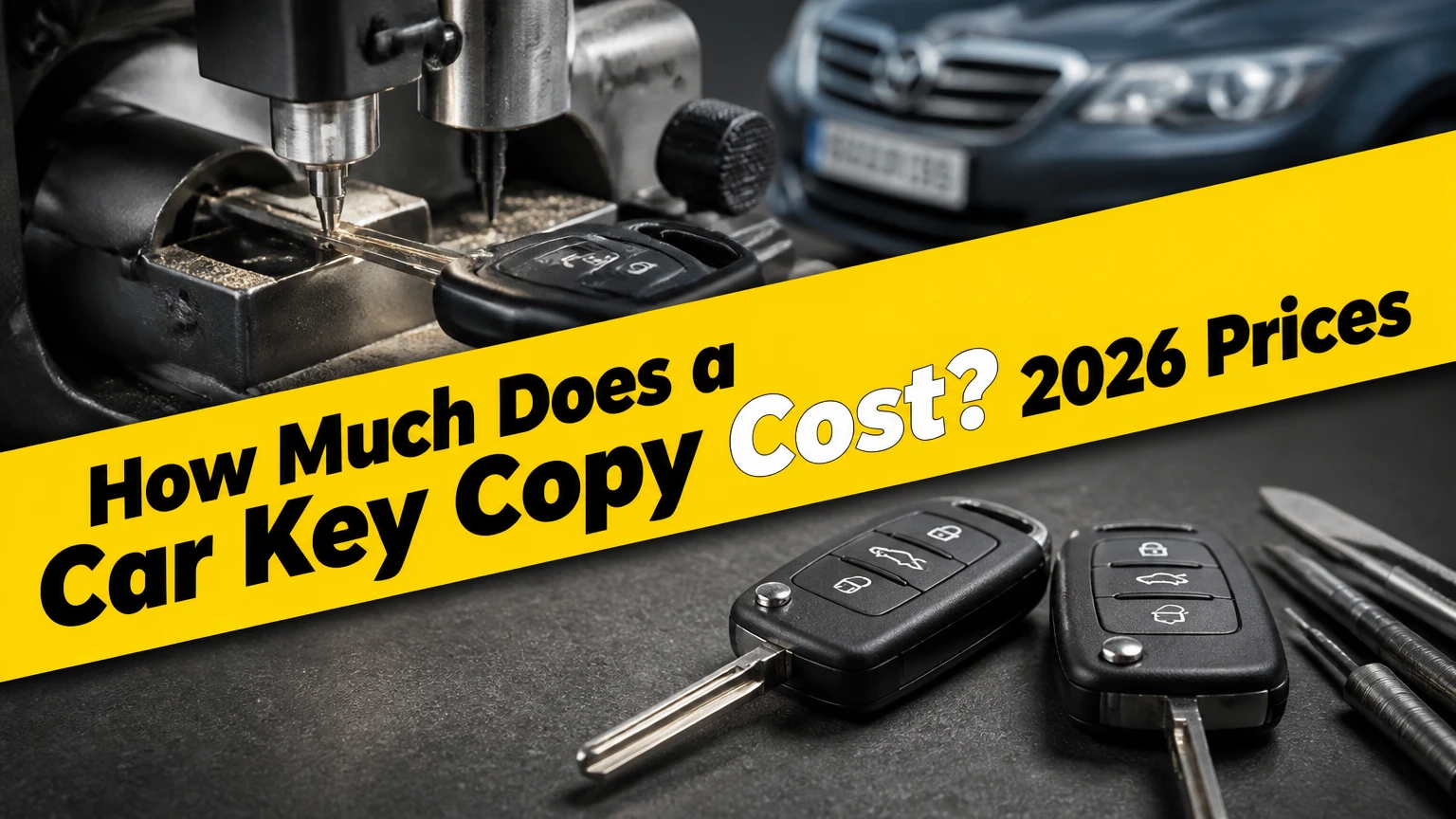
A car key copy costs about $10-$25 for a basic mechanical key, $60-$190 for a transponder key, $150-$350 for a remote-head key, or $200-$500 or more for a smart key fob. The final price depends mainly on the vehicle’s year, make, model, key technology, whether you still have a working key, and whether programming or mobile service is required.
Key Facts at a Glance
- A working-key duplicate usually costs less than an all-keys-lost replacement because the original supplies the mechanical and electronic reference.
- Hardware stores and kiosks commonly handle simple metal keys, but many cannot program immobilizer chips or proximity fobs.
- Automotive locksmith pricing is typically lower than dealership pricing, although luxury brands may require dealer-level software or security access.
- A key that turns the ignition may still fail to start the engine if its transponder is not authorized by the immobilizer.
- A remote-control battery powers buttons and proximity functions; it usually does not program the vehicle or replace an immobilizer registration.
- A written quote should separate the key or fob, cutting, programming, service call, taxes, and emergency or after-hours charges.
What Is Included in a Car Key Copy?
A car key copy is a duplicate made from a functioning key, while a replacement can involve generating a new key when every original is missing. The distinction matters because a duplicate can often be decoded and programmed faster, whereas an all-keys-lost job may require vehicle security data, ownership verification, towing, or dealer support.
A complete copy may contain two separate components:
- The mechanical portion: A metal blade cut to match the lock or ignition cylinder.
- The electronic portion: A transponder, remote transmitter, or proximity fob authorized for the vehicle.
A metal duplicate may unlock a door but fail to start the car. A remote may lock and unlock the doors but contain no valid immobilizer chip. A smart fob may need both button programming and proximity or push-button authorization.
The phrase “copy” therefore covers several different services. Ask whether the quote includes a cut blade, transponder programming, remote pairing, emergency-blade cutting, and testing in the vehicle.
Why Does a Working Key Reduce the Price?
A working key reduces duplication cost because the technician can use it as a physical pattern and electronic reference. The locksmith may still need a vehicle-specific blank and diagnostic tool, but the job normally avoids the additional work associated with retrieving key codes or erasing missing keys.
The savings are often substantial. A working-key transponder duplicate might cost $80-$180, while an all-keys-lost job for the same vehicle can reach $200-$600 after programming, travel, and recovery costs. The actual difference varies by brand, location, security generation, and whether the vehicle can be programmed through its diagnostic port.
How Much Does a Car Key Copy Cost by Type?
The cost of a car key copy generally rises with the number of mechanical and electronic functions it combines. Typical U.S. consumer prices range from $10 for a plain metal duplicate to more than $500 for a sophisticated proximity fob, with aftermarket and OEM parts producing different totals.
| Key type | Typical copy price | Typical time | Main requirement |
|---|---|---|---|
| Traditional metal key | $10-$25 | 2-5 minutes | Correct mechanical blank |
| Basic transponder key | $60-$190 | 10-20 minutes | Chip cutting and immobilizer programming |
| Laser-cut or sidewinder key | $70-$235 | 15-30 minutes | High-security milling machine |
| Remote-head or switchblade key | $150-$350 | 20-40 minutes | Blade cutting, chip registration, remote pairing |
| Smart or proximity fob | $200-$500+ | 30-60 minutes | Vehicle-specific fob and diagnostic authorization |
These ranges are typical practitioner ranges, not guaranteed national prices. OEM fobs, luxury European vehicles, urgent mobile calls, and vehicles with restricted programming access can exceed the upper figures.
Traditional Mechanical Keys
Traditional mechanical keys cost about $10-$25 because they contain no electronic security component. A key cutter duplicates the edge pattern onto a compatible blank, then checks that the blade operates the door and ignition without binding.
This option is common on older vehicles, utility vehicles, trailers, and some fleet equipment. A hardware store may cut it successfully if the blank is correct and the original is not excessively worn.
A cheap copy is not automatically a precise copy. If the original blade has rounded cuts, duplicating it can reproduce its wear and create a key that sticks. A locksmith can decode the lock or use the manufacturer key code when the original is too damaged to trust.
Transponder Chip Keys
Transponder duplicates cost approximately $60-$190 because the blade and immobilizer chip both have to work. The chip communicates with the vehicle’s immobilizer, and the engine control system permits starting only after recognizing an authorized identifier.
The key may look simple from the outside. Its plastic head can conceal a fixed-code, rolling-code, or encrypted transponder. Some chips can be cloned from a working key, while others require a new identifier to be registered directly to the vehicle.
A transponder key with a correct blade but an unprogrammed chip may turn the ignition and still leave the engine stalled. A flashing security or key-shaped warning light often points to that electronic failure.
Laser-Cut and Sidewinder Keys
Laser-cut, also called sidewinder or high-security, duplicates typically cost $70-$235. The blade is thicker, and the cut usually consists of a precise channel or wavy track through the blade rather than simple notches along one edge.
The price reflects specialized milling equipment and more expensive blanks. A standard key duplicator cannot accurately produce many sidewinder profiles.
Laser-cut does not automatically mean the key contains a transponder. Some sidewinder keys are mechanical only, while others combine the profile with an immobilizer chip or remote electronics. The vehicle’s key design determines the full price.
Remote-Head and Switchblade Keys
Remote-head and switchblade copies commonly cost $150-$350. These units combine a metal blade, an immobilizer transponder, and lock-control buttons in one housing, while switchblade models fold the blade into the casing.
The technician may perform separate procedures: cutting the blade, registering the immobilizer, and pairing the remote buttons. One part can work while another fails. For example, the car may start but the lock buttons may remain inactive if remote synchronization was skipped.
Aftermarket shells can lower the parts price, but compatibility depends on the circuit board, transponder type, radio frequency, button layout, and vehicle programming method.
Smart and Proximity Fobs
Smart-key copies usually cost $200-$500 or more because the fob communicates with the vehicle without being inserted into an ignition. Push-to-start vehicles may use proximity antennas, encrypted communication, rolling identifiers, and multiple interior detection zones.
The replacement must match the vehicle’s fob specification. A fob operating at 315 MHz may not work with a vehicle designed for 433 MHz, and a visually identical unit can contain a different circuit board or locked transponder.
The hidden emergency blade is separate from proximity operation. Confirm that the provider cuts and tests it, because that blade may be the only way to open the door when the vehicle battery or fob battery is dead.
What Determines the Price of a Duplicate Key?
Vehicle year, make, model, key technology, part quality, programming access, and service location determine the final price more reliably than the word “copy.” Two vehicles parked in the same driveway can require different equipment, software, and security credentials.
| Price factor | Lower-cost example | Higher-cost example | Typical effect |
|---|---|---|---|
| Vehicle age | 1998 metal key | 2024 proximity system | $10-$500+ total |
| Key source | Compatible aftermarket blank | OEM dealer fob | $30-$250 part difference |
| Key status | Working spare available | Every key lost | $75-$300 additional work |
| Service location | Shop visit | Mobile or after-hours call | $25-$150 fee difference |
| Brand security | Common Ford or Honda | BMW, Mercedes-Benz, or Audi | $100-$400+ additional cost |
| Programming method | Onboard owner procedure | Diagnostic or server authorization | $0-$200 labor difference |
Does OEM or Aftermarket Quality Change the Cost?
OEM keys usually cost more than aftermarket keys, but price alone does not determine reliability. An OEM fob is built for the vehicle’s exact part number, while a reputable aftermarket product can work well when its FCC ID, frequency, chip, button layout, and programming capability match.
Refurbished units create a separate risk. A used fob may retain a locked identifier from another vehicle, have a worn button membrane, or contain a weak circuit board. Some models accept a reusable fob, but many do not.
Before purchasing online, compare the old unit’s label and board with the proposed replacement. Match the manufacturer part number where available, not merely the year, make, and model listed in a marketplace title.
Where Should You Get a Car Key Copied?
An automotive locksmith is usually the best value for a programmed duplicate, while a dealership offers the most direct route for restricted systems and a hardware store is appropriate mainly for mechanical keys. The right provider depends on the key technology, urgency, vehicle brand, and availability of a working original.
| Provider | Typical price | Typical time | Best fit | Main limitation |
|---|---|---|---|---|
| Hardware store or kiosk | $5-$25 | 2-10 minutes | Metal keys | Limited chip and fob support |
| Automotive locksmith | $80-$300 | 15-60 minutes | Most working-key duplicates | Tool coverage varies by brand |
| Independent repair shop | $100-$300 | 30-90 minutes | Routine local service | Often lacks mobile response |
| Dealership | $200-$500+ | 1-5 business days | OEM or restricted systems | Higher parts and labor costs |
| Mobile emergency locksmith | $150-$450 | 30-120 minutes | Lockout or urgent duplicate | Travel and after-hours fees |
Published consumer guidance commonly places locksmith service below dealer pricing, but no universal percentage applies. Edmunds, in its coverage of vehicle-key costs, has warned that modern keys combine security electronics with a relatively expensive vehicle-specific part, which explains why a small plastic fob can cost more than a traditional key.
When Is a Dealership Worth the Extra Cost?
A dealership can be worth the extra cost when the vehicle requires factory authorization, an OEM-only fob, a security code unavailable to local technicians, or a programming procedure tied to the manufacturer’s server. BMW, Mercedes-Benz, Audi, some newer Stellantis vehicles, and certain luxury systems may fall into this category.
Dealership service is not automatically better for every duplicate. A dealer may charge diagnostic labor, require an appointment, and order the part by VIN, while a qualified automotive locksmith may complete a working-key copy at the vehicle’s location.
Ask the dealer whether the quote includes cutting, programming, taxes, and key registration. Some quotes show only the fob price and add labor at checkout.
When Is a Hardware Store Enough?
A hardware store is enough when the vehicle uses a plain mechanical blade and the original key is in good condition. The service is inexpensive because no immobilizer data, remote transmitter, or vehicle connection is involved.
Hardware kiosks are poor choices for diagnosing a no-start condition. A kiosk may copy the grooves accurately while providing no transponder, an incompatible chip, or no vehicle programming. The duplicate must be tested in the ignition, not judged by appearance.
How Is a Car Key Copy Made?
A professional duplicate follows four technical stages: identify the key system, cut the physical blade, program or clone the electronic component, and test every function. The process usually takes 10-60 minutes when a working key and compatible blank are available.
- Identify the vehicle and key system. The technician confirms the VIN or registration, model year, key style, frequency, and programming method.
- Decode the mechanical pattern. A machine traces the original key, or the technician reads a code from the lock, key tag, or manufacturer database.
- Cut the new blade. The correct blank receives edge cuts or a sidewinder track, then the technician removes burrs and checks insertion.
- Identify the transponder or fob. A diagnostic or cloning tool determines whether the chip is fixed, reusable, encrypted, or vehicle-registerable.
- Authorize the vehicle. The technician either clones compatible data or connects a programming tool through the diagnostic port and registers the new key.
- Test separately. The blade, engine start, lock buttons, trunk release, panic button, proximity detection, and emergency blade receive individual checks.
A remote pairing procedure is not the same as immobilizer programming. Button synchronization can restore door controls while leaving the engine authorization incomplete.
Can You Program a Duplicate Car Key Yourself?
You can program some duplicate keys yourself, but only when the vehicle supports an owner procedure and the replacement contains the correct electronics. Older Ford, General Motors, and Chrysler vehicles may allow onboard sequences, while many newer vehicles require a diagnostic tool, two recognized keys, a security PIN, or manufacturer server access.
Read the owner’s manual before buying a blank. A self-programming procedure may require two already programmed keys, a specific ignition sequence, or a limited time window. If every key is lost, the same procedure usually cannot create the first authorized key.
Remote-button programming is more widely available than immobilizer programming. A successful lock-button response does not prove that the transponder will start the engine.
DIY buying becomes risky when sellers use broad compatibility claims. Verify:
- Vehicle year, make, and model
- FCC ID or equivalent radio identifier
- OEM part number
- Radio frequency
- Button count and layout
- Blade profile
- Transponder type
- New, refurbished, or previously locked status
- Return policy after programming
What Does a Copy Cost When Every Key Is Lost?
An all-keys-lost replacement commonly costs $200-$600, although some luxury, exotic, and newer vehicles can exceed $1,000 after towing, security access, and dealer labor. The price is higher because the technician cannot simply read a working key and may need to generate, erase, or re-register the vehicle’s key list.
All-keys-lost service can include vehicle entry, key-code retrieval, immobilizer reset, programming, cutting by VIN or lock, and mobile travel. A dealer may require the vehicle at the service department, which adds towing if no key can move it.
Proof of ownership is normally required. Prepare the registration or title, government identification, VIN, and financing or rental documentation when applicable.
A lost key also creates a security issue. Ask whether the missing key can be erased from the vehicle’s authorized-key list. Cutting a new key without deleting the old identifier may allow the lost key to start or unlock the vehicle.
What If the Original Key Is Damaged or Worn?
A damaged original can still provide enough information for duplication, but a badly worn blade should not be copied directly. Rounded cuts transfer the wear pattern and may produce a key that works inconsistently in the ignition.
A locksmith can decode a lock, read a key code, or use vehicle records when the original is unreliable. If the ignition cylinder itself is worn, a new key may not solve the problem because the cylinder tolerances have already deteriorated.
Test a new duplicate gently. Do not force a stiff key, and do not use a key that requires twisting pressure to remove. Broken blades can damage the ignition cylinder and convert a low-cost duplicate into a larger repair.
What Problems Can Occur After Duplication?
The most common post-duplication failures are an incorrect blade, an unprogrammed transponder, an incompatible remote, a weak fob battery, or a vehicle security system that rejected the registration. Each symptom points toward a different repair rather than a second blind purchase.
| Symptom | Likely cause | First check | Typical remedy |
|---|---|---|---|
| Key will not enter lock | Wrong blade profile | Compare blank and original | Recut or replace blank |
| Key turns, engine stalls | Transponder not authorized | Security indicator | Program chip to vehicle |
| Engine starts, buttons fail | Remote not paired | Lock and unlock functions | Perform remote synchronization |
| Proximity works intermittently | Weak coin cell or antenna issue | CR2032 or CR2025 battery | Replace battery and retest |
| Emergency blade fails | Blade not cut or wrong profile | Manual door-cylinder test | Cut and test backup blade |
| Duplicate sticks | Worn original or poor cut | Compare cuts and insertion | Decode lock and recut |
Keep the original key away from the duplicate during the first immobilizer test. Some ignition systems can read two transponders near the antenna and produce confusing results, although the exact behavior varies by vehicle.
A weak CR2032 or CR2025 battery usually affects remote buttons or proximity detection, not a passive transponder that authorizes a traditional ignition key. Replacing the battery is sensible, but it will not correct a chip that was never programmed.
How Can You Get the Lowest Safe Price?
The lowest safe price comes from obtaining a duplicate while a working key remains available, comparing a qualified locksmith with the dealer, and confirming the complete installed price before service. Saving $40 on an incompatible online fob is not a saving if programming fails and the part cannot be returned.
Use this buying sequence:
- Photograph the original key, including its labels and part number.
- Record the vehicle year, make, model, trim, and ignition type.
- Ask two local providers for an itemized quote.
- Confirm whether the price includes the blank, blade cutting, chip programming, remote pairing, travel, and tax.
- Ask whether the provider can delete a lost key from the authorized list.
- Test starting, locking, unlocking, trunk release, panic function, proximity detection, and the emergency blade before paying.
- Keep the new duplicate in a separate secure location.
Insurance and roadside-assistance plans sometimes reimburse lockout or replacement costs, but coverage limits and exclusions differ. Obtain an invoice showing the vehicle, service date, parts, programming, and labor before filing a claim.
Expert Rules That Prevent Expensive Errors
- Duplicate before an emergency. A spare made from a functioning key is usually cheaper and less disruptive than an all-keys-lost service call.
- Price the installed result, not the part. A $35 online fob can become a $150 purchase after cutting, failed programming, shipping, and a second provider visit.
- Treat the emergency blade as a required function. A smart fob that starts the car but cannot open the door during a dead-battery event is incomplete.
- Do not copy a worn key blindly. The key may be worn because the lock is worn, and a duplicate can reproduce the defect.
- Separate remote pairing from immobilizer authorization. Door-button operation does not confirm engine-start permission.
Car Key Copy Cost FAQ
Is copying a car key cheaper than replacing one?
Copying a car key is usually cheaper than replacing one when a working original remains available. A basic duplicate may cost $10-$25, while a programmed duplicate often costs $60-$300. All-keys-lost replacement commonly reaches $200-$600 because security recovery and key-list registration may be required.
Can AutoZone or Walmart copy a car key?
AutoZone, Walmart, and similar retailers may sell or cut selected mechanical, transponder, or remote products, but service capability varies by location and vehicle. A plain metal key is the most reliable low-cost option. Confirm chip programming, cutting, return policy, and final installed price before purchase.
How long does it take to make a spare car key?
A mechanical spare usually takes 2-5 minutes. A transponder key commonly takes 10-20 minutes, while a remote-head or smart fob takes about 20-60 minutes when the correct blank and programming equipment are available. Dealer orders can take one to five business days if the part is not in stock.
Does a copied key need to be programmed?
A copied key needs programming when it contains a transponder, remote transmitter, or proximity system. A purely mechanical key does not. A key can fit and turn the ignition without being programmed, but the immobilizer may prevent the engine from continuing to run.
Can a locksmith make a car key without the original?
An automotive locksmith can often make a key without the original by decoding the lock, using the VIN or key code, and programming a new electronic identifier. The job costs more than a working-key duplicate and normally requires proof of ownership. Some restricted vehicles must be handled by a dealer.
Should I buy an OEM or aftermarket car key?
Choose an OEM key when the vehicle has restricted programming, a high-cost security system, or poor aftermarket support. A reputable aftermarket key can reduce cost for common vehicles if the FCC ID, part number, frequency, blade, chip, and programming method match exactly. Avoid unknown used fobs with no return protection.
The Bottom Line
The answer to how much does a car key copy cost is usually $10-$25 for a mechanical key, $60-$190 for a transponder key, $150-$350 for a remote-head key, or $200-$500 or more for a smart fob. Keep a working spare, request an itemized quote, and choose a hardware store, automotive locksmith, or dealership according to the vehicle’s actual key technology rather than its appearance.