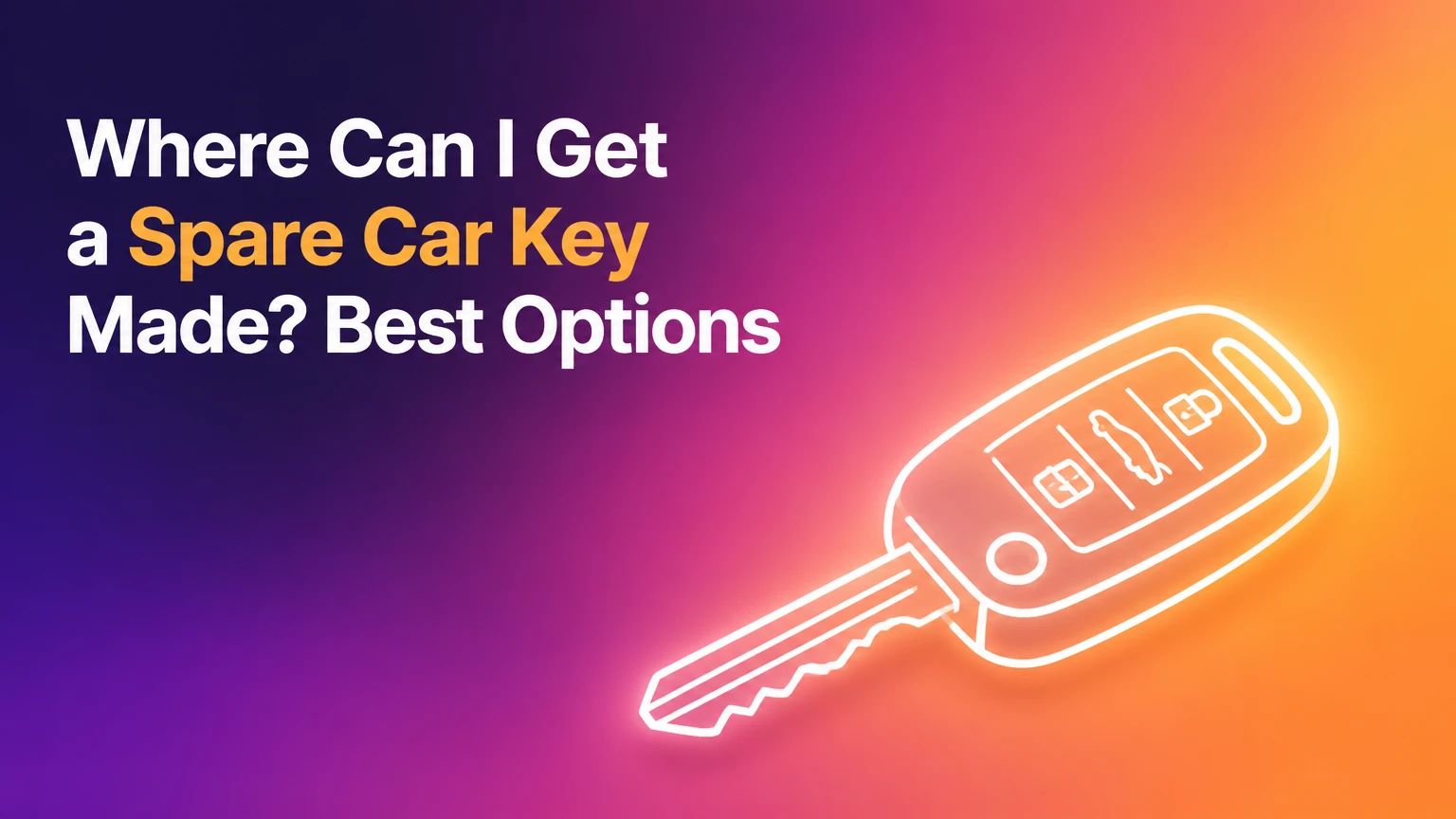
You can get a spare car key made by an automotive locksmith, vehicle dealership, hardware store, key kiosk, or online key supplier. An automotive locksmith is usually the best value for a programmed duplicate, while a hardware store handles only basic metal keys and a dealership is safest for newer luxury vehicles or restricted smart keys.
Key Facts at a Glance
- A basic metal car key typically costs $5-$20 and can take 5-15 minutes to duplicate.
- A transponder key needs both a correctly cut blade and an immobilizer chip programmed to the vehicle.
- A mobile automotive locksmith commonly makes a programmed spare in 20-60 minutes.
- Dealership smart-key replacement commonly costs $250-$600, with luxury models sometimes exceeding $800.
- A key fob’s FCC ID, part number, blade profile, vehicle market, and radio frequency must match the vehicle.
- If a key was stolen, ask the provider to erase the missing key from the vehicle’s authorized-key memory.
Where Can I Get a Spare Car Key Made?
An automotive locksmith is the best first call for most owners who still have one working key. Locksmiths can usually cut the blade, supply a compatible transponder or remote, program the immobilizer, and test the result at the vehicle, often for less than a dealer.
A dealership is the most dependable choice when the vehicle is new, leased, luxury-branded, or protected by manufacturer-controlled programming. Hardware stores and automated kiosks are appropriate only when the vehicle uses a plain mechanical key or the retailer explicitly supports the exact transponder system.
The right provider depends on four facts: the vehicle’s year, make and model; whether the car uses a physical ignition or push-button start; whether one working key remains; and whether the replacement must be OEM. A provider that can cut a blade may not be able to program the electronic security system.
Provider comparison
| Provider | Typical price | Typical time | Best use |
|---|---|---|---|
| Hardware store | $5-$20 | 5-15 minutes | Plain metal key |
| Key kiosk | $10-$150 | 10 minutes or 3-5 days | Supported duplicate or shipped fob |
| Automotive locksmith | $70-$300 | 20-60 minutes | Transponder, remote, or smart-key spare |
| Dealership | $150-$600+ | 1-2 hours or several days | OEM or restricted system |
| Online plus local programming | $20-$200 total | 1-7 days | Exact compatible aftermarket key |
Prices are typical US consumer ranges, not guaranteed quotes. Vehicle access, emergency call-out charges, key hardware, taxes, regional labor rates, and programming difficulty can change the final amount.
What Kind of Car Key Do You Need?
The key type determines whether duplication is simple, whether programming is required, and which providers can complete the job. A vehicle key may contain several separate functions: a mechanical blade for the lock, a transponder for engine authorization, buttons for remote entry, and a proximity system for keyless starting.
Mechanical metal keys
A traditional friction-cut key has notches along one or both edges and no electronic chip. Many older vehicles use this design for both the door and ignition, although some older cars have a separate security system or coded ignition.
A hardware store can generally duplicate a plain key from the original. The cheapest option is unsuitable if the plastic head contains a hidden transponder chip, because the new blade may unlock the door but leave the immobilizer unable to authorize engine operation.
Laser-cut or high-security keys
A laser-cut, sidewinder, or high-security key has a thicker blade and a milled track through the center or sides. Its profile requires a compatible milling machine rather than a basic edge-cut duplicator.
A locksmith or dealership should cut this type from a code or an accurate reference key. Copying a badly worn original can transfer its errors to the spare, so code-based cutting is preferable when available.
Transponder chip keys
A transponder key contains a passive electronic chip inside the plastic head. The engine immobilizer reads the chip when the key is inserted or brought near the ignition antenna, then permits starting only when the stored credential is accepted.
A mechanically perfect copy does not automatically become a working spare. The provider must either clone the original chip or add a separate key credential through an approved programming procedure.
Remote-head and flip keys
A remote-head key combines a blade with lock, unlock, trunk, or panic buttons. The immobilizer chip and remote-control circuit are related but separate functions, so a key may start the engine while its buttons remain unprogrammed.
Flip keys add a folding blade inside the fob. Replacement shells can repair worn buttons or cracked plastic, but a shell replacement does not replace a damaged transponder or circuit board.
Smart keys and proximity fobs
A smart key, proximity fob, or keyless-start fob allows the car to detect an authorized device without inserting a blade. The fob communicates with antennas around the cabin and exterior door areas, while a backup mechanical key may remain hidden inside the housing.
Smart fobs are the most expensive common key type because hardware, encryption, registration, and vehicle-specific procedures all affect the job. A dead fob battery usually prevents passive entry but does not necessarily mean the fob must be replaced. Many vehicles provide a designated emergency-start location described in the owner’s manual.
How Do Modern Car Keys Work?
Modern car keys usually perform two separate jobs: mechanical access and electronic authorization. The blade turns a lock or ignition cylinder, while the transponder or proximity system tells the immobilizer that the vehicle may start.
A passive transponder receives energy from an antenna near the ignition and returns an identification credential. A smart fob uses a battery-powered circuit for remote buttons and proximity communication, although the exact cryptographic design varies by manufacturer and model year.
The engine control system does not rely on the key blade alone. If the blade turns but the immobilizer rejects the chip, the starter may crank and the engine may run briefly before shutting down, or the vehicle may refuse to start at all. Remote lock and unlock functions can fail independently because they use a different circuit and programming process.
“Key programming” is not one universal operation. Some older vehicles allow an owner to add a key through a manufacturer-defined sequence when two recognized keys are already available. Others require a diagnostic tool, a security PIN, an online manufacturer account, or a dealer-authorized server connection.
Cutting, cloning, and programming
| Operation | What changes | Result | Main limitation |
|---|---|---|---|
| Mechanical cutting | Blade shape | Turns compatible lock | Does not authorize a chip |
| Remote pairing | Button transmitter memory | Locks and unlocks doors | Does not always start engine |
| Chip programming | Immobilizer key memory | Authorizes engine start | Model-specific procedure |
| Chip cloning | Original credential copied | Duplicate may start car | May not count as a unique key |
| Key erasure | Stored key list | Removes selected lost keys | Requires supported security access |
A clone can be useful for a basic spare, but it may create a hidden limitation. Some vehicles require two independently recognized keys before owner self-programming functions become available, and a clone may be treated as the same credential rather than a second unique key.
How Much Does a Spare Car Key Cost?
A spare car key typically costs $5-$20 for a plain metal key, $70-$160 for a standard transponder duplicate, $175-$300 for a laser-cut remote key, or $250-$600 for a modern smart fob. Dealership labor, luxury-brand security, emergency service, and OEM hardware can increase those ranges.
Typical cost by key type
| Key type | Hardware range | Programming or labor | Typical total |
|---|---|---|---|
| Plain metal key | $3-$10 | $2-$15 | $5-$20 |
| Transponder key | $25-$90 | $40-$100 | $70-$160 |
| Laser-cut flip key | $60-$150 | $100-$150 | $175-$300 |
| Remote-head key | $50-$150 | $75-$150 | $125-$300 |
| Proximity smart fob | $100-$350 | $100-$300 | $250-$600+ |
The cheapest online listing is not necessarily the cheapest completed key. A $25 fob can become a $150 purchase after shipping, cutting, diagnostic programming, a failed compatibility check, and a second service call.
What affects the final quote?
The vehicle’s year and immobilizer generation often matter more than the badge on the hood. A standard 2012 sedan may need a lower-cost transponder, while a newer version of the same model may use a proximity fob with encrypted, server-controlled registration.
Ask for an itemized quote covering the key or fob, blade cutting, programming, mobile attendance, emergency opening, taxes, and any warranty. Confirm whether the price applies to a spare made with one working key, because an all-keys-lost job normally requires more labor.
Which Provider Should You Choose?
Choose a mobile automotive locksmith for the best balance of price, speed, and capability in most spare-key situations. Choose a dealership for restricted, very new, leased, or luxury vehicles when OEM hardware and factory programming matter more than price.
Automotive locksmith
A qualified automotive locksmith can often originate a key from the vehicle identification number, cut high-security blades, program transponders, pair remotes, and work at a stranded vehicle. Mobile service is particularly useful when the vehicle cannot be driven because no working key remains.
Quality varies. Before booking, ask whether the technician supports the exact year, make, model, trim, and key type. A legitimate provider should explain identification requirements, provide a written quote, carry appropriate business identification, and state whether the new key has a programming guarantee.
Dealership
A dealer has direct access to OEM parts and manufacturer procedures. That access is valuable for late-model BMW, Mercedes-Benz, Audi, Volvo, some electric vehicles, and vehicles whose keys require factory authorization.
The trade-off is cost and logistics. A dealer may order the key by VIN, require registration and photo identification, and require the vehicle to be present for programming. If every key is lost, towing may add another $100-$250 or more depending on distance and location.
Hardware store and key kiosk
A hardware store is suitable for a plain mechanical key and selected supported transponder products. A kiosk may identify a supported key from an existing sample, but coverage differs by location, vehicle, key generation, and whether programming occurs on-site or after shipment.
Do not assume a kiosk can handle a push-button-start fob because it can duplicate a house key or a basic car blade. Verify the exact service before paying, since some complex keys are ordered rather than completed at the kiosk.
Online supplier and do-it-yourself programming
Online purchasing can reduce hardware cost when the owner can verify the exact part number, FCC ID, frequency, blade profile, button layout, and compatibility. The buyer still may need a locksmith to cut the blade and program the vehicle.
DIY programming is appropriate only when the owner’s manual confirms a user procedure and the necessary prerequisite keys are available. An aftermarket fob can have the right shape but the wrong frequency, transponder type, regional specification, or security-generation compatibility.
What Should You Prepare Before Calling?
Prepare the vehicle identification number, year, make, model, trim, current key, proof of ownership, photo identification, and the vehicle’s location. The original key is valuable because a technician can inspect its blade, identify its part number, and test whether the existing system works.
Before-you-call checklist
| Information or item | Where to find it | Why the provider needs it |
|---|---|---|
| VIN | Dashboard or driver-door label | Confirms vehicle identity and key code |
| Year, make, model, trim | Registration or owner’s manual | Identifies key generation |
| Working key | Key ring or vehicle | Enables duplication and testing |
| FCC ID or part number | Fob label or housing | Confirms remote compatibility |
| Proof of ownership | Registration or title | Prevents unauthorized key creation |
| Photo identification | Driver license or government ID | Verifies the requester |
| Vehicle location | Address or parking level | Determines mobile access and travel |
Call two providers with the same vehicle details. Ask five direct questions:
- Is the quoted amount a complete total?
- Does the price include cutting and immobilizer programming?
- Will the technician supply OEM or aftermarket hardware?
- What happens if the new key does not start the car?
- Can you erase a lost or stolen key from memory?
A provider that quotes only a blank-key price has not yet quoted the completed job.
How Do You Get a Spare Car Key Made?
Getting a spare car key made normally takes six stages: identify the vehicle, select a compatible key, verify ownership, cut the blade, program the electronic functions, and test every operation. A routine duplicate takes 20-60 minutes when one working key remains.
Step 1: Identify the vehicle and key system
Record the VIN and inspect the current key. Note whether the vehicle has a blade, remote buttons, a folding mechanism, or push-button starting.
The success checkpoint is a precise vehicle description, including trim and market when known. A common mistake is ordering a key for the right model name but the wrong model year or regional frequency.
Step 2: Choose a provider and obtain a complete quote
Select a locksmith, dealer, retailer, or online route based on the key type and urgency. Tell the provider whether the job is a duplicate, a replacement, or an all-keys-lost situation.
The success checkpoint is an itemized written price and a stated completion time. A common mistake is comparing a dealer’s complete quote with an online hardware-only price.
Step 3: Verify ownership and vehicle access
Bring registration or title and photo identification. Keep the vehicle accessible, with the original key available if possible.
The success checkpoint is provider approval before the appointment begins. A common mistake is assuming roadside assistance can create a key; many roadside plans unlock doors or tow vehicles but do not cut or program replacements.
Step 4: Cut the mechanical blade
The technician cuts the blade by code, code-generating software, or an accurate original key. Code-based cutting is preferable when an old blade is visibly rounded, because worn edges can produce a duplicate that fits poorly.
The success checkpoint is a blade that locks and unlocks the doors smoothly without excessive force. A common mistake is repeatedly forcing a tight new key, which can damage the lock cylinder.
Step 5: Program the chip and remote
The technician adds the immobilizer credential and pairs the remote buttons where required. Depending on the vehicle, programming may use an automotive diagnostic tool through the OBD-II port, a manufacturer procedure, or an authorized online connection.
The success checkpoint is an engine that starts and continues running, plus functioning lock, unlock, trunk, and panic buttons. A common mistake is treating a remote that locks doors as proof that the transponder will start the engine.
Step 6: Test and label the spare
Test the new key several times before leaving. Confirm ignition operation, remote range, proximity unlocking, emergency blade access, trunk release, and the dashboard’s immobilizer indicator.
The success checkpoint is a fully working spare stored separately from the primary key. A common mistake is discovering a programming failure after the original key has been misplaced or after the technician has left.
What If You Lost Every Car Key?
A mobile automotive locksmith is usually the first option when every car key is missing, provided the vehicle and brand are supported. The technician can unlock the vehicle, identify the key system, cut a key from the VIN or lock data, and program a new credential at the vehicle.
All-keys-lost service costs more than copying an existing key because the technician must gain lawful access, create a key without a sample, and often reset the stored key list. Typical totals range from $150-$500 for many vehicles, while restricted luxury and newer systems can cost $500-$1,000 or require dealer service.
Report stolen keys differently from accidentally misplaced keys. Ask the locksmith or dealer to erase all old credentials and register only the keys you possess. Deleting a key from engine authorization may not automatically disable every remote or mechanical door function, so ask what the vehicle’s system supports.
Can You Buy the Fob Online?
You can buy a replacement fob online, but compatibility must be verified using more than the vehicle’s make and model. Match the FCC ID, manufacturer part number, button layout, frequency, transponder type, blade style, and region-specific vehicle configuration.
A reputable automotive locksmith can often inspect an online fob before cutting or programming it. Some providers refuse customer-supplied hardware because counterfeit, previously programmed, locked, or incompatible modules can waste diagnostic time.
A replacement shell is different from a replacement fob. Shells transfer the original circuit board and transponder into new plastic, while a complete fob contains new electronics that require compatibility verification and programming.
Compatibility checks
| Check | Example value | Failure if mismatched |
|---|---|---|
| FCC ID | KR5TWB5G4 | Remote will not pair |
| Frequency | 315 MHz or 433 MHz | Vehicle may not receive signal |
| Part number | 95440-G9000 | Incorrect control module |
| Blade profile | HU66, TOY43, or manufacturer code | Blade will not turn lock |
| Transponder type | ID46, 4D, or model-specific | Engine remains immobilized |
| Vehicle region | North America or Europe | Different radio and security specification |
The counterintuitive rule is that a visually identical fob can be electronically incompatible. Photograph the label and compare the complete identifier before ordering.
What Mistakes Make a New Key Fail?
Most failed spare keys result from confusing mechanical duplication with electronic programming, buying an incompatible fob, or failing to test all functions before the provider leaves. A key that opens the door has passed only one part of the vehicle’s security system.
- Wrong frequency or FCC ID: The remote may look correct but cannot communicate with the vehicle.
- Wrong transponder: The blade turns, but the immobilizer rejects the chip.
- Clone mistaken for a unique key: The car may accept the duplicate, but later self-programming requirements may not recognize two independent credentials.
- Weak fob battery: Remote range becomes intermittent, although the immobilizer may still work.
- Worn ignition cylinder: A factory-correct new blade may expose wear in an ignition that had adapted to the old key.
- Uncleared stolen key: A missing credential may remain authorized unless the provider deletes it.
- Untested trunk or proximity function: The engine may start while a separate remote feature remains unpaired.
Replace a coin-cell battery before purchasing a new smart fob when the only symptom is weak remote range. The battery type is commonly CR2032, but the owner’s manual should confirm the correct specification.
How Do You Fix a Key That Does Not Work?
Diagnose the failure by separating blade, immobilizer, remote, and vehicle faults. A blade that will not turn indicates a cutting or lock-cylinder problem, an engine that starts and dies indicates an immobilizer problem, and inactive buttons indicate remote pairing, battery, or circuit trouble.
| Symptom | Likely cause | Correct next action |
|---|---|---|
| Door opens, engine will not start | Unprogrammed or wrong transponder | Return for immobilizer programming |
| Key will not enter or turn ignition | Wrong blade profile or worn cylinder | Stop forcing it; inspect cut and cylinder |
| Engine starts, buttons fail | Remote not paired or dead battery | Replace battery, then pair remote |
| Proximity entry fails, backup start works | Fob battery or antenna issue | Replace battery and test antenna system |
| All keys fail | Vehicle battery, immobilizer, or module fault | Test vehicle electrical system before buying keys |
| New key works intermittently | Damaged fob, interference, or weak battery | Test spare battery and signal at different locations |
A key programmer cannot repair a failing vehicle battery, damaged antenna ring, defective body-control module, or broken ignition cylinder. If both the old and new keys fail in the same way, diagnose the vehicle before ordering another key.
How Can You Reduce the Cost?
The most reliable cost-saving method is to make a spare before the last working key disappears. A locksmith can usually duplicate an existing transponder key faster and more cheaply than originating a key after total loss.
Use the following sequence:
- Identify the exact key type from the original.
- Obtain two complete quotes from local automotive locksmiths.
- Check AAA, roadside assistance, vehicle warranty, insurance, and extended-service benefits.
- Compare OEM and aftermarket hardware, not just headline prices.
- Ask whether programming, cutting, mobile travel, and warranty are included.
- Test the spare before paying the final balance.
Online hardware can reduce the total cost for common vehicles, but only when the seller accepts returns and the local programmer agrees to work with customer-supplied parts. A low-cost incompatible fob can eliminate the expected saving.
How Many Spare Keys Should You Keep?
Most households should keep two working keys, with one stored securely away from the vehicle and the primary key. Two keys reduce the cost and delay of an all-keys-lost event and may preserve owner programming procedures on vehicles that require two recognized keys.
Test each spare every few months. Replace weak coin-cell batteries, keep electronic fobs away from prolonged moisture and extreme heat, and avoid storing every key on the same ring. For a shared vehicle, each regular driver should have a separately identified key rather than relying on a single household spare.
Frequently Asked Questions
Can I get a car key made without the original?
Yes, an automotive locksmith or dealership can often create a key without the original by using the VIN, lock information, and vehicle security data. The provider still needs proof of ownership and vehicle access. Some newer or luxury vehicles require dealer authorization, factory ordering, or towing before programming can finish.
Can AutoZone, Walmart, or a hardware store make my key?
Some retailers can cut plain metal keys and support selected transponder products, but coverage varies by store and vehicle. Call with the exact year, make, model, and key type before visiting. A retailer may duplicate the blade without programming the immobilizer or remote functions.
Is a dealership always better than a locksmith?
A dealership is not always better. Dealers provide OEM parts and factory access, while a qualified automotive locksmith often offers faster mobile service at a lower total price. The dealer is usually the safer choice for restricted late-model systems, leased vehicles, and brands requiring server-authorized programming.
How long does it take to get a spare car key?
A plain metal key usually takes 5-15 minutes. A transponder or remote key commonly takes 20-60 minutes when one working key remains. A dealer-ordered smart fob may take one to several business days, depending on parts availability and manufacturer authorization.
Does insurance pay for a spare car key?
Standard auto insurance often does not pay for a routine spare, although comprehensive coverage, roadside plans, key-replacement endorsements, vehicle warranties, and dealership service contracts may provide limited benefits. Check the policy for deductibles, reimbursement limits, approved providers, and whether lost keys are covered.
Should I make a spare if my current key still works?
Yes. A working original makes duplication simpler, reduces programming risk, and usually lowers the price. Make the spare before the current key becomes badly worn or the battery fails, then confirm that the new key starts the vehicle and operates every remote function.
The Bottom Line
Where can I get a spare car key made? Start with a reputable automotive locksmith when one working key remains, because the locksmith can usually cut and program a complete duplicate in 20-60 minutes for less than a dealership. Use a hardware store only for a confirmed plain metal key, and use the dealership for restricted, leased, luxury, or very new vehicles.
Bring the VIN, proof of ownership, identification, and original key. Confirm the FCC ID and part number before buying online, request an itemized quote, and test the blade, immobilizer, remote buttons, and proximity functions before accepting the spare. A spare made early is faster, cheaper, and less disruptive than replacing the only key after it is lost.