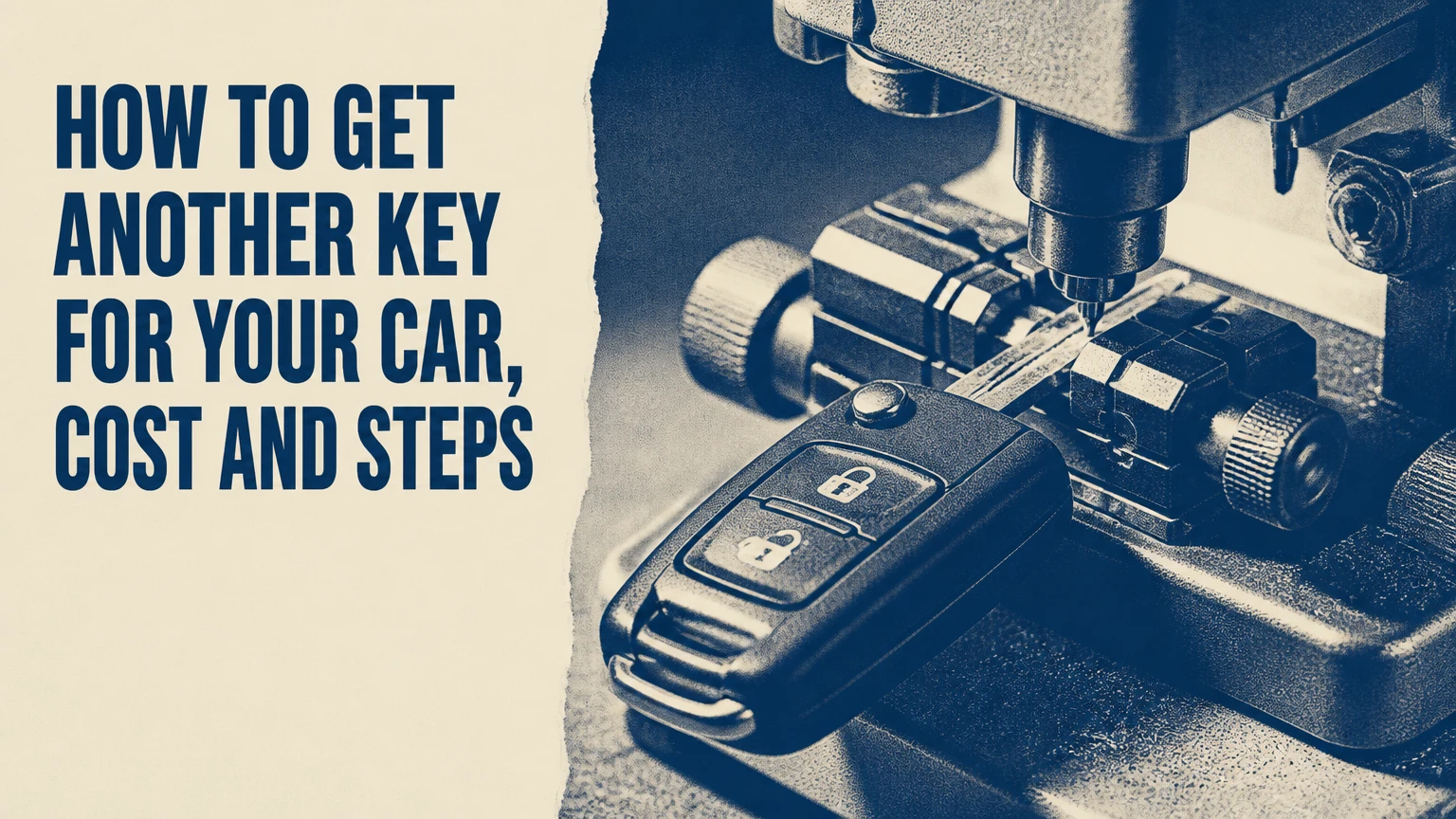
To get another key for your car, identify the vehicle’s exact year, make, model, and key system, then use an automotive locksmith or dealership to cut and, when required, program a compatible key or fob. A duplicate usually takes 15-90 minutes and costs about $10-$600, depending on the vehicle and key technology.
Key Facts at a Glance
- A metal key can open a lock without starting a vehicle if the car requires a programmed immobilizer chip.
- A working spare key is usually cheaper and faster to duplicate than a key made after all keys are lost.
- An automotive locksmith commonly provides mobile cutting and programming, while a dealership provides factory-authorized parts and software.
- A replacement smart key must match the vehicle’s part number, radio specifications, and immobilizer system.
- A lost key can remain authorized inside the vehicle’s memory unless a technician removes it during programming.
- A remote that locks and unlocks doors is not proof that the transponder can start the engine.
Before You Start
Prepare the vehicle information before requesting a quote. The exact year, trim, engine, ignition style, and market region can change the required key, frequency, programming method, and price.
| Requirement | Where to find it | Why the provider needs it |
|---|---|---|
| 17-character VIN | Dashboard, driver-door jamb, registration | Confirms vehicle identity and may retrieve the factory key code |
| Year, make, model | Registration, title, owner’s manual | Narrows the compatible key system |
| Ignition type | Physical ignition cylinder or push button | Distinguishes metal, transponder, and proximity systems |
| FCC ID or part number | Back of fob, inside battery compartment | Matches the remote electronics |
| Proof of ownership | Title, registration, insurance, photo ID | Prevents unauthorized key creation |
| Existing key count | Your key ring and vehicle memory | Determines duplication or all-keys-lost programming |
Have the car physically available unless the provider confirms that remote programming alone is possible. A technician generally needs access to the vehicle for immobilizer programming, diagnostic communication, or testing.
Do not send an unrestricted photograph of the VIN and registration to an unknown online seller. Use a licensed or established provider, confirm the business address, and ask for an itemized quote that separates the key, cutting, programming, service call, and tax.
What Type of Car Key Does Your Vehicle Use?
The key type determines the equipment, programming, and price. A vehicle can also use more than one component, such as a smart fob with a hidden emergency blade.
| Key type | Physical identifier | Vehicle operation | Typical replacement cost |
|---|---|---|---|
| Mechanical key | Metal blade with edge cuts | Blade turns ignition and locks | $10-$50 |
| Transponder key | Plastic head with coded chip | Blade starts ignition after chip authorization | $75-$200 |
| Laser-cut key | Thick blade with central winding groove | High-security ignition cylinder | $150-$300 |
| Remote-head or flip key | Blade attached to button remote | Blade and remote operate separately | $150-$400 |
| Smart proximity fob | Push-button start and wireless fob | Vehicle detects authorized fob nearby | $250-$600 or more |
| Digital key | Smartphone, card, or wearable credential | Bluetooth, NFC, or manufacturer app | $0-$300, depending on vehicle |
Mechanical keys
Older vehicles may use a plain metal key with no electronic security. A hardware store or ordinary locksmith can often duplicate these keys if the blank matches and the original is not badly worn.
A mechanical duplicate does not solve every lock problem. If the car has an immobilizer, the blade may turn the ignition while the engine remains disabled because no authorized transponder code is present.
Transponder, remote-head, and flip keys
A transponder key contains a passive chip that communicates with the immobilizer when the key is inserted or brought near the ignition reader. The remote buttons use a separate radio circuit, so a key can start the engine while its lock buttons fail, or operate the locks while the engine-start authorization fails.
Remote-head and flip keys combine a blade with lock and unlock buttons. Replacement requires a compatible shell and electronics, a correctly cut blade, and model-specific programming.
Smart proximity fobs
Smart keys communicate wirelessly with the vehicle and usually operate push-button ignition, passive entry, or both. The emergency blade inside the fob may unlock the driver door during a dead-battery situation, but the blade alone normally cannot authorize engine operation.
For smart keys, match the complete part number and vehicle application, not only the exterior shape. Similar-looking Toyota, Honda, Ford, Nissan, BMW, or Mercedes-Benz fobs can use different frequencies, immobilizer systems, encryption, or regional configurations.
How Does Car Key Replacement Work?
Car key replacement has two separate jobs: making the physical key fit the locks and authorizing the electronics to communicate with the immobilizer. A technician may cut the blade from an existing key, a key code, or vehicle-specific data, then pair the transponder or smart fob using approved diagnostic equipment.
The immobilizer checks an electronic credential before permitting engine operation. The exact handshake differs by manufacturer, and some newer vehicles require an online security account, a token from the manufacturer, or a security PIN rather than a simple onboard sequence.
Remote pairing is also separate from immobilizer programming on many vehicles. Remote pairing controls functions such as lock, unlock, trunk release, and panic buttons; immobilizer programming controls whether the powertrain allows the engine to run.
What information does the technician use?
A technician may use the VIN, mechanical key code, an existing working key, the key’s transponder type, and the vehicle’s diagnostic system. The VIN can help identify the correct factory configuration, but it does not guarantee that every aftermarket key advertised for that model will work.
A worn original key can produce a misleading duplicate. If the original blade has worn down, copying its shape reproduces the wear rather than the factory cut. A code-based cut is often preferable when the vehicle’s lock code is available.
Seven Steps to Get Another Key for Your Car
Step 1: Confirm whether you need a duplicate or a replacement
Decide whether one working key remains. A duplicate made while a valid key exists is generally the simplest route; an all-keys-lost job requires vehicle-originated programming and may require additional security authorization.
You will know this step is complete when you can state whether the provider is making a spare, replacing a lost key, or replacing a damaged fob. A common mistake is describing a push-button fob as “just a key,” which can lead to an incomplete quote.
Step 2: Record the vehicle and key specifications
Write down the VIN, model year, exact model, trim if known, ignition style, number of working keys, and any FCC ID or part number printed on the fob. Photograph the label privately if the characters are difficult to read.
You will know the information is sufficient when a provider can identify a specific part or key family rather than offering a generic estimate. Do not buy a fob based solely on the number of buttons.
Step 3: Gather ownership documents
Prepare a government-issued photo ID and current registration or title. Some providers also request insurance documents, a lease agreement, or a financing record when the registration does not show the current owner.
You will know the documentation is acceptable when the technician confirms it before dispatch. A provider that creates a vehicle key without checking ownership creates a security risk and may be violating local requirements.
Step 4: Request itemized quotes from qualified providers
Call at least two automotive locksmiths and the vehicle dealership’s service department. Ask whether the quote includes the key or fob, blade cutting, immobilizer programming, remote pairing, mobile travel, taxes, and a warranty.
You will know the comparison is fair when each quote covers the same functions. A low hardware price can become expensive after a service call, failed programming attempt, or required second visit.
Step 5: Choose the provider based on vehicle complexity
Select a mobile automotive locksmith for many mainstream vehicles when speed and driveway service matter. Select the dealership when the vehicle uses newer proprietary security, a factory-only key, an encrypted European system, or a software procedure local locksmiths cannot access.
You will know the choice is appropriate when the provider confirms experience with the exact model year, not merely the brand. The phrase “we work on that brand” is weaker evidence than a specific explanation of the required programming method.
Step 6: Have the blade cut and electronics programmed
The technician cuts the blade and connects an approved programmer or manufacturer diagnostic system when programming is necessary. The vehicle may need an OBD-II connection, an online authorization session, a security PIN, or a sequence involving existing keys.
You will know the programming worked when the engine starts, the locks respond, the trunk or panic function operates where equipped, and the emergency blade fits the door cylinder. Never treat a successful lock-unlock test as proof of immobilizer programming.
Step 7: Test every function and remove missing keys
Test the new key from outside the car, inside the cabin, and at the ignition. If a key was lost or stolen, ask whether the technician can erase it from the authorized-key list, and ask whether the vehicle’s door locks should be rekeyed.
You will know the job is complete when the final key count is documented and every supplied key operates correctly. Keep two working keys in separate secure locations.
Which Car Key Replacement Option Should You Choose?
For most mainstream cars, a reputable mobile automotive locksmith offers the best balance of cost, convenience, and capability. A dealership is the safer choice for factory-only systems, very new models, warranty-sensitive repairs, and vehicles requiring proprietary server access.
| Provider | Typical total cost | Typical time | Best fit | Main limitation |
|---|---|---|---|---|
| Hardware store | $10-$100 | 5-30 minutes | Plain metal or supported basic keys | Limited vehicle coverage |
| Online key plus local programming | $40-$250 before labor | 1-7 days plus appointment | Owners who can verify exact compatibility | Wrong part or unusable electronics |
| Mobile automotive locksmith | $75-$450 | 20-90 minutes | Mainstream vehicles and urgent roadside jobs | Tool coverage varies by model |
| Dealership service department | $200-$800 or more | Same day to several days | New, luxury, encrypted, or factory-only systems | Higher labor and possible transport cost |
When is a locksmith the better choice?
A locksmith is usually the practical choice when the car is stranded at home, one working key remains, or the vehicle is a common Ford, Toyota, Honda, Hyundai, Kia, Nissan, Chevrolet, or Subaru model. Mobile service avoids towing and often includes cutting and programming at the vehicle.
Verify licensing where required, liability insurance, model-specific experience, and the warranty on aftermarket parts. Ask whether the technician will supply an OEM key, a quality aftermarket key, or a refurbished unit.
When is a dealership the better choice?
A dealership is more appropriate when the vehicle is new, leased, high-value, imported, or supported by a factory security platform. BMW, Mercedes-Benz, Audi, Land Rover, and some newer models may require ordering a key against the VIN or using manufacturer-controlled authorization.
Dealership service does not always require towing. Some dealers can order the key first and program it during an appointment, but the exact requirement depends on the vehicle and whether all keys are lost.
Is buying a key online worth the risk?
Online purchase can reduce hardware cost, but only when the part number, FCC ID, frequency, blade profile, transponder type, and vehicle application all match. An online listing that says “fits 2015-2020 model” may combine incompatible regional or trim-specific systems.
The key may also arrive locked to another vehicle, contain weak electronics, or require programming equipment unavailable to a local store. Confirm the return policy before cutting the blade, because many sellers will not accept a cut key.
How Much Does Another Car Key Cost?
A typical spare car key costs $10-$50 for a mechanical key, $75-$200 for a transponder key, $150-$400 for a remote-head or flip key, and $250-$600 or more for a smart proximity fob. All-keys-lost service, luxury vehicles, towing, and factory-only programming can increase the total.
| Situation | Typical price | Typical completion time | Cost driver |
|---|---|---|---|
| Plain metal duplicate | $10-$50 | 5-15 minutes | Correct blank and cutting |
| One working transponder key | $75-$200 | 20-40 minutes | Chip and diagnostic programming |
| One working smart fob | $250-$600 | 45-90 minutes | Fob price and security authorization |
| All keys lost, mainstream car | $150-$500 | 45-120 minutes | Originating keys and programming |
| Luxury or encrypted vehicle | $400-$1,200 or more | 1-7 days | Factory ordering and server access |
| Emergency mobile callout | Add $50-$200 | Same day | Travel, night, weekend, or roadside service |
These are typical consumer ranges, not guaranteed quotes. Regional labor rates, key availability, taxes, vehicle security generation, and whether the car is accessible can change the total.
A counterintuitive cost rule applies: replacing a spare before the last key disappears is often cheaper than originating a key with no valid key present. Programming systems may also charge a session or service fee, so ask whether two keys can be programmed during one appointment.
Can You Program a Car Key Yourself?
You can program some older transponder keys or remotes yourself, but self-programming is model-specific and does not work on every vehicle. The owner’s manual is the controlling source because procedures vary by year, market, number of existing keys, and security system.
Some vehicles permit onboard remote pairing after a sequence of ignition cycles or button presses. Other vehicles require a diagnostic tool, a security PIN, an internet-connected manufacturer account, or a locksmith-level programmer.
DIY is reasonable only when the exact procedure and compatible part are confirmed. It is a poor choice for an all-keys-lost situation, a newer encrypted vehicle, or a key that must be returned after cutting.
Do not repeatedly attempt random programming sequences. Failed attempts can create a lockout, drain the fob battery, or leave the vehicle with no usable key until a professional resets the system.
What If All Car Keys Are Lost?
All-keys-lost service requires proof of ownership, a vehicle-specific replacement key, and programming that creates a new authorized credential. The technician may decode the lock, obtain a key code, access the immobilizer through the diagnostic port, or coordinate with the manufacturer.
Bring the vehicle registration, title if available, photo ID, VIN, and any key-number documentation. The car usually must be physically present, and some vehicles require towing to a dealer or a specialist.
Ask the provider to erase missing keys from the immobilizer memory. Deleting an old credential prevents that key from starting the vehicle, although it may not prevent the physical blade from opening a door. If theft is plausible, have the door cylinders, ignition cylinder, or complete lock set assessed.
Troubleshooting a New Key That Does Not Work
A new car key can fail in one function while succeeding in another because the blade, remote, transponder, and proximity antenna are separate systems. Diagnose the symptom before buying another part.
| Symptom | Most likely cause | First action |
|---|---|---|
| Blade will not enter or turn | Wrong blank or inaccurate cut | Stop forcing it; compare with the factory code |
| Doors unlock, engine will not start | Immobilizer chip not programmed or incompatible | Return for transponder diagnosis |
| Engine starts, remote buttons fail | Remote not paired or incorrect frequency | Check battery and FCC ID |
| Smart fob not detected | Weak battery, wrong fob, antenna issue | Install the specified battery and use backup start position |
| Key works intermittently | Worn blade, damaged chip, weak battery | Test the spare and inspect the shell |
| Programmer cannot communicate | Vehicle power, fuse, gateway, or tool compatibility issue | Check vehicle voltage and use model-specific equipment |
A dead smart-fob battery does not always prevent starting. Many manufacturers provide a backup location, such as holding the fob against the start button or placing it in a marked console pocket; the owner’s manual gives the exact position.
A blown accessory or cigarette-lighter fuse can affect some diagnostic equipment because OBD-II pin 16 commonly supplies battery power, but the fuse is not the only possible communication fault. Vehicle battery voltage, gateway security, tool coverage, and wiring also require consideration.
What Mistakes Make Replacement Keys More Expensive?
The most expensive errors happen before programming begins. Check compatibility and service scope first.
- Matching only the appearance: Two identical-looking fobs may use different FCC IDs, frequencies, chips, or regional software.
- Copying a worn key: A worn blade duplicates incorrect geometry and can damage the ignition cylinder.
- Ignoring the emergency blade: A smart fob without a correctly cut backup blade can leave you locked out after a battery failure.
- Accepting a remote-only quote: Confirm that the engine-start immobilizer is included, not only door-button pairing.
- Waiting until the last key disappears: All-keys-lost work generally takes longer and costs more.
- Skipping key deletion: A lost credential may remain authorized even after a replacement is programmed.
An experienced technician will ask whether the remaining key starts the engine, whether the vehicle is accessible, and whether the missing key should be removed. Those questions indicate a security assessment rather than a simple retail transaction.
Insurance, Roadside Assistance, and Warranty Coverage
Insurance and roadside-assistance plans sometimes cover lost, stolen, or damaged car keys, but exclusions and limits differ. Check comprehensive coverage, rental-car policies, manufacturer roadside plans, credit-card benefits, and membership clubs before paying for service.
Ask about the maximum reimbursement, deductible, approved-provider requirement, replacement-key limit, emergency lockout coverage, and whether programming is included. Keep the paid invoice, old fob, police report if theft occurred, and proof of ownership.
Warranty coverage is less predictable. A vehicle warranty may cover a manufacturing defect in a supplied key or immobilizer component, but ordinary loss, accidental damage, and depleted batteries are commonly excluded. A dealer can confirm coverage using the VIN.
Practical Variations by Situation
You still have one working key
Order the duplicate before the remaining key becomes unreliable. A locksmith can often test the existing transponder, cut a second blade by code, and program both keys during one visit.
The key is damaged but still starts the car
Do not continue using a cracked shell or loose blade. A technician may transfer a functioning circuit board into a new shell, but a damaged transponder or water-exposed circuit may require a complete replacement.
The smart key battery is dead
Use the emergency blade to unlock the door, then follow the vehicle’s backup-start procedure. Replace the specified coin-cell battery, checking polarity and avoiding contact with the circuit board.
The vehicle is leased or financed
Use the registered driver’s documentation and check whether the lease company requires OEM parts. Keep the replacement key for return inspection, because some contracts require a specified number of functioning keys.
The vehicle is imported or recently redesigned
Confirm the market region and frequency before ordering. A European, North American, and Japanese version of the same model can use different key systems, even in the same model year.
Frequently Asked Questions
Can I get another car key without the original?
Yes, an automotive locksmith or dealership can usually create a key without the original by using the VIN, lock data, and vehicle programming system. The vehicle must normally be available, and proof of ownership is required. All-keys-lost service costs more because the provider must originate and authorize a new credential.
Is a replacement car key the same as a duplicate?
No. A duplicate copies or adds a key while at least one authorized key remains, whereas a replacement restores access after loss or damage. Duplication is often faster and less expensive because the existing key helps identify the blade and may simplify programming.
Can a hardware store make a modern car key?
A hardware store can make some plain metal keys and selected supported transponder keys, but coverage is limited. Stores commonly cannot handle high-security laser cuts, smart proximity fobs, luxury vehicles, or all-keys-lost programming. Call first with the VIN-free vehicle details and exact key type.
How long does it take to get a spare car key?
A mechanical duplicate can take 5-15 minutes, while a transponder key usually takes 20-40 minutes and a smart fob commonly takes 45-90 minutes. Special-order dealer keys can take one to seven days before programming, depending on inventory and manufacturer authorization.
Should I buy an OEM or aftermarket key?
Choose OEM when security compatibility, dealer support, resale documentation, or warranty risk matters most. A reputable aftermarket key can reduce cost for supported mainstream vehicles, but confirm the exact part number, FCC ID, frequency, transponder type, and return policy before cutting it.
Can a lost key still unlock or start my car?
A lost physical key may still unlock the door if the blade fits, and it may still start the engine if its electronic credential remains stored. Ask a technician to erase the missing key from the immobilizer memory, then consider rekeying door cylinders if theft or targeted access is a concern.
The Bottom Line
To get another key for your car, first identify the key technology and collect the VIN, ownership documents, key number, FCC ID, or part number. Use a mobile automotive locksmith for many mainstream vehicles, and use the dealership for factory-only or encrypted systems. Expect $10-$600 or more and 5 minutes to several days, depending on the key and provider. Test every function, request deletion of lost keys, and create a spare before the last working key fails.