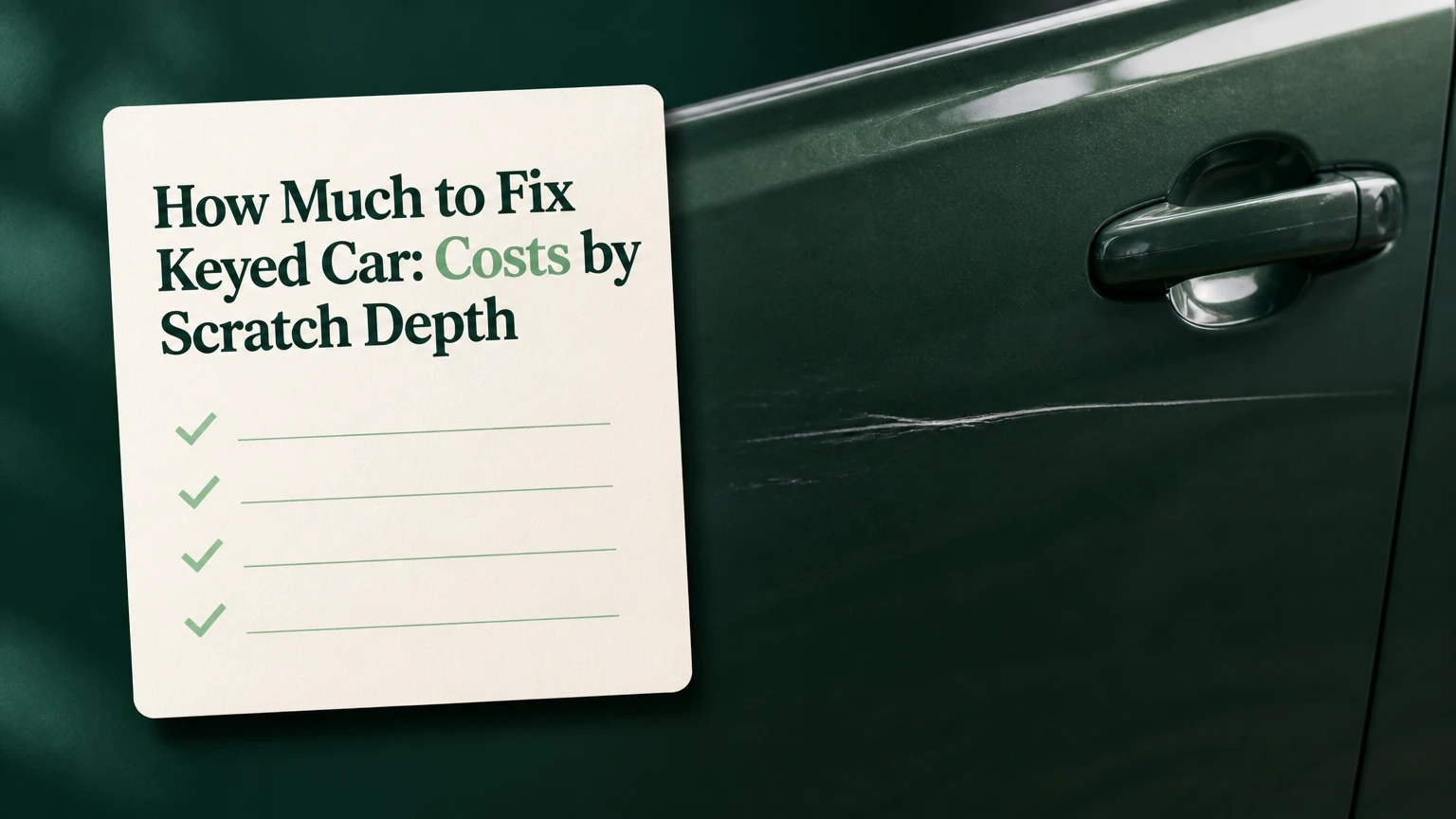
Repairing a keyed car typically costs $15-$100 for a DIY attempt, $150-$400 for mobile paint repair, or $500-$1,500 for professional work on one panel. A long key line crossing several panels can cost $2,000-$4,000 or more because each panel may require sanding, repainting, clear coating, and color blending.
Key Facts at a Glance
- A clear-coat-only mark usually costs $15-$50 to polish or compound.
- A scratch that catches a fingernail generally needs touch-up paint, spot repair, or a respray.
- Bare steel should be sealed promptly because moisture can start corrosion beneath the paint.
- A typical body-shop repair costs $500-$1,500 for one deeply damaged panel.
- Comprehensive auto insurance often covers vandalism, subject to the policy deductible and claim terms.
- Metallic, pearl, matte, and three-stage finishes usually require more careful color matching.
How Much Does It Cost to Fix a Keyed Car?
A keyed-car repair costs about $15-$50 for polishing, $25-$100 for a touch-up kit, $150-$400 for a mobile specialist, and $500-$1,500 for one body-shop panel. The final invoice depends on the scratch depth, panel count, vehicle finish, labor rate, and whether adjacent panels need blending.
These figures are typical United States consumer ranges, not fixed industry prices. A luxury vehicle in a high-cost metropolitan area can exceed them, while a small, flat-finish panel at an independent shop may cost less. A repair estimate should identify the affected panel, paint code, labor hours, materials, and blend requirements rather than provide one unexplained total.
| Repair method | Typical price | Typical time | Best use |
|---|---|---|---|
| Compound and polish | $15-$50 | 30-90 minutes | Clear-coat scuff |
| Factory touch-up kit | $25-$100 | 1-2 days | Narrow deep line |
| Mobile smart repair | $150-$400 | 2-4 hours | Minor or medium damage |
| Body shop, one panel | $500-$1,500 | 2-4 days | Deep gouge or bare metal |
| Body shop, two panels | $1,000-$2,500 | 3-6 days | Door and fender damage |
| Multiple-panel respray | $2,000-$4,000+ | 5-10 days | Continuous side-line vandalism |
The cheapest acceptable repair is usually the one that stops corrosion while meeting the vehicle’s appearance requirements. Polishing a deep groove may reduce contrast temporarily, but it cannot replace missing pigment or primer.
How Deep Is the Scratch?
Scratch depth determines whether a keyed car needs polishing, paint filling, or panel refinishing. Automotive paint normally has a clear coat over a pigmented base coat, with primer below the base coat; a scratch reaching primer or metal has removed material that a compound cannot restore.
Use three checks before buying supplies:
- Wash the panel. Dirt can make a surface mark appear deeper than it is.
- Run a clean fingernail across the line. A definite catch suggests penetration below the clear coat.
- Inspect the color. A white, gray, brown, or metallic-looking line may indicate primer, oxidation, or exposed metal rather than transferred surface material.
The fingernail test is a practical screening tool, not a paint-thickness measurement. A scratch can catch slightly because of a sharp edge while remaining repairable through careful polishing, and a broad shallow mark can look severe under direct sunlight.
| Visible condition | Likely layer affected | Appropriate response | Typical cost |
|---|---|---|---|
| Gray transfer with no groove | Foreign material or clear coat | Clean, clay, polish | $15-$60 |
| Fine line visible only in strong light | Clear coat | Compound and finishing polish | $15-$75 |
| Nail catches at one edge | Clear coat and base coat | Touch-up or spot repair | $50-$400 |
| White or gray valley | Base coat or primer | Matched paint and clear coat | $75-$600 |
| Shiny bare steel or orange corrosion | Metal beneath primer | Immediate sealing and refinishing | $300-$1,500 |
| Torn plastic bumper surface | Plastic substrate | Flexible repair and repaint | $400-$1,200 |
Paint color complicates diagnosis. Black paint makes haze and sanding marks obvious, while white paint can conceal a poor color match until viewed at an angle. Pearl and metallic finishes distribute reflective particles through the base or mid-coat, so a small touch-up can remain visible even when the color code is correct.
Can Polishing Fix a Keyed Car?
Polishing can fix a keyed car only when the damage remains within the clear coat or consists mainly of paint transfer. Polishing cannot replace missing base-coat pigment, rebuild primer, or protect bare steel; a deep line requires paint or professional refinishing.
For a shallow mark, use automotive soap, a microfiber towel, a small amount of compound, and a finishing polish. Work a test area by hand or with a dual-action polisher at a controlled speed, then wipe and inspect under direct light. Stop when the mark becomes less visible, the panel feels smooth, and the surrounding gloss remains consistent.
Do not repeatedly polish one narrow line. Clear coat is thin, and aggressive local correction can create a low-gloss patch or expose the base coat. A product marketed as a “scratch remover” may fill microscopic defects with oils or resin, but that visual improvement can disappear after washing.
How Can You Repair a Shallow Scratch Yourself?
A shallow-to-medium keyed scratch can receive a reasonable DIY repair when the owner accepts that a close inspection may still reveal the line. The objective is to clean the defect, seal exposed material, and level the repair without cutting through healthy surrounding clear coat.
Before you start
| Requirement | Typical specification |
|---|---|
| Working time | 1-3 hours of hands-on work |
| Cure time | 12-48 hours, depending on paint |
| Material cost | $25-$100 |
| Paint | Vehicle-specific factory paint code |
| Sandpaper | 2000, 2500, and 3000 grit |
| Protection | Nitrile gloves, eye protection, masking tape |
| Conditions | Shade, 60-80°F, low dust |
Follow this process:
- Wash and degrease the panel. Use automotive shampoo, dry it completely, and wipe the groove with an appropriate panel-prep product. Do not apply wax before paint.
- Mask the surrounding area. Place narrow automotive masking tape beside the damage, leaving enough access for the paint applicator while limiting accidental sanding.
- Apply matched touch-up paint. Use a fine brush or toothpick to place small amounts in the valley, rather than flooding the entire line. Let each layer flash according to the product directions.
- Let the paint cure. Twelve hours is a common minimum for small touch-up products, but two-part or temperature-sensitive products may need longer.
- Level only the raised paint. If the touch-up forms a ridge, use a lubricated 2000-3000 grit abrasive block with very light pressure. Keep the block moving and check every few seconds.
- Polish the sanding haze. Use a cutting compound first, then a finishing polish. A dual-action machine reduces some risks but does not eliminate them.
- Protect the finish. After the paint has fully cured, apply the manufacturer-approved sealant or wax.
You will know the repair is progressing when the groove is sealed, the raised paint is nearly flush, and the polished area has no expanding dull halo. Stop immediately if the surrounding paint becomes cloudy, the color changes, or the sanding block begins contacting untouched paint.
DIY repair is most suitable for a budget vehicle, a narrow isolated line, or temporary corrosion control. It is a poor choice for a lease return, a high-value vehicle, a matte finish, or damage that crosses multiple curved panels.
What Does Professional Repair Involve?
Professional keyed-car repair normally involves sanding, filling, priming, color matching, spraying, clear coating, curing, and sometimes blending into an adjacent panel. A body shop usually repairs the affected panel as a complete painted surface because painting only the narrow line can leave a visible color and gloss mismatch.
A typical workflow is:
- Document and inspect: The technician records damage, paint type, panel material, and hidden dents.
- Clean and mask: Wax, silicone, road film, and loose paint are removed.
- Sand the damaged area: Ridges are feathered so the repair has a gradual edge.
- Fill deep defects: Glazing putty or suitable filler restores the contour when the key removed material.
- Prime the substrate: Primer seals filler and provides adhesion over metal or plastic.
- Mix the color: The technician uses the manufacturer paint code and may adjust the blend for age-related fading.
- Spray and blend: Base coat is applied across the panel, with color feathered into an adjacent panel when necessary.
- Apply clear coat: The new clear layer restores gloss and environmental protection.
- Cure, polish, and inspect: The finish is cured, leveled if needed, and checked in multiple lighting conditions.
The phrase “paint the scratch” often understates the work. A deep key line can create a trough with raised edges, and those edges must be leveled before new paint can produce a straight reflection.
Ask the shop whether the quote includes blending, dismantling trim, corrosion treatment, taxes, and recalibration. A door or fender repair can involve cameras, radar sensors, moldings, handles, or weather seals that must be removed and refitted.
Which Repair Option Offers the Best Value?
Mobile smart repair offers the best value for a single shallow or medium scratch when the panel has no dent and the owner wants a substantial visual improvement. A conventional body shop is the better value for deep damage, complex finishes, corrosion, multiple panels, or a vehicle undergoing lease or resale inspection.
| Decision factor | DIY touch-up | Mobile specialist | Body shop |
|---|---|---|---|
| Typical price | $25-$100 | $150-$400 | $500-$4,000+ |
| Finish consistency | Visible at close range | Often strong on small areas | Highest potential |
| Deep metal damage | Seals temporarily | Limited | Appropriate |
| Metallic or pearl paint | Higher mismatch risk | Moderate mismatch risk | Best matching process |
| Dent or contour repair | Not suitable | Limited | Suitable |
| Vehicle downtime | 1-2 days of curing | 2-4 hours | 2-10 days |
| Lease-return suitability | Usually weak | Depends on inspection standard | Strongest |
Mobile Scratch Repair
Mobile repair is often appropriate when the damage is confined to a small area and the surrounding panel remains straight. The technician may use localized sanding, primer, color application, and clear coat rather than refinishing the entire panel.
The limitation is environmental control. A driveway lacks a controlled spray booth, dust filtration, and the same blending space available to a body shop. Mobile service also may not handle rust, sharp body creases, aluminum corrosion, or damage near sensors.
DIY Touch-Up Paint
Touch-up paint costs the least and can prevent water from reaching exposed metal. It rarely creates an invisible repair because a hand-applied line has different texture, height, and edge behavior from factory-applied paint.
Factory paint codes improve color selection, but the code is not a guarantee of an exact match. Sun exposure, repaint history, and production-batch variation can change the vehicle’s current color.
Conventional Body Shop
A body shop costs more because it controls preparation, paint atomization, curing, dust, and blend transitions. The higher price is justified when appearance, corrosion resistance, resale value, or a documented repair matters more than minimizing immediate spending.
No body shop can guarantee an invisible result on every aged or unusual finish. Ask for a written warranty and inspect the vehicle outdoors as well as under shop lighting.
What Should You Do First After Vandalism?
After a car is keyed, photograph the damage before washing or repairing it, preserve nearby surveillance evidence, and cover exposed metal from rain without trapping moisture against the panel. Police documentation and insurer notification can matter even when the owner ultimately pays out of pocket.
Use this sequence:
- Photograph every panel, the full vehicle, close-ups, and surrounding location.
- Note the date, time window, parking location, and possible witnesses.
- Request security-camera footage quickly because many systems overwrite recordings.
- File a police report if required by local procedure or your insurer.
- Obtain at least two written estimates for damage crossing more than one panel.
- Avoid rubbing compound on a deep cut before an adjuster or technician inspects it.
- Apply temporary protection only after the area is clean and dry.
A clear protective film or temporary automotive touch-up product can reduce moisture exposure, but household tape, nail polish, and oily products can complicate later preparation. Bare steel deserves the fastest response because corrosion can spread under intact paint and increase sanding and panel-preparation labor.
Will Insurance Pay for a Keyed Car?
Comprehensive auto insurance commonly covers vandalism, including keying, but the policy deductible determines whether filing a claim makes financial sense. Collision coverage generally addresses impact damage, not intentional scratching, and policy wording, claim history, and state regulations can change the result.
Calculate the likely benefit:
Estimated insurer payment = covered repair cost – comprehensive deductible
For example, a $900 estimate with a $500 deductible produces a potential $400 payment before policy-specific exclusions or limits. A $450 repair estimate produces no payment under that deductible. The claim may still be worth considering for $3,000 of multi-panel damage, but the owner should ask how the claim may affect underwriting or renewal.
Do not assume a premium increase will occur or will not occur. Insurers price risk differently, and a single comprehensive claim may be treated differently from an at-fault collision. Ask the carrier about deductible, claim reporting requirements, rental coverage, preferred shops, and whether an estimate is required before repairs.
Why Do Multi-Panel Repairs Cost So Much?
Multi-panel keyed-car repairs cost more because labor, masking, materials, disassembly, and color blending increase with every panel, while a long continuous mark often crosses doors, fenders, and quarter panels with different shapes and gaps. A technician must preserve a consistent reflection across those transitions.
| Damage pattern | Panels involved | Typical labor scope | Typical total |
|---|---|---|---|
| Short line on flat door | 1 | Spot repair or door refinish | $300-$900 |
| Full door-length gouge | 1 | Sand, prime, base, clear | $500-$1,500 |
| Door-to-fender line | 2 | Two-panel repair and blend | $900-$2,000 |
| Side line across three panels | 3 | Multi-panel refinish | $1,500-$3,500 |
| Both sides and hood | 5 or more | Extensive vandalism restoration | $3,000-$7,000+ |
| Damage with dents and rust | 1-3 | Metal repair plus paint | $1,000-$5,000+ |
Panel shape matters as much as line length. A flat door may be easier to blend than a quarter panel with a wheel arch, body crease, fuel door, or textured trim. A black vehicle can require extensive polishing after paint, while a matte finish may require replacement or complete-panel refinishing because spot polishing changes the sheen.
When Is Panel Replacement More Sensible?
Panel replacement can be more sensible when a keyed panel has severe dents, extensive corrosion, torn metal, damaged aluminum, or repair costs approaching the price of a compatible replacement panel. Replacement is not automatically cheaper because the part still requires paint matching, installation, trim transfer, and alignment.
Plastic bumpers and bolt-on fenders are often easier to replace than welded quarter panels. A quarter panel usually requires cutting, welding, corrosion protection, filler work, and refinishing, so repair remains common unless structural damage is severe.
Ask for both options when the estimate exceeds $1,500:
- Refinish the existing panel.
- Install a new original-equipment panel.
- Install a certified aftermarket panel.
- Use a recycled panel and repaint it.
- Leave cosmetic damage untreated after sealing the substrate.
The least expensive part is not always the least expensive finished repair. A pre-painted replacement can mismatch the rest of an older vehicle, while a recycled panel may need extensive preparation before spraying.
Common Mistakes and How Can You Correct Them?
The most expensive DIY mistake is sanding through the surrounding clear coat, because the repair then expands from a narrow line into a professional panel refinish. A second major mistake is leaving exposed metal unsealed, which allows corrosion to increase the eventual preparation cost.
| Mistake | Immediate symptom | Recovery |
|---|---|---|
| Heavy pressure while sanding | Cloudy halo outside scratch | Stop, inspect thickness, seek paint correction |
| Paint applied over wax | Beading, fisheyes, poor adhesion | Strip contamination and restart |
| Wrong color code | Obvious stripe after curing | Repaint with verified code and test card |
| Thick touch-up ridge | Raised, dark-looking line | Allow full cure, level cautiously |
| Household solvent used | Softened or stained clear coat | Stop chemical use and consult a detailer |
| Bare metal left exposed | Orange spots or bubbling | Remove corrosion and prime promptly |
A practitioner rule of thumb is to make the smallest repair that fully seals the defect. Expanding a repair area for cosmetic perfection increases the chance of a visible blend edge and consumes clear coat on healthy paint.
Another useful rule is to test every paint and abrasive on an inconspicuous area or spare painted sample before touching the vehicle. A product that works on solid white can behave differently on a soft black finish or a three-stage pearl.
What Does a Repair Estimate Need to Include?
A useful keyed-car estimate identifies the number of panels, repair method, labor hours, materials, paint system, blend plan, taxes, and expected completion date. “One scratch repair” is too vague to compare between shops because one provider may quote a spot repair while another quotes a full-panel refinish.
Check whether the estimate states:
- Panel names, such as left front door or right quarter panel.
- Damage depth and whether metal or plastic is exposed.
- Dent repair, filler, primer, corrosion treatment, and sanding.
- Base-coat, mid-coat, clear-coat, and blending charges.
- Removal and replacement of handles, moldings, mirrors, or trim.
- Paint-material fees and shop-supply charges.
- Warranty duration and exclusions.
- Rental-car or storage charges.
- OEM, aftermarket, recycled, or customer-supplied parts.
Compare scope, not only totals. A $650 estimate that excludes blending may be less complete than a $900 estimate that includes adjacent-panel color transition and final polishing.
What Changes for Leased and Luxury Vehicles?
Leased and luxury vehicles usually justify professional body-shop refinishing because return inspections evaluate visible paint defects, repair quality, and evidence of amateur work. A touch-up line that protects a daily driver may still produce a charge or negotiation problem at lease return.
Luxury paint systems can include metallic, pearl, matte, satin, or multiple translucent layers. Matte finishes are especially difficult to spot-repair because polishing changes surface sheen, while a correct repair may require refinishing the entire panel or a larger connected area.
For a leased vehicle, ask the leasing company about acceptable wear standards before choosing a repair. For a luxury vehicle, use a shop familiar with the manufacturer’s paint system and request documentation, photographs, and a written finish warranty.
How Should You Choose the Repair?
Choose DIY touch-up when the scratch is narrow, the vehicle is a budget daily driver, and sealing exposed material matters more than a perfect finish. Choose mobile repair when one undented panel needs a substantial cosmetic improvement. Choose a body shop when the cut reaches metal, crosses panels, involves a complex finish, or affects lease and resale value.
Budget Daily Driver
Spend $25-$100 on matched touch-up paint when the damage is isolated and the vehicle’s appearance standard is moderate. Prioritize cleaning, sealing, and corrosion prevention over aggressive sanding.
New or High-Value Vehicle
Use a reputable body shop and request panel-by-panel documentation. The extra $500-$1,500 for one-panel refinishing can protect resale presentation better than an obvious touch-up stripe.
Lease Return
Obtain a pre-return inspection and compare its standards with repair estimates. Professional refinishing is generally safer when the scratch is visible from several feet or crosses a body gap.
Several Panels
File an insurance inquiry before authorizing work, then compare the deductible with estimates commonly ranging from $2,000-$4,000 or more. Photographing every damaged panel supports both the estimate and the claim.
FAQ
Can a keyed car scratch rust overnight?
Bare steel can begin oxidizing quickly in humid or wet conditions, but visible structural rust usually develops over longer exposure. Clean and temporarily seal exposed metal as soon as practical, then have corrosion removed before permanent primer and paint are applied.
Is it cheaper to fix a keyed car at a dealership?
A dealership often costs more than an independent body shop because labor and paint-system rates can be higher. Dealer repair may be useful for manufacturer-specific finishes or lease documentation, while a certified independent shop can often deliver equivalent refinishing at a lower price.
Can toothpaste remove a key scratch?
Toothpaste may mildly abrade superficial residue, but it cannot repair a scratch that penetrates the clear coat or base coat. Automotive compound has more predictable abrasives and should still be used cautiously because repeated polishing removes surrounding clear coat.
How long does a keyed-car repair take?
A DIY touch-up may require 1-2 days because paint must cure between stages. Mobile repair commonly takes 2-4 hours, while a body shop usually needs 2-4 days for one panel and 5-10 days for extensive multi-panel work.
Should I repair a keyed car before selling it?
Repair a keyed car before selling it when the repair cost is materially lower than the expected price reduction and the result will be documented. For a low-value vehicle, sealing deep damage and disclosing it may cost less than a full cosmetic restoration.
Can a detailer repair a deep keyed scratch?
A detailer can polish clear-coat damage and may offer touch-up or smart-repair services, but a deep gouge, rust, dent, or multi-panel line generally needs a qualified body shop. Confirm the provider’s paint and corrosion capabilities before booking.
The Bottom Line
The answer to “how much to fix keyed car” is usually $15-$100 for DIY materials, $150-$400 for mobile repair, $500-$1,500 for one professionally refinished panel, and $2,000-$4,000 or more for several panels. Diagnose the scratch depth, count the panels, compare the estimate with your comprehensive deductible, and seal exposed metal before moisture creates a larger repair.