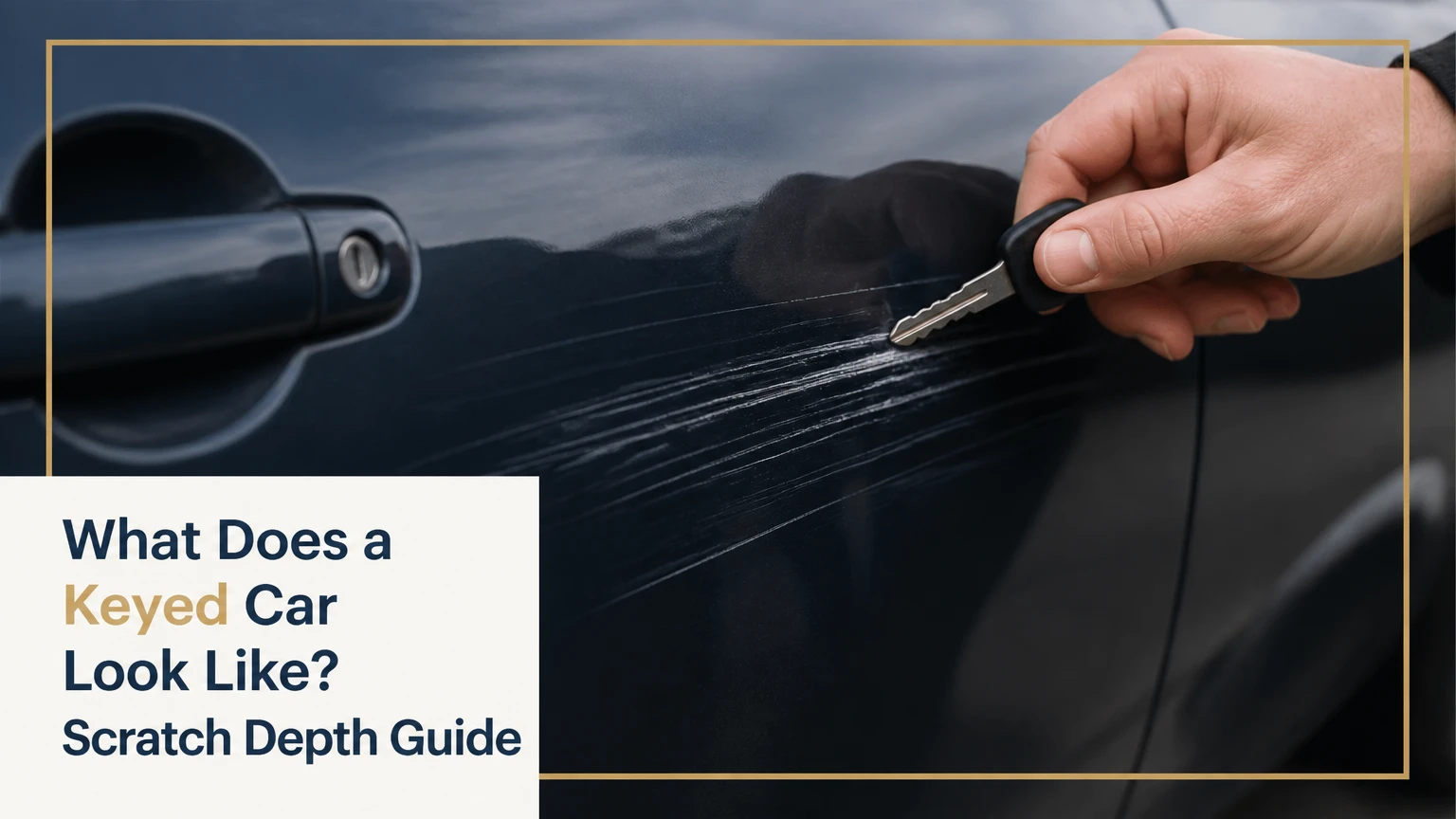
A keyed car usually has a deliberate, narrow groove cut across one or more painted panels, often at waist height along the doors, fenders, or quarter panel. The mark may appear white, gray, vehicle-colored, silver, or dark depending on whether the damage stops in the clear coat, reaches primer, or exposes the underlying panel. Shape and paint depth together provide stronger evidence than either feature alone.
Key Facts at a Glance
A keyed car commonly shows a long, narrow scratch that crosses a door, fender, or quarter panel.
A white line can indicate clear-coat damage, but white residue or paint transfer can create the same appearance.
A fingernail-catching groove usually reaches beyond the surface finish and needs more than polishing.
Water temporarily hiding a scratch suggests light clear-coat damage, not proof that the mark was caused by a key.
Bare steel can corrode after exposure, while aluminum and plastic panels do not rust in the same way.
A body shop should inspect damage across panel gaps because multi-panel scratches require separate preparation and blending.
What Does a Keyed Car Look Like?
A keyed car most often has a long, thin, hand-drawn line with an uneven path and visible interruption at panel gaps. The scratch may run from the front fender across a door and into a rear quarter panel, although a single short gouge can also be intentional vandalism.
Keying typically occurs on easily reached surfaces, including door skins, front fenders, rear quarter panels, hoods, and trunks. Waist-to-shoulder height is a common location because a person can walk beside the vehicle and maintain pressure, but location is only a clue. A scratch on a bumper, roof, or lower rocker panel cannot be ruled out as keying.
Fresh damage may have raised paint edges, loose flakes, or a sharply defined groove. Older damage can collect wax, road film, dust, and oxidation, making the line wider and less distinct. Dark vehicles often show a bright line through the finish, while light-colored cars may reveal a gray, tan, or dark underlayer.
A scratch by itself does not prove vandalism. A branch, shopping cart, bicycle, abrasive car wash brush, or loose object can produce a similar mark. The most reliable assessment combines trajectory, height, repeated depth, impact points, transfer material, and the condition of the groove.
How Can You Tell Keying From an Accidental Scratch?
Keying is more likely when a narrow, continuous mark follows a deliberate walking height across several adjacent panels, while accidental scratches more often cluster around a contact point or follow the shape of the object that caused them. No single visual characteristic establishes intent.
Inspect the mark in bright, indirect daylight after washing the panel with automotive shampoo. Do not begin with compound or polish, because polishing can remove evidence such as transferred paint, embedded debris, or the original edge profile. Photograph the entire vehicle, each panel, and close views before cleaning.
| Feature | More consistent with keying | More consistent with accidental contact |
|---|---|---|
| Path | 1-4 mm narrow line with irregular hand movement | Broad smear, curved branch pattern, or isolated impact |
| Height | 70-120 cm above ground on door skins | Height matches bumper, cart rail, hedge, or loading edge |
| Coverage | 2-4 adjacent panels with similar direction | One contact zone or several random short marks |
| Surface evidence | Sharp groove with little surrounding transfer | Colored transfer, plastic scuff, or compressed dirt |
| Panel gaps | Scratch resumes at a similar height after each gap | Damage ends at the object’s contact boundary |
Expert detailers often use the wipe test only after documentation. A damp microfiber towel can remove residue from a superficial mark, but it cannot restore missing paint. If the apparent scratch disappears completely after washing, the damage may be contamination or transfer rather than a cut in the coating.
Which Paint Layer Is Visible in the Groove?
The visible color in a scratch often indicates depth, but vehicle paint systems vary and color alone cannot identify the layer with certainty. Modern body panels commonly contain an e-coat or corrosion-resistant conversion layer beneath primer, a pigmented base coat, and a clear coat; some panels also contain filler or plastic substrate.
The outer clear coat is transparent and glossy. A cut limited to that layer can look like a white, silver, or hazy line because the edges scatter light. The body color remains visible in the groove, and the mark may appear less obvious when the panel is wet.
A scratch through the base coat can expose primer. Primer commonly appears gray, beige, white, red, or black, depending on the vehicle and repair system. A bare-metal groove may show bright silver aluminum, dull steel, or a dark oxidized surface. Plastic bumpers can reveal black, gray, or differently colored molded material instead of metal.
The factory layer sequence is not identical on every vehicle. Toyota, Ford, BMW, and other manufacturers use different primers, pigments, undercoats, and panel materials, so an online color chart cannot replace physical inspection.
What Does Each Scratch Depth Look Like?
| Damage depth | Typical visual appearance | Practical implication |
|---|---|---|
| Clear coat only | Hazy white line, glossy edges, body color still continuous | Polishing may improve or remove it |
| Base coat damage | Strong color contrast, dull groove, visible pigment loss | Requires matched paint or localized refinishing |
| Primer exposure | Gray, beige, white, red, or black recessed line | Seal promptly and prepare for paint repair |
| Bare steel | Silver or dark metallic center with sharp edges | Corrosion risk; professional repair often preferred |
| Aluminum or plastic | Silver aluminum or black/gray polymer, no steel rust | Oxidation, adhesion, and substrate repair still matter |
A wet surface can make clear-coat scratches temporarily disappear because water optically fills tiny surface irregularities. The test is useful but limited: water does not reliably hide deeper damage, and wax, oils, or dark paint can distort the result.
Does a Fingernail Test Reveal the Damage?
A fingernail that catches in a scratch indicates a measurable ridge or groove, but the test cannot determine the exact paint layer or guarantee that polishing will fail. Use light pressure with a clean fingernail across the mark, never along it, after washing and drying the panel.
If the nail glides over the mark, the defect may be a clear-coat scuff, transfer, or shallow scratch. If the nail catches sharply, the scratch likely has enough depth to require paint correction, touch-up, or refinishing. A soft microfiber towel can also snag on loose paint edges.
Professional technicians use a thickness gauge, magnification, lighting, and controlled test polishing rather than relying on the nail test alone. Paint-depth gauges measure the combined coating thickness and generally cannot identify which individual layer was cut. They also behave differently on steel, aluminum, and plastic.
Never sand a deep groove simply to test it. Removing surrounding clear coat can create a larger dull patch without repairing the missing base color or substrate.
What Are the Main Types of Keyed Paint Damage?
Keyed paint damage falls into three practical repair categories: superficial clear-coat damage, color-layer or primer damage, and substrate exposure. These categories describe repair requirements rather than proving that a key caused the mark.
| Type | Visual clues | Typical response |
|---|---|---|
| Superficial line | Wet appearance improves, no contrasting underlayer, nail barely catches | Clean, inspect, then polish conservatively |
| Color-layer cut | Groove remains visible when wet and body color is missing | Matched touch-up for small spots or refinishing |
| Primer-deep cut | Dull contrasting line with recessed texture | Prime exposed area and apply base coat and clear |
| Substrate gouge | Metal or molded plastic visible, possible sharp edges | Seal promptly; obtain body-shop estimate |
A deep scratch may contain several depths along its length. Pressure changes when a person crosses a door contour, crease, handle, or panel gap, so one end may be clear-coat-only while another reaches primer. Repair decisions should follow the deepest section, not the average appearance.
A key can also create a narrow indentation in soft aluminum or a plastic panel. In that situation, paint repair alone may leave a visible low spot. A technician must decide whether to straighten, fill, prime, and refinish the panel.
How Much Does It Cost to Repair a Keyed Car?
Typical repair costs range from about $100 for a small cosmetic correction to $1,500 or more for several panels, with labor rates, paint type, panel size, and blending needs driving the final estimate. A deep multi-panel scratch usually costs more than the same-length mark confined to one door.
The following figures are typical North American consumer ranges, not fixed prices. A shop may quote outside these bands for tri-coat pearl, matte, metallic, luxury, imported, or heavily faded finishes.
| Repair approach | Suitable damage | Typical price | Typical time |
|---|---|---|---|
| Wash and inspection | Transfer or residue | $0-$30 DIY | 30-60 minutes |
| Machine polish | Clear coat only | $100-$350 | 2-4 hours |
| Touch-up and local seal | Small primer or metal spot | $25-$150 | 1-3 hours plus curing |
| Mobile smart repair | One limited panel | $200-$600 | 3-8 hours |
| Panel refinish | Deep damage on one panel | $500-$1,500 | 2-5 days |
| Multi-panel refinish and blend | Continuous side damage | $1,200-$4,000+ | 3-10 days |
A repair quote should state whether it includes color blending into adjacent panels, removal and refitting of trim, corrosion treatment, tax, and rental-car charges. A low quote that only fills the visible line may not address lifting paint or hidden substrate damage.
Is Touch-Up Paint Better Than Polishing?
Polishing is better for a scratch confined to the clear coat, while touch-up paint is better for a small area where color, primer, or metal is exposed. Touch-up paint is a protective compromise, not an invisible factory repair, because a brush-filled line can remain raised or slightly mismatched.
| Method | Best use | Main limitation | Typical result |
|---|---|---|---|
| Compound and polish | Clear-coat haze or transfer | Cannot replace missing pigment | Improved gloss and reduced visibility |
| OEM paint pen | Small exposed spot | Brush marks and color mismatch | Sealed defect with visible repair |
| Precision touch-up | Short narrow groove | Requires careful curing and leveling | Better small-area appearance |
| Body-shop refinish | Deep or multi-panel damage | Highest cost and longer downtime | Closest to factory appearance |
Matte paint requires special caution. Conventional polishing changes sheen and can create a permanent glossy patch, so a matte-finish vehicle should generally go to a manufacturer-approved refinisher.
What Should You Do Immediately After Finding Keying?
Protect exposed material, document the scene, and avoid aggressive correction until the damage is assessed. The first practical sequence is:
- Photograph the vehicle before washing, including nearby debris, transferred color, and the full panel.
- Record the date, location, time window, and any possible witnesses or security cameras.
- Wash gently with pH-neutral automotive shampoo and a clean microfiber mitt.
- Dry the panel and identify the deepest visible section.
- Apply temporary automotive touch-up or corrosion protection only if bare metal is exposed and a repair appointment is delayed.
- Contact your insurer, property manager, employer, or police department when a vandalism claim or incident report is appropriate.
- Obtain written estimates from a detailer for clear-coat damage and a body shop for primer or substrate damage.
Do not use household solvent, a razor blade, coarse sandpaper, or a magic eraser on automotive paint. These can enlarge the defect, soften the clear coat, or remove surrounding color.
Can a Keyed Scratch Be Fixed at Home?
A careful DIYer can improve a shallow clear-coat mark or temporarily seal a small deep scratch, but home repair is poorly suited to long lines across multiple panels. The decisive factor is whether the defect has removed material, because polish can level a coating but cannot recreate missing paint.
For a small exposed spot, use the vehicle’s factory paint code, automotive wax and grease remover, a fine applicator, compatible primer, base coat, and clear coat. Apply tiny amounts rather than flooding the groove. Allow the products to cure according to their labels, because a generic 20-minute drying assumption is unsafe across different paint systems.
A practical DIY sequence is:
- Clean the area with automotive shampoo, then a compatible panel-prep product.
- Inspect under a strong LED light and mask the surrounding paint.
- Remove only loose flakes; do not widen the groove with a metal tool.
- Dab primer only where steel or another exposed substrate requires it.
- Apply color in thin layers, allowing the label’s stated flash time between coats.
- Add clear coat after the base coat has dried as directed.
- Leave the repair undisturbed until fully cured before any leveling or polishing.
The success checkpoint is corrosion protection and reduced contrast, not a flawless finish. Wet-sanding a touch-up repair is an advanced step; attempting it before full cure can pull paint from the groove and damage adjacent clear coat.
When Does a Keyed Car Need a Body Shop?
A body shop is the safer choice when the scratch exposes a broad area of metal, crosses multiple panels, contains dents, reaches a door edge, or involves a specialty finish. Professional refinishing also becomes more sensible when resale value, lease inspection, or a matching adjacent panel matters.
| Situation | Why professional work helps | Likely repair scope |
|---|---|---|
| Bare steel on a door | Corrosion control and panel preparation | Sand, prime, color, clear |
| Scratch crosses three panels | Separate panel alignment and blending | Multi-panel refinish |
| Aluminum hood or fender | Different sanding and corrosion procedures | Substrate-specific repair |
| Tri-coat pearl paint | Color requires controlled layer application | Blend and clear adjacent area |
| Matte or satin finish | Polishing can alter sheen | Manufacturer-compatible refinish |
| Visible dent under groove | Paint repair cannot restore shape | Dent repair plus refinishing |
A body shop normally cleans and inspects the damage, sands the affected area, treats corrosion if present, applies primer, mixes color, blends the base coat, and sprays clear coat. Technicians may use a spectrophotometer, but a camera cannot eliminate the need for a trained painter because lighting, panel angle, pigment orientation, and prior repairs affect the match.
Factory paint status also matters. A resprayed panel may be cosmetically excellent but can differ from untouched factory coating under a paint meter or close inspection. Ask the shop whether it will preserve trim, document coating thickness, and provide a warranty on adhesion and color.
How Do You Handle Insurance and Evidence?
Treat deliberate paint damage as a possible vandalism claim, but coverage depends on the policy, deductible, jurisdiction, and insurer’s definition of covered loss. Comprehensive auto coverage commonly addresses vandalism in the United States, while collision coverage generally addresses impact with another vehicle or object.
Before authorizing repairs, ask the insurer whether it requires an incident or police report, which shops are acceptable, how the deductible applies, and whether multiple damaged panels count as one occurrence. Filing a claim for a repair costing only slightly more than the deductible may have financial consequences that vary by insurer and location.
Preserve evidence before cleaning:
- Wide photographs showing the vehicle’s position.
- Close photographs with a ruler for scale.
- Images of paint transfer, debris, and broken trim.
- Security-camera locations and the relevant time range.
- Written estimates that separate each panel and operation.
- A record of when the car was last seen undamaged.
Avoid accusing a person without evidence. A scratch’s direction and height can support a report, but they cannot identify the offender.
What Problems Are Easy to Misdiagnose?
The most common misdiagnosis is calling every long white line keying. Paint transfer, clear-coat marring, tree branches, automatic wash brushes, and cargo contact can all imitate a vandalized vehicle.
A transferred object often leaves color on top of the paint rather than removing color from the panel. A small amount may come off on a clean microfiber towel with a dedicated automotive cleaner, although rubbing hard can turn transfer into additional marring.
Oxidized clear coat creates broad chalky patches rather than a narrow recessed groove. A door-ding crease may accompany a scratch but usually has a localized impact shape. Plastic bumper scuffs often show a smear or abrasion pattern rather than a clean, deep line.
Expert rule of thumb: inspect the edges before inspecting the center. A sharp raised edge, exposed underlayer, and consistent groove width indicate material removal; a soft edge with colored residue indicates transfer or surface contamination.
Can Bare Metal Rust in a Few Days?
Bare steel can begin oxidation quickly in humid or salty conditions, but visible orange rust does not appear on every vehicle within a fixed number of days. Galvanized coatings, dry climates, temperature, road salt, and the size of the exposed area change the timeline; aluminum panels oxidize differently and do not produce iron rust.
Covering a deep mark with ordinary wax does not repair the coating. Wax can trap contamination and conceal inspection. If repair must wait, keep the panel clean and dry, and use a compatible temporary touch-up product according to its instructions.
Expert rule of thumb: do not delay a metal-deep inspection merely because the line is narrow. Corrosion can spread under lifting paint, increasing the area that must be prepared.
Can Washing Make a Keyed Scratch Disappear?
Washing can remove dirt or paint transfer, but it cannot make missing automotive paint permanently disappear. A scratch that looks better when wet may be shallow, while a mark that remains visible after washing likely involves deeper marring, pigment loss, or substrate exposure.
Use two clean buckets or a rinseless-wash method, a soft wash mitt, and a fresh drying towel. Avoid automated brushes until the surface has been evaluated, because abrasive contamination can add scratches and obscure the original pattern.
Does Keying Damage the Metal Immediately?
Keying does not always reach the metal, and paint damage limited to clear coat or base coat does not expose the substrate. When a groove reaches steel, moisture and oxygen can begin corrosion at the exposed area, but the visible progression depends on environment and panel protection.
Steel body panels may include e-coat and primer beneath the visible paint. A scratch that appears silver may expose steel, aluminum, or a reflective primer, so confirm the substrate before choosing a rust treatment.
Frequently Asked Questions
What color is a keyed car scratch?
A keyed scratch can be white, gray, silver, black, beige, red, or the vehicle’s original color. Clear-coat damage often scatters light and appears white or bright, primer may appear dull gray or beige, and exposed metal can look silver or dark. Color transfer can imitate these appearances, so clean inspection is necessary.
How wide is a typical key scratch?
A typical key scratch may be approximately 1-4 millimeters wide, but pressure, key shape, paint hardness, and the panel’s contour change the measurement. The groove can widen when paint flakes away or when later washing and rubbing abrade the edges. Width alone cannot establish whether the mark was intentional.
Will toothpaste remove a keyed car scratch?
Toothpaste is not a reliable automotive paint repair product. Its abrasives may reduce very light surface haze, but they cannot replace missing base coat, primer, or metal protection, and repeated rubbing can create a larger dull area. Use a paint-specific polish for clear-coat defects and professional inspection for deeper grooves.
Should I report a keyed car to the police?
Report suspected vandalism when your insurer, local rules, property owner, or claim process requires documentation, especially when the damage is extensive or security footage may exist. Provide photographs and a factual timeline rather than asserting who caused the damage. Police reporting does not guarantee an investigation or reimbursement.
Can a detailer repair a keyed car?
A detailer can often correct clear-coat scratches, remove transfer, and perform limited touch-up work. A collision-repair facility is more appropriate for primer, bare metal, dents, several adjacent panels, aluminum, or specialty finishes. Ask the detailer to identify the deepest layer before authorizing machine polishing.
Will a keyed car fail a lease inspection?
A visible deep scratch may create a lease-end charge, but inspection standards differ by leasing company and contract. Document the damage, compare repair costs with the stated excess-wear policy, and ask whether a qualified mobile repair or body-shop repair is accepted. Do not conceal exposed metal with an incompatible product.
The Bottom Line
A keyed car usually shows a narrow, irregular groove across an accessible painted panel, often at walking height, with the visible color determined by the deepest damaged layer. The exact keyword question, what does a keyed car look like, cannot be answered by line shape alone: wash the panel, document the evidence, inspect the groove, and distinguish clear-coat marring from missing paint or exposed substrate before choosing polish, touch-up paint, an insurance claim, or body-shop refinishing.