To open a locked car trunk without a key, first check for a lawful factory access route: the unlocked cabin release, a hidden mechanical key blade, the manufacturer’s remote app, or an authorized roadside service. If the car is fully locked, the battery is dead, or a child or animal is inside, avoid prying and call roadside assistance, a licensed automotive locksmith, the dealer, or emergency services.
Key Facts
A locked trunk usually has a factory fallback, but the exact route depends on the vehicle’s year, body style, battery state, and security system.
A hidden emergency key inside many modern fobs can unlock the driver’s door, but it may not operate the trunk lock.
A dead battery can disable an electronic trunk actuator while leaving a mechanical key cylinder operational.
A plastic wedge, coat hanger, screwdriver, or slim jim can damage airbags, wiring, weather seals, glass, and paint.
Typical non-emergency locksmith or roadside lockout service costs range from $75-$250, depending on location, time, vehicle, and required key work.
A child, vulnerable adult, or animal trapped in a vehicle changes the problem from a lockout to an emergency. Call emergency services immediately.
What Is the Safest Way to Open a Locked Car Trunk?
The safest way to open a locked car trunk is to use the manufacturer’s documented access method or a trained professional. Check whether another door is unlocked, whether the key fob contains a removable emergency blade, and whether the vehicle app can unlock the doors or trunk. If none applies, contact roadside assistance or an automotive locksmith.
Modern trunks combine a latch, actuator motor, body-control module, alarm, valet setting, and sometimes a separate mechanical cylinder. A method that works on a 2005 sedan may fail on a 2024 SUV and create expensive damage. The vehicle owner’s manual is the most reliable source for the exact emergency procedure.
Do not treat the trunk lid seam, license-plate recess, tail-light housing, or under-bumper area as an access point. Those areas can contain harnesses, radar sensors, parking sensors, airbag wiring, or reinforced structures. Improvised entry also creates evidence of forced access that can complicate insurance or police reports.
Before You Choose an Entry Method
Confirm the situation before touching the vehicle. The most important facts are whether the cabin is accessible, whether the battery has power, and whether the key or fob is inside the trunk.
| Question | Safe check | Why it changes the response |
|---|---|---|
| Is any door unlocked? | Test each exterior handle without forcing it | The interior release may solve the problem |
| Is the fob inside? | Check pockets, bags, and cargo compartments | Passive-entry systems may lock a fob in some conditions |
| Is the battery alive? | Test horn, interior lights, hazards, or app status | Electronic releases need vehicle or auxiliary power |
| Is the car a hybrid or EV? | Identify the powertrain from the badge or manual | High-voltage components require special caution |
| Is anyone trapped inside? | Look through windows and assess heat, cold, and distress | Emergency services take priority over property access |
| Can you prove authorization? | Prepare identification, registration, or a rental agreement | Professionals may require ownership or permission |
Record the exact year, make, model, body style, and location. A locksmith can often reduce arrival time when you provide whether the vehicle has a traditional key, proximity fob, alarm, power liftgate, or dead battery.
Can You Open the Trunk From Inside the Cabin?
You can open the trunk from inside the cabin when the driver’s door or another passenger door is already accessible and the vehicle has an interior trunk release. Look for a button or lever on the driver’s lower dashboard, door panel, center console, or floor area, then follow the owner’s manual for the required ignition or unlock state.
Some vehicles disable the interior trunk button while the car is locked, in valet mode, or in a security state. Others require the transmission to be in Park, the ignition to be on, or a separate trunk-release switch to be enabled. A power button may click without moving the latch if the battery is weak or the actuator has failed.
If the rear seats fold, the manual may describe a cargo pass-through. Do not assume every rear seat folds, releases from the cabin, or gives safe access to the latch. Fixed seatbacks, structural barriers, child restraints, and cargo can make that route unavailable.
If the Key or Fob Is Inside the Trunk
If the key or fob is inside the trunk, use the vehicle’s app, manufacturer support line, spare key, roadside assistance, or an automotive locksmith. Some cars prevent a powered trunk from latching when a recognized fob is detected, but that feature is not universal and may fail when the fob battery or vehicle battery is weak.
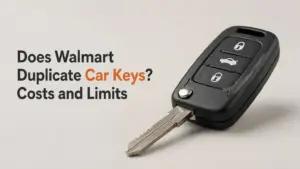
Check the fob for a small sliding latch or release tab. Many removable emergency blades unlock the driver’s door, while some vehicles also provide a mechanical trunk cylinder under a cap or trim cover. The blade may not start the engine, and forcing it into an unfamiliar opening can damage the lock.
Do not repeatedly press the trunk button while standing near the lid if the latch is misaligned. Repeated commands can drain the battery further without correcting a mechanical obstruction.
Does the Car Have a Mechanical Trunk Key?
Many vehicles have a mechanical key backup, but its location and function vary. The emergency blade may unlock only the driver’s door, operate the ignition, or open the trunk cylinder, while some newer vehicles hide the cylinder behind a removable handle cap or license-plate-area cover.
Use the owner’s manual or the manufacturer’s official support page to identify the cylinder. Never remove trim by force. A cover can contain clips, illumination wiring, camera hardware, or a sensor.
| Vehicle feature | Typical backup location | Likely limitation |
|---|---|---|
| Proximity fob | Removable blade inside fob | Often opens the driver’s door only |
| Exterior trunk cylinder | Behind a handle or trim cap | Cylinder may be disabled by valet mode |
| Glove-box valet switch | Glove box or console | Requires cabin access and may block trunk release |
| Remote-connect app | Manufacturer smartphone application | Requires enrollment, signal, and account access |
| Dealer key code | Dealer records or VIN-based system | Identity verification and programming may be required |
A mechanical key can turn while the latch remains closed if the cylinder linkage is broken, disconnected, or electronically controlled. That symptom requires service rather than more force.
What If the Car Battery Is Dead?
A dead car battery prevents an electronic trunk actuator from operating, but it does not automatically mean the trunk is inaccessible. First check for a manufacturer-provided jump point under the hood, a mechanical door key, or an owner-manual procedure for powering the vehicle from an approved terminal.
Only use the positive and negative terminals identified by the manufacturer. Do not connect a booster to random body bolts, sensor wires, fuse-box contacts, or exposed high-voltage components. Incorrect polarity can damage control modules, trigger airbag faults, or cause a battery fire.
| Battery situation | Appropriate next step | Avoid |
|---|---|---|
| Conventional 12-volt battery, hood accessible | Use the designated jump posts and manual | Reversing polarity or touching terminals together |
| Hood closed, cabin accessible | Follow the manual’s hood-release procedure | Pulling unknown cables through body gaps |
| Hood and cabin both inaccessible | Call roadside assistance or a locksmith | Reaching under the bumper for the latch |
| Hybrid vehicle | Use the specified 12-volt service points | Contacting orange high-voltage cables |
| Electric vehicle | Follow the model-specific rescue or access guide | Applying power to unmarked terminals |
The AI Overview’s suggestion to reach an under-hood latch from underneath the bumper is not a safe general instruction. Vehicle layouts differ, and reaching through the front structure can damage wiring, cooling components, radar sensors, or active shutters.
How to Restore Power Without Opening the Trunk
When a vehicle has approved under-hood jump posts, a roadside technician can connect a jump pack, restore 12-volt power, and operate the factory trunk release. Restoring power may not solve a failed actuator, seized latch, blown fuse, or damaged wiring.
After the trunk opens, do not close it again until you confirm that the battery charges, the key is outside the cargo area, the emergency release works, and the latch closes and releases normally.
Which Option Should You Choose?
Choose the least invasive option that matches the vehicle and situation: a spare key or app first, the interior release second, professional lockout service when the entire car is secured, and dealer service when key programming or immobilizer work is required.
| Option | Typical cost | Typical time | Best use | Main limitation |
|---|---|---|---|---|
| Spare key or emergency blade | $0-$20 | 1-10 minutes | Key available nearby | Blade may open only one door |
| Manufacturer app | $0-$15 monthly | 1-10 minutes | Enrolled connected vehicle | Requires account, signal, and battery |
| Roadside assistance | $0-$150 | 20-90 minutes | Covered lockout or dead battery | Wait time varies by location |
| Automotive locksmith | $75-$250 | 15-60 minutes | Entire vehicle locked | Proof of authorization is required |
| Dealer service | $100-$400 plus key work | 1-5 hours | Lost or unprogrammed key | Usually slower and more expensive |
| Emergency services | Varies by agency | Immediate priority | Person or animal in danger | Not a routine property-access option |
Prices are typical North American ranges, not guaranteed quotes. Rural travel, nighttime calls, luxury vehicles, security keys, key programming, and replacement parts can raise the total.
When Is a Locksmith Better Than DIY Entry?
A locksmith is the better choice when all doors are locked, the key is inside, the battery is dead, the lock cylinder is damaged, or the vehicle has complex electronic security. A licensed automotive locksmith uses vehicle-specific tools and procedures while reducing the risk of broken glass, bent frames, damaged airbags, or alarm activation.
Ask for the total estimate before work begins. Confirm the technician’s business name, license requirements in your jurisdiction, insurance status, and the documents accepted as proof of ownership or permission.
A dealer is usually better when the key is lost, the immobilizer must be programmed, the vehicle has a restricted key system, or the lock cylinder needs replacement. Roadside assistance is often cheaper when lockout coverage is included with an auto club, insurer, manufacturer warranty, or new-car service plan.
What Tools Should You Avoid?
Avoid screwdrivers, coat hangers, slim jims, inflatable wedges, drilled lock cylinders, and attempts to pull release cables from outside the vehicle. These methods can damage door airbags, wiring harnesses, window regulators, weather seals, paint, and electronic modules, while offering no reliable path into a modern trunk.
Slim jims are especially unsuitable for many newer vehicles because door locks are integrated with electronics and restraint systems. A tool inserted through the window seal can interfere with side-impact airbags or sever wiring inside the door.
Drilling the trunk cylinder rarely releases a shielded modern latch. It usually converts a lockout into a lock, cylinder, and body-repair bill. Prying the trunk lid can permanently distort the flange and create water intrusion.
Expert Rule: Do Not Trade a Lockout for a Safety-System Fault
A small paint scratch is cheaper than an airbag or body-control-module repair. Technicians commonly inspect the door edge, weather seal, and wiring after amateur entry because invisible damage may later cause water leaks, intermittent locks, warning lights, or restraint faults.
Expert Rule: Do Not Force a Key That Turns Without Opening
A freely turning or partially turning cylinder may indicate a disconnected linkage or failed latch rather than a stiff lock. More torque can break the key blade or internal cam without moving the release. Stop and report the symptom to the locksmith.
Expert Rule: Verify the Key Before Closing the Trunk
Place the key, fob, phone, and any spare inside the passenger compartment before closing the trunk. Confirm that the trunk release and emergency handle operate while the vehicle is open.
Why Does the Trunk Button Click but Not Open?
A clicking trunk button with no opening usually indicates a weak actuator, failed linkage, low voltage, blown fuse, seized latch, broken wiring, valet-mode restriction, or mechanical misalignment. Listen for whether the sound comes from the latch area or only from a relay, then inspect the owner’s manual for valet and manual-release instructions.
| Symptom | Likely cause | Safe response |
|---|---|---|
| No sound, no lights | Dead battery, fuse, switch, or module | Check approved power source and manual |
| Relay click, no latch movement | Low voltage or failed actuator | Stop repeated attempts; request diagnosis |
| Motor sound, lid remains shut | Jammed or misaligned latch | Do not pry; use service access |
| Key turns, trunk stays locked | Disconnected cylinder linkage or valet mode | Contact locksmith or dealer |
| Lid opens but will not latch | Obstruction, damaged striker, weak mechanism | Keep lid secured and arrange repair |
| Works intermittently | Wiring, moisture, switch, or module fault | Record conditions and seek electrical diagnosis |
Valet mode is not universal. On some vehicles it disables the trunk button or cylinder, while on others it limits remote operation. The correct reset procedure is model-specific and may require a glove-box switch, infotainment setting, or authorized key.
How Do You Handle Frozen, Jammed, or Misaligned Trunk Latches?
A frozen trunk latch should be thawed gradually with the manufacturer-approved de-icer or gentle cabin heat, while a jammed or misaligned latch should be diagnosed without levering the lid. Do not pour boiling water onto the lock or pull the lid repeatedly, because water can refreeze and force can bend the latch alignment.
Clear snow and ice around the seal using a soft brush. If the trunk motor runs but the lid does not release, stop cycling the actuator because repeated attempts can overheat it or discharge the battery.
A collision, rear-end impact, loaded cargo, or a bent striker can create misalignment. The trunk may appear closed while pressure holds the latch against the striker. A technician can release and realign the mechanism without damaging the lid.
What Should You Do in an Emergency?
If a child, animal, vulnerable adult, or injured person is locked in the trunk or vehicle, call emergency services immediately and state the exact location, vehicle type, temperature, and condition of the person or animal. Do not spend time searching for tools, downloading an app, or waiting for a routine locksmith response.
For a person in immediate danger, emergency responders may use the fastest lawful access method available. Move away from the vehicle when instructed and keep identification or ownership information available once the immediate danger is controlled.
If the trunk contains medication, medical equipment, or another time-sensitive necessity, tell roadside assistance and emergency dispatch. The priority level can affect which service is sent.
What Information Will a Professional Need?
A professional will usually need the vehicle’s exact year, make, model, location, ownership or permission documents, and a description of the lockout. Additional details about a dead battery, key location, alarm, proximity fob, damaged lock, or hybrid powertrain help determine the correct equipment.
Prepare these details:
- Vehicle identification number, if accessible through the windshield or records.
- License plate number and state or province.
- Driver’s license, registration, rental agreement, or owner authorization.
- Whether the key is lost, locked inside, broken, or merely unresponsive.
- Whether any door, hood, or liftgate is already open.
- Whether the vehicle is a sedan, hatchback, wagon, SUV, convertible, hybrid, or EV.
- Whether a child, pet, medication, or hazardous item is inside.
A legitimate technician should not ask you to defeat an alarm or provide instructions for covert entry. The technician should verify authorization and explain the expected method and price.
How Can You Prevent the Next Trunk Lockout?
Prevent another trunk lockout by keeping a tested spare key accessible, enrolling the manufacturer’s remote app when available, replacing weak fob batteries, and checking the interior emergency release during routine maintenance. Store a spare with a trusted person or in a secure location, not loose inside the cargo area.
| Prevention measure | Typical interval | Verification |
|---|---|---|
| Test spare key | Every 6 months | Unlock door and operate ignition if applicable |
| Replace key-fob battery | 1-3 years or at warning | Confirm lock and trunk commands |
| Check emergency release | Every 6 months | Confirm handle moves and is visible |
| Review connected app | Monthly | Confirm account and vehicle pairing |
| Inspect latch and seal | At oil service | Check corrosion, ice damage, and alignment |
| Save roadside number | Before travel | Confirm membership and coverage area |
Do not leave the only key in a trunk during loading. For vehicles with hands-free liftgates, understand whether the system can close automatically when the fob is nearby or inside cargo.
FAQ
Can the police open a locked car trunk?
Police generally do not perform routine lockouts when no one is in danger, although policies vary by jurisdiction. Call emergency services when a person or animal is trapped, the vehicle is creating an immediate hazard, or medical conditions make delay dangerous. For ordinary access, use roadside assistance, a locksmith, or the dealer.
Will roadside assistance open the trunk if my keys are inside?
Many roadside plans cover vehicle lockouts, including keys locked inside, but coverage limits and service methods vary. The provider may require identification, registration, a membership number, or owner authorization. Tell dispatch that the key is in the trunk, because the technician may need to unlock a door rather than operate the trunk directly.
Can a dead key-fob battery prevent trunk access?
A dead key-fob battery can prevent remote or passive-entry commands, but it does not always prevent mechanical entry. Use the removable emergency blade if the vehicle has one, then follow the manual for starting the car or replacing the fob battery. A vehicle battery failure is a separate problem and may disable the electronic trunk actuator.
Can I open a trunk through the rear seats?
You can use the rear-seat pass-through only if the seats are designed to fold or a manufacturer-approved release is accessible from the cabin. Fixed seatbacks, locked seat releases, cargo barriers, and vehicle structure may prevent access. Do not crawl into a confined cargo area unless the vehicle is stable and no person is at risk.
How much does it cost to replace a lost car key?
A replacement key typically costs $100-$500 or more, depending on whether it is a basic metal key, transponder key, proximity fob, or smart key. Dealer programming, towing, emergency service, and a missing master key can increase the total. Obtain a written quote that separates entry, cutting, programming, and parts.
What should I do after a locksmith opens the trunk?
Retrieve the key, inspect the trunk latch and emergency release, and test every door and trunk control before closing the vehicle. If the battery was boosted, check charging voltage through a qualified technician or service center. Replace a damaged fob, repair a failed latch, and make a spare key before the next trip.
The Bottom Line
The safest answer to how to open a locked car trunk without a key is to use a factory backup, a spare key, an enrolled vehicle app, roadside assistance, or a licensed automotive locksmith. Check cabin access and the emergency key blade first, treat dead batteries and hybrid systems carefully, and never pry, drill, fish through seals, or reach under the bumper. If a person or animal is trapped, call emergency services immediately.