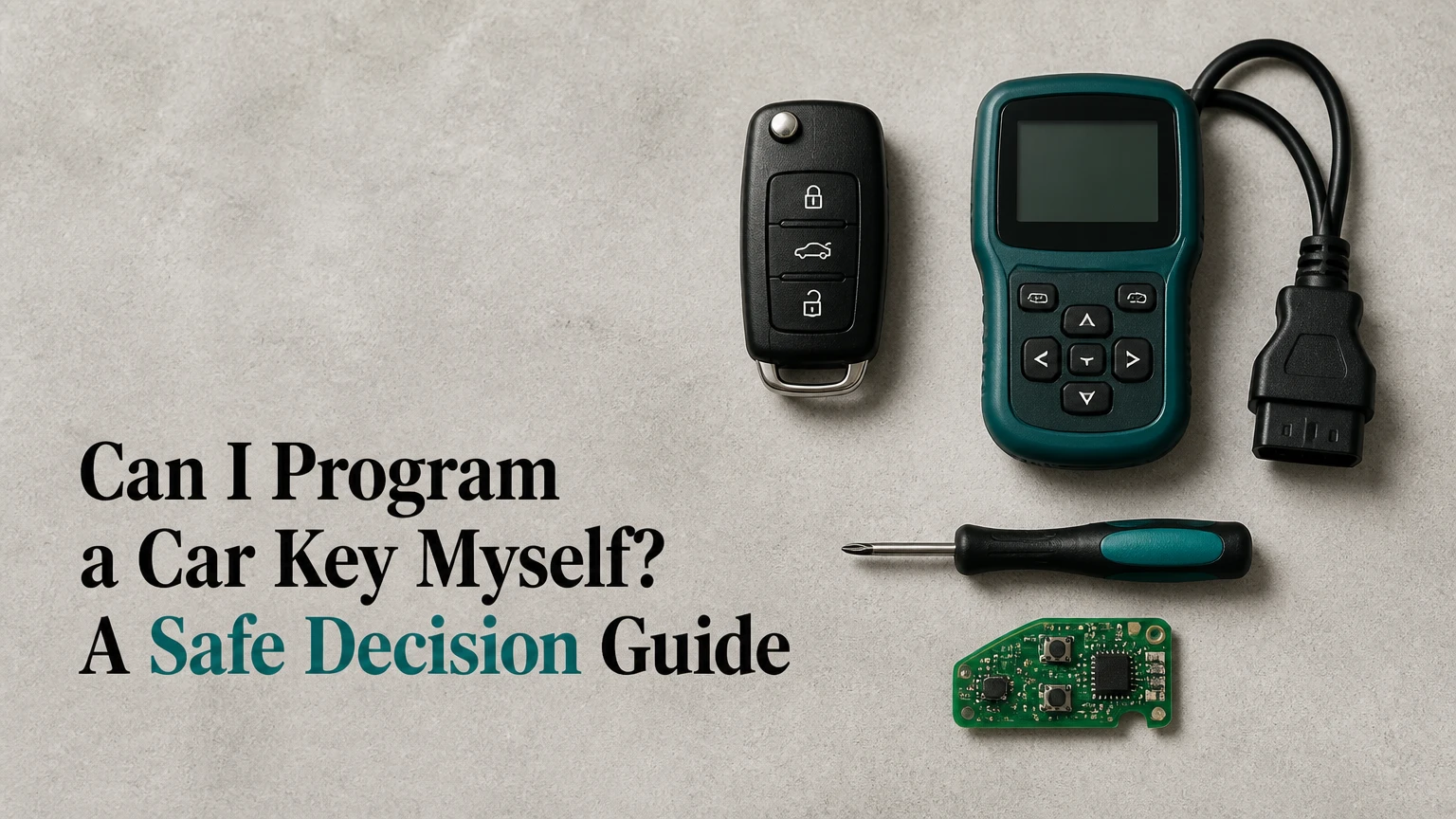
You can often program a car key yourself, but the answer depends on the vehicle’s make, model, year, immobilizer system, and key type. Older vehicles may support an onboard sequence, while many modern transponder and smart keys require manufacturer-level or locksmith diagnostic equipment.
Key Facts at a Glance
- Remote-button pairing and engine immobilizer programming are separate operations on many vehicles.
- A two-key onboard procedure usually requires two already recognized keys and the exact instructions for that vehicle.
- A mechanical copy can unlock the door yet fail to start an immobilized engine.
- Push-button-start vehicles commonly need a compatible smart fob, a charged vehicle battery, and security programming equipment.
- Typical replacement-key costs range from $20-$60 for a basic blank to $200-$600 for some modern dealer or locksmith services.
- Losing every working key removes the prerequisite for many owner-programming procedures.
Can I Program a Car Key Myself?
Yes, if the vehicle supports owner programming and the replacement key matches the vehicle exactly. The easiest cases are older cars with a documented ignition sequence, two working keys, and a correctly cut transponder blank; the hardest cases are newer push-button vehicles, all-keys-lost situations, and vehicles requiring online security authorization.
The first task is identifying what “programming” means for your key. A key may have a metal blade, a passive transponder, remote lock buttons, or a proximity transmitter. Those functions can use separate modules and separate procedures.
A practical decision rule is:
- Two working keys and an ignition cylinder: check the owner’s manual for an add-a-key procedure.
- One working key: look for a vehicle-specific kit or contact a locksmith before buying a blank.
- Push-button start: assume professional or approved diagnostic equipment is needed unless the manufacturer explicitly documents a self-service method.
- No working keys: use a qualified automotive locksmith or dealer.
Vehicle year alone does not determine the answer. A 2010 vehicle may be simple in one trim and restricted in another, while a newer model may support a manufacturer-approved owner process.
What must match before you start?
The replacement must match the vehicle’s part number, transponder type, remote frequency, button layout, blade profile, and regional specification. Compare the FCC ID or equivalent identifier, printed part number, number of buttons, and vehicle compatibility listing. Visual similarity is not proof of compatibility.
The blank also needs the correct mechanical cut. Some laser or sidewinder blades require specialized cutting equipment, even when the electronic pairing procedure is straightforward.
How Does Car Key Programming Work?
Car key programming enrolls an electronic key identifier in the vehicle’s immobilizer system, which then permits that key to authorize engine operation. A passive transponder normally receives energy from an antenna near the ignition cylinder and returns an encoded response, while a smart key communicates wirelessly with the vehicle’s proximity system.
The immobilizer compares the key response with authorized data stored in an immobilizer control unit, body control module, or related vehicle computer. Depending on the design, the PCM participates in the start authorization decision, but the PCM is not always the module that directly stores the key list.
A correctly cut blade controls the lock cylinder. The transponder controls start authorization. The remote transmitter controls functions such as locking, unlocking, trunk release, or panic operation. A proximity fob can add passive entry and push-button authorization.
That separation explains a common diagnosis: the doors lock and unlock, but the engine does not start. Remote pairing succeeded, while immobilizer enrollment did not.
Why does a mechanical copy sometimes fail?
A metal key without a recognized transponder can turn the ignition but cannot complete the immobilizer handshake. Some vehicles crank without starting; others allow a brief start before disabling fuel or ignition. The exact symptom depends on the manufacturer’s anti-theft strategy.
The security indicator often flashes rapidly or remains illuminated when the vehicle does not recognize the transponder. A discharged fob battery does not normally erase immobilizer programming, although it can prevent remote buttons or passive detection from working.
Which Key Types Can Owners Program?
Traditional transponder keys and remote transmitters offer the best chance of home programming, while proximity fobs and high-security blades more often require compatible equipment. The key’s physical design does not prove that its electronic functions share one programming procedure.
| Key type | Typical vehicle period | Owner-programming likelihood | Main requirement |
|---|---|---|---|
| Metal key only | Before mid-1990s | High, no electronic pairing | Correct blade cut |
| Transponder blade key | Mid-1990s to late 2000s | Medium to high | Exact chip and often two working keys |
| Integrated remote key | Late 1990s to 2010s | Medium | Separate remote and immobilizer procedures |
| Laser or sidewinder key | 2000s onward | Low for cutting, variable for pairing | CNC or specialist cutting plus correct chip |
| Smart or proximity fob | 2000s onward | Low to medium | Vehicle-specific diagnostic programming |
| Digital key or phone credential | Recent model years | Low | Manufacturer account, app, and compatible phone |
How do frequency and identification numbers affect compatibility?
Remote frequency is region and model dependent. Common examples include 315 MHz and 433.92 MHz, but frequency alone does not identify a usable key because encryption, rolling-code protocol, FCC ID, vehicle software, and immobilizer data also matter.
Use the original key’s label and the manufacturer parts catalog where possible. Do not rely on a marketplace listing that says “fits many models.” A key can transmit at the correct frequency and still fail because its immobilizer chip, board revision, or encrypted protocol is wrong.
| Compatibility item | What to compare | Failure if mismatched |
|---|---|---|
| FCC ID or regional ID | Original and replacement labels | Buttons do not pair |
| Part number | Manufacturer catalog and trim | Fob rejected or incomplete |
| Transponder type | Vehicle-specific chip designation | Engine remains immobilized |
| Blade profile | Keyway and cut code | Key will not turn |
| Button layout | Lock, unlock, trunk, panic | Missing or wrong functions |
| Region and frequency | 315 MHz, 433.92 MHz, or listed equivalent | Remote signal ignored |
Can You Add a Key With Two Working Keys?
Some vehicles allow a new transponder key to be added with two recognized keys, but the exact sequence, timing, and key requirements vary by manufacturer. The owner’s manual is authoritative for the procedure; generic “three-to-five-second” instructions are unsafe because timing and ignition positions differ.
A typical add-a-key workflow looks like this:
- Verify prerequisites. Confirm that both existing keys start the vehicle and that the new key is the correct, unprogrammed type.
- Prepare the vehicle. Sit in the driver’s seat, close the doors, disable accessories, and keep all keys available.
- Use the documented ignition sequence. The manual may require moving from OFF to RUN with the first key, then the second, within a stated time window.
- Enroll the replacement. Insert or present the new key only when the vehicle enters add-key mode.
- Confirm authorization. Watch for the specified security-light or instrument-cluster message.
- Test every function. Confirm engine starting, locking, unlocking, trunk release, and emergency key operation.
The exact process may differ between Ford, General Motors, Chrysler, Toyota, Nissan, Honda, and their model generations. Some vehicles erase keys rather than add one, and some require a PIN or scan tool even when two keys are present.
What is the success checkpoint?
You know the immobilizer enrollment worked when the new key starts the engine normally after the procedure ends. A working lock button is not enough. Test the new key away from other fobs, because signal interference or a nearby recognized key can hide a programming mistake.
Do not repeatedly guess sequences. Some systems impose a security delay after failed attempts, and a procedure intended for one model can place another model into a different configuration mode.
Can You Program the Remote Buttons Separately?
Yes, many vehicles let owners pair the remote buttons separately from the transponder, but remote pairing does not authorize the engine. An ignition-cycle or door-lock sequence may teach the body control module the remote’s rolling code while leaving the immobilizer chip unrecognized.
A typical remote-only process requires all doors to be closed, the ignition in a specified position, and a button press within a narrow time limit. Some vehicles confirm entry with hazard flashes or automatic door-lock cycling. Others require a diagnostic tool.
Before attempting remote pairing, replace the fob battery with the specified type and verify battery orientation. Keep other transmitters away during enrollment if the manual recommends it.
| Symptom after attempted pairing | Likely function completed | Next check |
|---|---|---|
| Lock and unlock work, engine will not start | Remote transmitter only | Program transponder |
| Engine starts, buttons do not work | Immobilizer only | Pair remote buttons |
| Neither function works | Wrong key, procedure, or vehicle fault | Verify part number and battery |
| Passive entry fails, buttons work | Proximity detection issue | Check fob battery and antenna |
| Security lamp flashes rapidly | Immobilizer rejection | Stop repeated attempts |
Are OBD2 Programming Kits Safe?
Vehicle-specific OBD2 kits can program some replacement keys without a dealership, but they are safe only when the kit is explicitly compatible with the vehicle’s exact year, trim, market, and key system. A generic OBD2 code reader cannot normally enroll an immobilizer key.
Consumer kits from companies such as Tom’s Key Company advertise bundles that combine a replacement key with a vehicle-specific interface or app. Such products may be restricted to one vehicle identification number, one programming event, or a defined set of supported models.
Before buying, verify:
- Exact year, model, engine, trim, and market.
- Whether the kit adds a key or erases and relearns all keys.
- Whether one working key is required.
- Required phone operating system and Bluetooth permissions.
- Vehicle battery-voltage requirements.
- Return policy for an incorrectly ordered key.
- Whether a subscription, PIN, or security token is required.
A stable battery charger may be recommended by the manufacturer, but do not connect equipment unless its instructions specify the correct connection. Programming interruptions can leave a module in an incomplete state, creating a larger repair than the original key problem.
What is an OBD2 kit not good for?
An inexpensive OBD2 reader is not a substitute for an immobilizer programmer. It can read emissions-related diagnostic trouble codes, but key enrollment requires security access, vehicle communication protocols, and model-specific software.
App kits are also poor choices when the vehicle has no working key, the replacement fob is used and locked to another vehicle, the car has an aftermarket alarm, or the battery and charging system are unstable. A mobile locksmith is often cheaper than recovering from a failed security-module procedure.
How Much Does Programming Cost?
Typical total costs range from about $20-$60 for a compatible basic blank and owner programming to $200-$600 for some modern smart-key replacements through a locksmith or dealer. The final price depends on the key hardware, cutting, programming method, mobile service, vehicle security system, and whether all keys were lost.
| Situation | Typical hardware | Typical labor or service | Typical total |
|---|---|---|---|
| Metal duplicate | $5-$20 | $0-$15 | $5-$35 |
| Transponder blank with two working keys | $15-$50 | $0-$80 | $15-$130 |
| Remote key, owner-programmed | $20-$80 | $0 | $20-$80 |
| Remote key, locksmith supplied | $50-$150 | $60-$150 | $110-$300 |
| Smart fob, locksmith supplied | $80-$250 | $100-$250 | $180-$500 |
| Smart fob, dealer supplied | $150-$400 | $100-$250 | $250-$650 |
| All-keys-lost mobile service | $100-$350 | $150-$400 | $250-$750 |
These are typical U.S. consumer ranges, not fixed prices. Luxury brands, encrypted systems, imported vehicles, emergency hours, and required key cutting can increase the total.
The cheapest reliable path is usually creating a spare while one original key still works. All-keys-lost work removes that advantage because the technician must identify the vehicle, obtain security access, cut a key, and enroll or reset the key memory.
What Commonly Prevents Programming?
Incorrect compatibility, insufficient prerequisites, low vehicle voltage, and a previously used locked fob account for many failed DIY attempts. The most expensive mistake is beginning an immobilizer procedure without confirming whether the method adds one key or deletes the existing key list.
Common failure causes include:
- Wrong transponder: The blade fits, but the chip is incompatible.
- Used smart fob: The fob remains paired to another vehicle and cannot be reused through the owner procedure.
- Remote-only instructions: The buttons pair, but engine authorization is still missing.
- Full key memory: The vehicle has reached its permitted key count, which may be four, eight, or another model-specific limit.
- Low voltage: A weak battery or unstable charger interrupts module communication.
- Regional mismatch: The frequency or software variant differs between markets.
- Incorrect timing: The vehicle exits programming mode before the replacement is presented.
Practitioner rule: never buy the cheapest visually identical key. Match the original part number and immobilizer specification first, then compare price.
How Do You Troubleshoot a Failed Key?
Troubleshoot a failed key by separating mechanical, remote, and immobilizer symptoms before repeating any procedure. Check the blade, battery, part number, vehicle battery, and owner-manual prerequisites in that order, then stop if the security lamp continues flashing or the vehicle enters a lockout delay.
The key turns but the engine does not start
Check whether the replacement contains the correct transponder and whether the immobilizer procedure actually completed. A cut blade can rotate the ignition while an unrecognized chip prevents start authorization.
Do not keep cycling the key indefinitely. If the security indicator flashes rapidly, wait for the manufacturer-specified security period and consult the manual or a professional.
The buttons work but the vehicle will not start
Remote pairing succeeded, but transponder enrollment failed or was never attempted. Confirm that the key contains the correct immobilizer chip rather than a remote-only board.
The engine starts but the buttons do not work
The immobilizer is probably recognized, while the remote transmitter needs separate pairing or a new battery. Verify the battery type, polarity, and remote part number before repeating the button sequence.
The security light stays on
A persistent or flashing security light can indicate an unrecognized key, antenna fault, low voltage, module communication problem, or an active security delay. Do not disconnect the battery as a generic reset, because it can erase vehicle settings, trigger radio-security requirements, or fail to clear immobilizer data.
The new key is rejected immediately
Recheck the key’s part number, FCC ID, transponder type, market, and whether the key is new or previously used. If all values match, a full memory or security-access restriction may require a locksmith scan tool.
Which Option Fits Your Situation?
The best option depends on the number of working keys, the vehicle’s security generation, and the value of avoiding programming risk. DIY sequencing suits an older vehicle with two recognized keys, while a locksmith is usually the practical choice for a smart key, a used fob, or an all-keys-lost event.
| Owner situation | Best first option | Expected time | Main risk |
|---|---|---|---|
| Older car, two working keys | Owner-manual add-key sequence | 10-20 minutes | Wrong blank |
| Older car, one working key | Vehicle-specific kit or locksmith | 15-45 minutes | Kit incompatibility |
| Push-button start, one working fob | Compatible kit or mobile locksmith | 20-60 minutes | Security access failure |
| No working keys | Automotive locksmith or dealer | 30-120 minutes | Higher service cost |
| Used replacement fob | Confirm reuse eligibility first | 15-60 minutes | Fob remains locked |
| Key starts car but remote fails | Remote battery and pairing check | 5-15 minutes | Separate procedures |
You have two working keys
Check the owner’s manual first. If the manual provides an add-key procedure, buy a compatible blank, have the blade cut by a qualified cutter, and perform the sequence without improvising timing.
You have one working key
Avoid assuming that a two-key method will work. Compare a vehicle-specific kit with a locksmith quote, including the cost of cutting, compatibility guarantees, and what happens if the kit fails.
You have lost every working key
Use a mobile automotive locksmith or the dealership. All-keys-lost programming may require security credentials, immobilizer reset capability, ownership verification, and a key cut from the vehicle code.
A legitimate provider should request identification and proof of ownership before performing security-related work. That protects both the vehicle owner and the technician.
The remote battery is dead
Replace the coin-cell battery first, then use the vehicle’s documented emergency-start location. Many vehicles can detect a weak fob in a designated pocket or against the start button, but the location varies by model.
A dead remote battery usually does not mean the key has lost its immobilizer enrollment. Test the emergency-start method before paying for programming.
Can a Used Fob Be Reprogrammed?
A used fob can sometimes be reused, but many smart keys cannot be re-enrolled after they have been locked to another vehicle. Traditional remote transmitters may be reset on certain models, whereas encrypted proximity fobs often require a new unit or specialist equipment.
Ask the seller for the exact part number, original vehicle application, reuse status, and return policy. A marketplace listing that says “未programmed” or “resettable” is not sufficient evidence unless the seller identifies the supported vehicle systems.
Can I Program a Car Key Myself Without the Original?
Sometimes, but most owner-level add-key procedures require at least one or two recognized keys. Without an original key, the vehicle may require a security PIN, online authorization, immobilizer reset, EEPROM-level work, or a manufacturer diagnostic platform.
A locksmith can often create a key from the vehicle identification number and immobilizer data after verifying ownership. The VIN identifies the vehicle; it does not automatically provide a complete working key or guarantee that a replacement can be programmed.
Frequently Asked Questions
Does changing the key-fob battery erase programming?
No, replacing a normal coin-cell battery does not erase the fob’s stored identity or the vehicle’s immobilizer enrollment. Battery replacement affects power for remote transmission and passive detection. If the vehicle still does not respond, check polarity, battery voltage, water damage, and whether the fob requires separate remote pairing.
Can a locksmith program a key cheaper than a dealer?
Often, yes. A mobile automotive locksmith may charge less because the service avoids dealership labor rates, although luxury vehicles, encrypted systems, emergency calls, and all-keys-lost jobs can narrow or reverse the difference. Request a total price that includes the key, cutting, programming, travel, tax, and warranty.
Does a car key need programming after duplication?
A purely mechanical key does not need electronic programming. A key containing a transponder or remote transmitter may need programming, even when the blade was copied accurately. Ask whether the replacement must start the engine or only operate the door lock, because those are different requirements.
Can I program a replacement key with the car battery disconnected?
No. The vehicle must have stable electrical power during electronic programming, and disconnecting the battery does not generally clear immobilizer enrollment. Use the manufacturer’s specified voltage procedure, avoid unstable jump packs, and stop if the battery is weak or the vehicle shows charging-system faults.
How many keys can a car store?
The permitted number varies by vehicle and module software. Four or eight keys are common examples, but the owner’s manual or diagnostic system determines the actual limit. If memory is full, adding another key may require deleting old entries, so confirm which keys will remain authorized before proceeding.
Should I buy a key online or from a dealer?
Online keys can reduce hardware cost when the exact part number and programming method are verified. Dealer-supplied keys reduce compatibility uncertainty but usually cost more. For a vehicle with one working key, compare the complete online cost, cutting, programming risk, return policy, and locksmith alternative before ordering.
The Bottom Line
You can program a car key yourself when the vehicle supports an owner procedure and the replacement matches its mechanical and electronic specifications. Two working keys, an ignition cylinder, and a clear owner-manual sequence provide the strongest DIY case.
Modern smart keys, used proximity fobs, full key loss, full memory, and security-module restrictions usually justify professional help. Before buying anything, identify the key type, confirm the part number and frequency, count your working keys, and decide whether you need remote pairing, immobilizer programming, or both. That checklist answers “can i program a car key myself” more accurately than the vehicle’s age alone.