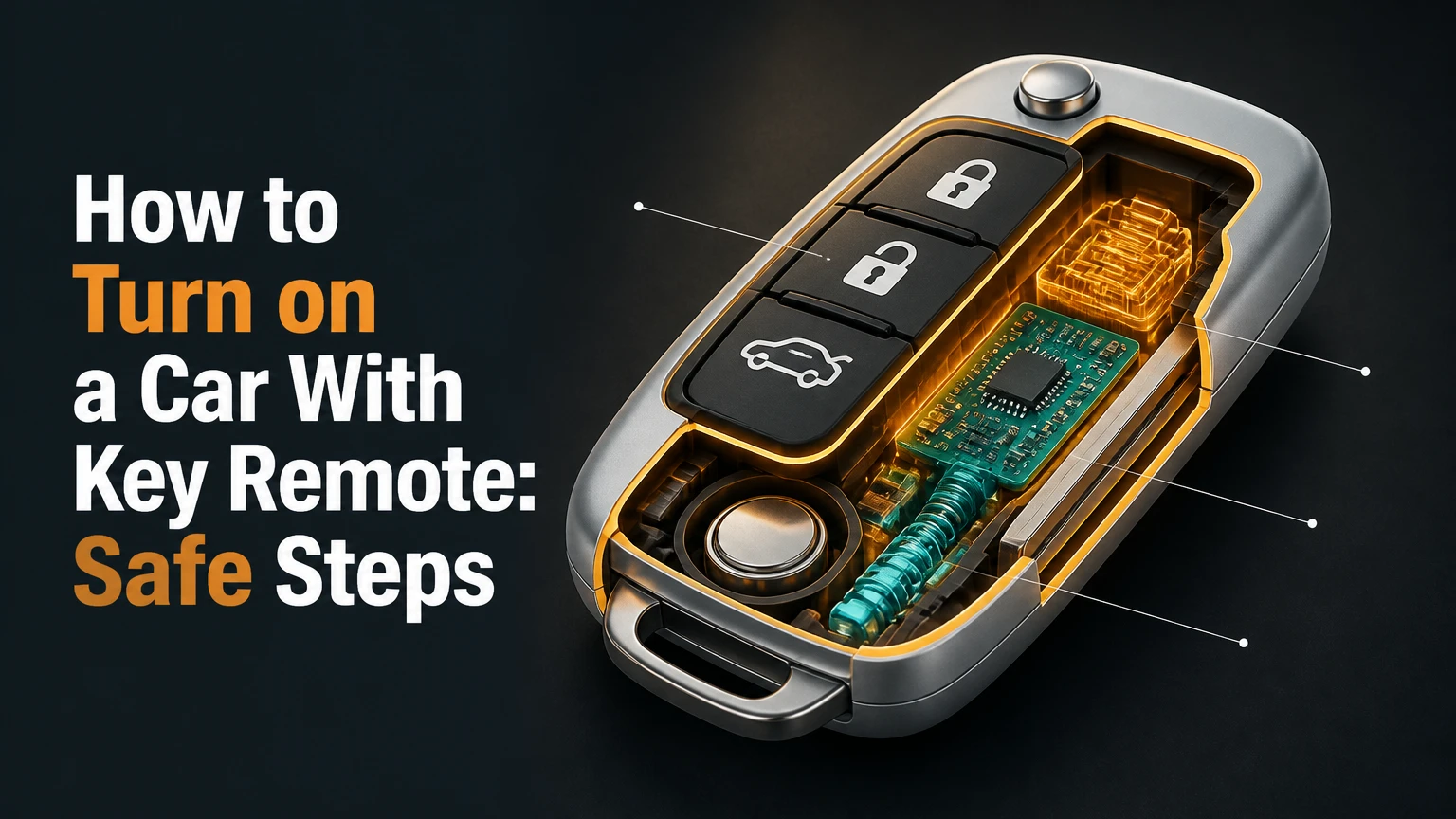
To turn on a car with a key remote, the vehicle must have factory or aftermarket remote-start capability, not merely keyless entry. Lock the vehicle, press the remote-start button or the manufacturer-specific lock sequence, and wait for confirmation from the parking lights, horn, or remote display. Exact commands vary by make, model, year, and system.
Key Facts at a Glance
A lock-and-unlock key fob does not automatically include remote engine start.
Most factory systems require the vehicle to be in Park, with the hood, doors, and liftgate closed.
A typical remote-start cycle lasts 10-15 minutes before automatic shutdown.
Push-button vehicles usually require the key fob inside the cabin before the brake pedal and Start button are used.
Remote starting in an enclosed garage creates carbon-monoxide risk, even when the garage door is open.
Typical aftermarket installation costs range from $150-$600, depending on range, data integration, and cellular features.
Does Your Key Remote Have Remote Start?
A key remote has remote-start capability only when the fob includes a dedicated remote-start button or the vehicle supports a documented button sequence. A circular arrow, “2X,” or engine-shaped symbol commonly identifies the feature, while separate lock and unlock buttons alone normally provide access control without engine ignition.
Check the fob first. A circular arrow may be printed on a separate button, embedded in a lock button, or shown on the reverse side. Some Toyota and Lexus vehicles use three presses of the Lock button rather than a dedicated symbol, whereas many Ford, Chevrolet, Honda, Hyundai, Kia, Nissan, and Subaru models use a marked remote-start control when equipped.
The owner’s manual, manufacturer app, or vehicle settings menu provides the reliable answer. A dealer can also check the vehicle identification number for factory equipment, but a dealer’s answer may not identify an aftermarket system installed by a previous owner.
Keyless Entry Is Not Remote Start
Keyless entry unlocks or locks doors; remote start activates the engine without a person turning the ignition or pressing the Start button. The two functions often share one fob, which causes the most common misunderstanding behind this search query.
Look for these clues:
| Fob or vehicle clue | Likely function | What to verify |
|---|---|---|
| Lock and unlock buttons only | Keyless entry | Owner’s manual equipment list |
| Circular-arrow button | Factory or aftermarket remote start | Required hold time |
| “2X” printed near lock | Two-press remote start | Whether Lock must be pressed first |
| Lock button used three times | Toyota or Lexus-style sequence | Exact model-year instructions |
| Smartphone start control | Connected remote start | Active cellular service and subscription |
Never test an unknown button sequence while the vehicle is inside a closed garage, near children, or beside a person working under the hood. A remote command can start the engine unexpectedly if the system is active.
How Does Remote Ignition Work?
Remote start uses a coded radio or cellular command, a receiver, and a control module that checks vehicle safety conditions before allowing the engine to run. The vehicle generally confirms Park, hood and door status, immobilizer authorization, battery condition, and fault status before engaging the starter.
With a factory key fob, the transmitter sends a short-range radio-frequency signal to the vehicle receiver. Depending on market and vehicle architecture, remote systems may use frequencies such as 315 MHz or 433.92 MHz, but the exact frequency does not determine compatibility by itself.
The body control module and engine control module then authenticate the command. Modern vehicles retain immobilizer protections through a data interface or approved bypass strategy; a proper remote-start installation should not leave a physical ignition key permanently hidden in the dashboard.
The engine starts only after the system sees acceptable conditions. Automatic transmissions normally must be in Park, the hood switch must report closed, and the security system must be armed. The climate system may resume the last setting or use a programmed heating or cooling profile.
A remote starter is not a substitute for a mechanical key. It commands a permitted ignition event while the steering lock, immobilizer, transmission interlock, and brake takeover controls remain active.
How Do You Start a Car With a Factory Key Fob?
Use the factory remote-start command after securing the vehicle, then confirm the engine has started before approaching the car. The most common sequence is Lock followed by holding the circular-arrow button for approximately 2-4 seconds, although the owner’s manual controls the final procedure.
Before You Start
| Requirement | Typical value | Why it matters |
|---|---|---|
| Vehicle position | Park, level or normal parking space | Prevents unintended movement |
| Remote distance | 30-100 feet for many OEM fobs | Radio range changes with walls and interference |
| Engine cycle | 10-15 minutes | Limits unattended running |
| Fob battery | CR2032 or CR2025 in many remotes | Weak voltage reduces transmission reliability |
| Fuel level | Above the low-fuel warning | Some vehicles inhibit remote start |
| Exterior condition | Hood, doors, trunk closed | Safety interlocks must report secure latches |
Step 1: Put the Vehicle in a Safe State
Park the vehicle in an open, well-ventilated outdoor location. Select Park, apply the parking brake, close the hood and all doors, and remove people, pets, and loose objects from the immediate area.
You will know the vehicle is ready when the instrument cluster shows Park and no door, hood, or liftgate warning remains active. A frequently missed hood switch can prevent starting even when every visible latch appears closed.
Step 2: Lock the Vehicle
Press the Lock button once and wait for the vehicle to confirm locking. Some systems require two lock commands, while others arm remote start only after the doors have locked successfully.
You will know the command registered when the locks cycle, the hazard lamps flash, or the horn chirps according to the vehicle’s settings. Do not continue pressing random buttons because panic, trunk release, and alarm functions may have different consequences.
Step 3: Press the Remote-Start Command
Press and hold the button marked with a circular arrow or “2X” for about 2-4 seconds. Keep the fob pointed generally toward the vehicle, although modern radio systems do not require precise aiming.
You will know it worked when the parking lamps flash, the horn sounds, the engine noise begins, or a two-way fob displays a running-engine icon. Release the button after the confirmation signal instead of holding it indefinitely.
Step 4: Confirm the Running Cycle
Observe the vehicle from a safe position and verify that the engine is running normally. Do not enter immediately if the vehicle is in an enclosed structure, and do not assume a flashing light means the engine started because some models flash for a rejected command.
A successful cycle usually keeps the doors locked and runs the engine for 10-15 minutes. The system may shut down sooner if a fault appears, the hood opens, the alarm triggers, or the programmed temperature and battery conditions cannot be maintained.
How Does the Toyota or Lexus Lock Sequence Work?
Many Toyota and Lexus vehicles with factory remote start use a Lock-Lock-Lock sequence: press Lock once, press it again within about one second, then press and hold it a third time for approximately three seconds. This procedure is model-specific and is not universal across Toyota or Lexus years.
Use the following sequence only after confirming that the vehicle supports it:
- Press the Lock button once.
- Press Lock a second time within one second.
- Press and hold Lock a third time for roughly three seconds.
- Watch for hazard-lamp confirmation or engine operation.
Toyota’s connected-services system may use a smartphone app instead, and subscription requirements vary by vehicle and market. Some Toyota and Lexus vehicles also limit remote operation, turn off when a door is opened, or require a manual takeover before driving.
The most important practical distinction is the confirmation method. If the locks cycle but no engine starts, the vehicle may have accepted the security command while rejecting remote ignition because of a hood sensor, low battery, fault code, or subscription state.
How Do You Take Over and Drive After Remote Start?
Enter the vehicle with the authorized key or key fob, then complete the manufacturer’s takeover procedure before selecting a gear. Push-button vehicles generally require the fob inside, the brake pedal pressed, and the Start button pressed once; keyed vehicles commonly require turning the key to Run, not Start, followed by the brake.
Push-Button Ignition
- Unlock the vehicle with the authorized fob.
- Sit in the driver’s seat and keep the fob inside the cabin.
- Press the brake pedal firmly.
- Press the Engine Start/Stop button once.
- Confirm that the instrument cluster remains on and select Drive.
The engine may shut off when the door opens on some OEM systems. That behavior is a security design, not necessarily a defect. Restart the vehicle normally if the manufacturer requires a full ignition transition.
Physical Ignition Key
- Unlock the vehicle and sit in the driver’s seat.
- Insert the programmed key into the ignition cylinder.
- Turn the key to On or Run, stopping before the Start position.
- Press the brake pedal.
- Select Drive after the vehicle confirms the key.
Do not turn the key to Start while the remote-started engine is already running. The starter may engage against a running engine, and the remote module may cancel the cycle.
What If the Car Has a Manual Transmission?
Most remote-start systems do not support manual-transmission vehicles unless a specialized reservation-mode system is installed. The central problem is that a remote command cannot reliably prove that the transmission is in neutral and that the vehicle was left with the parking brake set.
A compatible manual-transmission system may require a shutdown sequence that records neutral, closed doors, parking-brake status, and a controlled exit. Opening a door, releasing the parking brake, or changing the vehicle state usually cancels reservation mode.
Never bypass these safeguards with improvised wiring. A manual car left in gear can move when the starter engages, causing severe injury or property damage. Professional installers should confirm the exact system, clutch-interlock strategy, local regulations, and insurer requirements before installation.
Which Remote-Start System Fits Your Car?
Factory remote start is usually the cleanest choice for compatible vehicles, while a professionally installed two-way aftermarket system offers more range and confirmation. A cellular system is the practical option when the driver cannot see the car, but it adds a subscription and depends on mobile coverage.
| System type | Typical range | Typical installed cost | Confirmation and recurring cost |
|---|---|---|---|
| Factory OEM fob | 30-100 feet | $300-$500 dealer add-on | Vehicle lamps or horn, usually no separate fee |
| Aftermarket one-way fob | 800-1,500 feet | $150-$300 | No return confirmation, usually no subscription |
| Aftermarket two-way fob | 1,500-3,000+ feet | $250-$500 | Beep, vibration, or display confirmation |
| Smartphone cellular module | Network-dependent | $300-$600 | App status, typically $5-$15 monthly |
OEM Versus Aftermarket Installation
An OEM system usually integrates with the body control module, climate controls, alarm, and factory immobilizer. That integration reduces compatibility risk, but dealer programming may cost more and the system may offer only short-range operation.
An aftermarket system can add two-way confirmation, longer-range remotes, turbo timers, temperature reporting, alarm sensors, or cellular control. Installation quality matters more than the brand name because modern vehicles contain multiplexed networks, immobilizers, and low-voltage modules that can react badly to incorrect connections.
Ask the installer whether the system supports the exact make, model, year, engine, transmission, and trim. Also ask whether the installation preserves factory remote functions, whether a spare key must remain in the vehicle, and what labor warranty covers electrical faults.
| Decision factor | OEM system | Aftermarket one-way | Aftermarket two-way | Cellular app |
|---|---|---|---|---|
| Best operating scenario | Near the vehicle | Visible parking lot | Large building or campus | Airport or distant parking |
| Start confirmation | Lamps or horn | None from vehicle | Fob display or vibration | App status |
| Smartphone control | Sometimes | Usually unavailable | Optional module | Core feature |
| Subscription | $0-$15 monthly | $0 | $0-$15 monthly if added | Usually $5-$15 monthly |
| Typical installation | Dealer, 1-2 hours | Installer, 2-4 hours | Installer, 2-4 hours | Installer, 3-5 hours |
| Main limitation | Short range | No confirmation | Extra remote to carry | Cellular dead zones |
How Much Does Remote Start Cost?
Remote start costs about $0 when already included, $300-$500 for many dealer-installed OEM upgrades, $150-$500 for many wired aftermarket systems, and $300-$600 for cellular-equipped installations. Parts compatibility, labor, key-bypass requirements, and subscription plans create the largest price differences.
A quote should identify hardware, bypass or data module, labor hours, programming, warranty coverage, and future subscription charges. A low parts price can become expensive if the vehicle needs a specialized interface or if an installer uses a hidden spare key rather than a secure data solution.
What Safety Rules Matter Most?
Remote start should be used outdoors, never in a closed garage or other enclosed space where carbon monoxide can accumulate. The National Highway Traffic Safety Administration warns that carbon monoxide is colorless and odorless, so opening a garage door does not make engine operation reliably safe.
Keep the vehicle away from dry grass, flammable vapors, children, and pets. Remote start warms the engine and cabin, but it does not remove ice from glass unless the driver confirms visibility before moving.
Remote starting also has practical limits. Extended idling can waste fuel, increase local emissions, and delay mechanical warm-up compared with gentle driving. In cold weather, an engine block heater may reduce cold-start stress more effectively than repeated 10-minute remote cycles, depending on the climate and vehicle.
Some regions restrict unattended idling. Check local municipal rules, apartment policies, and the vehicle manufacturer’s emissions guidance before using the feature routinely.
Why Will the Remote Start Not Work?
A failed remote start usually results from a blocked safety condition, weak communication, low fob voltage, a diagnostic fault, or a disabled aftermarket module. Start with the vehicle state and fob battery before assuming the starter motor or engine has failed.
| Symptom | Likely cause | Corrective action |
|---|---|---|
| Locks work, remote start fails | Hood switch, low fuel, fault code, or unsupported feature | Close hood, check warnings, consult manual |
| No response from fob | Dead battery or range interference | Install the specified CR2032 or CR2025 battery |
| Lights flash, engine does not crank | System rejected Park, brake, hood, or immobilizer state | Cycle ignition normally and inspect warnings |
| Engine starts, then stops | Takeover error, open door, alarm, or low battery | Repeat authorized takeover sequence |
| App says command failed | Cellular outage, subscription, or weak 12-volt battery | Check service status and vehicle battery |
| Worked before service, then stopped | Aftermarket valet mode | Disable valet mode using the system manual |
Check the Basic Conditions
Confirm that the vehicle is in Park, the hood and liftgate are fully latched, the doors are locked, the fuel warning is not active, and the check-engine light is not illuminated. Many systems inhibit remote start when a diagnostic fault could make unattended engine operation unsafe.
Replace the fob coin cell with the exact battery type specified by the manufacturer. Keep the battery contacts clean and fit the positive side in the correct direction. A fob may still unlock doors while lacking enough transmission strength for a remote-start command.
Reset the Operating State
Start the car normally, allow the security system and dashboard to complete their checks, then switch the engine off and lock the vehicle. This can clear a temporary rejected-state condition, but it will not repair an active diagnostic fault.
Aftermarket systems may enter valet mode during service or battery work. Valet mode often preserves door locking while disabling remote start, so check the system’s LED, service switch, or branded manual rather than guessing button combinations.
Many manufacturers permit only two consecutive remote-start cycles. A normal keyed or push-button start usually resets that limit. The exact count varies, so the owner’s manual takes priority over general instructions.
What Mistakes Cause Remote Start to Fail?
The most common mistakes are using a keyless-entry fob, pressing the wrong timing sequence, leaving the hood slightly open, and pressing the brake before completing takeover. These errors imitate equipment failure because the vehicle intentionally rejects commands without always displaying a detailed explanation.
- Using Lock only: Some vehicles need a dedicated circular-arrow command; others require two or three timed Lock presses.
- Holding the button too briefly: A 0.5-second press may lock the doors but not request ignition.
- Opening the hood: A hood sensor interrupts remote start even when the hood looks closed.
- Pressing the brake while entering: The brake can cancel a remote session if the key or Start button has not completed takeover.
- Leaving the vehicle in an incompatible state: Park, neutral, parking-brake, and alarm requirements differ by system.
- Trying repeated commands: Excessive attempts can trigger a start limit or make a weak fob battery appear worse.
A useful installer rule is to diagnose the confirmation path in order: did the fob transmit, did the locks respond, did the vehicle acknowledge the command, and did the engine complete its start cycle? That sequence separates radio problems from vehicle-interlock problems within minutes.
Can You Add Remote Start to a Car Without It?
You can add remote start to many automatic-transmission vehicles, but compatibility must be checked before buying a kit. The installer needs the exact year, trim, engine, transmission, immobilizer design, key type, and whether the vehicle uses a factory alarm or connected-services module.
The main alternatives are:
- Dealer-installed OEM activation: Best when the vehicle already contains remote-start hardware that only needs programming.
- Professional aftermarket installation: Suitable when the vehicle lacks factory remote start and the owner wants longer range or two-way confirmation.
- Cellular add-on: Useful for distant parking, provided the vehicle has reliable network coverage and the owner accepts recurring fees.
- Block heater or cabin heater: Better for some cold climates when the primary goal is easier starting rather than remote cabin cooling.
Avoid universal kits advertised as fitting every vehicle. “Universal” usually describes the control module, not the required data interface, immobilizer integration, hood switch, or transmission safety logic.
Situations That Change the Procedure
Vehicle design and parking conditions can change whether remote start is available, how long the engine runs, and whether the system is safe to use. The same fob command may fail in a basement, disable itself after a fault, or behave differently after a battery replacement.
| Situation | Expected behavior | Safer response |
|---|---|---|
| Underground parking garage | Cellular or RF signal may be blocked | Use a normal start after reaching the vehicle |
| Extreme cold | Battery voltage and oil viscosity reduce reliability | Use a block heater and inspect battery condition |
| Hot cabin | Climate settings may resume slowly | Confirm HVAC mode and ventilation before leaving |
| Open hood for maintenance | Remote start should be inhibited | Keep the key remote away from the vehicle |
| Vehicle recently serviced | Valet mode may be active | Check the aftermarket system status |
| Low 12-volt battery | Module may receive commands but fail to crank | Test and charge or replace the battery |
Remote start is not suitable for checking an engine while someone works under the hood. The hood switch is a safeguard, but no electronic interlock should replace a technician’s lockout procedure.
When Should You Choose a Phone App?
Choose a cellular remote-start app when the vehicle is regularly parked beyond fob range and cellular coverage is dependable. Choose a key fob system when immediate control, no monthly fee, and operation in signal-blocking locations matter more than unlimited distance.
A phone command travels through a service provider to a cellular module installed in the vehicle. The app can report command status, schedule starts, display cabin temperature, or provide GPS features, but the result depends on the vehicle’s 12-volt battery, subscription, server availability, and network signal.
Cellular control is not literally unlimited. It works wherever the module and service provider have compatible coverage, not inside every concrete garage or remote area. A two-way RF system can be more dependable for a visible parking lot even when its stated range is shorter than a phone network’s theoretical reach.
FAQ
Can I start my car remotely with the unlock button?
Usually, no. The Unlock button normally opens the vehicle without requesting engine ignition, although some aftermarket systems assign custom commands to multiple button presses. Check the fob manual and vehicle manual before testing, because a repeated-button command may activate remote start, panic mode, or trunk release.
Does remote start use more fuel?
Yes, a remote-start cycle consumes fuel while the vehicle idles, although the exact amount depends on engine size, temperature, accessory load, and runtime. A typical 10-15-minute cycle uses less fuel than extended idling, but repeated cycles can add measurable consumption and emissions over a winter.
Will remote start work if the key fob battery is dead?
A dead key fob battery normally prevents the remote command from reaching the vehicle. Replace the specified coin cell first; if the fob still fails, test the second fob, reduce the distance, and inspect for aftermarket valet mode or vehicle battery problems.
Can someone drive away after I remote-start the car?
A person generally cannot drive away without the authorized key or fob because the immobilizer and takeover procedure remain active. Remote-start security does not eliminate theft risk, so keep the fob secured, lock the vehicle, and never leave the running car unattended with the key inside.
Why does the engine stop when I open the door?
Some factory systems shut down when a door opens to prevent an unauthorized person from entering and driving away. Other systems support takeover mode and continue running after the authorized fob is detected, the brake is pressed, and the Start button or ignition key completes the required transition.
Is remote start bad for the engine?
Remote start is not inherently harmful when used according to the manufacturer’s instructions, but long idle periods provide less efficient warm-up than gentle driving and can increase fuel use. In severe cold, correct oil, a healthy battery, and a block heater may offer more mechanical benefit than repeated remote starts.
The Bottom Line
To turn on a car with key remote, first verify that the fob supports remote start rather than only keyless entry. Lock the vehicle, use the documented circular-arrow or manufacturer-specific Lock sequence, confirm the engine response, and complete the authorized takeover before driving.
If the command fails, check Park, hood and door latches, fuel level, warning lights, fob battery, vehicle battery, valet mode, and the system’s consecutive-start limit. For a vehicle without remote start, obtain a compatibility check from the dealer or a qualified installer before selecting an OEM, aftermarket, or cellular solution.
Title tag: how to turn on car with key remote: Safe Steps
Meta description: Start your engine in 2-4 seconds, complete push-button takeover, and fix failed commands. Check garage, fob battery, and valet-mode risks.