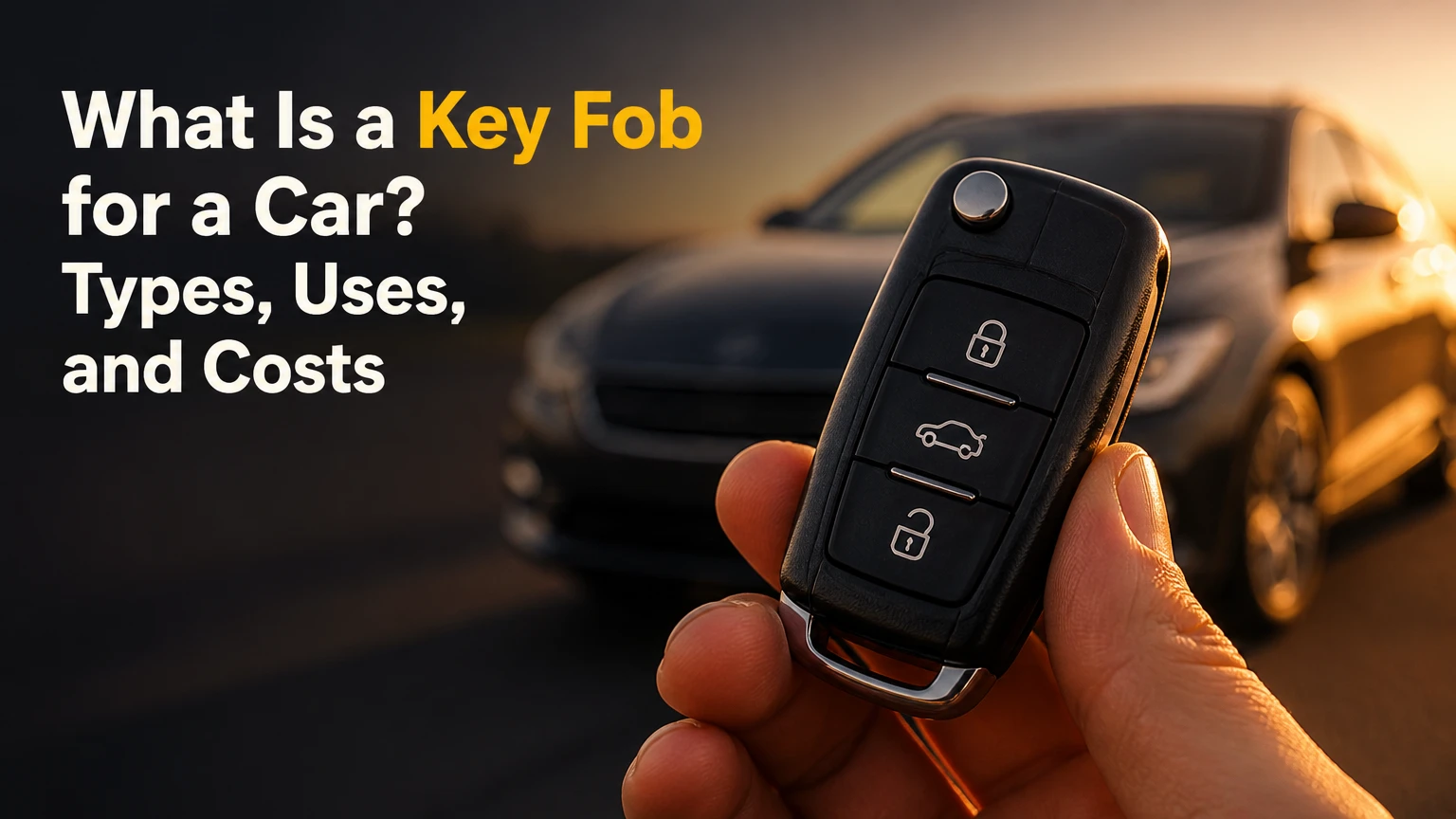
A key fob for a car is a small electronic device that sends an authenticated wireless command to the vehicle for locking, unlocking, opening the trunk, sounding the panic alarm, or authorizing ignition. Depending on the vehicle, the fob may include a mechanical key, an immobilizer transponder, proximity sensors, or a push-button-start credential.
Key Facts at a Glance
- A car key fob communicates with the vehicle through short-range radio, not an internet connection.
- A remote key fob normally requires a button press, while a smart key can work when it remains in a pocket or bag.
- A key fob battery powers communication and buttons, but many fobs contain a passive transponder for emergency starting.
- The FCC ID, ISED or IC identifier, part number, frequency, and vehicle programming determine replacement compatibility.
- Typical U.S. replacement costs range from about $15 for a DIY basic remote to more than $800 for some dealer-programmed smart keys.
- A Faraday pouch can reduce relay theft risk for passive-entry vehicles, but it cannot repair a damaged fob or prevent ordinary key theft.
What Is a Key Fob for a Car?
A car key fob is an electronic remote or proximity credential that lets a vehicle recognize an authorized key without requiring a metal key for every function. Basic fobs control door locks and alarms; integrated keys add a blade and transponder, while smart keys can authorize passive entry and push-button starting.
The word “fob” originally described a small ornament attached to a pocket-watch chain. Automotive key fobs became common with remote keyless entry systems, which replaced repeated manual use of a door lock cylinder with a coded radio command.
A fob is not always the same as a complete car key. A standalone remote may only operate the locks, whereas a transponder key or smart key may also be required to disable the engine immobilizer. That distinction matters when ordering a replacement because a shell that looks correct may lack the correct electronic board, transponder, blade, or vehicle-specific programming.
What Can a Key Fob Control?
A key fob can control different functions depending on the vehicle’s trim level and software configuration. Common functions include:
- Locking and unlocking the doors
- Unlocking the liftgate or trunk
- Opening a power liftgate
- Activating the panic alarm
- Starting the engine remotely
- Lowering windows on selected models
- Turning on lights or locating the parked vehicle
- Enabling passive entry and push-button starting
- Operating remote parking or vehicle summoning on limited luxury models
A button icon is not a universal promise. For example, a circular-arrow button may indicate remote start, but the vehicle may require two presses, a long press, or a manufacturer app subscription.
How Does a Key Fob Communicate With a Car?
A button-operated key fob transmits a short-range radio-frequency message to the vehicle, which checks the message against its stored identity and cryptographic sequence before carrying out the requested command. A passive smart-key system also uses low-frequency signals from the car to detect whether the fob is nearby.
The basic communication sequence is:
- The driver presses a button or approaches a vehicle with passive entry.
- The fob transmits an identifier and command through a radio-frequency channel.
- The vehicle receives the signal through an antenna.
- A receiver and body control module evaluate the credential.
- The vehicle accepts, rejects, or ignores the command.
- Approved commands operate locks, alarms, trunk actuators, or starting authorization.
Many systems use a rolling code, which changes after accepted transmissions so that a previously captured unlock message cannot simply be reused. KeeLoq was used in some older remote-entry systems, but modern vehicles use varied proprietary and cryptographic designs. The often-repeated claim that every car accepts the next 256 codes is too specific: an acceptance window is manufacturer-dependent and can vary by system generation.
Remote Entry and Passive Entry Are Different
Remote keyless entry usually works only after the driver presses a button. Passive entry, also called proximity entry, starts with the vehicle sending a low-frequency challenge or detection signal, commonly around 125 kHz in many systems, although exact architectures vary.
The fob replies over a higher-frequency radio link. If the credential passes authentication and is within the permitted zone, the car may unlock when the driver touches the handle. Starting authorization normally involves additional antennas inside the cabin, because the vehicle must confirm that the smart key is inside rather than outside the car.
Operating frequencies such as 315 MHz in North America and approximately 433.92 MHz in many European applications are useful clues, not sufficient buying specifications. Regional regulations, modulation, encryption, antenna design, and part numbers also affect compatibility.
What Are the Main Types of Car Key Fobs?
The main automotive fob types are standalone remotes, remote-head keys, switchblade keys, smart proximity keys, and advanced display or digital keys. The correct category depends on whether the car uses a mechanical ignition, an immobilizer transponder, passive entry, push-button start, or a smartphone credential.
| Fob type | Physical design | Starting method | Typical functions |
|---|---|---|---|
| Standalone remote | Plastic remote, separate metal key | Insert and turn mechanical key | Lock, unlock, panic, trunk |
| Remote-head key | Key blade attached to remote body | Turn blade; transponder authorizes engine | Locks, immobilizer, panic |
| Switchblade key | Folding spring-loaded blade | Insert and turn folded-out blade | Locks, immobilizer, compact storage |
| Smart proximity key | Electronic fob, hidden emergency blade | Push button with fob inside cabin | Passive entry, start, trunk, alarm |
| Display key | Fob with screen and advanced electronics | Push-button or proximity start | Vehicle status, remote parking on selected models |
| Digital key | Smartphone, card, or wearable credential | App, NFC, Bluetooth, or UWB authorization | Unlocking and starting on supported vehicles |
Standalone Remote
A standalone remote operates the vehicle’s convenience functions but does not necessarily start the engine. Older vehicles often pair one with a separate mechanical key, while some cars use a separate transponder key for immobilizer authorization.
Remote-Head and Switchblade Keys
A remote-head key combines the buttons, circuit board, and metal blade in one housing. A switchblade key adds a spring-loaded blade that folds into the case, reducing pocket bulk and protecting the blade from snagging.
Both designs may contain a transponder chip that communicates with the immobilizer during starting. The transponder is a separate function from the button battery, so replacing a coin cell will not fix a damaged or unprogrammed immobilizer chip.
Smart Keys and Display Keys
A smart key supports passive entry and passive start when the vehicle detects an authorized fob nearby or inside the cabin. A display key adds a screen that may show fuel level, range, charging status, or vehicle position, but these features are limited to specific manufacturers and model years.
Display keys are expensive because they contain specialized electronics, a rechargeable or replaceable battery, a screen, and vehicle-specific security credentials. They are not interchangeable with ordinary remotes.
How Do You Find the Correct Replacement Fob?
Find the correct replacement by matching the vehicle’s year, make, model, trim, market, FCC ID or ISED identifier, part number, button layout, frequency, blade style, and programming requirements. A visual match alone is unreliable because several nearly identical fobs can use different electronics.
| Identification detail | Where to locate it | Why it matters |
|---|---|---|
| FCC ID | Back of fob or inside battery cover | Confirms U.S. radio certification and design family |
| ISED or IC number | Fob label or regulatory marking | Identifies Canadian-market radio approval |
| OEM part number | Case, circuit board, dealer catalog | Matches vehicle platform and equipment |
| Frequency | Label, service data, manufacturer listing | Prevents incompatible radio operation |
| Button layout | Front of existing fob | Helps identify trunk, remote-start, or liftgate options |
| VIN and trim | Registration, windshield plate, dealer system | Confirms immobilizer and feature configuration |
The VIN can resolve conflicts that labels cannot. A 2020 vehicle sold in North America may use a different fob from the same model sold in Europe, and a high-trim version may require passive entry hardware absent from a base model.
Used fobs also carry risk. Some can be reset and reprogrammed; others remain locked to the original vehicle or have worn buttons, weak range, damaged solder joints, or an exhausted rechargeable cell.
How Much Does a Replacement Cost?
A typical U.S. replacement costs approximately $15-$40 for a basic aftermarket remote, $50-$350 through a mobile automotive locksmith, or $150-$800 or more through a dealership. Smart keys, luxury display keys, emergency service, towing, and all-keys-lost situations can increase the total.
| Replacement route | Basic remote | Transponder or switchblade | Smart proximity key | Typical time |
|---|---|---|---|---|
| DIY compatible part | $15-$40 | $30-$100 | $50-$150 | 15-60 minutes |
| Mobile locksmith | $50-$150 | $120-$300 | $180-$450 | 20-90 minutes |
| Independent repair shop | $75-$175 | $150-$350 | $250-$500 | 30-120 minutes |
| Authorized dealership | $150-$300 | $250-$450 | $400-$800+ | 30 minutes-5 days |
| Luxury display key | Not typical | Not typical | $800-$2,000+ | 1-5 business days |
These are typical planning ranges, not a quote. Vehicle security level, location, key availability, programming equipment, tax, emergency labor, and whether an existing working key is available all change the final price.
A locksmith is often less expensive than a dealer for common vehicles, but a dealer may be necessary when the vehicle requires a manufacturer server connection, proprietary immobilizer access, or a replacement key that must be ordered by VIN.
Can You Program a Key Fob Yourself?
You can program some basic remotes yourself, but many modern transponder and smart keys require diagnostic equipment, security credentials, or dealer-level authorization. The owner’s manual is the safest source for a vehicle-specific procedure because generic “turn the ignition five times” sequences apply only to selected older models.
Before attempting programming, confirm four separate requirements:
- The replacement has the exact compatible electronics.
- The vehicle supports owner-performed remote programming.
- The procedure does not erase existing keys.
- The immobilizer can be programmed separately from the lock buttons.
Some vehicles allow button synchronization at home but still require a locksmith or dealer to register the transponder for engine starting. Others need one or more functioning keys, a security PIN, a scan tool, or a manufacturer account.
Do not repeatedly buy inexpensive universal fobs without checking compatibility. A universal shell can fit physically while its radio protocol, immobilizer chip, or frequency remains wrong.
What If the Key Fob Battery Dies?
A dead key fob battery usually stops remote buttons and passive detection, but it does not always prevent the vehicle from starting. Most smart-key vehicles provide a model-specific backup method, such as touching the fob to the start button, placing it in a marked backup pocket, or holding it near a designated antenna.
Common coin-cell batteries include CR2032 and CR2025. The number identifies the cell family and approximate dimensions, but the vehicle manufacturer’s specification controls; substituting a thicker CR2032 for a CR2025 can prevent the case from closing or damage the contacts.
Replace the battery carefully:
- Photograph the old battery’s orientation.
- Use the exact specified cell.
- Avoid bending circuit-board contacts.
- Keep moisture and metal tools away from the exposed electronics.
- Test every button and passive-start function afterward.
The backup-start method differs by vehicle. The passive transponder or emergency antenna arrangement may authorize starting without a powered button circuit, but the fob must still be physically positioned correctly.
Why Is the Key Fob Range Short?
Short range usually indicates a weak battery, damaged antenna, case obstruction, radio interference, or a vehicle-side receiver problem. If the fob works only within a few feet after previously working across a parking lot, replace the battery first and test a second known-good fob.
| Symptom | Likely cause | First action | Escalation point |
|---|---|---|---|
| No buttons work | Dead cell, poor contact, damaged board | Install specified battery | Test spare fob |
| Works only beside car | Weak battery or antenna fault | Replace battery outdoors | Diagnose fob and vehicle receiver |
| Unlock works, start fails | Immobilizer or key-registration issue | Use backup-start position | Locksmith or dealer scan |
| One button fails | Worn membrane or switch | Inspect case and button pad | Replace shell or board |
| Car ignores both fobs | Vehicle battery, fuse, receiver, or interference | Check vehicle battery and manual key entry | Automotive electrical diagnosis |
| Works after battery change, then stops | Loose contact or incorrect cell | Inspect seating and contacts | Repair board or replace fob |
A vehicle battery can create a misleading key-fob symptom. If interior lights are dim, the alarm behaves abnormally, or both programmed keys fail simultaneously, inspect the vehicle’s 12-volt battery and relevant fuses before buying another fob.
Common Fob Problems
Water, heat, drops, chemical exposure, and crushed buttons can damage a remote even when the plastic case appears intact. A washing-machine cycle can corrode contacts or dislodge a battery holder, while a hot dashboard can deform the housing and stress the circuit board.
Do not pry contacts aggressively. Excessive force can break a solder joint and turn a battery replacement into a circuit-board repair.
Are Key Fobs Secure?
Key fobs provide stronger access control than an ordinary metal key, but passive-entry systems can be vulnerable to relay attacks when thieves extend communication between a vehicle and a nearby fob. A Faraday pouch or metal storage box can reduce that risk when the pouch fully blocks the relevant signals.
Relay theft does not normally “clone” the original fob by guessing its rolling code. Instead, relay equipment can make the vehicle believe the legitimate fob is nearby, allowing an otherwise valid exchange to occur. Newer vehicles use additional timing checks, ultra-wideband ranging, motion detection, or sleep behavior, but protection varies by model.
Practical security measures include:
- Store passive-entry fobs away from exterior walls, doors, and windows.
- Test a Faraday pouch by attempting to unlock the vehicle with the fob inside.
- Disable passive entry if the vehicle provides that setting.
- Keep software and vehicle security updates current.
- Use the mechanical backup key only when necessary and secure it separately.
- Do not leave a spare fob in an unprotected vehicle.
A Faraday pouch is not a complete theft solution. It does not stop key theft, protect a phone-based digital key from account takeover, or prevent attacks against the vehicle itself.
Smart Key Versus Traditional Remote
A smart key offers hands-free access and push-button starting, while a traditional remote generally costs less, uses fewer proximity features, and depends on a button press or mechanical key. Smart keys are preferable for frequent short trips; traditional systems can be easier and cheaper to replace.
| Criterion | Traditional remote | Smart proximity key |
|---|---|---|
| Entry action | Press lock or unlock button | Touch handle or press button |
| Starting method | Mechanical key or separate transponder | Push button with fob inside cabin |
| Typical battery | CR2032 or CR2025, 2-5 years | Coin cell, 1-3 years typical |
| Typical replacement | $15-$300 | $50-$800+ |
| Relay-theft exposure | Lower when no passive entry exists | Higher unless protected by vehicle controls |
| Backup access | Mechanical key | Hidden mechanical blade and backup antenna |
| Main failure risk | Battery, buttons, blade | Battery, antennas, immobilizer, proximity system |
Convenience is not the same as security. A traditional remote requires a deliberate button press, but a smart key can remain available to an attacker using relay equipment if it is stored too close to an exterior wall.
What Are the Alternatives to a Physical Fob?
Alternatives include a mechanical key, a transponder key, a manufacturer smartphone key, an NFC key card, or a wearable credential. Each alternative requires compatible vehicle hardware and has a different failure mode.
A mechanical key can unlock a door but cannot defeat an electronic immobilizer on most modern vehicles. A transponder key can authorize starting but may lack remote locking. A smartphone key may use Bluetooth, NFC, or ultra-wideband and can be convenient, yet it depends on phone power, account access, application support, and vehicle compatibility.
Phone keys are useful as a backup, not as a universal replacement. A dead phone, disabled account, expired subscription, or unsupported trim can remove access when a physical key would still work.
Who Should Replace a Lost Fob?
Choose a mobile automotive locksmith for many common vehicles when you need a lower-cost, on-site replacement; choose a dealership when the model requires factory authorization, a special-order smart key, or advanced immobilizer programming, while 3rd-gen Tacoma key fob programming distinguishes keyed-ignition and Smart Key procedures. DIY replacement is appropriate only when compatibility and owner programming are confirmed.
Bring or provide:
- Vehicle year, make, model, and trim
- VIN and registration or ownership proof
- Existing keys, if any
- The old fob or its identifying label
- The number of working and missing keys
- The symptoms, such as remote failure versus no-start
If a fob is lost rather than merely broken, ask the locksmith or dealer to erase the missing credential from the vehicle’s memory. A replacement key that adds a new credential without deleting the lost one may leave the vehicle accessible to whoever finds it.
Key Fob Maintenance Rules That Prevent Trouble
Replace a weak battery before the remote becomes intermittent, keep the fob dry, and maintain at least one programmed spare. A practical rule is to test the spare every few months and store it outside the vehicle, because a spare with an unknown dead battery is not an emergency plan.
Three practitioner rules matter:
- Match the electronics, not the appearance. FCC ID and part number are screening tools; VIN-based confirmation is stronger.
- Separate lock programming from start authorization. A remote can lock doors while its immobilizer remains unregistered.
- Diagnose both sides of the system. A new fob will not fix a blown receiver fuse, weak vehicle battery, broken antenna, or failed body control module.
Frequently Asked Questions
Does a key fob have a physical key inside?
Many smart keys include a hidden mechanical blade that slides or releases from the housing. The blade usually unlocks the driver’s door manually when the fob battery is dead, but it may not start the engine because electronic immobilizer authorization remains separate.
Do key fobs drain a car battery?
A normal button remote should not drain a healthy vehicle battery merely because it is stored nearby. Passive-entry vehicles periodically communicate with nearby fobs, and unusual storage conditions or a faulty vehicle module can contribute to battery drain, but proximity alone is not a universal diagnosis.
How long do car key fob batteries last?
A traditional button remote commonly lasts about two to five years on one coin cell, while a frequently used smart key often lasts about one to three years. Temperature, button usage, passive-entry polling, battery quality, and storage conditions change the interval.
Can a locksmith make a key fob?
Many automotive locksmiths can cut blades, supply compatible remotes, program transponders, and register smart keys. Capability varies by vehicle and model year, so ask whether the locksmith supports the immobilizer system, all-keys-lost situations, and the specific VIN before scheduling service.
Can I drive if the key fob stops working?
You may still drive if the vehicle recognizes the fob through its backup-start procedure, even when the coin cell is dead. Follow the owner’s manual, which may specify touching the fob to the start button or placing it in a backup slot.
Is a digital key safer than a physical key fob?
A digital key can add device authentication, biometric access, remote disabling, and ultra-wideband ranging, but safety depends on the vehicle and phone implementation. Account compromise, phone loss, dead batteries, and software outages create risks that a physical fob handles differently.
The Bottom Line
A key fob for a car is a wireless access and authorization device, not simply a plastic remote. Basic models operate locks, integrated keys add a mechanical blade and immobilizer transponder, and smart keys enable passive entry and push-button starting. Before replacing one, match the FCC ID or ISED marking, part number, frequency, button layout, VIN, and programming requirements. For a dead battery, use the specified CR2032 or CR2025 and the vehicle’s backup-start procedure; for a lost smart key, have the missing credential erased. Recognizing those distinctions prevents the most expensive replacement mistake: buying a fob that looks right but cannot communicate with or authorize the car.