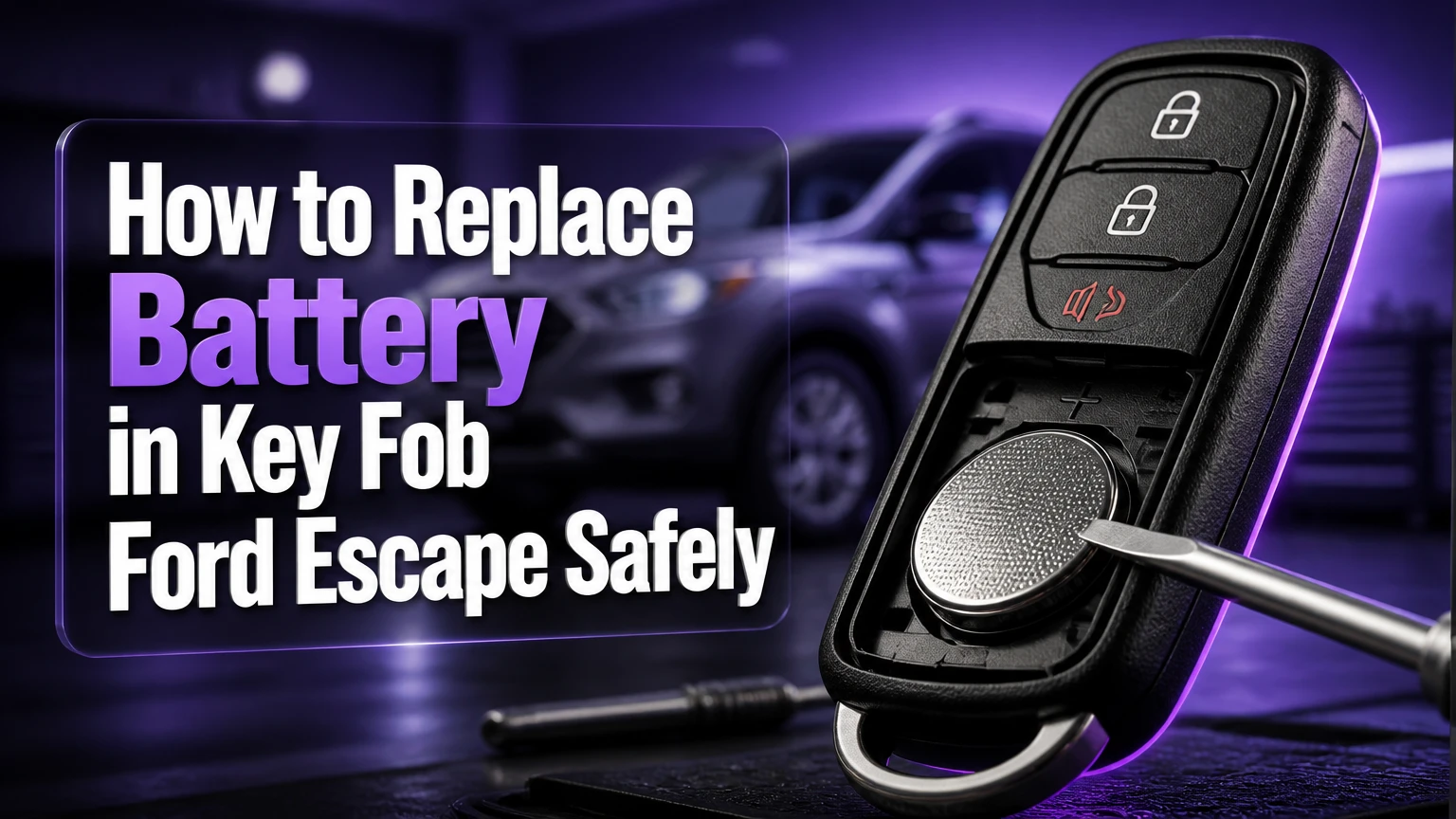
To replace the battery in a Ford Escape key fob, identify the remote housing, buy the matching CR2032 or CR2450 coin cell, remove the emergency key if fitted, split the case at its designated notch, and install the new battery in the same orientation as the old one. The job usually takes 2-5 minutes and does not erase key programming.
Key Facts at a Glance
- Ford Escape key fobs commonly use a CR2032 or CR2450 lithium coin battery, depending on remote design and model year.
- A battery change normally preserves the Ford Escape key fob’s remote programming and vehicle pairing.
- The positive-side orientation is not universal across every Escape remote, so the original battery position and case markings take priority.
- A new battery costs typically $2-$7 for a two-pack, while professional replacement commonly costs $10-$50.
- A dead intelligent-access fob may still start the Ford Escape from its backup detection location.
- A replacement battery cannot repair a cracked circuit board, damaged contacts, water intrusion, or a failed vehicle receiver.
Which Battery Fits a Ford Escape Key Fob?
The correct battery depends on the fob housing, not the model year alone. Ford Escape vehicles from older generations generally use CR2032 cells, while many 2020-and-newer Intelligent Access remotes use the physically thicker CR2450; Ford used multiple remote designs, so inspect the installed cell before purchasing.
A CR2032 measures approximately 20 millimeters across and 3.2 millimeters thick. A CR2450 has the same approximate 20-millimeter diameter but is 4.5 millimeters thick. The thicker CR2450 cannot safely substitute for a CR2032 if it prevents the cover from closing or bends the retaining contacts.
Look for the battery designation stamped directly on the old cell. If the printing is unreadable, check the Ford owner’s manual, the remote part number, or the molded battery specification inside the housing. Do not rely on a seller’s compatibility list that combines every Escape generation.
| Escape remote style | Typical Escape years | Common battery | Opening feature | Orientation rule |
|---|---|---|---|---|
| Separate rectangular remote | 2001-2012 | CR2032 | Side seam or notch | Match the removed cell |
| Flip key with folding blade | 2001-2012 and some later replacements | CR2032 | Notch exposed after blade release | Match case marking and old cell |
| Square Intelligent Access remote | 2013-2019 | CR2032 | Emergency-key slot | Verify the housing before installation |
| Sleek proximity remote | 2020-2026 | CR2450 in many versions | Emergency-key slot | Confirm the manual and internal symbol |
| Replacement or aftermarket housing | Any year | Varies | Housing-specific seam | Read the installed cell, not the listing |
The year ranges are practical identification guides, not an absolute fitment rule. A replacement key, regional trim difference, or aftermarket shell can change the battery requirement.
What tools and materials are needed?
You need one matching coin cell, a small flat-head screwdriver or plastic pry tool, and a lint-free cloth. A quarter works for some older remote covers, but a plastic tool reduces scratches and avoids slipping into the circuit board.
Before You Start
| Requirement | Typical value | Practical instruction |
|---|---|---|
| Replacement cell | 1 CR2032 or 1 CR2450 | Buy the exact printed designation |
| Work time | 2-5 minutes | Add 5 minutes if the shell is tight |
| DIY cost | $2-$7 | Typical two-pack price for a branded cell |
| Tools | 1 small flat-head tool | Use a plastic pick where possible |
| Difficulty | Low | Stop if clips or contacts begin to deform |
| Safety | Dry, clean surface | Keep the coin cell away from children and pets |
Work over a table rather than a parking-lot floor. The emergency blade, cover clips, and battery-retaining spring are small enough to disappear.
How Do You Replace the Battery in a Ford Escape Key Fob?
Replace the battery by opening the shell at its intended notch, preserving the circuit board and contacts, installing the matching cell with verified polarity, and snapping the case together without forcing it. A successful replacement leaves the cover flush, the buttons responsive, and the vehicle able to lock and unlock normally.
Before opening the fob, press each button once and note the symptom. A weak lock response, intermittent range, or “No Key Detected” warning points toward a depleted cell, but a completely silent remote can also have a damaged board or failed button.
Step 1: Identify and purchase the replacement cell
Read the designation on the installed battery and buy one CR2032 or CR2450 from a reputable manufacturer such as Panasonic, Energizer, Duracell, or Maxell. Check the package for intact sealing and a current expiration date; coin cells stored for years can measure below their nominal voltage before installation.
Do not stack two CR2032 batteries to imitate a CR2450. The combined thickness can crush the housing, short the cells, or permanently distort the contacts.
Success checkpoint: The new cell has the same printed designation and approximately 3 volts open-circuit voltage.
Common mistake: Buying a CR2450 because the diameter looks identical. Thickness determines whether the cell fits safely.
Step 2: Remove the emergency key when present
Press or slide the release on the back or lower edge of an Intelligent Access remote, then pull the emergency metal key blade from the housing. The removed blade exposes the internal opening point on many 2013-and-newer Escape fobs.
Older flip keys may require pressing the blade-release button before the folding blade can move. Keep the blade beside the fob because it may be needed to pry the case apart.
Success checkpoint: The key blade is fully removed and the internal slot is visible.
Common mistake: Prying around the outer seam before removing the blade. That can break the first retaining clip or mar the plastic.
Step 3: Open a 2020-2026 proximity remote
Insert the tip of the emergency key blade or a thin flat-head screwdriver into the slot exposed by the removed blade. Twist gently, using the tool as a wedge rather than levering against the circuit board. Separate the back cover only far enough to release the clips.
Many newer Escape proximity remotes use a CR2450. Ford’s exact battery orientation can vary by housing, so photograph the old cell before removal and follow the plus/minus marking molded into the battery tray.
Lift the old battery from its edge. Avoid sliding a metal tool across the board or pressing down on the spring contact.
Success checkpoint: The back cover separates without a broken tab, and the battery tray remains flat.
Common mistake: Using a wide screwdriver with excessive force. A small twist at the notch is safer than a large pry at the seam.
Step 4: Open a 2013-2019 Intelligent Access remote
Remove the emergency key and insert its tip into the slot inside the key-blade compartment. Twist carefully to split the two shell halves. Some square Ford remotes expose the battery with the circuit board in the upper half, while others retain it in the lower half.
Record the original orientation before lifting the CR2032. In many Ford Intelligent Access housings, the positive side faces downward, but the internal tray and molded symbols are the final authority for that specific remote.
Success checkpoint: The new CR2032 sits completely flat, and the spring contact touches its edge or designated face without bending.
Common mistake: Assuming every CR2032 remote uses the same plus-side direction. Battery diameter does not determine polarity orientation.
Step 5: Open a 2001-2012 standard or flip key
Find the indentation along the side seam near the key ring loop on a separate rectangular remote. Insert a coin or small flat-head tool, then twist slowly until the back plate releases.
For a flip key, fold or release the metal blade as the design permits and use the exposed notch. Remove the old CR2032 and compare its face orientation with the replacement. Older standard remotes commonly show the positive side upward, but the installed cell and case marking remain more reliable than a year-based rule.
Success checkpoint: The back plate closes evenly around the entire perimeter.
Common mistake: Pulling the cover straight upward before releasing the clips. Twisting at the marked notch distributes less force.
Step 6: Reassemble and test every function
Align the shell’s upper tabs first, then press the lower portion until the clips click. Reinsert the emergency key blade and test lock, unlock, panic, liftgate, and remote start functions if equipped.
Test from several distances. A button response at one foot confirms basic operation, while normal range requires a second test from roughly 30-60 feet in an open area; buildings, other transmitters, and vehicle orientation affect that distance.
Success checkpoint: The case has no gap, each button has normal travel, and the Escape responds consistently.
Common mistake: Closing the shell with the battery edge trapped under a clip. Reopen it immediately if the cover will not sit flush.
What Is the Battery Orientation?
Battery orientation must be copied from the original Ford Escape key fob and confirmed against the tray symbol. Some older standard remotes commonly place the positive side upward, while several Intelligent Access designs place the positive side downward; installing a cell by model year alone can reverse the polarity.
The plus sign is usually stamped on the visible face of a coin cell. The negative side is commonly plain, although some cells include printing on both faces. A correctly installed battery sits flat, with no rocking or forced compression.
Ford support instructions for key batteries emphasize following the remote’s construction and disposing of the old battery responsibly. The battery is a power source, not a memory backup, so removing it briefly does not normally delete the remote’s encrypted identity.
How should the contacts and circuit board be handled?
Handle the circuit board only by its edges and do not scrape the dull factory residue from the housing. That residue may be dielectric grease or protective compound, and removing it can reduce moisture resistance.
Clean only visible dirt or corrosion, using a dry lint-free swab first. Do not spray household cleaner, alcohol, or contact cleaner into a sealed key fob unless the product is specifically suitable for electronics and the board is already exposed.
Does Replacing the Battery Reprogram the Ford Escape Key?
Replacing a Ford Escape key-fob battery normally does not require reprogramming. The remote’s stored identity and the vehicle’s immobilizer authorization remain in nonvolatile memory, so changing the coin cell restores power rather than creating a new key.
A battery replacement cannot pair an unrecognized replacement fob. Programming is required when a key is newly cut, an electronic key is added, all keys are lost, or the transmitter and vehicle no longer share valid authorization. That is a separate procedure involving Ford-specific equipment or, on some older vehicles, a documented ignition-cycle sequence.
A key that unlocks the doors but does not start the Escape can have an immobilizer or transponder problem, not simply a weak remote battery. Conversely, a key that starts the vehicle but has no button response usually has a remote battery, switch, board, or transmitter fault.
How Much Does a Ford Escape Key-Fob Battery Replacement Cost?
A DIY Ford Escape battery change typically costs $2-$7 and takes 2-5 minutes. A parts-store counter may charge nothing beyond the cell, while a locksmith or dealership commonly charges $10-$50 for a simple battery service; programming or a complete replacement key costs substantially more.
These are typical consumer ranges, not fixed Ford prices. Labor varies by location, business policy, remote design, and whether the provider assumes responsibility for damaged clips or contacts.
| Replacement route | Typical parts cost | Typical labor cost | Typical total time | Best use |
|---|---|---|---|---|
| DIY with CR2032 | $1-$4 per cell | $0 | 2-5 minutes | Standard and older Intelligent Access fobs |
| DIY with CR2450 | $2-$5 per cell | $0 | 2-5 minutes | Newer proximity remotes |
| Auto-parts counter | $2-$10 | $0-$10 | 5-15 minutes | Basic cell replacement |
| Automotive locksmith | $5-$15 | $10-$35 | 10-20 minutes | Stuck shell or uncertain fitment |
| Ford dealership service lane | $5-$15 | $15-$50 | 15-30 minutes | Owners wanting dealer handling |
| New programmed key | $50-$300+ | Included or additional | 30-120 minutes | Lost, damaged, or unrecognized key |
A new programmed key is not the normal solution to a depleted battery. Ask the provider to diagnose the existing remote before approving key replacement.
DIY or Professional Replacement: Which Is Better?
DIY replacement is the best choice for an intact Ford Escape fob when the correct cell and opening notch are clear. Professional service is worthwhile when the shell is already cracked, the emergency key will not release, the contacts are corroded, or the remote remains dead after a verified new battery.
| Decision factor | DIY replacement | Auto-parts counter | Locksmith | Ford dealership |
|---|---|---|---|---|
| Typical total cost | $2-$7 | $2-$20 | $15-$50 | $20-$65 |
| Typical completion time | 2-5 minutes | 5-15 minutes | 10-20 minutes | 15-30 minutes |
| Battery diagnosis | Visual and functional | Basic | Basic to advanced | Advanced |
| Risk of shell damage | Owner-dependent | Low to moderate | Low | Low |
| Programming capability | No | Usually no | Often yes | Yes |
| Best situation | Clear, undamaged fob | Simple cell change | Fault finding or stuck case | Key-system diagnosis |
A professional counter is not automatically safer if the worker uses a large screwdriver or cannot identify the remote. Confirm the battery number and polarity before the case is closed.
Why Is the New Battery Still Not Working?
A Ford Escape key fob that remains unresponsive after battery replacement usually has reversed polarity, poor seating, a dead replacement cell, damaged contacts, a worn button, or a failed circuit board. Troubleshoot in that order because the first three causes can be corrected without replacing the remote.
Check these failure modes in sequence
- Battery installed upside down: Reopen the housing and compare the plus sign with the tray marking and your original photograph.
- Battery not seated flat: Confirm that the retaining spring touches the designed contact point, not the plastic rim.
- Defective or old cell: Test another sealed battery from a different pack or measure approximately 3 volts with a multimeter.
- Bent contact: Restore only a slightly displaced spring with a nonconductive pick; do not repeatedly bend brittle metal.
- Dirty or corroded contact: Remove loose surface contamination with a dry swab. Green corrosion indicates moisture damage.
- Worn button or board: If one button fails while others work, inspect the switch area; if every function fails, suspect the board or transmitter.
A short operating range after installation does not prove finger oils caused the problem. Range can also fall because of a low-quality cell, a partially closed case, a damaged antenna trace, radio interference, or a vehicle receiver fault.
Can the Escape Start With a Dead Key Fob?
A Ford Escape with push-button start can often detect a dead intelligent-access fob through a backup location, although the location differs by generation and owner’s manual. Common locations include a center-console slot, a designated pocket, or a backup position near the steering column.
Place the fob in the specified backup location with the buttons oriented as the manual illustrates, then press the brake and the engine-start button. The passive transponder can authorize starting even when the coin cell cannot transmit normally.
The emergency metal key also provides mechanical access to the driver door on many remotes. It may trigger an alarm when used, but placing the recognized fob in the backup position and starting the vehicle should cancel the alarm on supported systems.
Do not assume a remote that starts the vehicle has a healthy battery. Passive immobilizer detection and long-range button transmission use different parts of the key system.
What Edge Cases Require Extra Care?
A Ford Escape key fob with a wet interior should be opened only after the vehicle is secure and the battery is removed. Dry the housing and board fully in moving room-temperature air; avoid ovens, heat guns, and direct high heat, which can deform the shell and damage components.
A cover that will not open should not be forced around its entire perimeter. Search for the emergency-key slot, use a thin plastic pick, and apply a small twisting motion at the molded notch. If the clips remain locked, a locksmith can open the housing with less risk than repeated levering.
A missing emergency blade does not prevent battery replacement, but it removes the most convenient opening tool. Use a plastic pry pick or precision screwdriver that fits the notch exactly, and place tape around the tool if protecting a glossy shell matters.
Coin cells present a serious ingestion hazard. Store new and used CR2032 or CR2450 batteries in closed packaging and take depleted cells to a battery-recycling point rather than leaving them loose in a drawer or glovebox.
Frequently Asked Questions
Will a Ford Escape key fob work after sitting without a battery?
Yes, the Ford Escape key fob normally works after a brief battery removal because its programming is stored in nonvolatile memory. The remote may fail only if the cell was installed backward, the contacts were disturbed, or the fob already had a transmitter or circuit-board fault.
Can I use a CR2032 instead of a CR2450?
No, not when the Ford Escape housing specifies a CR2450. Both cells are about 20 millimeters wide, but a CR2032 is 1.3 millimeters thinner, so it may not maintain contact; stacking cells is unsafe and can damage the remote.
How long should a Ford Escape key-fob battery last?
A typical lithium coin cell lasts about 2-4 years, although heavy button use, frequent remote start, passive proximity operation, cold weather, and storage conditions change the interval. A battery warning or sharply reduced range is a better replacement signal than a fixed calendar date.
Can an auto-parts store replace the battery?
Many auto-parts stores will install a readily accessible coin cell, but policies vary and staff may decline a remote with a fragile shell or uncertain battery fit. Bring the fob, verify the exact CR2032 or CR2450 designation, and ask whether installation responsibility is included.
Should I replace both key-fob batteries at once?
Replace the battery in the spare Ford Escape key fob if it is the same age and has similar reduced range, but do not replace a healthy cell solely because the primary remote needed service. Keep one sealed, correctly sized spare at home rather than loose in the vehicle.
The Bottom Line
To replace the battery in a Ford Escape key fob, match the existing CR2032 or CR2450, remove the emergency blade when applicable, pry only at the designated notch, copy the original polarity, and test every function after reassembly. The process usually costs $2-$7 and takes 2-5 minutes, with no reprogramming required for a normal battery change; for an Audi A3, the Audi A3 key battery replacement how-to distinguishes flip-key and smart-key opening methods.