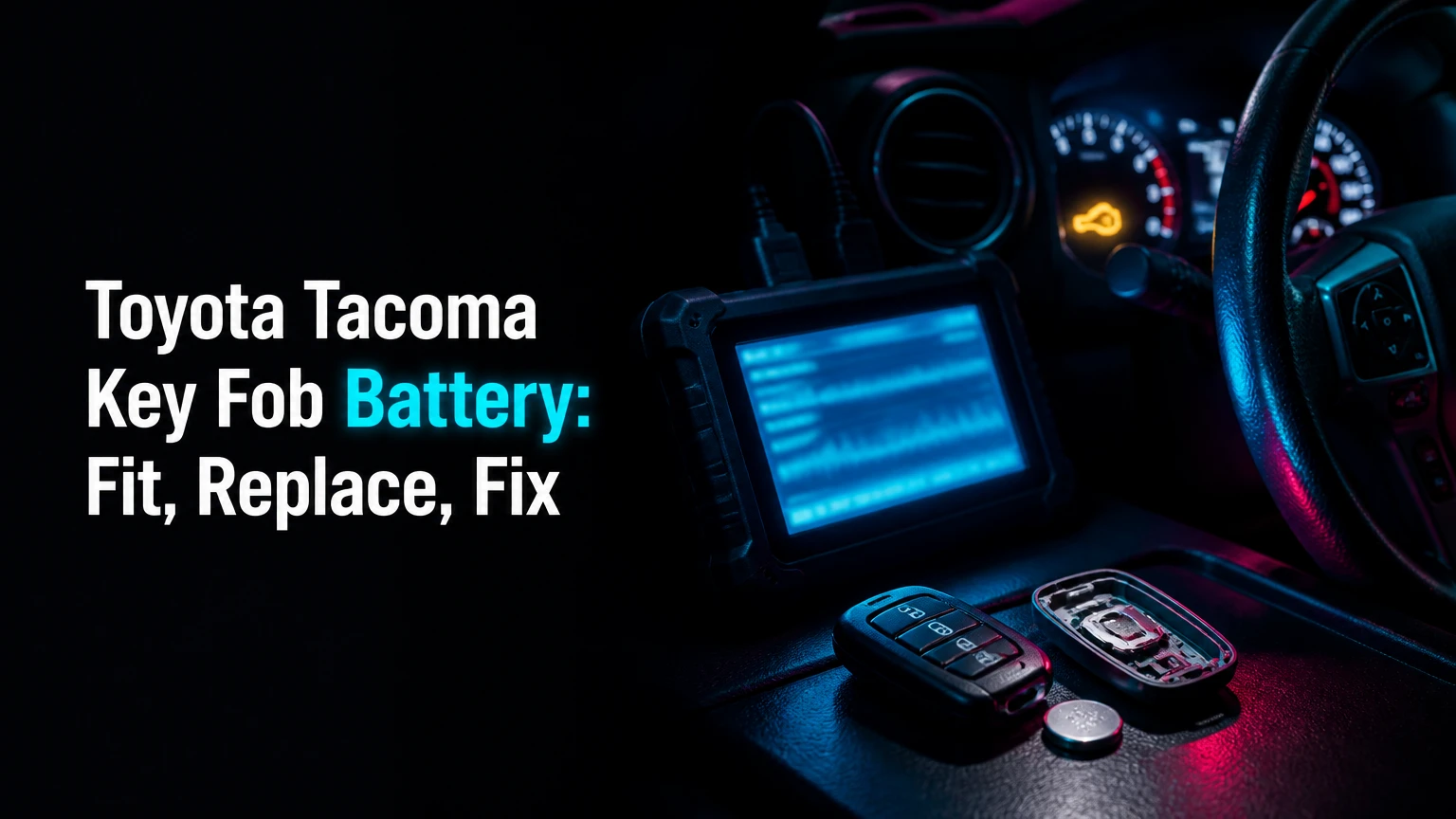
The correct Toyota Tacoma key fob battery depends on the fob design and model year, with CR2032 common on many 2005-2023 remotes and CR2450 used by many 2024-and-newer Smart Keys. Verify the number printed on the old cell or in the owner’s manual before buying. Most replacements take 5-10 minutes and require no reprogramming.
Key Facts at a Glance
- A Toyota Tacoma key fob uses a 3-volt lithium coin cell, not the truck’s 12-volt starting battery.
- Many 2005-2023 Tacoma remotes use CR2032 cells, but some earlier fobs use CR2016.
- Many fourth-generation 2024-and-newer Smart Keys use a thicker CR2450 cell.
- The positive side usually faces upward, but the housing markings and owner’s manual control.
- Replacing the cell normally does not erase the key’s programming.
- A dead Smart Key can usually start the Tacoma by touching the Toyota-emblem side of the fob to the engine switch while pressing the brake.
Which Battery Fits a Toyota Tacoma Key Fob?
The battery number molded or printed inside the fob is the most reliable fitment reference. Model year narrows the choice, but Toyota supplied multiple remote styles, trim packages, and replacement housings, so a year-only lookup can produce the wrong thickness.
A CR2032 measures approximately 20 millimeters across and 3.2 millimeters thick. A CR2016 has the same diameter but is 1.6 millimeters thick, while a CR2450 measures about 24 millimeters across and 5.0 millimeters thick. Those physical differences affect the spring contacts and battery retainer.
| Tacoma application | Common remote design | Common cell | Verification requirement |
|---|---|---|---|
| 2005-2015 standard remote | Integrated key or separate rectangular transmitter | CR2016 or CR2032 | Read the installed cell |
| 2016-2023 Smart Key | Rectangular fob with emergency blade | CR2032 | Confirm fob marking or manual |
| 2016-2023 non-Smart remote | Button remote with conventional ignition key | CR2016 or CR2032 | Match the old battery |
| 2024-and-newer Smart Key | Larger fourth-generation proximity fob | CR2450 on many models | Confirm the owner’s manual |
| Dealer-installed replacement fob | May differ from original housing | Cell marked inside | Inspect before purchase |
The safest rule is simple: never force a CR2016, CR2025, CR2032, or CR2450 into a holder designed for another size. Diameter, thickness, contact pressure, and polarity all matter.
Why does the battery number matter so much?
A coin cell that is too thin can lose contact during vibration, while a cell that is too thick can bend the retaining clip or prevent the housing from closing. The Tacoma’s suspension, doors, and key ring expose the remote to repeated movement, so a marginal contact can create intermittent locking that looks like a transmitter failure.
CR2025 is a common source of confusion. It has the same 20-millimeter diameter as CR2032 but is 0.7 millimeters thinner. It may power a CR2032-equipped remote temporarily, but the reduced thickness can produce unreliable contact. It is not a proper substitute unless Toyota specifies it for that exact fob.
How Does a Tacoma Key Fob Battery Work?
The coin cell supplies low-voltage power to the Tacoma remote’s transmitter, buttons, indicator light, and Smart Key electronics. The remote sends an encrypted authorization signal to the vehicle, while the immobilizer system separately confirms whether the key is authorized to start the engine.
A conventional remote transmits when a button is pressed. A Smart Key also participates in short-range vehicle communication when the fob is near the truck, allowing passive locking, unlocking, and push-button authorization on equipped models. The fob does not replace the vehicle battery, and changing the coin cell does not charge or repair the truck’s electrical system.
Toyota’s owner manuals commonly describe the symptom directly: “The electronic key battery is depleted.” That warning means the fob cell has reached a low-power condition, not that the key has automatically lost its security registration.
What range should a fresh battery provide?
A typical working range is about 30-50 feet in open conditions, but Toyota does not guarantee one universal distance for every Tacoma. Metal buildings, other radio transmitters, a pocket containing several electronic devices, vehicle orientation, and a partially discharged battery can reduce range substantially.
A useful diagnostic pattern is more informative than a single range number:
- The lock button works only beside the driver’s door: suspect a weak cell or damaged antenna.
- The red indicator becomes dim or fails to flash: suspect the battery or an internal contact.
- Passive door unlocking fails but buttons work: suspect Smart Key settings, vehicle detection, or a separate fob fault.
- Both registered fobs fail together: inspect the truck’s 12-volt battery, Smart Key settings, and vehicle-side receiver before buying more cells.
What Do You Need Before Replacing the Battery?
A Tacoma key fob battery replacement usually requires one new coin cell, the emergency mechanical key, and a clean fingernail or plastic pry tool. A small flathead screwdriver can help with older remotes, but direct contact with the circuit board increases the chance of damage.
| Item | Quantity | Typical cost | Purpose |
|---|---|---|---|
| Correct lithium coin cell | 1 | $2-$5 | Replacement power source |
| Emergency metal key | 1 | Included with Smart Key | Opens many Smart Key housings |
| Plastic pry tool or fingernail | 1 | $0-$8 | Separates the shell safely |
| Clean work surface | 1 | $0 | Prevents lost buttons and debris |
| Nitrile gloves, optional | 1 pair | $0.25-$1 | Limits oil on battery contacts |
Before opening the shell, photograph the fob exterior and note the battery orientation. Work over a tray or light-colored cloth. Small rubber button membranes can move when the housing separates.
How Do You Replace a 2016-2023 Tacoma Smart Key Battery?
A 2016-2023 Tacoma Smart Key battery replacement takes approximately 5-10 minutes. Remove the emergency blade, use it to separate the shell, install the specified cell with the marked polarity, and close the housing without disturbing the circuit board.
Step 1: Remove the mechanical key
Press and hold the release latch on the side of the Smart Key. Pull the metal emergency blade from the housing and place it beside the fob.
Success checkpoint: The blade slides out without force, exposing the shell separation point.
Common mistake: Pulling on the blade without pressing the release latch can damage the latch or deform the key channel.
Step 2: Separate the fob shell
Look for the small slot near the mechanical-key opening. Insert the tip of the removed blade into the slot and twist gently, using a rotational motion rather than levering aggressively against the plastic.
Open the case with the buttons facing downward. This position reduces the chance that loose button pieces or the rubber membrane will fall out and change position.
Success checkpoint: The two shell halves separate along their seam without cracked plastic or a bent metal clip.
Common mistake: Sliding a screwdriver deep into the housing can scratch the circuit board or break a retaining post.
Step 3: Expose the coin cell
Lift the inner cover, shield, or electronics module only as far as necessary to reach the cell. Do not pull on the circuit board, antenna trace, or small metal contacts.
Inspect the existing battery before removing it. Record its number and polarity. Toyota housings usually show a plus symbol, but the installed cell provides the final confirmation.
Success checkpoint: The battery number is visible and the cell can be lifted from its retaining slot.
Common mistake: Opening the case buttons-up can scatter the rubber membrane and individual plastic buttons.
Step 4: Remove the old battery
Use a fingernail or plastic tool at the designated edge of the cell. Lift the battery from the side, avoiding pressure on the circuit board and spring terminals.
Hold the new cell by its outer edge. Finger oils are less likely to contaminate the contact surfaces when the flat faces are not handled.
Success checkpoint: The retaining tabs remain aligned and none is flattened against the circuit board.
Common mistake: Prying directly beneath a soldered component can fracture a circuit-board connection even when the fob looks undamaged.
Step 5: Install the replacement cell
Install the correct battery with the positive side facing the same direction as the old cell, normally upward toward the shell marked with a plus sign. Press evenly until the cell sits below the retainer and does not rattle.
For a typical CR2032, the replacement is a 3-volt lithium cell. Do not stack two thinner batteries to imitate a thicker one.
Success checkpoint: The cell is flat, secure, and fully captured by the retaining clip.
Common mistake: Installing a CR2016 where a CR2032 belongs may create intermittent power loss during vibration.
Step 6: Reassemble and test
Align the shell halves, press around the perimeter, and reinstall the mechanical blade. Test lock, unlock, panic, and hatch buttons beside the truck, then test passive entry and push-button starting if equipped.
Success checkpoint: The indicator flashes normally, every button responds, and the housing closes evenly without a gap.
Common mistake: A shell that does not close usually indicates a displaced inner cover, button membrane, or incorrect battery thickness. Do not clamp it shut.
How Do You Replace a 2005-2015 Tacoma Remote Battery?
Older Tacoma remotes usually open at a molded seam or small notch along the housing edge. Remove the screw if the housing has one, separate the halves with a small flat tool, match the installed cell, and reinstall the cover without pinching the rubber button membrane.
The older generation is especially difficult to identify by year alone because some trucks use an integrated key with remote buttons and others use a separate rectangular transmitter. CR2016 and CR2032 cells share a 20-millimeter diameter, so visual similarity does not prove compatibility.
| Fob condition | Recommended action | Reason |
|---|---|---|
| Housing has a visible screw | Remove screw before prying | Prevents broken shell posts |
| Housing has a seam notch | Insert a thin flat tool at notch | The notch is the intended opening point |
| Buttons fall out | Photograph button layout first | Prevents reversed or misplaced buttons |
| Cell number is unreadable | Check owner’s manual or dealer parts record | Avoids guessing by appearance |
| Shell is cracked | Replace shell before final testing | A loose shell can interrupt contact |
Older remotes generally retain their programming after a battery change. If the buttons still fail, check the cell orientation and contact clips before attempting key registration.
Which Battery Brand Should You Buy?
A fresh Panasonic, Energizer, or Duracell lithium coin cell is a sensible choice when the package comes from a reputable retailer and has a long remaining shelf life. Brand matters less than correct size, genuine packaging, clean contacts, and proper storage.
| Battery option | Typical retail price | Practical strength | Main limitation |
|---|---|---|---|
| Panasonic CR2032 or CR2450 | $2-$4 each | Common OEM-style replacement | Less consistently stocked locally |
| Energizer lithium cell | $3-$6 each | Broad availability and cold-weather performance | Higher single-cell price |
| Duracell lithium cell | $3-$6 each | Easy retail access and long storage life | Packaging varies by retailer |
| Generic multipack | $0.50-$2 each | Lowest cost per cell | Greater variation in age and quality |
| Dealer-supplied cell | $10-$25 installed | Correct fitment assistance | Highest labor and service cost |
Battery manufacturers such as Energizer identify these cells as 3-volt lithium coin batteries with long storage lives, often up to approximately 10 years under stated storage conditions. Storage life is not operating life: a fob exposed to frequent Smart Key communication, heat, or cold may require replacement sooner.
Avoid loose cells from unknown marketplace sellers. Counterfeit or old batteries can have reduced capacity, poor labeling, or damaged seals. For an overland trip, carry one sealed spare in its original package, away from metal tools and extreme heat.
How Long Does the Battery Last and What Does Replacement Cost?
A Tacoma key fob battery commonly lasts 1-3 years, while a typical DIY replacement costs $2-$5 and takes 5-10 minutes. Heavy Smart Key use, repeated button presses, cold temperatures, and storing the fob close to the truck can shorten the interval.
| Situation | Typical battery interval | Typical replacement cost | Best approach |
|---|---|---|---|
| Conventional button remote | 2-4 years | $2-$5 DIY | Replace when range declines |
| Daily Smart Key use | 1-3 years | $2-$6 DIY | Keep one spare available |
| Cold outdoor operation | 1-2 years | $3-$6 premium cell | Use a fresh name-brand cell |
| Dealer replacement | Same cell life | $10-$25 installed | Use when housing is damaged |
| Long-term vehicle storage | Variable | $2-$6 DIY | Disable Smart Entry if supported |
A preventive two-year replacement schedule is reasonable for a commuter who cannot tolerate a dead remote, but replacing a working cell every few months wastes batteries. The better trigger is reduced range, a dim indicator, an intermittent button, or a vehicle warning.
Does Replacing the Battery Require Programming?
Replacing the coin cell normally does not require programming because the key’s security data remains stored in the fob and vehicle. Programming becomes relevant when the entire fob is replaced, the key is unregistered, the immobilizer system has a fault, or the remote has suffered circuit-board damage.
A battery change cannot repair a lost registration. It also cannot make an aftermarket housing compatible with a different circuit board. If a new battery produces no indicator light, inspect polarity and contacts first. If the indicator works but the truck never responds, compare the second registered fob and check whether the vehicle’s 12-volt battery is discharged.
Dealerships and qualified automotive locksmiths can verify Toyota part numbers, register compatible keys, and diagnose immobilizer faults. Do not assume that a replacement shell, blank blade, and coin cell together create a complete programmable key.
How Can You Start a Tacoma With a Dead Key Fob?
A Tacoma with a depleted Smart Key battery can usually be started by pressing the brake pedal and holding the Toyota-emblem side of the fob directly against the engine Start/Stop switch. The vehicle uses the close-range backup transponder reading even though the normal remote functions are unavailable.
Use this sequence:
- Sit in the driver’s seat with the Smart Key inside the cabin.
- Press the brake pedal firmly.
- Touch the Toyota-logo side of the fob to the engine switch.
- Keep the fob against the switch while pressing the switch.
- Remove the fob only after the engine starts.
The exact logo location and switch wording can vary by Tacoma generation. If the truck does not respond, confirm that the brake lights work, move other electronic keys away, and try the second fob. A completely discharged vehicle battery will prevent starting even when the key fob is functional.
The metal emergency blade can unlock the driver’s door mechanically, but it does not by itself authorize the engine. The immobilizer still needs a recognized electronic key.
Why Does the Tacoma Key Still Not Work After Replacement?
A Tacoma key fob that remains inoperative after a battery change usually has a polarity error, poor contact pressure, damaged circuitry, or a separate vehicle-side problem. Check the simple physical causes before paying for programming or purchasing another fob.
| Symptom after replacement | Likely cause | Corrective action |
|---|---|---|
| No LED and no button response | Reversed cell or dead cell | Reinstall or test with a new cell |
| LED works, truck does not respond | Wrong frequency, damaged transmitter, vehicle fault | Test second fob and inspect vehicle |
| Works only when pressed hard | Loose retainer or thin substitute cell | Install specified thickness and restore clip |
| Lock works, unlock fails | Worn button pad or switch | Inspect membrane and switch contacts |
| Passive entry fails, buttons work | Smart Entry disabled or weak proximity circuit | Check settings and test near handle |
| Housing will not close | Wrong cell or displaced cover | Reopen and realign internal parts |
| Battery dies within weeks | Stuck button, moisture, internal short | Inspect for contamination or replace fob |
A battery can measure near 3 volts with no load and still fail under transmitter demand. If two fresh cells behave the same way, the problem is unlikely to be simple battery capacity.
Why does the fob battery keep dying?
Repeated battery failure usually indicates a stuck button, water intrusion, a damaged contact, or unusually frequent Smart Key communication. A fob left inside or immediately beside the Tacoma can communicate more often than one stored several rooms away, increasing drain in some Smart Entry configurations.
Inspect the rubber membrane for deformation and the housing for cracks. Do not wash the fob or spray electrical cleaner into it. Moisture damage often requires circuit-board repair or replacement rather than another coin cell.
What Should You Avoid When Handling the Fob?
The most expensive mistakes are preventable: forcing the wrong battery, levering against the circuit board, and closing the shell with misaligned internal pieces. A Tacoma fob contains delicate spring contacts and surface-mounted components that do not tolerate repeated rough opening.
Use these practitioner rules:
- Match thickness before diameter. A CR2025 can look correct beside a CR2032 but may not maintain pressure.
- Pry at the molded opening point. Random seam prying creates cracked tabs and a loose housing.
- Keep the circuit board dry and clean. Battery residue or water can create leakage paths.
- Photograph button placement before separating an older remote.
- Test every button before adding a silicone cover or bulky key case.
- Recycle the removed lithium cell through a battery collection point, and cover its terminals with tape during transport.
A fob case that closes only under force is not repaired. The internal stack is probably wrong, and continued pressure can crack the board.
Can Smart Key Battery Drain Be Reduced During Storage?
Many Tacoma Smart Key systems provide a battery-saving or Smart Entry disable function, but the exact button sequence varies by generation and manual. Toyota commonly documents a procedure involving the Lock button and repeated Unlock presses, with the key indicator flashing to confirm a sleep state.
Do not treat that sequence as universal. Check the Tacoma owner’s manual for the exact model and confirm the indicator response. Store the fob away from the truck, radio equipment, and extreme heat, and keep the mechanical blade accessible.
A Faraday pouch can reduce relay-attack exposure and radio communication, but a cheap pouch may not block all frequencies. Test the pouch by checking whether the truck detects the enclosed fob before relying on it for long-term storage.
Is DIY Replacement Better Than Dealer Service?
DIY replacement is preferable when the housing is intact, the battery number is clear, and the buttons work normally. Dealer or locksmith service is better when the fob is water-damaged, cracked, unrecognized, or missing its emergency blade.
| Condition | DIY suitability | Dealer or locksmith need | Typical time |
|---|---|---|---|
| Routine coin-cell change | High | None | 5-10 minutes |
| Broken shell with good electronics | Moderate | Optional shell replacement | 15-30 minutes |
| Lost or unregistered fob | Low | Usually required | 30-90 minutes |
| Water-damaged circuit board | Low | Diagnostic service | 30-120 minutes |
| Dead Tacoma 12-volt battery | None | Roadside or battery service | 15-60 minutes |
A service counter may replace a battery while you wait, but the charge often reflects labor and inspection rather than the cell’s wholesale price. Ask whether the quoted amount includes a battery test, housing inspection, and functional test.
Frequently Asked Questions
Can I use a CR2025 instead of a CR2032 in a Tacoma key?
A CR2025 should not be treated as a permanent CR2032 replacement. Both cells are 20 millimeters wide, but CR2025 is 0.7 millimeters thinner, which can reduce contact pressure in the Tacoma holder. Use the exact cell number printed inside the fob unless Toyota specifically lists another size.
Will a dead key fob prevent the Tacoma from unlocking?
A dead key fob battery disables the normal wireless buttons and may disable passive Smart Entry, but the mechanical blade can unlock the driver’s door. A Smart Key Tacoma can often start through the backup procedure, which requires pressing the brake and touching the fob to the engine switch.
Why does my Tacoma say key battery low after replacement?
The warning may persist briefly if the new cell is weak, installed backward, or not contacting the terminals. Verify the battery number, positive orientation, and clip pressure, then lock and unlock the truck several times. If the warning continues with a verified fresh cell, the fob or vehicle may need diagnosis.
Do I need to replace the battery in both Tacoma key fobs?
Replace only the fob showing low range or a warning, but compare both remotes if they were purchased at the same time. Two cells from the same old package can reach the end of their storage life together. Keeping one correctly sized spare is more useful than replacing a fully working cell early.
Can a Tacoma key fob battery leak?
Lithium coin cells can leak or vent when damaged, overheated, shorted, or stored improperly. Do not use a swollen, corroded, or punctured cell. If residue appears inside the fob, avoid touching it with bare hands and have the electronics inspected before installing another battery.
Where can I find the exact battery size for my Tacoma?
Check the number printed on the existing coin cell, the battery diagram inside the fob, and the Tacoma owner’s manual. A Toyota dealer parts department or qualified automotive locksmith can verify the fob by vehicle identification number, but the physical cell marking remains the quickest confirmation.
The Bottom Line
The Toyota Tacoma key fob battery is usually a CR2032 on many 2005-2023 remotes and a CR2450 on many 2024-and-newer Smart Keys, but the fob’s printed battery number takes priority over a year chart. Replace the cell with the same size and polarity, open the housing at its intended slot, and test every function before closing the case permanently. If the new battery does not restore operation, inspect contacts, the shell, the second fob, and the truck’s 12-volt battery before attempting programming.