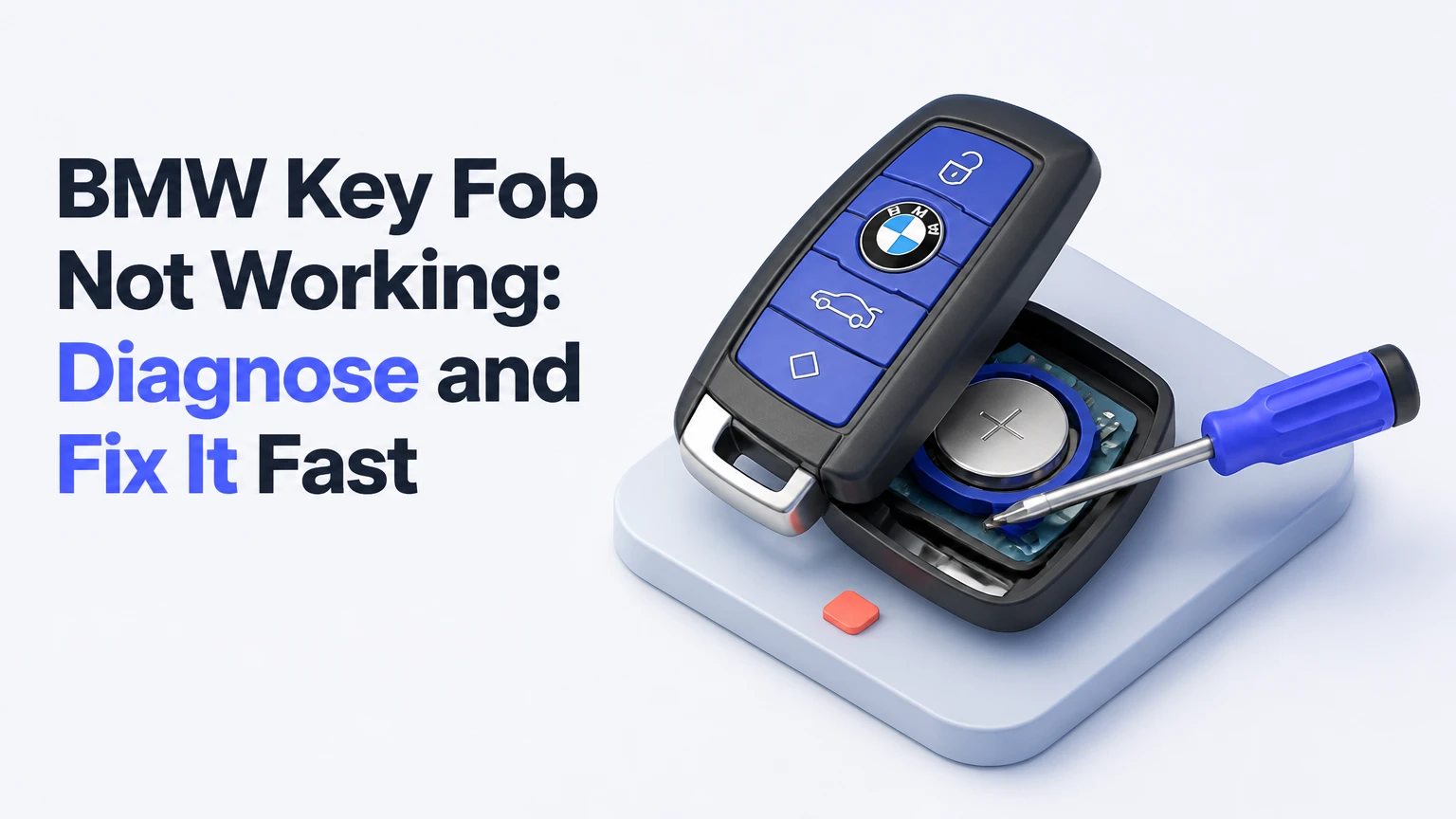
A BMW key fob not working usually results from a depleted battery, damaged key electronics, radio interference, or a vehicle-side fault such as a weak 12-volt battery or failed receiver. Test the backup-start position first, then separate remote-locking failure from immobilizer failure before replacing or programming the key.
Key Facts at a Glance
- A BMW remote key can stop locking doors while its immobilizer chip still permits engine starting.
- Comfort Access keys commonly use a replaceable CR2032 or CR2450 battery, but many older standard keys use a rechargeable VL2020 cell.
- A BMW with a weak vehicle battery can imitate a failed key fob by disabling central locking and key detection.
- Holding the key against the BMW backup-start symbol is a diagnostic test, not a permanent repair.
- A replacement BMW key normally requires vehicle-specific authorization or programming, and a used key may not be reusable.
- Typical US costs range from $5-$15 for a battery, $150-$300 for locksmith programming, and $400-$800 for a dealer-supplied replacement key.
What Does a BMW Key Fob Control?
A BMW key fob contains separate systems for vehicle access and engine authorization. Button presses transmit a radio-frequency command to the vehicle, while the immobilizer transponder communicates with the car through a short-range induction or near-field system when the vehicle validates the key for starting.
Remote locking, Comfort Access, and engine starting can therefore fail independently; Comfort Opening may lower the windows when you hold Unlock continuously, depending on equipment. For example, a key with a depleted coin cell may not unlock the doors remotely, yet the engine can still start when the fob is held at the designated backup antenna.
BMW key systems use encrypted identification and changing codes rather than a permanently repeated unlock signal. The commonly cited operating bands are approximately 315 MHz in North America and 433 MHz in many European markets, but the correct replacement depends on the vehicle’s market, chassis, frequency, electronics, and security system.
BMW owner documentation treats the emergency-start location as a backup method when the vehicle cannot detect the key normally. That location varies by generation. The owner’s manual for the specific year remains more reliable than a generic online reset sequence.
Which BMW key fob do you have?
| Key type | Typical BMW use | Battery or power source | Common clue |
|---|---|---|---|
| Standard key, older design | Many E-series and early F-series vehicles | Rechargeable VL2020 soldered to circuit board | No normal battery door |
| Comfort Access key | F-series and newer vehicles with passive entry | Replaceable CR2032 or CR2450, commonly 3 volts | Door-handle touch unlocks vehicle |
| Display Key | Selected late F-series and G-series models | Rechargeable lithium-ion battery | Color screen and remote functions |
| Slim or newer smart key | Selected G-series vehicles | Model-specific rechargeable or replaceable cell | Compact sealed housing or wireless charging |
Do not install a CR2032 into a key designed for a rechargeable VL2020. The battery type, charging circuit, contacts, and housing are different, and the substitution can damage the printed circuit board.
Why Is My BMW Key Fob Not Working?
The most likely cause is a depleted or damaged key battery, but the symptom pattern identifies the fault more accurately than the age of the battery. A key that unlocks the vehicle manually but does nothing electronically has a transmitter, battery, or synchronization problem; a key that unlocks remotely but cannot authorize starting has a different problem.
| Symptom | Most likely causes | First test | Likely next action |
|---|---|---|---|
| No buttons work, engine still starts | Dead coin cell, weak button contacts | Backup start | Replace battery and inspect contacts |
| No buttons work, engine will not start | Key electronics, vehicle battery, receiver, immobilizer issue | Try spare key | Measure vehicle battery and obtain diagnostics |
| Comfort Access fails, buttons work | Door-handle antenna, passive-entry sensor, local interference | Press unlock button | Inspect handle area and test at another location |
| One key fails, second key works | Failed battery, water damage, broken solder joint | Compare keys within 1 minute | Repair or replace the faulty key |
| Both keys fail together | Vehicle battery, fuse, receiver, BDC, FEM, CAS, interference | Check interior electrical power | Diagnose vehicle-side system |
| Display Key screen is blank | Discharged internal battery, charger, cable, display fault | Charge with approved method | Allow charging time, then seek repair |
A short range is an early battery warning. If the remote works only within a few feet, replace the correct cell before assuming that programming has been lost.
Could radio interference be the cause?
Radio interference can block remote commands without damaging the BMW key fob. Test the key away from a phone, wireless charging pad, airport parking area, security gate, or other high-radio environment, then try the vehicle again from the normal distance.
Metal containers can also reduce transmission range. Keep the key away from a metal wallet, large key ring, or tightly packed bag during testing.
Can You Start a BMW With a Dead Key Fob?
Yes, many BMW models can start with a depleted remote battery by placing the key at the vehicle’s backup detection point and pressing the Start/Stop button. The method works because the immobilizer transponder can be read at close range even when the remote transmitter lacks enough battery power.
Step 1: Perform the backup-start test
- Enter the vehicle with the key or use the mechanical blade if remote unlocking fails.
- Locate the key-shaped marking or backup antenna symbol.
- Hold the BMW key directly against that marking.
- Press the brake or clutch as required by the vehicle.
- Press the Start/Stop button while keeping the key in position.
The location may be on the steering column, beside the steering column, in a center-console tray, or in another marked compartment. Your BMW manual determines the exact point.
Success checkpoint: The engine starts or the ignition activates when the fob touches the marked location.
What that result means: The immobilizer portion of the key and the vehicle’s authorization system are probably functional, while the remote battery or transmitter remains suspect.
Common mistake: Holding the key near the marking instead of against it. Close proximity may not provide enough coupling for the emergency reader.
If the backup-start test fails, try the spare key. A second failed key points toward the vehicle battery, receiver, antenna, or immobilizer system rather than two simultaneous fob failures.
How Do You Open the BMW Door Without the Remote?
The metal emergency blade opens the driver’s door mechanically when the remote buttons fail. The concealed lock cylinder may sit behind a small cover on the exterior handle, and some BMW models require careful removal of that cover before the blade can turn the cylinder.
Step 2: Use the emergency key blade
- Press the release button on the rear or side of the fob.
- Pull out the metal mechanical blade.
- Find the driver-door lock-cylinder cover.
- Insert the blade fully and turn it with controlled pressure.
- Refit the cover after entry.
The alarm may sound after mechanical entry, especially if the vehicle has not yet recognized the electronic key. Place the fob at the backup-start location and switch on the ignition promptly.
Success checkpoint: The driver door unlocks without excessive force, and the key blade rotates smoothly.
Common mistake: Twisting a partly inserted blade or prying the handle cover with a screwdriver, which can damage painted trim and the lock cover.
A seized lock cylinder is a separate mechanical problem. Lubrication and lock repair may be necessary even when the electronic key is healthy.
How Do You Replace a BMW Key Battery?
Replace a BMW key battery only after identifying the key housing and its original battery type. Comfort Access housings usually have a removable cover for a CR2032 or CR2450, while many older standard housings require circuit-board repair because the rechargeable VL2020 is soldered in place.
Step 3: Replace a replaceable coin cell
- Remove the emergency blade from the fob.
- Use the blade or a plastic trim tool at the intended battery-cover slot.
- Lift the cover without bending the housing.
- Record the old battery number and polarity.
- Install a new, reputable 3-volt CR2032 or CR2450 matching the original.
- Press the cover closed until every clip engages.
- Test lock, unlock, trunk, and panic functions from several feet away.
Success checkpoint: The key operates consistently, and the vehicle responds at the expected range.
Common mistake: Choosing a battery by appearance rather than the number printed on the old cell or specified in the owner’s manual.
Do not touch both battery faces unnecessarily, crush the cell, or leave the cover partially sealed. A loose contact can create an intermittent fault that looks like lost programming.
What if the BMW key uses a VL2020?
A VL2020 is a rechargeable lithium coin cell used in some older BMW keys. It normally charges while the key is inserted into the ignition slot, although charging depends on the key design and vehicle system.
A soldered VL2020 should not be treated like a disposable CR2032. Replacing it requires opening the housing, desoldering the old cell, fitting the correct rechargeable part with matching tabs, and checking the board for cracked joints or corrosion. An automotive electronics specialist is safer than forcing the shell open at home.
Expert insight: A rechargeable key that works briefly after charging but dies rapidly often has a worn cell, not a synchronization problem. Repeated “reset” attempts cannot restore lost battery capacity.
Does a BMW Key Fob Need Reprogramming After a Battery Change?
A battery change normally does not erase the BMW key’s vehicle authorization, but some older remote systems may require resynchronization after prolonged loss of power. The correct procedure depends on the chassis, key type, ignition system, and market, so a generic button sequence is not universally safe.
Step 4: Try synchronization only when the model supports it
Older BMW procedures commonly involve entering the vehicle, closing the doors, switching the ignition on briefly, switching it off, then holding unlock while pressing lock several times. The exact timing and button order vary, and the procedure can differ between E-series and later F-series vehicles.
Do not assume that the frequently repeated “hold unlock and press lock three times” sequence applies to every BMW. It may resynchronize a compatible older remote, but it will not repair a failed Comfort Access antenna, replace a missing immobilizer authorization, or program a modern G-series key.
Success checkpoint: The locks cycle immediately after the supported synchronization procedure.
Common mistake: Performing an unrelated sequence repeatedly and concluding that the key or CAS module is permanently bricked.
If the battery is new and the key still does not transmit, use a BMW-capable scan tool or qualified locksmith. Avoid coding modules without a verified backup and stable vehicle power.
What Should You Check When Both BMW Keys Fail?
When both programmed keys stop working at the same time, investigate the vehicle before buying two replacement fobs. A weak 12-volt battery, blown fuse, receiver fault, failed Comfort Access antenna, CAS or FEM issue, and radio interference can affect every key simultaneously.
Step 5: Check the vehicle-side power and reception
- Test the vehicle’s interior lights, instrument cluster, hazard lamps, and central locking.
- Measure the 12-volt battery, preferably at rest and during a start attempt.
- Try the spare key at the backup-start position.
- Move the vehicle away from suspected radio interference.
- Check whether the mechanical blade still locks the driver door.
- Have a BMW-capable technician scan the relevant access and immobilizer modules.
A healthy 12-volt battery commonly measures about 12.4-12.7 volts after resting, although voltage alone does not prove battery capacity. A load test is more useful when the vehicle shows multiple low-power symptoms.
Expert insight: Replacing the key first is often the expensive mistake. If both keys fail and the cabin electronics are weak, a vehicle battery diagnosis can resolve the apparent key problem without any key programming.
When is the key itself the likely fault?
The fob is the primary suspect when only one key fails, the spare works normally, the failed key shows corrosion or impact damage, or the remote range declined gradually before stopping. Water inside the housing can damage the antenna, switches, battery contacts, and immobilizer board.
A button that feels soft or remains depressed can also prevent normal operation. Inspect the rubber membrane and housing, but do not spray household cleaner into the electronics.
Which BMW Key Replacement Option Is Best?
A BMW dealer is the safest choice for newer encrypted systems and ownership-controlled replacement, while a qualified automotive locksmith is often faster and less expensive for supported older chassis. Online DIY kits cost less but carry the highest risk when the key requires soldering, module access, or security programming.
| Replacement route | Typical US price | Typical time | Best fit | Main limitation |
|---|---|---|---|---|
| Battery replacement | $5-$15 | 5-15 minutes | Replaceable CR2032 or CR2450 | Does not repair board damage |
| Key electronics repair | $50-$150 | Same day to 3 days | VL2020, switches, cracked joints | Quality varies by specialist |
| Automotive locksmith | $150-$300 | 1-2 hours | Supported E-series or F-series | Requires BMW-capable equipment |
| BMW dealership | $400-$800 | 2-5 business days | Newer or restricted systems | Highest total cost |
| Display Key replacement | $900-$1,200 | 3-7 business days | Damaged or lost Display Key | Limited repair availability |
Prices are typical US ranges, not fixed BMW rates. Vehicle year, key design, programming policy, proof-of-ownership requirements, mobile call-out charges, taxes, and whether all keys must be present can change the final quote.
What information should you provide for a replacement?
Provide the vehicle identification number, registration or title, government identification, model year, chassis or model designation, and the number of working keys. A reputable provider should verify ownership before cutting or authorizing a key.
Do not send a VIN and personal documents to an unverified online seller. A VIN alone does not guarantee that a generic transmitter matches the vehicle’s frequency, immobilizer generation, or Comfort Access hardware.
Can a Used BMW Key Fob Be Reprogrammed?
A used BMW key fob is usually a poor replacement because its immobilizer authorization may remain permanently paired with another vehicle. Some housings can be reused, and certain electronic repair services can recover parts, but a used complete key is not equivalent to a new vehicle-authorized key.
| Purchase choice | Typical cost | Compatibility risk | Security position | Recommendation |
|---|---|---|---|---|
| New dealer key | $400-$800 | Low when VIN-matched | Strongest controlled supply | Best for G-series |
| Qualified locksmith key | $150-$300 | Moderate by chassis | Depends on provider | Good for supported systems |
| Used complete fob | $30-$150 | High | Unknown history | Avoid as primary key |
| Empty replacement shell | $10-$40 | Low for housing only | Original electronics retained | Useful for cosmetic damage |
| DIY programmer kit | $100-$500 | High | Module damage possible | Only for trained technicians |
A used shell can be practical when the original circuit board works. Transfer the original electronics only when the replacement housing is designed for that board and the battery arrangement matches.
How Much Time and Money Does the Repair Take?
A replaceable battery repair usually takes 5-15 minutes and costs $5-$15, while diagnosis of a vehicle-side access fault can take 30-120 minutes before parts are identified. Replacement-key costs range from approximately $150 for supported locksmith work to more than $1,000 for some Display Key situations.
| Scenario | Diagnostic time | Repair time | Typical total cost |
|---|---|---|---|
| CR2032 or CR2450 replacement | 5 minutes | 5-10 minutes | $5-$15 |
| Emergency blade plus backup start | 5-10 minutes | Immediate | $0 |
| VL2020 specialist repair | 15-30 minutes | 1-3 hours | $50-$150 |
| Vehicle battery diagnosis | 30-60 minutes | 1-3 hours | $100-$300 |
| Locksmith replacement | 30-60 minutes | 1-2 hours | $150-$300 |
| Dealer replacement | 30-90 minutes | 2-5 business days | $400-$800 |
The fastest path is symptom isolation, not immediate replacement. Testing the backup start and spare key can reduce an unnecessary dealer appointment.
Common Mistakes and Safer Fixes
- Installing a CR2032 in a VL2020 key: Confirm the original battery before opening the housing; rechargeable and replaceable cells are not interchangeable.
- Assuming a new battery requires programming: Test the buttons first, then follow only the procedure documented for the specific chassis.
- Forcing a sealed key shell: Use a specialist for soldered cells, because broken clips and lifted circuit traces can exceed the value of the repair.
- Buying a used programmed fob: Buy through a dealer or verified BMW locksmith instead of assuming an online key can be paired.
- Ignoring the vehicle battery: Test 12-volt power when both keys fail or interior electronics behave abnormally.
- Testing only Comfort Access: Use the physical buttons because a door-handle antenna can fail while the remote transmitter remains functional.
- Leaving the key in a hot vehicle: Heat, moisture, and repeated impact can shorten circuit-board and battery life.
BMW’s key system is not a good candidate for unverified module coding. DIY programmers may be appropriate for trained automotive electronics professionals working on supported older chassis, but incorrect data handling can disable access modules or create a vehicle lockout.
What Should You Do in Specific Situations?
The key stopped working after washing the car
Remove the battery if the housing allows it, dry the exterior, and avoid heat guns or ovens. Water damage can affect contacts and circuit traces even after the key appears dry, so a specialist inspection is preferable to repeated button pressing.
The car will not unlock in a parking garage
Use the emergency blade, then perform the backup-start test. If the key works at the steering-column or console marking, drive away from the suspected interference source and replace the battery afterward.
The spare key works but the main key does not
Replace or repair the failed key rather than reprogramming the vehicle. The working spare proves that the car’s basic receiver and authorization path are probably operating.
The key starts the car but buttons remain dead
Replace the correct remote battery and inspect the contacts. The immobilizer transponder can remain operational because it uses a separate close-range power and communication path.
The vehicle battery is completely flat
Restore vehicle power safely before judging the key. A dead 12-volt battery can prevent central locking, Comfort Access detection, and normal module communication, although it does not erase the key’s authorization.
Frequently Asked Questions
Will a BMW key fob work with no battery?
A BMW key may still start the vehicle without a functioning remote battery when its immobilizer transponder is placed at the designated backup-start point. Remote locking and Comfort Access generally require battery power, so the emergency-start method does not restore normal button operation.
How often should a BMW Comfort Access battery be replaced?
Replace a Comfort Access battery when range decreases, buttons become intermittent, or the cell tests weak. A typical service interval is approximately 1-2 years, but temperature, daily use, and battery quality can shorten that period.
Why does BMW Comfort Access stop working first?
Comfort Access often fails before button locking because passive entry depends on door-handle sensors, local antennas, and the key’s proximity detection. A depleted key battery, wet handle, damaged antenna, or interference can disable passive entry while the buttons still work.
Can a BMW key be programmed at home?
Some older BMW remote keys support owner synchronization procedures, but a replacement immobilizer key generally requires vehicle-specific security authorization and BMW-capable equipment. Modern F-series and G-series systems should be handled by an authorized dealer or qualified locksmith.
Does changing the BMW key battery erase the key?
Changing a correctly matched battery normally does not erase the key’s vehicle authorization. If the remote stops responding afterward, inspect polarity, contacts, battery quality, housing closure, and model-specific synchronization requirements before assuming the key must be programmed.
Should I replace the BMW key or the car battery first?
Replace the key battery first when one key fails gradually and the spare works. Investigate the car battery and vehicle electronics first when both keys fail together, the dashboard is weak, or central locking and interior functions are also unavailable.
The Bottom Line
A BMW key fob not working is usually resolved by identifying the key type, testing the backup-start position, using the emergency blade, and installing the correct battery. If one key fails, repair or replace that key; if both keys fail, test the BMW’s 12-volt battery, receiver, antennas, and access modules before paying for programming or a replacement fob.