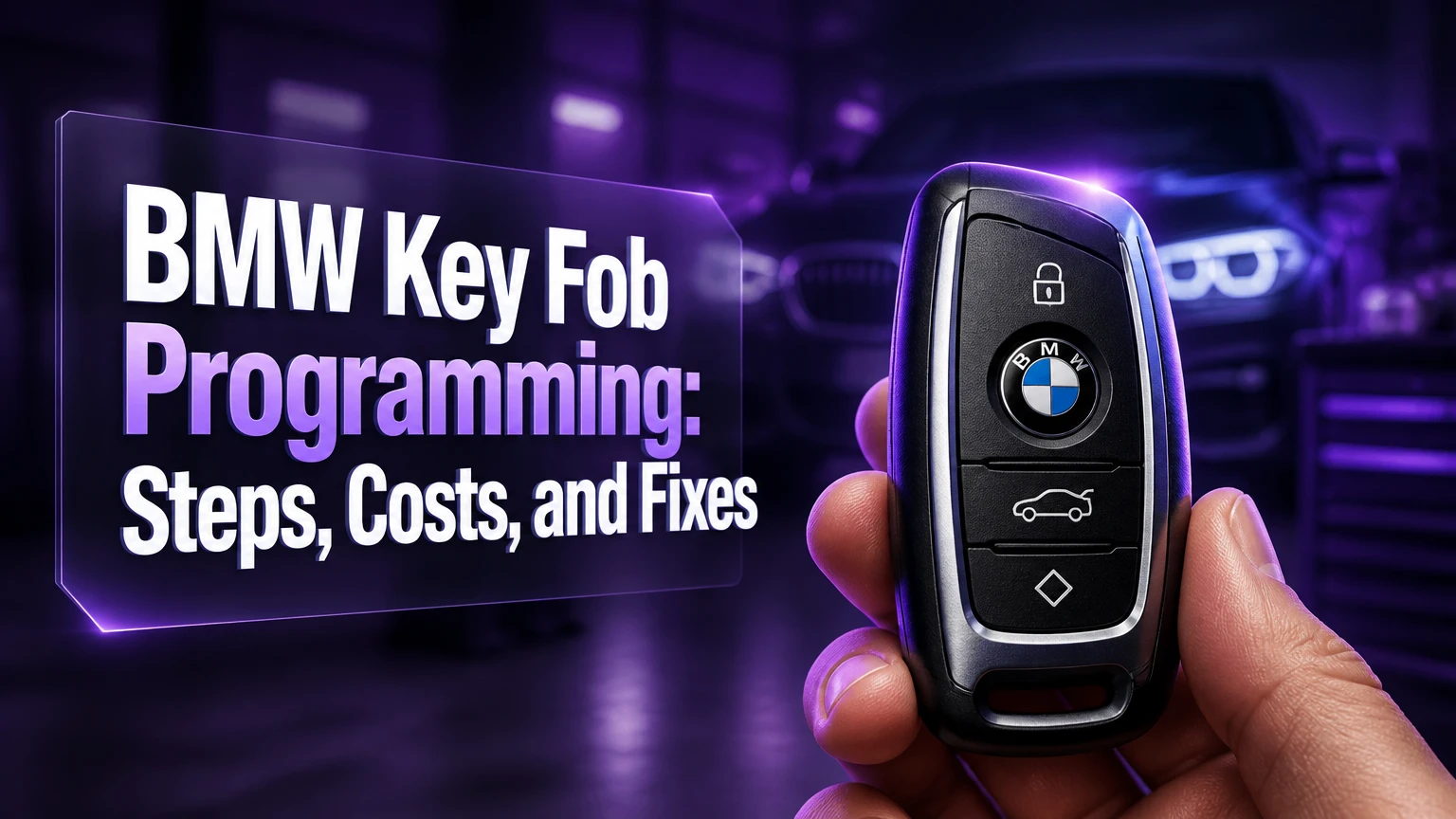
BMW key fob programming can mean remote-button synchronization, immobilizer authorization, or activation of a factory-coded replacement key. Older E-chassis BMWs may allow remote synchronization at home, while CAS, FEM, and BDC vehicles generally require diagnostic equipment, security credentials, or an authorized locksmith or dealer.
Key Facts
Remote synchronization controls locking, unlocking, trunk release, and alarm functions; it does not necessarily authorize engine starting.
Older BMWs such as the E46 and E39 commonly use an ignition-cycle and button sequence for adding remotes.
A replacement key for many modern BMWs is ordered to the vehicle identification number and cannot be treated like a universal blank.
Every existing working remote should be synchronized during one older-model session because unsynchronized remotes may stop operating the locks.
Typical professional BMW key service costs range from $100-$750, depending on chassis, key type, location, and whether all keys are lost.
A used BMW key usually cannot be assigned to another vehicle without specialized refurbishment, transponder work, or module-level programming.
What Does BMW Key Fob Programming Actually Do?
BMW key fob programming establishes communication between the remote transmitter, the vehicle’s receiver, and, where applicable, the immobilizer system. The remote sends a radio signal containing a rolling code; the car validates the code before operating the central locking or alarm.
The starting authorization is separate. On older BMWs, an EWS transponder communicates with the immobilizer, while later vehicles use CAS, FEM, or BDC security architecture. A remote that locks the doors can therefore be incorrectly diagnosed as a fully programmed ignition key.
The practical distinction matters when a replacement fob produces one symptom but not another:
- Buttons do nothing: remote synchronization, battery, frequency, receiver, or antenna problem.
- Buttons work but engine will not start: immobilizer authorization, transponder, key slot, CAS, FEM, BDC, or vehicle fault.
- Engine starts but buttons do nothing: the transponder is accepted, but the remote portion is not synchronized or has failed.
- Vehicle says “No Key Detected”: the car is not receiving the expected proximity or emergency-start signal.
How the BMW Key Communicates With the Car
BMW remote keys use a vehicle-specific rolling-code relationship rather than a fixed code that remains unchanged after every button press. Common market frequencies include 315 MHz in North American applications and 433 MHz in many European and other markets, although exact frequency and regional configuration depend on model, production date, and homologation.
The frequency is only one compatibility requirement. The key must also match the correct BMW generation, immobilizer family, button layout, transponder type, and market configuration. A physically identical fob with the wrong frequency or encrypted system may never communicate with the vehicle.
Which BMW Key System Does Your Car Use?
BMW chassis and production dates overlap, so the vehicle identification number and build date are more reliable than a model-year label alone. The following table is a practical starting point, not a substitute for VIN-based identification.
| BMW platform or example | Approximate production period | Typical security system | Usual service route |
|---|---|---|---|
| E38, E39, E46, E53, E83, E85 | 1995-2006 | EWS with separate remote synchronization | Owner sequence for remote; locksmith for immobilizer or all-keys-lost work |
| E90, E91, E92, E93, E60, E70 | 2004-2013 | CAS 1, CAS 2, CAS 3, or CAS 3+ | BMW-capable locksmith or dealer; module data may be required |
| F10, F20, F30, F15, F25 | 2011-2019 | CAS 4, FEM, or related systems | OEM ordering plus activation, or specialist diagnostic programming |
| G20, G05, G30, G11, iX and newer platforms | 2016-present | BDC or BDC2 with newer vehicle security | Dealer or qualified locksmith with current BMW access and credentials |
The key shell does not identify the immobilizer system. A diamond-shaped key, rectangular key, display key, or Comfort Access fob can look similar across markets while using different internal electronics.
What Is the Difference Between a Remote and an Immobilizer Key?
A BMW remote transmitter operates convenience features, while an immobilizer transponder authorizes engine operation. The two functions may share one housing, but they use different circuits, antennas, and security exchanges.
Older diamond keys often contain a rechargeable cell for the remote electronics, while many later keys use a replaceable coin cell. Some BMW keys are charged inductively through the ignition or a dedicated charging arrangement, but that behavior is not universal. Do not assume an hour of driving will recharge a key simply because the vehicle is an older BMW.
How Do You Program an Older BMW Remote?
Older BMW remote synchronization usually takes under five minutes when one working key is available and the vehicle accepts the correct sequence. The most important conditions are closed doors, a rapid ignition cycle, and synchronizing every remote during the same session.
Before You Start
| Requirement | Typical value or condition | Why it matters |
|---|---|---|
| Vehicle time | 3-10 minutes | The procedure is short if no fault exists |
| Working key | At least 1 for normal resynchronization | A working key permits the ignition-cycle step |
| Additional remotes | All available keys, usually 2-4 | Missing keys may lose remote-locking synchronization |
| Ignition position | Position 1, then Position 0 | Position 1 wakes vehicle electronics without starting |
| Timing window | Usually within 30 seconds | Older receivers commonly close the pairing window quickly |
This procedure applies broadly to many EWS-era BMW remotes, including several E38, E39, E46, E53, E83, and E85 configurations. BMW production variations exist, so a failed sequence does not prove that the key is defective.
Step 1: Close and Secure the Vehicle
Sit in the driver’s seat, close every door, and keep the hood, trunk, and windows shut. Remove other remote keys from the immediate cabin area so the receiver does not process an unintended transmitter.
Success checkpoint: The instrument cluster shows no open-door warning.
Common mistake: Leaving the trunk or a passenger door partially latched prevents the central locking module from entering synchronization mode.
Step 2: Cycle the Ignition
Insert the known working key and turn it to Position 1, where the dashboard illuminates but the engine remains off. Return the key to Position 0 and remove it promptly, normally within five seconds.
Success checkpoint: The key is out of the ignition and the car remains unlocked.
Common mistake: Turning the key to the starting position, waiting too long, or leaving it in Position 1 exits the intended sequence.
Step 3: Synchronize the First Remote
Press and hold the Unlock button. While holding Unlock, press the BMW logo or Lock button three times quickly, then release Unlock. The exact button labels vary by key generation.
Success checkpoint: The door locks cycle once, usually locking and unlocking.
Common mistake: Pressing Unlock three times instead of holding Unlock while pressing Lock, or using slow button presses that fall outside the receiver’s timing tolerance.
Step 4: Synchronize Every Additional Remote
Within roughly 30 seconds of the first lock cycle, hold Unlock on the next remote, press Lock three times, and release Unlock. Repeat the same sequence for every remote that should operate the vehicle.
Success checkpoint: The locks cycle after each accepted remote.
Common mistake: Testing a previously synchronized key before the session ends. Pressing buttons outside the procedure can interrupt timing.
Step 5: Exit and Test the Remotes
Turn the ignition on briefly, return it to Position 0, close the vehicle, and test lock, unlock, trunk release, and panic or alarm functions from several feet away.
Success checkpoint: Each intended remote locks and unlocks the vehicle consistently.
Common mistake: Assuming successful lock cycling proves that the key can start the engine. Remote synchronization does not rewrite the EWS immobilizer.
Can You Program a BMW Key Without a Working Key?
A BMW owner usually cannot add a completely new immobilizer key through the older button sequence when every original key is lost. The button sequence synchronizes remote controls, but it does not create the secure transponder authorization required for engine starting.
A dealer or BMW-capable automotive locksmith normally verifies ownership, identifies the chassis and security system, and supplies or programs a compatible key. Depending on the vehicle, the professional may use an OEM key ordered by VIN, diagnostic authorization, or specialized module and key data procedures.
For an all-keys-lost case, ask these questions before authorizing work:
- Will the provider cut the emergency blade or mechanical key?
- Will the lost key be disabled in the vehicle’s key list?
- Does the quoted price include the key, programming, travel, cutting, and tax?
- Can the provider recover the vehicle if the new key fails?
- Will the replacement be OEM, refurbished OEM, or aftermarket?
A key that only unlocks the door mechanically is not proof that the immobilizer has been programmed.
How Are Modern BMW Replacement Keys Activated?
Modern BMW replacement keys are commonly supplied for a particular VIN and then recognized or programmed through the vehicle’s security system. The exact process differs by CAS, FEM, BDC, Comfort Access, and production software, so a universal button sequence is unreliable on F-series and G-series cars.
If the vehicle has an emergency key-recognition location, place the fob at the location shown in the owner’s manual, often near the steering column or a marked start area, and press the Start/Stop button. This can allow emergency recognition when the fob battery is weak, but it does not repair a wrong-frequency, incompatible, damaged, or unregistered key.
What Should You Check Before Buying a Replacement?
Match the replacement against the vehicle’s VIN and these attributes:
| Compatibility attribute | Required match | Typical failure if mismatched |
|---|---|---|
| Chassis and build date | E46, F30, G20, or exact platform | Key is physically similar but electronically rejected |
| Market frequency | 315 MHz, 433 MHz, or specified regional version | Buttons never reach the receiver |
| Security generation | EWS, CAS, FEM, BDC, or BDC2 | Immobilizer authorization fails |
| Key style and feature set | Standard, Comfort Access, display, or digital key | Passive entry or remote functions remain unavailable |
| New or used status | VIN-appropriate new key preferred | Used key may remain locked to its original vehicle |
Online marketplace listings often describe a key as “programmable” when only the shell or remote board is reusable. Confirm whether the listing includes a virgin transponder, a compatible encrypted board, or merely a replacement housing.
How Much Does BMW Key Fob Programming Cost?
Typical BMW key replacement and programming costs range from about $100 for a simple older remote service to more than $750 for a modern OEM key, dealer labor, and vehicle recovery. The price depends more on key generation and whether all keys are lost than on the button synchronization itself.
| Service route | Typical total cost | Typical time | Best fit |
|---|---|---|---|
| Older remote synchronization only | $0 DIY or $75-$150 professional | 5-30 minutes | E38, E39, E46, E53 owners with a working key |
| Mobile BMW-capable locksmith | $200-$450 | 30-90 minutes | F-series, G-series, lost or damaged key |
| BMW dealer replacement | $400-$750 or more | 2-5 business days plus appointment | OEM assurance and newer BDC vehicles |
| DIY module or EEPROM work | $40-$250 in tools, plus key | 1-4 hours, excluding research | Experienced electronics technician with backups |
These are typical practitioner ranges, not a guaranteed local price. Dealer pricing varies by country and retailer, while locksmith pricing changes with travel distance, after-hours service, key stock, and security-system complexity.
The lowest quote deserves scrutiny. A $40 listing may exclude cutting, immobilizer authorization, battery, vehicle access, shipping, or the cost of recovering a failed module.
Which Service Route Is Safest?
A reputable BMW-capable locksmith is usually the best value when the provider has the correct equipment, verifies ownership, and gives a written warranty. A dealer is the conservative choice for newer BDC vehicles, warranty-sensitive repairs, or owners who require factory-supplied hardware.
| Decision factor | BMW dealer | Specialist locksmith | DIY programming |
|---|---|---|---|
| Typical price | $400-$750+ | $200-$450 | $40-$250 tools, plus key |
| Typical availability | Appointment, 2-5 day key order | Same day, often mobile | Depends on parts and software |
| OEM hardware | Usually yes | OEM or aftermarket varies | Depends on purchase |
| Module damage risk | Low for customer | Low with qualified provider | High with incorrect data handling |
| All-keys-lost capability | Yes, with ownership proof | Often yes, by chassis | Limited and technically demanding |
| Best vehicle range | New F and G systems | EWS, CAS, FEM, many BDC cases | Older EWS systems for trained users |
DIY EEPROM work is not a sensible shortcut for most owners. Incorrect voltage, corrupted data, interrupted writing, or an incorrect module file can disable starting, erase key data, or require module replacement.
Why Does a BMW Key Start the Car but Not Lock It?
A BMW key that starts the engine but does not operate the buttons has an accepted immobilizer transponder and a separate remote-control problem. Resynchronize the remote first, then test battery condition, frequency, transmitter damage, and the vehicle receiver.
Use this diagnostic order:
- Replace the battery if the key uses a replaceable coin cell, observing polarity and contact pressure.
- Repeat the correct remote synchronization procedure for the chassis.
- Test every available key. If only one fails, the vehicle receiver is less likely to be the cause.
- Inspect the housing for water intrusion, cracked solder joints, broken buttons, or a loose battery contact.
- Check whether the locks respond to the interior switch and mechanical key.
- Have the receiver, diversity antenna, central locking module, or body controller scanned if no remote works.
The opposite symptom also occurs. If the doors respond but the engine does not crank or start, repeating the remote sequence will not repair the immobilizer authorization.
What Should You Do When the BMW Says No Key Detected?
When a BMW displays “No Key Detected,” hold the key directly against the vehicle’s documented emergency-start recognition point and press the Start/Stop button. If the engine starts there, replace the fob battery and investigate the proximity antenna system before buying another key.
If emergency recognition fails, check the following:
- The key is the correct VIN and market version.
- The fob battery is installed correctly and has adequate voltage.
- The vehicle battery is not severely discharged.
- The key has not been exposed to water, impact, or high heat.
- A second known-good key produces the same warning.
- The vehicle has no recent CAS, FEM, BDC, or Comfort Access fault.
The emergency-start location is a recovery feature, not a universal programming method. It cannot make an incompatible used key become a valid replacement.
What Mistakes Cause BMW Programming to Fail?
Most BMW key failures result from an incorrect key type, an incomplete older-model sequence, or confusion between remote synchronization and immobilizer programming. The recovery depends on the failure mode, and repeated random button sequences rarely improve the result.
| Failure symptom | Likely cause | Correct response |
|---|---|---|
| Locks never cycle | Door open, wrong sequence, wrong key frequency | Close all panels, verify key specification, repeat once |
| One remote works, another does not | Missing synchronization or failed transmitter | Resynchronize all keys; test battery and board |
| Key starts car but buttons fail | Remote section unsynchronized or damaged | Perform remote procedure; inspect key electronics |
| Buttons work but engine will not start | Transponder or immobilizer authorization fault | Use BMW-capable diagnostic service |
| New key shows no response | Wrong VIN, used locked key, incompatible system | Stop repeated attempts and verify part compatibility |
| Vehicle loses all remote function | Receiver, diversity antenna, body module, or power fault | Scan vehicle and check fuses, battery, and antenna |
Practitioner Rules That Prevent Expensive Errors
First, identify the system before buying the key. The model badge and year alone do not reliably identify CAS, FEM, or BDC hardware.
Second, bring every working key to an older BMW synchronization session. The receiver can retain only the remotes accepted during that session, so a key left at home may need to be synchronized again.
Third, never write module data without a verified backup. A stable power supply, correct file, and recovery plan matter more than the advertised price of an EEPROM tool.
Fourth, separate a dead battery from a dead key. A coin cell can power the buttons but cannot correct a failed circuit board, while an older rechargeable key may need proper charging or replacement rather than a CR2032.
Can a Used BMW Key Be Reprogrammed?
A used BMW key is usually not a plug-and-play replacement because its encrypted immobilizer data may remain assigned to another vehicle. Some keys can be refurbished or electronically reset by a specialist, but compatibility depends on the board, security generation, frequency, and available key data.
A used housing is different from a used electronic key. Replacing a cracked shell may be harmless if the original circuit board and transponder are transferred correctly. Buying a used complete fob is riskier because the seller may not know whether the key was previously locked, water-damaged, or from the correct market.
A new VIN-ordered OEM key is normally the lowest-risk choice for newer BMWs. A refurbished key can cost less, but obtain a written compatibility guarantee and confirm whether the immobilizer and Comfort Access functions are covered.
How Are Lost BMW Keys Disabled?
BMW lost-key security normally requires a dealer or qualified locksmith to remove or disable the missing key’s authorization, depending on the vehicle’s security architecture. Remote synchronization alone does not reliably erase an immobilizer key from CAS, FEM, or BDC memory.
Request key deletion when a key was stolen, not merely misplaced. Also ask whether the provider can disable remote locking for the missing fob, because immobilizer disablement and remote-function disablement can be separate operations.
Proof of ownership commonly includes government identification, registration, title, insurance documentation, and the VIN. Requirements differ by provider and jurisdiction.
How Do You Choose Between a Dealer and Locksmith?
Choose a dealer when factory sourcing, current BDC support, warranty documentation, or a newer vehicle’s digital security features matter most. Choose a specialist locksmith when mobile service, same-day completion, or a lower price matters and the locksmith can demonstrate BMW-specific capability for the exact chassis.
Before booking, provide the VIN, production date if known, key count, symptom, location, and whether the vehicle starts. Ask for an itemized quote rather than a generic “programming” price.
A provider who cannot distinguish EWS from CAS, FEM, and BDC is not an appropriate choice for module-level BMW key work. The terminology itself is a useful screening test.
Frequently Asked Questions
Can I program a BMW key with the car running?
No. Older remote synchronization uses the ignition in Position 1 and Position 0, not a running engine. Modern immobilizer registration requires the appropriate security procedure and equipment. Running the car does not pair a replacement transponder or convert an incompatible key into an authorized one.
How many BMW keys can the car store?
The number varies by chassis, security module, and key type, so there is no universal BMW capacity. Older systems commonly support multiple remote keys, while later systems manage encrypted key slots through CAS, FEM, or BDC. A BMW dealer or locksmith can identify occupied and available slots from the vehicle data.
Does changing the BMW key battery erase programming?
Changing a correctly specified key battery normally does not erase remote synchronization or immobilizer authorization. A damaged battery contact, reversed polarity, wrong battery type, or water-damaged circuit board can make the key appear unprogrammed. Resynchronize the remote only after confirming the battery and housing are sound.
Can a BMW key be programmed with an OBD scanner?
A basic OBD scanner cannot program BMW immobilizer keys. Specialized BMW-capable equipment, security access, stable vehicle voltage, and the correct key data may be required for CAS, FEM, or BDC systems. An OBD tool that only reads fault codes cannot authorize a replacement key.
Why does only the trunk button work on my BMW key?
A single functioning button usually indicates a worn switch, damaged circuit board, weak battery contact, or partial remote failure rather than an engine-authorization problem. Test the remaining buttons, replace the battery where applicable, and inspect the fob. If all remotes show the same behavior, diagnose the vehicle receiver.
The Bottom Line
BMW key fob programming is easy only when the task is limited to remote synchronization on a compatible older key. A replacement or all-keys-lost situation can require VIN verification, key cutting, immobilizer authorization, and CAS, FEM, or BDC programming that belongs with a BMW dealer or qualified automotive locksmith.
Use the exact chassis and build date to identify the system, verify frequency and key type before purchase, bring every existing key to an older-model session, and treat the remote and immobilizer as separate fault paths. Those checks prevent most failed BMW key fob programming jobs and avoid unnecessary module damage.