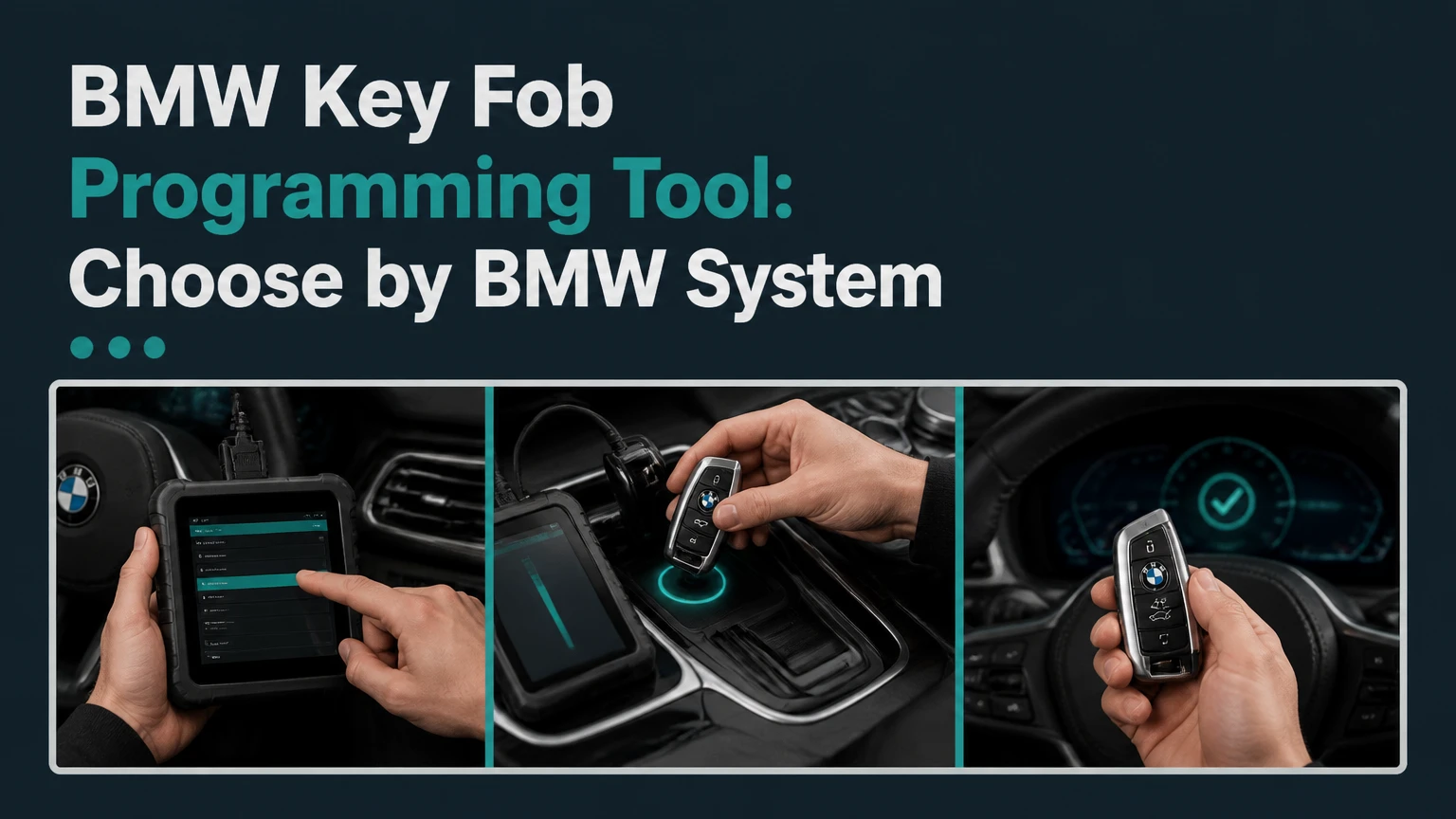
A BMW key fob programming tool is specialized hardware and software that authorizes a compatible key to start a BMW and, on supported systems, configures its remote functions. The correct tool depends on the vehicle’s immobilizer, key generation, market frequency, and whether a working key remains. Generic OBD scanners usually cannot perform this security function.
Key facts at a glance
BMW E-Series vehicles commonly use EWS or CAS immobilizer systems, while many F-Series and G-Series vehicles use CAS, FEM, or BDC modules.
Remote-button synchronization and engine-start authorization are separate functions.
A 315 MHz and a 433 MHz key are not interchangeable merely because the shell looks identical.
AK90-class devices target older EWS systems; modern CAS, FEM, and BDC work generally needs professional immobilizer equipment.
A stable power supply is required during supported diagnostic programming because voltage loss can interrupt module communication or flash operations.
Tool coverage is never enough by itself. The blank key, transponder, software license, vehicle region, and immobilizer version must also match.
What Is a BMW Key Fob Programming Tool?
A BMW key fob programming tool is an immobilizer-capable programmer that exchanges authorized security data with the vehicle or key transponder. Depending on the BMW platform, the device may communicate through the diagnostic port, read a removable immobilizer module, or program a transponder through a separate key interface.
The phrase “key fob programming” covers two different jobs. Remote synchronization makes lock, unlock, trunk, or panic buttons communicate with the car. Immobilizer programming gives the key authorization to start the engine. A key can complete the first job and still fail the second.
A standard code reader cannot normally add a BMW key. Diagnostic tools that clear fault codes, display live data, or reset service intervals lack the security functions and key hardware required for immobilizer work. Some professional tablets combine ordinary diagnostics with an immobilizer application, but the application, cable, software subscription, and compatible key accessory may all be required.
Which BMW systems must the tool support?
The immobilizer family is the primary compatibility attribute. BMW naming varies by platform and production period, so the vehicle identification number, production date, and module identification matter more than a broad “1995-2020 BMW” claim.
| BMW platform example | Common immobilizer family | Typical key technology | Practical programming implication |
|---|---|---|---|
| E46, E53, E83 | EWS II or EWS III | Transponder plus remote key | EWS-specific equipment or locksmith service |
| Late E-Series and early F-Series | CAS1-CAS3, with version variations | Integrated transponder and remote | Coverage depends on CAS generation and key type |
| F30, F10, F25 examples | CAS4, FEM, or related systems | Comfort Access or standard smart key | Professional OBD or bench capability often required |
| G20, G05, G11 examples | BDC and newer security architecture | Smart key, regional frequency variant | Current licensed equipment and authorized access may be needed |
The table is a planning guide, not a guaranteed compatibility list. BMW used overlapping systems across markets and production dates, and aftermarket tools frequently support only specified hardware revisions or software releases.
How Does BMW Key Authorization Work?
BMW key authorization links a vehicle immobilizer record with a transponder identity and, on many keys, a radio remote identity. The immobilizer checks that relationship before permitting engine operation, while the body electronics handle locking, comfort access, and other convenience features.
Older EWS systems and newer CAS, FEM, and BDC systems do not use identical procedures. A supported device may read vehicle information, identify available key positions, prepare a compatible transponder, and complete a learning operation. Exact security data handling differs by tool and system.
BMW vehicles are often described as having ten key positions, especially in discussions of EWS and CAS systems. That description should not be treated as a universal promise that ten unrestricted slots remain available. Occupied, disabled, reserved, or system-specific positions can change the result, and a tool may display slot information differently from BMW factory software.
What happens during OBD programming?
OBD programming connects a compatible interface to the vehicle’s diagnostic connector and uses an immobilizer function approved for that platform. The operator identifies the vehicle, maintains voltage, follows the tool’s prompts, and verifies the result without interrupting communication.
OBD access is convenient because the module remains installed. It is also less forgiving when a battery drops, a cable disconnects, software loses communication, or the tool applies an incompatible procedure. A failed operation can leave the vehicle unable to recognize previously working keys.
A professional workflow normally includes a power supply, verified software version, stable laptop or tablet connection, vehicle identification, and a documented recovery plan. OBD programming should not be confused with ordinary remote pairing, which does not write engine authorization.
What happens during bench programming?
Bench programming removes or accesses an immobilizer module outside the vehicle and uses an approved connection to read or configure supported data. This approach is associated with older EWS work and selected modern module procedures, but it requires electronics handling skill and exact module identification.
Bench work can reduce some in-vehicle communication variables, yet it introduces different risks. Incorrect module removal, electrostatic discharge, physical damage, poor connections, or an altered data file can create a no-start condition. Detailed chip access, security-data extraction, and write instructions should be left to a trained automotive locksmith or BMW electronics technician.
A useful safety rule is simple: never modify an immobilizer module without a verified backup, a documented recovery method, and equipment that explicitly supports that module revision. A low-cost programmer is not automatically a low-risk programmer.
Which BMW Key Fob Programming Tool Should You Buy?
The best BMW key fob programming tool depends on the immobilizer family and the operator’s experience. AK90-type equipment is appropriate only for a narrow group of older EWS applications, while multi-brand tablets and BMW-specialist systems offer broader coverage at substantially higher cost.
| Tool or category | Typical purchase range | Main BMW coverage | Best-fit user | Important limitation |
|---|---|---|---|---|
| AK90+ or AK90 II | $30-$80 | Selected EWS II and EWS III applications | Experienced E-Series owner or technician | Old software, limited coverage, bench skill required |
| BMW-specific cable and software package | $100-$500 | Selected diagnostic and older immobilizer functions | Specialist with verified vehicle support | Coverage and licensing vary widely |
| Xhorse VVDI BMW or BIMTool product | $800-$1,500 | Selected CAS, FEM, BDC, and EWS functions | Independent locksmith | Tokens, adapters, updates, and key compatibility affect cost |
| Autel MaxiIM IM508 or IM608 class | $1,000-$4,000 | Multi-brand immobilizer coverage, BMW dependent on accessories | Automotive locksmith or repair shop | Annual updates and XP-series accessories may be required |
| Microtronik Autohex II | $3,000-$6,000 plus subscription | BMW-focused CAS, FEM, BDC, and related functions | BMW immobilizer specialist | High acquisition cost and specialist learning curve |
| Dealer or qualified locksmith service | $150-$1,000 typical | Vehicle-specific authorized or professional procedure | Owner without equipment | Price depends on key, location, and all-keys-lost status |
Prices are typical market ranges, not quotations. A $40 tool may still require a $100 key, a compatible computer, obsolete drivers, and several hours of work. A professional tablet may require annual software renewal, security access, specific adapters, and paid tokens.
What should you check before buying?
Verify compatibility using the VIN, production date, immobilizer family, key part number, and radio frequency. Do not rely on a product title that lists every BMW model in one sentence.
Check these attributes:
- Key type: standard remote key, Comfort Access smart key, display key, or aftermarket transponder.
- Immobilizer: EWS, CAS version, FEM, BDC, or a module identified by diagnostic scan.
- Market frequency: commonly 315 MHz in parts of North America and 433 MHz in many other markets, with regional exceptions.
- Programming state: new virgin key, previously used key, refurbished key, or cloned key.
- Software status: current vehicle coverage, update cost, token requirements, and supported operating system.
- Recovery support: technical documentation, backup procedures, repair service, and vendor support.
- Legal access: proof-of-ownership requirements and local locksmith licensing rules.
A key shell, battery, transponder, and remote board are separate considerations. Replacing only the shell cannot create a valid immobilizer key.
Can You Program a BMW Key Without a Tool?
A BMW owner can often synchronize the buttons on an already compatible key without a dedicated programmer, but a blank key normally cannot be authorized to start the engine through that procedure. The exact button sequence varies by key and vehicle, so the owner’s manual or BMW service information should control.
Remote synchronization is relevant when the key starts the car but the lock buttons stopped responding after a battery replacement or long period away from the vehicle. The procedure generally involves a specific ignition or start-state sequence followed by button presses, but BMW does not use one universal sequence across all generations.
Tool programming is required when the transponder lacks the vehicle’s authorization, when all keys are lost, or when the replacement key has a different hardware configuration. A generic “turn the ignition five times” instruction can be wrong for a push-button BMW and can waste time without solving the immobilizer problem.
What Is the Safe BMW Key Programming Workflow?
A safe BMW key programming workflow has six stages: identify the vehicle, verify the key, prepare power, select the supported procedure, complete the learning operation without interruption, and test every function. The most important success factor is accurate system identification before any write command.
Step 1: Identify the vehicle and immobilizer
Record the VIN, production date, model, market, engine, key style, and available working keys. Use a compatible diagnostic scan or professional database to confirm the immobilizer family rather than guessing from the model badge.
Success checkpoint: the tool or technician identifies the same module family shown by the vehicle documentation.
Common mistake: choosing “3 Series” or “X5” without entering the production date and module version.
Step 2: Verify the replacement key
Confirm the BMW part number, frequency, transponder type, Comfort Access support, and whether the key is new and programmable. Many used keys are locked to their original vehicle and cannot be reset economically.
Success checkpoint: the supplier confirms compatibility by VIN or exact key specification.
Common mistake: buying a visually identical key from another market.
Step 3: Stabilize vehicle power
Connect a regulated automotive power supply to the correct charging points and follow the tool manufacturer’s voltage guidance. A healthy resting battery is not the same as a controlled power supply during programming.
Success checkpoint: voltage remains stable throughout the scan and learning session, with no battery warning or communication interruption.
Common mistake: relying on a small consumer battery charger that cannot maintain current during module activity.
Step 4: Run the supported learning function
Select the exact immobilizer procedure documented for the vehicle. Read all prompts, save any permitted diagnostic report or backup, and do not disconnect the interface while the tool communicates with the module.
Success checkpoint: the software reports a completed learning operation and identifies the key as accepted.
Common mistake: selecting an active position or an unrelated “reset” operation.
Step 5: Test start authorization and remote functions
Test engine start, lock, unlock, trunk release, comfort access, emergency-start recognition, and the original key. Testing only the locks does not prove immobilizer programming.
Success checkpoint: the engine starts and every intended remote function operates from a normal distance.
Common mistake: diagnosing a radio-frequency problem as an immobilizer failure.
Step 6: Document the result
Record the key part number, frequency, tool version, date, vehicle mileage, and any disabled or unoccupied key positions. Documentation helps a locksmith or repair shop recover the vehicle if a later key operation fails.
Success checkpoint: the owner has a complete key inventory and knows which keys work.
Common mistake: leaving the vehicle with only the newly programmed key untested.
How Much Does BMW Key Programming Cost?
BMW key programming typically costs $150-$1,000, depending on the key, vehicle generation, location, and whether a working key remains. A dealership usually supplies a vehicle-specific key, while an independent automotive locksmith may reduce labor cost but may not support every BDC or newer security configuration.
| Service situation | Typical key or service cost | Typical time | Main cost driver |
|---|---|---|---|
| Remote synchronization only | $0-$150 | 5-30 minutes | Owner procedure or labor charge |
| Older EWS spare key | $100-$350 | 30-120 minutes | Key quality and module access |
| CAS or FEM replacement key | $250-$700 | 1-3 hours | Key type, security procedure, and labor |
| BDC or newer smart key | $350-$1,000 | 1-4 hours | Key price, access, software, and travel |
| All keys lost | $400-$1,500 | 2-6 hours | Security verification and recovery procedure |
| Module replacement or corrupted module recovery | $500-$2,000 or more | 3 hours to several days | Module sourcing, coding, and repair |
These figures are typical planning ranges, not guaranteed quotes. Mobile service, emergency hours, remote locations, imported vehicles, and unusual Comfort Access faults can increase the total.
Which Alternative Is Safer Than Buying a Tool?
A dealership is usually the lowest-risk option for a current BMW when the owner can wait for a VIN-matched key and provide ownership documents. A qualified automotive locksmith is often faster for older EWS or CAS vehicles and may offer mobile service, but the locksmith must confirm coverage before accepting the job.
| Option | Typical result | Typical timeframe | Best situation | Main drawback |
|---|---|---|---|---|
| BMW dealership | VIN-linked replacement key | 1-7 business days | Newer BMW, no urgency | Higher labor and travel inconvenience |
| Automotive locksmith | On-site key service | 30 minutes-4 hours | Spare key or lost key | Equipment coverage varies |
| Mail-in module service | Programmed module or key | 2-7 days including shipping | Vehicle cannot move | Shipping and immobilizer downtime |
| DIY tool purchase | Owner-controlled attempt | 2 hours to several days | Older EWS and experienced user | Corruption, compatibility, and support risk |
A generic OBD scanner is not a substitute for any of these options. An owner should avoid DIY programming when the vehicle is the only transportation, all keys are lost, the module is a newer BDC, or the tool’s recovery procedure is unclear.
Why Does the Key Start the BMW but Not Unlock It?
A BMW key that starts the engine but does not operate the locks usually has a remote synchronization, battery, antenna, or frequency problem rather than a failed transponder. The immobilizer and central-locking systems use different communication paths, so one function can work while another fails.
Check the key battery, battery contacts, regional frequency, remote-board condition, and vehicle antenna system. Use the model-specific synchronization procedure from BMW documentation, and test a known-good key if available.
Do not attempt to change a key’s frequency through an undocumented button sequence. A 315 MHz board cannot become a correct 433 MHz board through software alone, and a frequency-correct key can still have the wrong transponder or Comfort Access hardware.
What Are the Most Common Programming Failures?
The most common failures are incorrect key hardware, unstable voltage, unsupported immobilizer software, poor module connections, and confusion between remote pairing and immobilizer authorization. Each failure has a different remedy, so repeating the same programming command can make the situation worse.
| Symptom | Likely cause | Safe first response | Escalation point |
|---|---|---|---|
| Tool cannot identify vehicle | Cable, driver, ignition state, or unsupported system | Check interface, software, and vehicle identification | Stop if module communication is intermittent |
| Key starts car but buttons fail | Battery, frequency, or remote synchronization | Verify key specification and follow model procedure | Test antenna and body module |
| Key is rejected | Used key, wrong transponder, or wrong immobilizer | Confirm key part number and programming state | Use dealer or qualified locksmith |
| Original key stops working | Wrong slot or interrupted operation | Stop further writes and preserve reports | Specialist recovery service |
| Module becomes unresponsive | Voltage loss or failed flash operation | Disconnect nothing unnecessarily; document symptoms | BMW electronics or immobilizer specialist |
| Tool reads data but cannot write | License, token, security access, or version issue | Check vendor coverage and subscription | Do not use an unverified workaround |
What should you do if all BMW keys are lost?
All-keys-lost work requires stronger ownership verification and a recovery plan because there is no working key for comparison. Contact a dealership or qualified automotive locksmith, provide the VIN and registration documents, and ask whether the proposed method supports the exact immobilizer and key type.
A replacement key alone may not solve the problem if the vehicle has a failed BDC, CAS communication fault, damaged antenna, or a previous aftermarket modification. Ask for a complete quote covering the key, programming, emergency travel, module diagnosis, and any recovery charge before authorizing work.
What if an E-Series tool uses old computer software?
Some low-cost EWS programmers rely on legacy USB drivers and older Windows environments. A more reliable choice is a technician who already maintains the required computer, cable, backup process, and tested hardware, because driver experimentation on a vehicle module adds no value.
Do not disable operating-system security or install unknown driver packages on a primary computer merely to save a small service fee. A used laptop dedicated to documented legacy work is safer than an unverified download.
Expert Rules for Choosing the Equipment
Rule one: buy coverage, not a brand name. A tool marketed as “BMW compatible” may support only EWS or only selected CAS versions. Require a written compatibility result using the VIN or immobilizer identification.
Rule two: treat power control as part of the tool. A programmer without a regulated power supply is an incomplete setup for modern BMW work. Experienced technicians commonly use a supply capable of maintaining approximately 13.0-14.5 volts under the vehicle’s actual load, while following the equipment manufacturer’s limits.
Rule three: preserve the original key path. If one working key exists, keep it separate, labeled, and tested before any programming session. The original key can distinguish an immobilizer problem from a remote-board problem and may be essential for recovery.
The counterintuitive point is that the cheapest tool is often the most expensive failure route. A $50 programmer can become a $1,000 repair if it leaves a CAS or BDC module unable to communicate.
FAQ
Can an Autel scanner program every BMW key?
No. Autel MaxiIM equipment supports many BMW immobilizer procedures, but coverage depends on the tablet model, XP-series accessory, software version, vehicle architecture, key type, and security access. Confirm the VIN-specific function before purchase, and distinguish immobilizer programming from ordinary BMW diagnostics.
Is AK90+ suitable for an F30?
Usually not as a complete solution. AK90-class programmers primarily target older EWS systems, while many F30 vehicles use CAS or FEM architectures with different procedures and security requirements. Confirm the exact production date and immobilizer module before buying any E-Series programmer for an F30.
Can a used BMW key be reprogrammed?
Sometimes, but many used BMW keys remain paired with their original vehicle or contain a locked transponder. A key shell can be reused, but the electronic board and transponder may not be resettable. A new, correctly specified key is often more predictable than a cheap used key.
Does BMW key programming erase the old key?
It can, depending on the selected key position and procedure. Some systems allow individual keys to be enabled or disabled, while others handle key positions differently. Ask the technician to preserve the working key inventory and verify every key after programming.
How long does a BMW replacement key take?
Remote synchronization can take 5-30 minutes when the key is already compatible. A new programmed key commonly takes 30 minutes to four hours, while dealership ordering may take one to seven business days. All-keys-lost recovery can take longer if module diagnosis or replacement is necessary.
Should an owner program a BDC key at home?
Most owners should use a BMW dealer or qualified immobilizer locksmith for BDC work. BDC systems carry greater recovery and communication risk than a simple remote pairing procedure, and a home attempt is especially unsuitable when the BMW has no backup key or stable regulated power supply.
The Bottom Line
Choose a BMW key fob programming tool by immobilizer family, key hardware, market frequency, software support, and recovery capability, not by the BMW model name alone. AK90-class equipment fits a narrow older EWS use case; VVDI, Autel, and Autohex products target broader professional work at higher cost. For a modern CAS, FEM, or BDC vehicle, a qualified locksmith or BMW dealership is usually safer than an improvised DIY operation. A tool can only help when the key, vehicle system, voltage supply, and programming procedure all match.