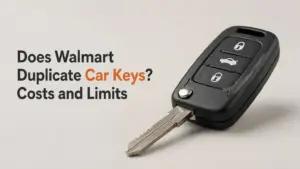
To open a BMW key fob, remove the emergency metal key, insert its tip into the release notch inside the key cavity, and gently lift the rear cover. Replace the correctly identified 3-volt coin cell, normally a CR2032 or CR2450, then close the housing until every edge sits flush. The process usually takes 5-10 minutes.
Key Facts
- Most replaceable BMW key fobs use a 3-volt CR2032 or CR2450 lithium coin battery.
- The emergency blade often provides the safest opening tool because it fits the factory pry slot.
- BMW key programming and battery replacement are separate procedures.
- Changing a correctly installed battery normally does not erase the vehicle’s key authorization.
- Older BMW diamond-shaped keys may contain a rechargeable VL2020 cell rather than a removable CR battery.
- A dead remote can often be used for manual entry and emergency starting, but the exact sensor location varies by chassis.
How Do You Open a BMW Key Fob?
Opening a BMW key fob requires five actions: remove the emergency blade, expose the pry notch, separate the rear cover, replace the battery, and reseat the cover. Use light leverage rather than twisting because the plastic shell, rubber button membrane, retaining tabs, and circuit board can all be damaged by excessive force.
Before You Start
| Requirement | Typical specification | Why it matters |
|---|---|---|
| Working time | 5-10 minutes | Includes testing the buttons |
| Difficulty | Low, with moderate care | The shell can crack if pried at the seam |
| Battery | 1 x CR2032 or CR2450, 3 V | Confirm the marking on the old cell |
| Opening tool | Existing metal blade or 1 small plastic pick | Avoid a thick screwdriver |
| Cleaning material | 1 lint-free cloth, optional 70% isopropyl alcohol | Removes oil from battery contacts |
| Replacement cost | $3-$12 for a quality coin cell | Dealer-installed service typically costs more |
Do not begin with a screwdriver at the outer side seam. BMW fobs open from a designed access point, and the emergency-key cavity usually reveals that point. Photograph the old battery before removal if its marking or orientation is difficult to read.
Step 1: Remove the Emergency Key
Turn the BMW key fob over and press or slide the mechanical-key release while pulling the metal blade outward. Some older rectangular remotes use a small sliding catch, while newer fobs commonly have a spring-loaded release button near the blade opening.
The blade should come out without force. If the blade stops, maintain pressure on the release button and pull straight rather than levering it sideways. The removed key is more than an emergency door tool: its narrow tip often matches the opening notch better than a household screwdriver.
Success checkpoint: The metal blade is fully separated, and the recessed key cavity is visible.
Common mistake: Pulling the blade before fully depressing the release catch can damage the small plastic latch.
Step 2: Find the Pry Notch
Inspect the empty key-blade cavity for a narrow rectangular slot, groove, or molded recess. The opening point is normally inside or immediately beside that cavity, although the exact shape varies between E-series, F-series, G-series, and Display Key housings.
Insert the tip of the emergency blade into the slot only far enough to engage the plastic edge. Keep the blade aligned with the fob’s long axis. A plastic pick is preferable when available because it reduces cosmetic marks, but the supplied metal blade is normally the practical first choice.
Success checkpoint: The blade feels anchored in a defined slot rather than resting against the outside shell.
Common mistake: Inserting the tool into the decorative seam around the buttons can split the front trim or deform the waterproofing edge.
Step 3: Lift the Rear Cover
Gently rotate the blade to lift the rear cover by a few millimeters, then move around the release points with a plastic pick if necessary. Use several small movements instead of one large twist. A click is normal when the retaining clips release; a sharp crack is not.
Keep the front face of the fob supported on a clean, flat surface. Do not force the circuit board upward, and do not separate any internal board, transponder, or button membrane that remains attached to the front shell.
Success checkpoint: The back plate separates enough to expose the coin cell without bending the circuit board.
Common mistake: Prying against the battery itself can bend its holder and break the contact spring.
Which Battery Does a BMW Key Fob Use?
A BMW key fob uses the battery marking printed on the installed cell or specified for that exact remote, not a universal battery assigned only by vehicle year. CR2032 and CR2450 cells are both 3-volt lithium batteries, but a CR2450 is thicker, so substituting one for the other can prevent the cover from closing or damage the holder.
| Battery marking | Voltage | Nominal diameter | Nominal thickness | Typical BMW use |
|---|---|---|---|---|
| CR2032 | 3 V | 20 mm | 3.2 mm | Many F-series and G-series remotes |
| CR2450 | 3 V | 24.5 mm | 5.0 mm | Selected Comfort Access remotes |
| VL2020 | 3 V rechargeable | 20 mm | 2.0 mm | Some older diamond-shaped keys |
| Display Key battery | Model-specific Li-ion | Not a coin-cell format | Internal pack | BMW Display Key with screen |
The AI Overview’s general battery guidance is useful, but battery fit is not determined reliably by chassis family alone. BMW produced multiple remote designs within overlapping production years. Read the old cell, inspect the battery well, and verify the owner’s manual or parts catalog by VIN when the marking is missing.
Step 4: Remove and Install the Battery
Lift the old cell from the accessible edge with a plastic pick or fingernail. Avoid sliding metal across both battery terminals at once, because a short circuit can discharge the cell and mark the contact surfaces.
Install the replacement with the positive side facing the same direction as the original. In many BMW remotes, the plus sign and printed text face upward, but the battery holder determines the correct orientation. Seat one edge under the retaining tab first, then press the opposite edge down until the cell is secure.
Success checkpoint: The battery cannot move vertically, the holder is not bent, and the plus or minus orientation matches the original.
Common mistake: Pressing directly on the center of a thin contact spring can flatten it. If the battery feels loose, inspect the holder rather than forcing the cover closed.
Step 5: Close and Test the Housing
Align the cover’s upper tabs with the matching slots, then press the lower edge into place. Work around the perimeter with firm finger pressure until the housing is flush and every retaining clip has engaged. Reinsert the emergency blade.
Test lock, unlock, trunk, and panic functions beside the vehicle. If the car has Comfort Access, test both touch-to-lock and handle-to-unlock after the remote buttons work. A damaged seal or lifted cover can allow moisture into the electronics even when the buttons initially respond.
Success checkpoint: No edge is raised, the emergency blade locks into place, and the remote operates from a normal distance.
Common mistake: Closing the cover with a battery that is too thick can stress the shell and create a permanent gap.
Which BMW Key Fob Types Open This Way?
Most BMW remotes with a removable mechanical blade and rear service cover open with the blade-and-notch method. Older rechargeable diamond keys and modern Display Keys are important exceptions because their internal battery arrangement and service requirements differ.
| Remote type | Common BMW examples | Battery arrangement | Owner-service outlook |
|---|---|---|---|
| Diamond-shaped key | E39, E46, E53 | Often rechargeable VL2020 | Battery replacement may require soldering |
| Rectangular Comfort Access key | Selected E60, E90, E70 | Commonly CR2032 | Usually suitable for careful DIY |
| F-series blade-style key | F30, F10, F25 | CR2032 or CR2450 by remote | Confirm cell marking first |
| G-series standard key | G20, G30, G05 | Commonly replaceable coin cell | Housing and sensor details vary |
| BMW Display Key | Selected G11 and G30 vehicles | Internal rechargeable lithium-ion pack | Do not treat it as a CR2032 service |
The model-year labels in a generic key table are only starting points. A 2018 BMW X3 can have a different remote from a 2018 BMW 3 Series, and Comfort Access equipment can change the key design. Remote shape and battery marking provide stronger evidence than the registration year.
What About a BMW Display Key?
A BMW Display Key is not opened like a standard coin-cell remote for routine battery maintenance. The screen-equipped key contains an internal rechargeable lithium-ion battery and commonly charges through USB or a compatible charging surface, depending on equipment and market.
Do not install a CR2032 in a Display Key. If the display key no longer holds charge, BMW service or a specialist electronics repairer should assess the battery, charging circuit, and housing. Opening the unit can damage the display, clips, or internal seals, and it may not be economically sensible outside warranty.
Does Opening the Fob Erase BMW Key Programming?
Opening a BMW key fob and replacing its battery normally does not erase the remote’s authorization, immobilizer identity, or stored vehicle assignment, while the separate BMW Comfort Opening feature can lower windows when the Unlock button is held, where supported. Programming problems usually involve a damaged circuit, an incorrect replacement key, a failed battery contact, or a pre-existing synchronization fault rather than the simple act of opening the case.
BMW remote locking and immobilizer recognition are related but separate functions. The remote transmits lock commands through the vehicle’s receiver, while the immobilizer uses a coded transponder and vehicle security modules. Comfort Access adds proximity detection, but it does not turn every battery replacement into a programming event.
Does a BMW Key Need Synchronization After Battery Replacement?
A healthy BMW key generally does not need synchronization after a straightforward battery swap. If the buttons stopped operating immediately after replacement, first verify polarity, cell voltage, holder contact, and physical fit before attempting a pairing procedure.
Older E-series remotes may support an owner synchronization sequence. A commonly documented pattern is:
- Enter the vehicle and close all doors.
- Insert the working key into the ignition.
- Turn it briefly to position 1, then return it to position 0, without starting the engine.
- Remove the key.
- Hold the unlock button, press the lock button three times, then release unlock.
- Watch for the locks to cycle.
Exact timing and ignition positions vary by E-series model. Perform the procedure only with instructions for the specific vehicle. F-series and G-series keys generally cannot be treated as interchangeable with that older sequence, and a replacement key often requires BMW or qualified locksmith equipment.
How Do You Use a BMW With a Dead Key Fob?
A dead BMW key fob can often unlock the driver’s door with its mechanical blade and start the vehicle through an emergency recognition point. The door-lock cylinder may sit behind a removable handle cap, and the backup reader location differs by chassis, so the owner’s manual is the final authority.
For many BMW models, the emergency-start procedure is:
- Remove the integrated metal blade and unlock the driver’s door.
- Enter the vehicle and place the fob against the marked key symbol or designated steering-column area.
- Press the brake pedal in an automatic vehicle, or the clutch where applicable.
- Press the Start/Stop button.
Some BMWs use a steering-column reader, while others identify the remote near the steering column or a specific center-console location. Comfort Access may stop working when the coin cell is dead, but the passive immobilizer function can remain available because it uses a separate low-power or inductive recognition path.
If the vehicle does not recognize the fob, try the spare key, remove nearby phones or other RFID devices, and check the vehicle battery. A weak 12-volt battery can create symptoms that resemble a failed remote.
Why Does a BMW Key Fob Still Not Work After a New Battery?
A BMW key fob that remains dead after battery replacement usually has an incorrect cell, reversed polarity, poor holder contact, a damaged circuit board, or a vehicle-side fault. A new battery cannot restore a remote when the case has crushed its contact spring or the board has suffered water or impact damage.
| Symptom after replacement | Most likely cause | First corrective action | Typical next step |
|---|---|---|---|
| No LED or button response | Reversed cell or poor contact | Recheck plus side and holder | Test another quality cell |
| Works only when squeezed | Loose battery or cracked holder | Inspect retaining tabs | Repair holder or replace remote |
| Remote works nearby only | Weak cell or antenna damage | Measure cell under load | Compare with spare key |
| Locks work, Comfort Access fails | Passive sensor or vehicle fault | Test handle touch function | Scan Comfort Access system |
| Vehicle starts, buttons fail | Remote transmitter issue | Check button membrane and board | Locksmith or BMW diagnosis |
| Neither key works | Vehicle battery or receiver fault | Check 12-volt battery voltage | Professional electrical diagnosis |
A coin cell can read close to 3 volts without delivering stable current under load, especially after long storage. Use a fresh cell from a reputable manufacturer, avoid touching both faces with oily fingers, and do not stack two batteries in the holder.
Can a Key Be Repaired After Water Damage?
A wet BMW key fob should be opened, dried, and inspected promptly, but drying does not guarantee recovery. Remove the battery, blot moisture, leave the parts in a warm ventilated area for at least 24 hours, and avoid high heat that can warp the shell or board.
Do not rely on uncooked rice to remove corrosion. White or green residue on contacts indicates chemical corrosion, which may require board-level cleaning and electronic repair. A waterproof-looking shell is not proof that the internal circuit is sealed against immersion.
OEM, Aftermarket, or Locksmith Replacement?
For a simple battery change, a quality branded coin cell is usually the sensible choice. For a lost or damaged key, an OEM replacement ordered through BMW provides the clearest compatibility path, while a qualified automotive locksmith may reduce cost when the locksmith can verify ownership and support the exact BMW immobilizer system.
| Option | Typical cost | Typical timeframe | Programming position | Best fit |
|---|---|---|---|---|
| DIY coin-cell replacement | $3-$12 | 5-10 minutes | No programming normally needed | Working fob with weak battery |
| BMW dealer replacement key | $250-$600+ | 1-14 days | VIN-linked factory process | Lost key or newer G-series |
| Automotive locksmith key service | $150-$450 typical | Same day to several days | Equipment and model dependent | Cost-sensitive owner with proof |
| Used online BMW key | $30-$150 hardware | Immediate purchase | Often locked to another vehicle | Usually poor risk-adjusted choice |
| Display Key replacement | $500-$1,000+ typical | Several days to weeks | Vehicle-specific authorization | Damaged or missing screen key |
Prices vary by country, model, key type, emergency service fee, and whether all keys must be present. BMW key replacements commonly require identification, registration, and proof of ownership. A used key may contain a transponder that cannot be reset for another vehicle, so low purchase price does not establish compatibility.
When Should You Stop the DIY Repair?
Stop when the cover will not separate from the designed notch, the battery holder moves with the battery, the circuit board is cracked, or the fob contains a rechargeable soldered cell. Continuing with greater force can turn a low-cost battery service into a complete remote replacement.
A locksmith or BMW technician is the better option when both keys fail, the vehicle cannot detect the emergency transponder, the remote has severe water damage, or a replacement key must be authorized. DIY opening is maintenance, not a substitute for immobilizer programming equipment.
Common Mistakes and How to Fix Them
BMW key-fob damage most often results from using the wrong opening point, fitting the wrong battery thickness, or assuming remote failure means lost programming. These errors are preventable because the housing, battery holder, and vehicle response each provide diagnostic clues.
- Prying the outer cosmetic seam: Return to the emergency-key cavity and use the molded notch.
- Installing a CR2450 where a CR2032 belongs: Remove the thicker cell and match the original marking.
- Reversing polarity: Remove the cell, inspect the plus and minus symbols, and reinstall it correctly.
- Bending the contact spring: Lift it only slightly with a plastic pick, then test battery retention.
- Using a coin cell in a rechargeable-key design: Stop and identify whether the fob uses a VL2020 or internal lithium-ion pack.
- Buying a pre-owned coded key: Confirm reset and compatibility capability before paying for the hardware.
Practitioner rule: The battery marking is more reliable than a generic internet compatibility chart. BMW used overlapping remote designs, regional equipment packages, and Comfort Access revisions.
Practitioner rule: Test the remote before fully snapping the case shut when the housing design allows it. If the button works only while the cover is compressed, the battery holder or board has a mechanical fault.
Counterintuitive point: A BMW can start with a dead remote while the remote buttons remain inoperative. Starting recognition and radio remote locking do not depend on exactly the same electrical path.
What Is the Safest Opening Method for Each Situation?
The safest method depends on the remote design, battery type, and condition of the shell. A standard replaceable-cell fob is appropriate for careful home service, while a rechargeable or screen-equipped key deserves model-specific instructions or professional repair.
| Situation | Safe approach | Avoid | Expected result |
|---|---|---|---|
| Weak CR2032 remote | Blade in internal notch | Outer-seam prying | Battery replacement |
| Weak CR2450 remote | Verify 5.0 mm cell thickness | Forcing a CR2032 holder | Correct case closure |
| Old diamond key | Confirm VL2020 design | Installing a disposable CR cell | Rechargeable circuit remains intact |
| Dead Display Key | Charge through designated port | Opening the screen housing | Charging diagnosis |
| Lost remote | Use mechanical blade if available | Buying an unverified used key | Secure replacement process |
| Water-exposed remote | Remove battery and dry | High heat or immediate testing | Damage assessment |
BMW owner manuals and service information remain the strongest source for the exact emergency-start point and synchronization process. Online videos can show shell geometry, but a video for a similar-looking key may show a different battery holder or release mechanism.
FAQ
Will changing a BMW key battery reset the odometer?
No. Replacing the battery in a BMW key fob does not reset the vehicle’s odometer. BMW service data and vehicle mileage are stored in vehicle modules, while the remote holds identification and convenience-function data. An odometer discrepancy indicates a vehicle electronics or coding issue, not ordinary coin-cell replacement.
How long should a BMW key fob battery last?
A replaceable BMW key-fob battery commonly lasts about 2-4 years, depending on button use, Comfort Access activity, temperature, storage, and cell quality. A remote stored beside the vehicle may wake more often than one kept farther away. Replace the cell when range decreases or the vehicle reports a low-key warning.
Can I open a BMW key fob with a screwdriver?
Yes, a small flat screwdriver can open some BMW housings, but the emergency blade or plastic pick is safer. A screwdriver should enter the internal pry notch, not the exterior seam, and its tip should be thin enough to avoid spreading or gouging the plastic retaining edge.
Does a dead key fob battery prevent Comfort Access?
A dead coin cell commonly prevents Comfort Access from detecting the remote for passive unlocking and locking. The vehicle may still start through its emergency recognition location because immobilizer recognition can use a separate passive path. Test the spare key before diagnosing the vehicle’s Comfort Access antennas.
Can BMW keys be programmed at home?
Older BMW remote synchronization can sometimes be completed at home, but a new immobilizer-authorized key usually requires vehicle-specific equipment, ownership verification, and a compatible blank. F-series and G-series systems differ from older E-series procedures. Never assume a used marketplace key can be reset or paired.
How do I know whether my BMW key uses a CR2032 or CR2450?
Remove the back cover and read the marking on the installed cell. CR2032 batteries measure 20 mm by 3.2 mm, while CR2450 batteries measure 24.5 mm by 5.0 mm. Do not select by appearance alone, because a thicker or wider cell can damage the holder or prevent closure.
The Bottom Line
To open a BMW key fob, remove the emergency blade, use the internal pry notch, replace the exact battery marking, and close the shell without forcing it. Most standard remotes take 5-10 minutes and use a CR2032 or CR2450, but older rechargeable keys and BMW Display Keys require different service methods. The BMW key fob open procedure is simple when the remote type and battery specification are confirmed first.