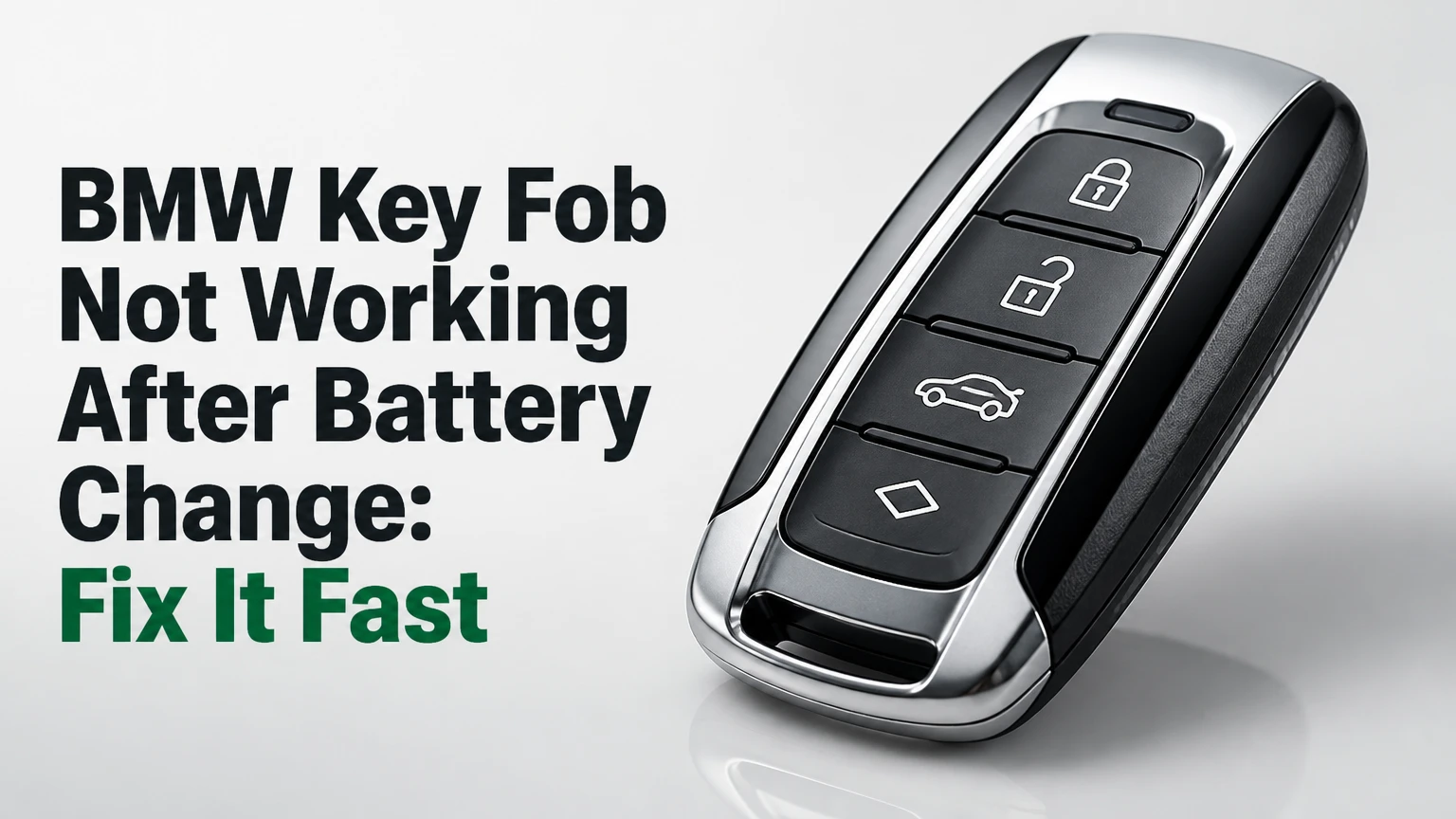
A BMW key fob that is not working after a battery change usually has an incorrect battery, poor terminal contact, reversed polarity, or a damaged housing rather than a lost immobilizer code. Confirm the battery specification and installation first, then reinitialize the remote only if the vehicle generation supports that procedure. A dead remote does not automatically mean the key must be replaced.
Key Facts at a Glance
- BMW remote buttons and the engine immobilizer use separate functions inside the key.
- A BMW battery replacement normally does not erase the key’s immobilizer authorization.
- Older BMW keys may require remote reinitialization through the ignition and button sequence.
- Modern BMW keys can often start the vehicle through an emergency detection area even when remote buttons fail.
- CR2032, CR2450, and rechargeable VL2020 cells are not interchangeable without confirming the original specification.
- If two correctly working keys fail simultaneously, investigate the vehicle receiver, fuse supply, or antenna before buying another key.
Why Is the BMW Key Fob Not Working After Battery Change?
The most common cause is a power or contact problem, not synchronization. A battery installed upside down, a protective film left attached, a bent spring terminal, or a low-quality cell can prevent the remote transmitter from operating immediately after the case is closed.
BMW keys contain a remote transmitter for locking functions and a passive transponder or immobilizer component for authorization. The remote transmitter needs battery power; the immobilizer can be read by the vehicle through a separate inductive system. That explains why a BMW may start while the lock, unlock, trunk, or Comfort Access functions remain dead.
A battery change can expose an existing fault. For example, prying a sealed E-series key apart can crack solder joints, while pressing a coin cell against a damaged retainer can flatten the contact spring. Remote range that declined gradually before replacement points more strongly to a weak cell or aging transmitter than to a sudden rolling-code failure.
The correct diagnostic order
Use the following order because each check takes less time and costs less than the next:
- Verify the exact battery number printed on the old cell.
- Confirm polarity and remove every shipping film.
- Inspect the battery contacts and case for physical damage.
- Test the spare key.
- Try the correct remote reinitialization procedure.
- Diagnose the vehicle receiver or order a replacement key.
A reinitialization sequence cannot repair a disconnected battery terminal or a cracked printed circuit board.
Which Battery Does a BMW Key Use?
The correct BMW key battery depends on the key design, Comfort Access equipment, and production generation. CR2032 and CR2450 are replaceable coin cells, while many older non-Comfort Access keys use a rechargeable VL2020 cell soldered to the circuit board.
| BMW key configuration | Typical battery | How to verify | Main warning |
|---|---|---|---|
| Comfort Access remote, many E-series keys | CR2032 | Read the old cell and key label | Do not substitute CR2450 without clearance |
| Comfort Access remote, many F-series keys | CR2450 | Match the printed code and holder depth | A thicker cell can distort the cover or contacts |
| Older diamond-shaped non-Comfort Access key | VL2020 rechargeable | Inspect the soldered cell and PCB | Cutting the case can damage the board |
| Display Key and specialist high-spec keys | Internal rechargeable Li-ion | BMW documentation or dealer identification | Do not install a CR2032 unless designed for it |
| Replacement aftermarket shell | Battery specified by PCB holder | Match the original circuit board | The shell does not determine the electronics |
Battery codes identify physical dimensions and chemistry, not universal BMW compatibility. A CR2032 is approximately 20 millimeters wide and 3.2 millimeters thick; a CR2450 is approximately 4.5 millimeters thick. The larger CR2450 can fail to seat correctly in a holder designed for a CR2032.
Use a reputable lithium coin cell from Panasonic, Varta, Energizer, or Duracell. Check the manufacturing date when possible, because a cell stored for years can show acceptable open-circuit voltage but collapse under the transmitter’s short current demand.
How should the battery be installed?
Place the positive side according to the markings inside the holder, usually with the “+” side facing the cover or visible side. BMW key layouts differ, so the molded polarity symbol inside the key is more reliable than a generic online photograph.
Remove any transparent shipping sticker. Do not touch both faces repeatedly with oily fingers, and do not bend the cell to force it under a retainer. The spring terminal should press firmly against the battery without preventing the cover from closing.
A fresh lithium coin cell normally measures close to 3 volts with no load. A multimeter reading alone does not prove transmitter performance, but a reading substantially below the marked nominal voltage justifies replacing the cell again with a known-good brand.
Does a BMW Key Need Programming After a Battery Change?
A BMW key normally does not need immobilizer programming merely because its coin-cell battery was replaced. Some older BMW remotes do need a short remote-control reinitialization when the buttons stop communicating, but that process is different from adding a new key to the vehicle’s security system.
Remote reinitialization pairs the existing transmitter’s button operation with the vehicle receiver. Immobilizer programming authorizes a new or replacement key through BMW security modules such as EWS, CAS, FEM, or BDC. The latter generally requires BMW-specific diagnostic equipment, security credentials, or a qualified automotive locksmith.
The phrase “rolling-code desynchronization” is often used too broadly. Pressing buttons repeatedly while the battery is removed can create a synchronization issue on some systems, but a normal battery change does not reliably or routinely erase the rolling-code relationship. Check hardware and battery installation before assuming a code problem.
What should happen when the remote works?
Press the lock or unlock button beside the vehicle. A functioning remote should operate within a normal range, often several meters, although the exact distance changes with interference, vehicle position, and antenna condition.
Check the trunk button separately. On models with Comfort Access, test the door-handle touch area only after confirming the remote battery and vehicle battery have adequate voltage. Comfort Access has its own antennas and may fail while conventional remote buttons still work.
How Do You Reinitialize an Older BMW Key?
Older BMW models with a physical ignition switch or ignition slot commonly use a timed button sequence. The usual procedure is to cycle the ignition briefly, remove the key, hold Unlock, press Lock three times within about 10 seconds, and repeat the button sequence for additional keys within the vehicle’s short programming window.
This method applies broadly to many E46, E39, E53, E60, E70, and E90 configurations, but equipment and regional programming instructions vary. A physical key shape alone cannot identify the correct sequence because the same chassis may have different Comfort Access systems.
Step-by-step older BMW procedure
Step 1: Enter the vehicle and close the doors
Unlock the driver’s door with the emergency metal blade if necessary. Sit in the vehicle, close all doors, and leave the doors unlocked. Keep every key that must work nearby.
Success checkpoint: The vehicle interior is accessible and no door is open.
Common mistake: Starting the sequence with a door ajar can prevent the receiver from entering its programming state.
Step 2: Cycle the ignition
Insert the key into the ignition slot or switch. Turn it to the first accessory position, where the instrument cluster or accessories activate, then return it to Off within approximately five seconds. Remove the key completely.
Success checkpoint: The key is out of the ignition before any remote buttons are pressed.
Common mistake: Turning the ignition to the engine-running position, which interrupts the intended sequence.
Step 3: Press the remote buttons
Hold the Unlock button continuously. While holding Unlock, press the BMW logo Lock button three times quickly within approximately 10 seconds. Release Unlock after the third Lock press.
Success checkpoint: The door locks cycle down and up, or the vehicle gives another documented confirmation.
Common mistake: Releasing Unlock between presses or waiting several seconds between Lock presses.
Step 4: Add additional keys
Program the next key without putting it into the ignition. Repeat the button sequence within roughly 30 seconds of the first key’s confirmation.
Success checkpoint: Every programmed key locks and unlocks the vehicle before leaving programming mode.
Common mistake: Inserting the second key into the ignition, which can exit the initialization process.
If no lock confirmation occurs, repeat the complete sequence once after checking the battery and contacts. Repeating it indefinitely will not repair a defective transmitter.
How Do You Start a Modern BMW With a Dead Remote?
A modern BMW with a failed remote battery can often start when the key is placed against the vehicle’s emergency detection antenna while the brake pedal and START/STOP button are used. The exact antenna position varies by chassis, so consult the owner’s manual rather than assuming every BMW uses the right side of the steering column.
Common locations include a marked area on or near the steering column, a designated tray in the center console, or another interior emergency-start zone. BMW uses inductive detection for this backup function, so holding the key in the specified location matters more than pressing the remote buttons.
Step-by-step emergency start
- Remove the emergency metal blade from the fob if the driver’s door is locked.
- Unlock the driver’s door manually and enter the vehicle.
- Place the entire key fob at the owner’s-manual emergency detection location.
- Press the brake pedal firmly on automatic-transmission models.
- Press the START/STOP button while keeping the fob in position.
- Hold the fob there until the instrument cluster recognizes the key.
Success checkpoint: The instrument cluster displays key recognition or the engine starts.
Common mistake: Holding only the metal blade near the button, because the blade does not contain the powered remote electronics needed for this detection method.
Starting successfully with the emergency antenna proves that the immobilizer path can recognize the key. It does not prove that the remote transmitter, battery contacts, Comfort Access antenna, or vehicle radio receiver is healthy.
Why Does the BMW Start but the Remote Buttons Fail?
A BMW that starts but will not lock or unlock remotely usually has a fault in the coin-cell circuit, transmitter, remote antenna path, or Comfort Access system rather than the immobilizer. The passive authorization circuit can remain functional while the battery-powered radio transmitter is dead.
Use the spare key as a controlled comparison. If the spare locks and unlocks normally, focus on the first key’s battery holder, switch contacts, PCB, or transmitter. If both keys start the vehicle but neither operates the remote, investigate the vehicle side.
| Symptom | Most likely area | Useful test | Next action |
|---|---|---|---|
| Engine starts, one remote fails | Key battery, contacts, PCB | Compare with spare key | Repair or replace affected key |
| Engine starts, both remotes fail | Vehicle receiver or fuse | Test both keys at close range | Scan receiver and inspect supply |
| Remote works near car only | Weak cell, interference, antenna | Try a new branded cell outdoors | Inspect antenna if unchanged |
| Lock works, unlock fails | Button switch or PCB trace | Test each button separately | Key repair or replacement |
| Comfort Access fails, buttons work | Handle antenna or Comfort Access module | Use conventional buttons | Diagnose door-handle system |
| No key recognized, engine will not start | Immobilizer, vehicle battery, key fault | Try emergency location and spare | BMW diagnostic scan required |
The vehicle’s 12-volt battery also matters. Low system voltage can disable convenience features or create misleading symptoms, especially after the vehicle has been parked for an extended period.
What If Both BMW Keys Stop Working?
If both BMW keys stop operating remotely at the same time, suspect the vehicle before replacing both keys. A failed receiver, diversity antenna, power supply, fuse, wiring connection, or water-damaged module can affect every key simultaneously.
On some E-series vehicles, the diversity antenna amplifier is positioned near the rear window or spoiler area, where water intrusion can cause intermittent or complete remote failure. The exact location and fuse numbers depend on chassis, production date, body style, and market.
Do not rely on a generic fuse list. BMW fuse assignments change, and a fuse that looks intact can have a poor connection. Use the fuse card for the vehicle, test the relevant circuit with a meter or test lamp, and scan the car with a BMW-capable tool such as ISTA or an equivalent professional system.
A useful isolation test is to stand directly beside the driver’s door and test both remotes after installing known-good batteries. If neither works at close range but both start the engine, the RF receiver path becomes more likely than radio interference.
Which BMW Repair Option Should You Choose?
Choose DIY reinitialization when one older remote stopped locking after a confirmed battery installation and the key case is undamaged. Choose a locksmith when the key needs PCB repair, coding, or mobile service. Choose a BMW dealer when a secure replacement key, Comfort Access compatibility, or a vehicle security-module diagnosis is required.
| Repair route | Typical US cost | Typical time | Best use | Limitation |
|---|---|---|---|---|
| Battery and contact inspection | $5-$20 | 5-15 minutes | Incorrect cell or poor contact | Cannot repair a damaged PCB |
| Remote reinitialization | $0 | 2-5 minutes | Existing older key lost remote operation | Not a replacement-key process |
| Key PCB repair | $75-$180 | 1-3 days | Broken solder joint or switch | Repair quality varies |
| Automotive locksmith | $150-$350 | 1-3 hours | Mobile diagnosis or coded key | Availability depends on BMW system |
| BMW dealer replacement | $300-$800+ | 2-10 business days | OEM coded key and security documentation | Highest typical cost |
| Vehicle receiver diagnosis | $100-$250 diagnostic fee | 1-3 hours | Both keys fail remotely | Module or wiring repair costs extra |
These are typical US consumer ranges, not fixed BMW prices. Dealer pricing changes substantially by series, Comfort Access hardware, key type, local labor rate, and whether the vehicle must be towed.
An aftermarket shell can restore buttons and cosmetics, but it does not create a valid immobilizer key. An uncut blank or online remote may require specialized coding, and some security systems cannot be programmed through a simple button sequence.
Common Mistakes and How to Fix Them
Installing a CR2450 where a CR2032 belongs
A thicker battery can press against the case, distort the holder, or prevent reliable contact. Replace it with the exact number printed on the original cell or specified for the key’s PCB.
Assuming every BMW key is rechargeable
Many older non-Comfort Access keys use a soldered rechargeable VL2020 cell. Opening the molded case with a knife can cut antenna traces and damage the circuit board. Use a specialist repair service when the cell is soldered.
Reinitializing a modern key with an old procedure
The ignition-slot sequence is not a universal BMW programming method. F-series and G-series vehicles may use emergency-start recognition, diagnostic programming, or no user-accessible remote reinitialization at all.
Testing only one button
A failed Lock microswitch does not prove the entire transmitter is dead. Test Lock, Unlock, and Trunk separately, then compare the results with the spare key.
Blaming synchronization before checking contacts
A weak mechanical connection can produce intermittent operation that looks like code loss. Press the cover firmly, inspect the retainer, and look for a flattened or oxidized terminal.
Replacing both keys after a vehicle-side failure
Two simultaneous remote failures are statistically more suspicious for a shared receiver or power problem than for two independent new battery faults. Diagnose the car before ordering replacements.
BMW Key Fob Troubleshooting by Situation
The car is locked and the remote is completely dead
Use the emergency blade in the driver’s door lock. Some BMW handles conceal the lock cylinder beneath a removable trim cap, so avoid forcing the handle or inserting the blade at an angle.
After entry, try the emergency-start antenna location from the owner’s manual. A successful engine start gives access to the vehicle but does not repair the remote.
The remote works only after several presses
Install a known-good branded battery and inspect the contacts before attempting synchronization. Repeated button presses can also indicate a worn microswitch, cracked solder joint, or transmitter with reduced output.
If the remote works only within a few inches of the car, test outdoors away from possible radio interference. Persistent short range with both keys points toward the vehicle antenna system.
The battery change caused physical damage
Stop using a loose cell or cracked cover. A battery that moves inside the case can intermittently short, lose contact, or damage the holder. A locksmith or electronics repair specialist can often replace a switch or resolder a contact for less than a complete OEM key.
The BMW key was immersed in water
Remove the battery if possible, do not repeatedly press the buttons, and allow the electronics to be assessed by a specialist. Drying a contaminated PCB may not remove corrosion under the switches or shielding.
What Information Does a Technician Need?
Provide the model, production year, chassis code if known, Comfort Access status, battery number, and the exact symptom. State whether the engine starts, whether the spare key works, whether the interior buttons operate the locks, and whether remote range declined gradually or failed immediately.
The most useful evidence is comparative:
- One key fails, spare key works: likely key-side fault.
- Both keys fail, interior lock buttons work: likely remote receiver or antenna path.
- Both keys fail, vehicle battery is weak: check voltage and fault memory first.
- Engine will not start with either key: investigate immobilizer recognition, not only remote locking.
- Remote works but Comfort Access fails: diagnose handle antennas and Comfort Access modules.
BMW’s owner documentation treats the integrated key as a manual access method; BMW owner manuals also distinguish manual unlocking from electronic remote operation. That distinction matters because opening the door with the metal blade does not prove the radio transmitter is working.
FAQ
Can I drive my BMW if the key fob battery is dead?
Usually, yes, if the vehicle recognizes the passive key through its emergency detection area. Unlock the vehicle with the emergency blade, place the fob at the model-specific backup antenna, press the brake, and use START/STOP. A completely damaged or unrecognized key may still prevent starting.
Will disconnecting the BMW car battery reprogram the key?
Disconnecting the vehicle’s 12-volt battery normally does not create a new immobilizer key or erase the key’s identity. Low voltage can disable convenience functions or store faults, however, so restore a healthy vehicle battery and test both keys before attempting programming.
Can I program a new BMW key myself?
A new BMW key generally requires security authorization and BMW-compatible diagnostic equipment, while older remote reinitialization only synchronizes an existing key’s buttons. The ignition-slot button sequence does not usually add a new immobilizer key to the vehicle.
Why does my BMW key fob work near the car but not from a distance?
Short-range operation usually indicates a weak or unsuitable battery, poor contact, a damaged transmitter antenna, or a vehicle receiver problem. Test a high-quality correct cell first, then compare the spare key and test outdoors away from radio interference.
Is a BMW key fob replacement covered by warranty?
Coverage depends on the vehicle’s warranty, key protection plan, retailer, and the cause of failure. Physical damage, lost keys, and wear often have different terms from an electronic defect. Ask the dealer or insurer for written coverage details before authorizing a replacement.
The Bottom Line
A BMW key fob not working after a battery change should be diagnosed from the battery outward: verify the cell number, polarity, shipping film, contact pressure, and case condition before attempting reinitialization, with BMW X3 battery and emergency-start checks varying by generation. Older ignition-slot BMWs may recover through the timed Unlock and Lock sequence, while modern BMWs often use an emergency detection location and may require diagnostic programming for replacement keys.
If the engine starts but one remote fails, repair or reinitialize that key. If both keys fail remotely, test the vehicle’s receiver, antenna, fuse supply, and 12-volt battery before spending hundreds of dollars on replacement keys. The correct fix depends on the key’s electronics and BMW chassis, not on the battery change alone.