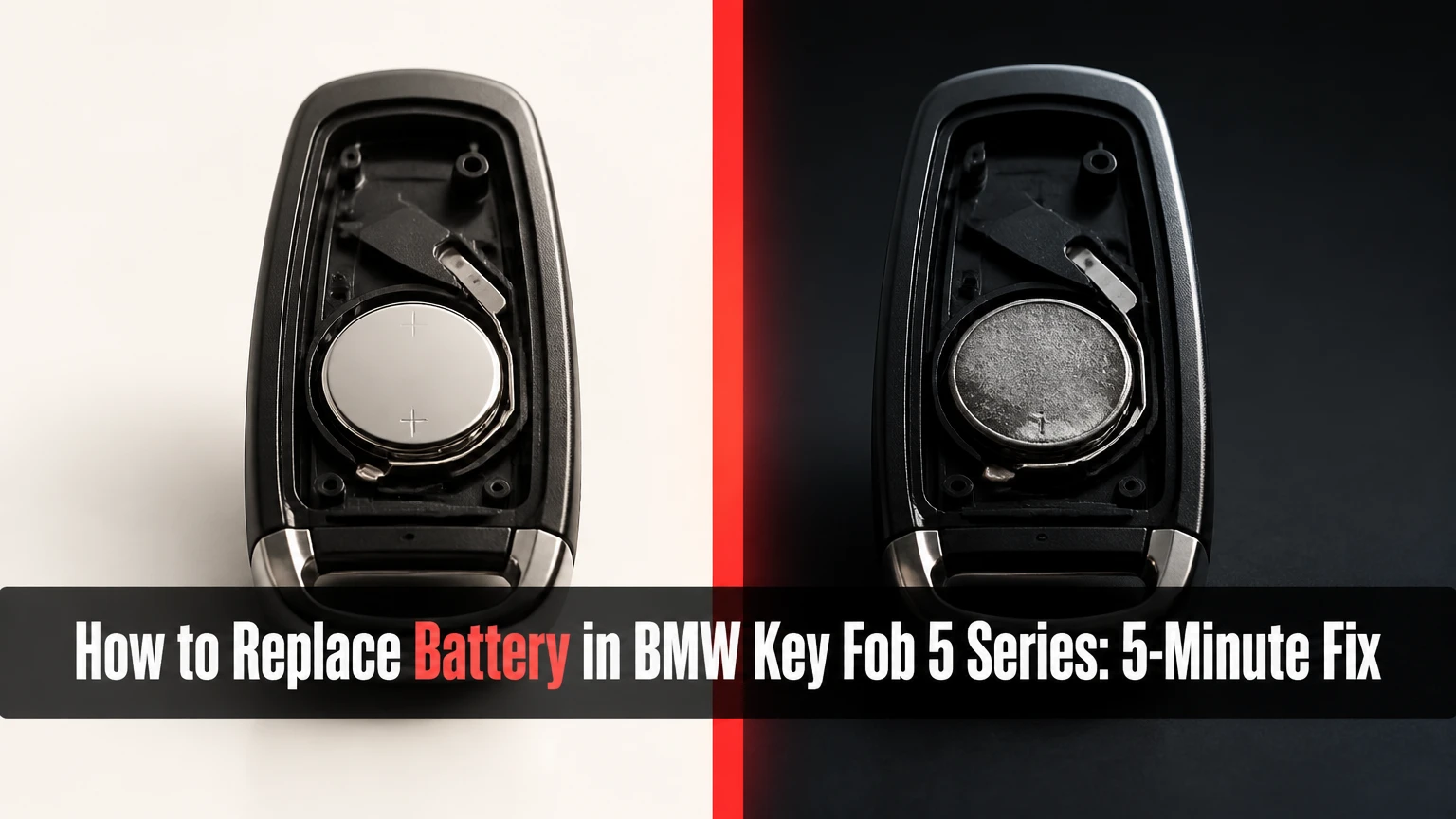
Replacing the battery in a BMW 5 Series key fob usually takes 2-5 minutes and requires only a new coin cell plus the emergency-key blade or a plastic pry tool. First identify the fob design, because F10/F11 keys commonly use a CR2450, while many G30/G31 and G60 keys use a CR2032. A normal battery swap does not require reprogramming.
Key Facts at a Glance
A BMW 5 Series key battery replacement normally preserves the existing key pairing.
F10 and F11 silver-blade keys commonly use a 3-volt CR2450 coin cell.
G30 and G31 keys commonly use a 3-volt CR2032 coin cell.
BMW 5 Series E-Series keys may contain a rechargeable VL2020-style battery instead of a replaceable coin cell.
A Display Key uses an internal rechargeable lithium-ion battery, not a standard CR2032.
Confirm the number printed on the old battery and the polarity mark inside the housing before installation.
What Battery Does a BMW 5 Series Key Fob Use?
The correct BMW 5 Series key battery depends on the generation, Comfort Access equipment, and physical key housing. Model year provides a useful starting point, but the old cell’s printed designation and the battery compartment marking are the final authorities because BMW used more than one transmitter design within some production periods.
BMW key fobs contain a circuit board, radio transmitter, immobilizer transponder, buttons, emergency mechanical key, and battery contacts. The coin cell powers remote locking, unlocking, trunk release, and, on Comfort Access-equipped vehicles, passive-entry communication. The immobilizer authorization remains associated with the key, so removing the battery does not normally delete it.
| 5 Series generation or key style | Typical production period | Common battery | Replacement status |
|---|---|---|---|
| E39 diamond key | 1997-2003 | VL2020 rechargeable | Usually soldered or internally fitted |
| E60/E61 standard key | 2004-2010 | VL2020-style rechargeable | Often not a simple coin-cell swap |
| E60/E61 Comfort Access key | 2004-2010 | CR2032, 3 V lithium | Replaceable in compatible housing |
| F10/F11 silver-blade key | 2011-2017 | CR2450, 3 V lithium | Replaceable rear cover |
| G30/G31 standard key | 2017-2023 | CR2032, 3 V lithium | Replaceable cover or tray |
| G30 Display Key | 2017-2023 | Internal lithium-ion pack | Recharge through charging interface |
| G60 curved key | 2024-present | Commonly CR2032, 3 V lithium | Housing-specific tray or cover |
The table gives typical fitment rather than a VIN-level guarantee. BMW of Madison and BMW service guidance both frame newer fob replacement as a straightforward cell change, while iFixit’s E39 guide demonstrates why older diamond keys require different handling. A CR2032 and CR2450 are both 3 volts, but they are different physical sizes and are not interchangeable.
How do you identify the key style?
Identify the key by its housing before purchasing a battery. A silver-blade F10/F11 fob has a broad, relatively thick body with the metal emergency blade released from the rear; a G30 key has a more contemporary rectangular body and may have colored side trim or a slide-out battery tray.
Check four details:
- Read the number on the existing battery.
- Look for a molded plus or minus symbol inside the compartment.
- Compare the replacement cell’s diameter and thickness with the old cell.
- Check the owner’s manual or BMW parts catalog using the vehicle identification number if the housing has been modified.
Do not install a CR2450 where a CR2032 was specified simply because both cells are lithium and 3 volts. The larger CR2450 can deform contacts or prevent the cover from closing.
What Should You Prepare Before Opening the Fob?
Prepare one verified replacement battery, a clean work surface, and a non-marring pry tool. Most BMW 5 Series owners need no programming equipment, soldering iron, diagnostic scanner, or special reset procedure for F10, F11, G30, G31, and compatible G60 replaceable-cell fobs.
Before you start
Time: 2-5 minutes for a replaceable-cell fob
Difficulty: Low, provided the cover is opened at its release point
Battery cost: Typically $3-$8 for a reputable two-pack
Tools: Emergency metal key, fingernail, plastic spudger, or thin plastic pick
Materials: One correct 3-volt CR2032 or CR2450 cell
Workspace: Dry table with a soft cloth
Prerequisite: Confirm the fob is not a rechargeable E-Series or Display Key
Use a Panasonic, Energizer, Duracell, Sony, or another established battery brand with a distant expiration date. Keep the replacement cell in its packaging until installation, and prevent metal tools from bridging both battery surfaces because a short circuit can discharge the cell.
Why does the exact battery matter?
Battery dimensions determine contact pressure, cover fit, and electrical reliability. A CR2032 measures approximately 20 millimeters in diameter and 3.2 millimeters thick, whereas a CR2450 measures approximately 24 millimeters across and 5.0 millimeters thick.
The chemistry is also relevant. Replaceable BMW coin cells are generally non-rechargeable lithium batteries; rechargeable VL2020 cells in older keys belong to a different charging circuit. Installing a non-rechargeable CR2032 into a key designed to charge an internal cell can create a safety and circuit problem.
How to Replace Battery in BMW Key Fob 5 Series
The replacement sequence is: remove the emergency blade, release the rear cover or battery tray, replace the cell with the housing’s marked polarity, and close the fob until every edge sits flush. The battery should not be forced into place, and the circuit board should remain in its original position throughout the job.
Step 1: Remove the emergency key blade
Press the small release button on the rear or side of the BMW key fob, then pull the metal emergency blade straight out. Set the blade aside only after checking whether its tip will be used to release the battery cover.
The release button can be small and flush with the plastic. Press it fully rather than twisting the blade, because twisting can damage the internal retaining channel.
Success checkpoint: The metal blade is completely removed and the key slot or tray-release opening is visible.
Common mistake: Pulling on the plastic housing instead of pressing the release button can crack the blade retainer.
Step 2: Open the rear cover or battery tray
Insert the end of the emergency blade into the designated internal slot, if the fob has one. Apply light upward pressure at the release point, then work around the cover only if the design requires it.
Some G30/G31 variants use a removable back panel. Other BMW keys use a slide-out tray that unlatches when the emergency blade is inserted into a narrow slot. Do not insert a tool into the seam near the buttons unless the housing specifically provides no other release point.
Success checkpoint: The cover lifts or the battery tray slides out without bending the plastic.
Common mistake: Using a thick flat-head screwdriver at the corner can leave permanent marks or snap the cover tabs. A plastic pick reduces that risk.
Step 3: Remove the old battery
Lift the coin cell from its edge using a fingernail or a plastic tool. Avoid levering directly against the circuit board, button contacts, or small surface-mounted components.
Note the old battery’s orientation before removal. Photograph the compartment if the polarity mark is difficult to see, then inspect the contacts for flattened springs, white residue, corrosion, or dirt.
Success checkpoint: The old cell is out and the retaining contacts remain straight, clean, and firmly attached.
Common mistake: Pulling upward from the center can bend the retaining clip. Lift the accessible edge instead.
Step 4: Install the replacement cell
Fit a new cell of the same designation, matching the positive and negative symbols molded into the compartment. Many F10/F11 and G30/G31 housings place the positive face outward or upward, but the exact face can vary by housing, so the marking inside the fob takes priority over a generic internet diagram.
For the G60, inspect the tray and the printed polarity symbol carefully. A battery-facing instruction that is correct for one curved-key sub-variant may be wrong for another.
Success checkpoint: The battery lies flat, the retaining clip holds it securely, and the cover can close without pressure.
Common mistake: Installing the cell by color or logo rather than its plus and minus markings can reverse polarity and produce a dead remote.
Step 5: Refit the cover and emergency blade
Hook the cover’s upper tabs into the corresponding slots, then press the lower edge until it clicks. If the design has a sliding tray, push the tray fully home until it locks. Reinsert the metal emergency blade.
The housing should close evenly with no raised corner. A cover that will not sit flat usually indicates a misaligned tab, an oversized battery, or a cell that is not fully beneath its retaining clip.
Success checkpoint: The case is flush on all sides, the blade locks in place, and no button feels trapped.
Common mistake: Squeezing the case hard to compensate for incorrect fitment can break the housing or compress the battery contacts.
Step 6: Test every function
Stand near the vehicle and test lock, unlock, trunk release, panic operation if fitted, Comfort Access entry, and engine starting. Test the spare key as well if the vehicle has been reporting a general key-battery warning.
The BMW 5 Series should respond immediately when the replacement cell and contacts are healthy. A battery swap does not normally require synchronization, although the vehicle may take one or two button presses to respond if the old cell had been nearly exhausted.
Success checkpoint: The doors lock and unlock, the trunk responds, and the engine starts normally.
Common mistake: Testing only the lock button can conceal a damaged trunk or unlock switch.
Which Battery Orientation Is Correct?
Battery orientation is determined by the plus and minus marks inside the specific BMW key housing, not by the vehicle generation alone. The positive side usually has the large flat face marked with a plus sign, while the negative side is the flatter or less prominently marked face, but the installed direction must match the fob’s contacts.
| Key style | Typical cell | Common installation pattern | Verification method |
|---|---|---|---|
| F10/F11 silver blade | CR2450 | Positive face commonly outward | Confirm plus sign in tray |
| G30/G31 standard | CR2032 | Positive face commonly outward | Match molded compartment symbol |
| G60 curved key | CR2032 | Housing-dependent | Follow tray plus/minus marks |
| E60 Comfort Access | CR2032 | Housing-dependent | Photograph old cell before removal |
| E39 or standard E60 rechargeable | VL2020-style | Internal charging circuit | Do not substitute a disposable cell |
The practical rule is simple: match the old battery’s printed side only after confirming that the old installation was correct. If a prior owner installed the cell backward, copy the housing’s polarity symbol, not the old mistake.
Do Older E-Series Keys Use a Replaceable Battery?
Older E39 and many standard E60/E61 diamond keys use a rechargeable internal battery that receives charge inductively while the key is positioned in the ignition. Those keys are not equivalent to newer F10 or G30 fobs, and opening them can require soldering or specialist board repair.
An E60 Comfort Access key may use a replaceable CR2032, which is why E60 battery advice often appears contradictory. Comfort Access equipment, key housing shape, and the presence of a removable battery cover determine the procedure.
| Symptom on an older key | Likely cause | Appropriate next action |
|---|---|---|
| Remote range fades after long storage | Rechargeable cell discharged | Drive and allow normal inductive charging |
| Key starts car but buttons fail | Remote battery or PCB fault | Inspect key electronics professionally |
| Housing is sealed | Internal rechargeable cell | Use an automotive locksmith or electronics technician |
| CR2032 compartment is visible | Replaceable-cell design | Match the cell and polarity marking |
| Charging does not restore operation | Cell, solder joint, or board failure | Repair or replace the key |
Do not use improvised charging methods such as placing a sealed key on an unrelated magnetic charger. The charging coil, current control, and cell chemistry must match the original design.
Can You Replace a BMW Display Key Battery?
A BMW Display Key does not use a user-replaceable CR2032 in the same way as a standard G30 key. The Display Key contains a rechargeable lithium-ion battery and normally charges through its specified USB connection or compatible wireless charging tray.
The screen, wireless functions, and internal battery make Display Key service more complex. If the Display Key will not hold a charge, a BMW dealer or qualified electronics specialist should test the battery pack and charging circuit rather than opening the touchscreen housing with a coin-cell procedure.
Does a BMW Need Reprogramming After Battery Replacement?
A BMW 5 Series normally does not need reprogramming after a correctly installed replacement battery. The key’s identity and rolling-code relationship are stored in the key and vehicle electronics, while the removable cell supplies operating power.
Reprogramming becomes relevant when adding a replacement key, changing a key’s electronic module, or diagnosing a failed transmitter. It is not the standard remedy for a simple low-battery warning.
If the remote does not respond after replacement, check the following in order:
- Confirm the cell number and polarity.
- Check that the cell is seated under the retaining clip.
- Inspect the contacts for bending or corrosion.
- Test the replacement cell with a multimeter if available.
- Try the spare key to separate vehicle faults from fob faults.
- Use the emergency-start position if the car cannot detect the key.
How Can You Start a BMW 5 Series With a Dead Key?
A BMW 5 Series can often start when the remote battery is weak or empty by placing the key against the vehicle’s designated emergency-detection area and pressing the Start/Stop button. The exact position varies by generation, so the owner’s manual symbol or instrument-panel instruction should control.
On many BMW models, the emergency reader is near the steering column or a marked steering-column area. Hold the key flat against that location while pressing the brake and Start/Stop button. This procedure uses the key’s passive transponder and is different from remote locking.
A successful emergency start proves only that the immobilizer transponder is readable. It does not prove that the buttons, transmitter, battery contacts, or Comfort Access antenna are working.
What If the Key Is Not Detected After Replacement?
A “key not detected” message after a battery change most often results from reversed polarity, an unseated cell, damaged contacts, or a battery tray that has not fully latched. A second key test helps determine whether the fault is in the fob or the vehicle.
Use this diagnostic sequence:
| Test | Result | Interpretation |
|---|---|---|
| Press lock beside vehicle | No response | Check polarity and contact pressure |
| Try spare key | Spare works | Primary fob needs inspection |
| Emergency-start procedure | Engine starts | Transponder works; remote side has a fault |
| Both keys fail | Neither responds | Check vehicle battery or receiver system |
| New cell measures below 3 V | Weak replacement | Install a fresh cell |
| Buttons feel soft or stuck | Housing or switch damage | Inspect PCB and button membrane |
A fresh battery cannot repair water damage, cracked solder joints, broken antenna traces, or worn microswitches. If the key became wet, remove the battery only if the housing allows safe access, leave the electronics to dry completely, and seek professional inspection before repeated testing.
How Much Does BMW Key Battery Replacement Cost?
DIY replacement typically costs $3-$8 and takes 2-5 minutes for a replaceable-cell key. Dealer, locksmith, and independent-shop pricing commonly ranges from $10-$60 depending on whether the provider performs only a battery swap or diagnoses a damaged key.
| Replacement option | Typical cost | Typical time | Best use |
|---|---|---|---|
| DIY CR2032 two-pack | $3-$8 | 2-5 minutes | Standard G30/G31 or compatible G60 key |
| DIY CR2450 two-pack | $4-$10 | 2-5 minutes | F10/F11 silver-blade key |
| Independent repair shop | $10-$30 | 10-30 minutes | Battery, contact, or housing inspection |
| Automotive locksmith | $15-$60 | 15-45 minutes | Key diagnosis or shell transfer |
| BMW dealer | $25-$60 for simple service | 15-60 minutes | Convenience and documented service |
| New programmed key | Several hundred dollars | Appointment required | Lost, damaged, or non-repairable key |
Prices vary by country, labor rate, and whether the key is a Display Key or sealed rechargeable design. A dealer’s quote for a complete new key should not be compared with the price of a disposable coin cell.
Should You Use a Dealer, Locksmith, or DIY Method?
DIY is the sensible choice when the fob has a clearly removable cover, the old cell is visible, and the only symptom is a low-battery warning. An automotive locksmith is preferable when the housing is sealed, the key has water damage, or a new shell must receive the original circuit board.
| Situation | DIY | Independent locksmith | BMW dealer |
|---|---|---|---|
| Replace visible CR2032 | Strong choice | Unnecessary | Usually expensive |
| Replace visible CR2450 | Strong choice | Optional | Usually expensive |
| Repair rechargeable E-Series key | Poor choice | Strong choice | Strong choice |
| Program an additional key | Not suitable | Often suitable | Suitable |
| Diagnose vehicle receiver fault | Limited | Strong choice | Strong choice |
| Replace Display Key battery | Not suitable | Depends on equipment | Strong choice |
The main limitation of DIY service is scope. It replaces a power cell, but it cannot establish whether a failed key has a transmitter fault, immobilizer problem, damaged PCB, or vehicle-side antenna failure.
Common Mistakes and How to Fix Them
Installing the wrong coin cell
A CR2032 is smaller and thinner than a CR2450. If the replacement does not lie flat without force, stop and verify the designation rather than pressing the cover closed.
Reversing polarity
Remove the cell, wait several seconds, and reinstall it according to the housing’s plus and minus marks. If the remote remains dead, test the cell voltage and inspect the contacts.
Bending the battery contact
A flattened spring contact can interrupt power even with a new battery. Carefully restore only slight contact pressure with a plastic tool; replace or repair the contact if it is detached from the PCB.
Scratching or splitting the housing
Use the emergency blade at its intended release slot. If the cover resists, locate another latch rather than increasing force at the seam.
Buying a rechargeable key for a disposable cell
The word “BMW key” does not identify the battery architecture. Confirm whether the key has a removable tray, a rear cover, or a sealed rechargeable design before ordering parts.
Assuming a new battery fixes every failure
Short range can result from a weak cell, but it can also result from a damaged antenna, corroded contacts, radio interference, or a failing transmitter. Test the spare key before replacing more parts.
The Bottom Line
The safest way to replace a battery in a BMW 5 Series key fob is to identify the housing first, install the exact cell marked inside it, and confirm polarity before closing the case. F10 and F11 keys commonly use CR2450 cells, while many G30, G31, and G60 keys use CR2032 cells, but older rechargeable keys and Display Keys require a different service path.
A standard replacement takes 2-5 minutes and normally requires no reprogramming. If the BMW 5 Series key still fails after a correctly fitted battery, use the emergency-start procedure, test the spare key, and then have the fob or vehicle receiver diagnosed rather than repeatedly buying batteries.
FAQ
Will changing the BMW key battery erase the memory?
No. Replacing the power cell normally does not erase the BMW key’s vehicle pairing, stored identity, or immobilizer authorization. The key may briefly fail to transmit if the new cell is reversed or poorly seated, but that condition is corrected by checking polarity and contact pressure rather than programming the key again.
How long should a BMW 5 Series key battery last?
A replaceable lithium coin cell commonly lasts several years, although Comfort Access use, frequent button presses, temperature, storage conditions, and battery quality affect service life. A key that loses range within weeks of replacement may have poor contacts, a parasitic electronic fault, or a low-quality cell.
Can I use a CR2025 instead of a CR2032?
Do not substitute a CR2025 unless the specific BMW key housing explicitly permits it. Both cells are 20 millimeters wide and 3 volts, but a CR2025 is thinner than a CR2032, which can reduce contact pressure and cause intermittent operation in a compartment designed for the thicker cell.
Why does the car start but the remote buttons do not work?
Starting can use the key’s passive immobilizer transponder, while remote buttons require battery-powered radio transmission. Therefore, a BMW 5 Series may start with a weak or failed remote battery even when locking, unlocking, trunk release, and Comfort Access functions no longer respond.
Can a BMW key battery be tested without opening the key?
A low-key warning, reduced remote range, or intermittent buttons can indicate a weak battery, but reliable voltage testing requires access to the cell. A replacement with the correct fresh battery is usually faster for a removable-cell fob, while a sealed rechargeable key should receive professional testing.
Where should I buy the replacement battery?
Buy the exact CR2032, CR2450, or rechargeable replacement specified for the housing from a reputable automotive-parts retailer, electronics supplier, BMW parts department, or established battery brand. Avoid unbranded cells with unclear expiration dates because low stored voltage can mimic a key or vehicle fault.