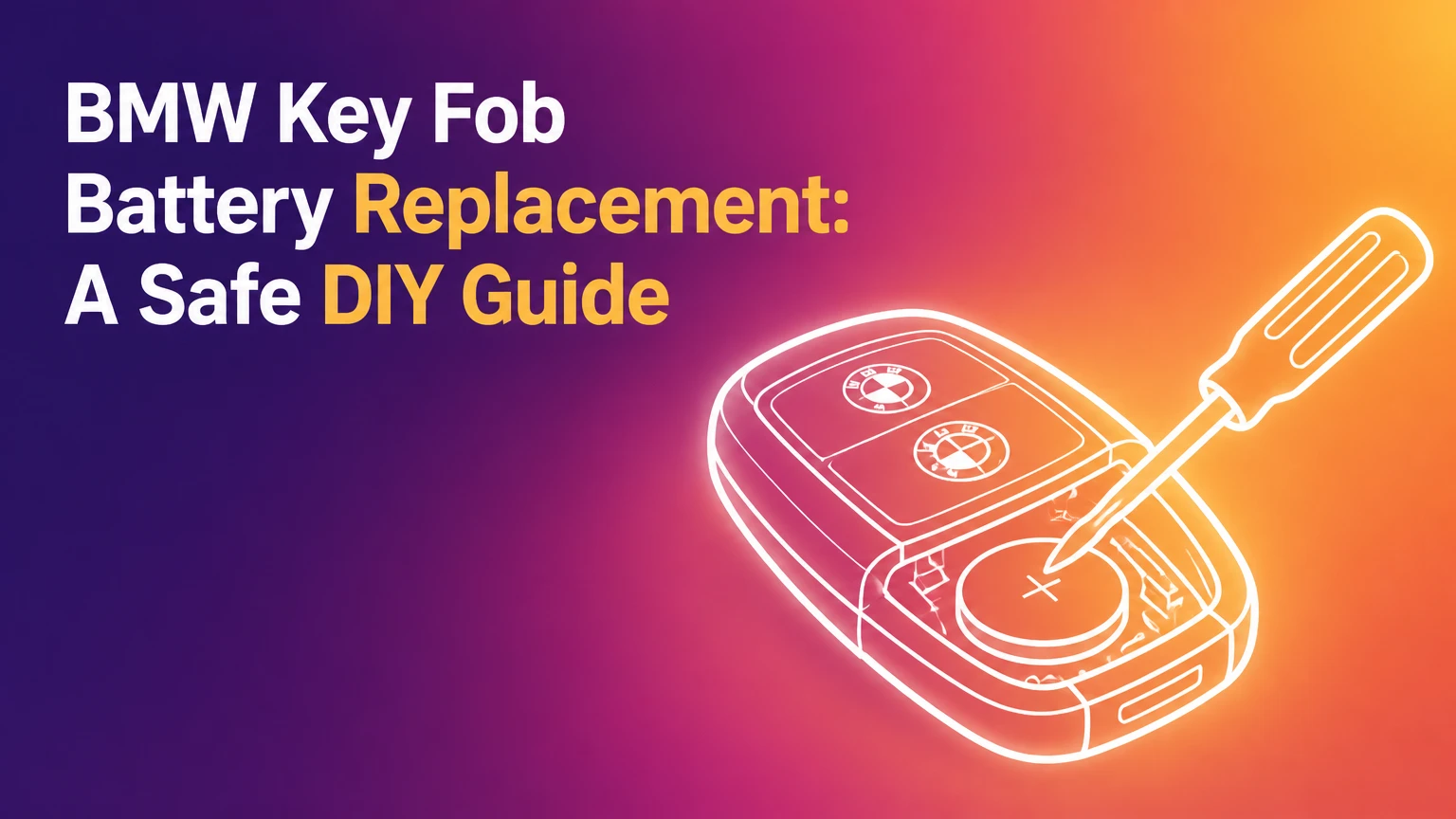
BMW key fob battery replacement usually takes 2-5 minutes and costs about $5-$10 when the housing has a removable cover. Most modern BMW flip, trapezoid, and silver fobs use a CR2032 or CR2450 coin cell, while older diamond keys commonly contain a soldered rechargeable VL2020 battery that requires specialist repair or key replacement.
Key Facts at a Glance
- A removable-cover BMW key normally does not need programming after its coin battery is changed.
- CR2032 and CR2450 cells are different thicknesses, so Comfort Access fobs must use the size specified for that housing.
- The positive side of a replaceable coin cell usually faces the marked side of the battery compartment.
- Older diamond-shaped BMW keys often use a rechargeable VL2020 cell soldered inside a sealed case.
- A BMW with a weak key can often start when the fob is held against the vehicle’s marked backup-reader location.
- A new battery will not repair damaged buttons, water intrusion, a broken antenna, or a failed key-control circuit.
Which BMW Key Battery Do You Need?
The correct BMW key battery is determined by the fob housing and the battery marking, not by the vehicle’s badge alone. A 2015 BMW 3 Series, for example, may use a different cell from another 3 Series built for a different market or equipped with Comfort Access.
Look for the battery number after opening the serviceable compartment. If the fob is sealed, do not pry it open merely to confirm the number unless you intend to repair the housing. BMW key shells, internal circuit boards, and rechargeable cells vary across generations.
| BMW key style | Common production period | Typical battery | Replacement method |
|---|---|---|---|
| Diamond-shaped E-Series key | 1999-2006 | VL2020 rechargeable | Soldered repair or complete key |
| Trapezoid F-Series key | 2011-2019 | CR2032 or CR2450 | Removable cover on many versions |
| Silver G-Series key | 2018-present | CR2032 on many versions | Removable cover |
| BMW Display Key | 2016-present on selected models | Internal rechargeable pack | USB or wireless charging |
| Comfort Access fob | Model-dependent | Often CR2450, sometimes another specified cell | Confirm inside housing |
Model years overlap because BMW introduced different key designs by platform, market, equipment package, and production date. The battery printed on the old cell remains the most reliable identification method for a user-serviceable fob.
Why does Comfort Access affect battery size?
Comfort Access can affect battery size because the key may communicate with the vehicle more frequently for passive entry and passive starting. Many Comfort Access housings use the thicker CR2450, while comparable non-Comfort Access housings may use the thinner CR2032.
A CR2032 is approximately 20 millimeters in diameter and 3.2 millimeters thick. A CR2450 is approximately 24 millimeters in diameter and 5.0 millimeters thick. The numbers identify dimensions, not battery quality.
| Coin cell | Diameter | Thickness | Typical BMW use | Interchangeable? |
|---|---|---|---|---|
| CR2032 | 20 mm | 3.2 mm | Many silver and non-Comfort fobs | No, unless housing specifies it |
| CR2450 | 24 mm | 5.0 mm | Many Comfort Access housings | No, thicker and wider |
| CR2025 | 20 mm | 2.5 mm | Some unrelated remotes | Usually no |
| VL2020 | 20 mm | About 2.0 mm | Older rechargeable diamond keys | No, different chemistry and use |
Do not force a CR2450 into a CR2032 compartment. Excess pressure can bend contacts, crack the plastic carrier, or damage the circuit board. A CR2025 may fit physically in some compartments, but its lower thickness can produce unreliable contact even when the buttons appear to work.
Before BMW Key Fob Battery Replacement
Prepare the replacement cell, a plastic pry tool or the emergency blade, and a clean work surface before opening the fob. Avoid a metal screwdriver near exposed battery contacts unless the housing specifically requires one and you can control the tool precisely.
| Preparation item | Typical value | Why it matters |
|---|---|---|
| Replacement battery | 1 cell | Match the printed code exactly |
| Work time | 2-5 minutes | Removable-cover fob, normal access |
| First-time time | 5-15 minutes | Includes identifying the release points |
| DIY parts cost | $5-$10 | Branded retail coin cell |
| Pry tool | 1 plastic tool | Reduces scratches and shorting risk |
| Cleaning material | 1 lint-free cloth | Removes dirt from contact areas |
| Optional alcohol | 70% isopropyl alcohol | Cleans dry, accessible contacts |
Choose a fresh battery from Panasonic, Murata, Energizer, or another reputable manufacturer with a clear production date. A coin cell that has sat for years in hot storage can have reduced capacity before installation.
Keep the old cell away from children and pets. Coin batteries can cause severe injury if swallowed, so place the removed battery directly into a designated recycling container rather than leaving it on the workbench.
BMW Key Fob Battery Replacement: Step-by-Step
BMW key fob battery replacement for a removable-cover fob follows six actions: remove the emergency blade, release the rear cover, record polarity, install the matching cell, test the buttons, and close the housing. The battery compartment design determines success more than force or specialized equipment.
Step 1: Remove the emergency key blade
Press and hold the small release button on the side or rear of the BMW fob. Pull the metal emergency blade straight out without twisting it.
The blade usually reveals the access point for the rear cover. Put the blade on the work surface rather than using it immediately as a lever if its tip is sharp enough to mark the housing.
Success checkpoint: The blade comes out fully, and the release button returns to its normal position.
Common mistake: Pulling the blade while only partly pressing the release button can damage the retaining mechanism.
Step 2: Find the battery-cover release point
Inspect the recess exposed by the removed blade. Silver G-Series housings commonly have a narrow slot designed for the blade tip, while trapezoid F-Series housings may use a notch, tab, or separate rear shell seam.
Insert the blade or a plastic pry tool into the designated slot. Keep the tool perpendicular to the cover and apply short, controlled pressure rather than levering from a random corner.
Success checkpoint: One edge of the rear cover lifts slightly without bending or whitening the plastic.
Common mistake: Starting at the widest corner puts force on small retaining clips that are difficult to replace.
Step 3: Lift off the rear cover
Work around the release point only far enough to disengage the nearest clip. Once the first clip releases, use your fingers or a plastic pick to separate the remaining clips in sequence.
Some BMW housings open as a distinct battery door; others expose the entire rear shell. Do not pull the halves apart aggressively because a rubber gasket, button membrane, or internal contact may remain aligned with the cover.
Success checkpoint: The cover separates while the buttons, circuit board, and contact springs remain seated.
Common mistake: Using a thick screwdriver can gouge the seam and permanently reduce the housing’s fit.
Step 4: Record polarity and remove the old cell
Before touching the battery, photograph its position or write down which face is visible. The side marked with a plus sign usually faces upward toward the cover, but the compartment markings take priority.
Lift the cell from its accessible edge with a plastic pick, nylon tool, or clean fingernail. Avoid bridging the positive and negative surfaces with a metal tool, which can briefly short the cell and damage delicate contacts.
Success checkpoint: The old battery is removed without bending the spring contact or tearing the retaining tab.
Common mistake: Pushing directly down on the cell can flatten the contact spring and create an intermittent connection.
Step 5: Install the matching replacement cell
Place the new CR2032 or CR2450 into the same orientation as the old cell. Seat the edge under the retaining lip first, then press the opposite edge down until it lies flat.
Do not apply grease, adhesive, or tape to the battery. If a child-safe coating appears to interfere with contact, wipe the cell’s accessible metal surface with a clean, dry cloth; use a small amount of isopropyl alcohol only when the compartment is dry and the liquid can evaporate completely.
Success checkpoint: The cell sits flat, the positive marking matches the compartment, and the retaining clip holds it firmly.
Common mistake: Substituting a smaller or thinner cell because it is available can cause voltage interruption when the fob is moved.
Step 6: Test the fob and close the housing
Press lock, unlock, trunk, and panic functions, if fitted, while standing near the BMW. Check whether the vehicle responds before snapping the cover fully closed.
If the buttons work, align the cover with the housing and press around the perimeter until every clip engages. Reinsert the emergency blade and confirm that it locks into place.
Success checkpoint: The fob operates, the cover has no raised edge, and the blade cannot slide out without pressing its release.
Common mistake: Closing the case before testing can hide a reversed battery or displaced contact and force a second opening.
Does a BMW Key Need Programming After Battery Replacement?
A BMW key normally does not need programming after replacement of its removable coin cell because the key’s pairing data is stored in nonvolatile memory, not in the battery. Replacing the battery restores power to the transmitter; it does not create a new key identity or erase the vehicle’s authorization data.
The lock and unlock buttons may require a separate synchronization procedure on some older BMW systems if they stopped responding after extended loss of power. That procedure is different from immobilizer programming and does not add a key to the vehicle.
BMW’s owner guidance for vehicles with a backup-reader location commonly uses wording similar to, “Hold the vehicle key against the marked area,” but the exact location and starting sequence vary by model and owner’s manual. Do not treat a steering-column procedure as universal.
How can you start the car with a weak key?
Hold the BMW key against the vehicle’s marked key symbol or backup-reader area while pressing the Start/Stop button, with the brake pedal depressed when the vehicle requires it. The backup antenna can read the transponder even when the remote battery cannot transmit reliably.
The location may be on the steering column, beneath the steering column, in the center console, or in another labeled compartment. Consult the vehicle’s manual if no key symbol is visible.
This method does not repair remote locking. It only provides an emergency starting path on compatible BMW systems.
Why Does a BMW Key Fail After a New Battery?
A BMW key that still fails after a new battery usually has reversed polarity, poor contact pressure, the wrong cell, a damaged circuit board, or a vehicle-side fault. Replacing a second battery without testing those possibilities can waste money and conceal the real failure.
Use the following sequence:
- Confirm the battery code. Read the marking on the installed cell and compare it with the original.
- Confirm polarity. The plus side must match the compartment diagram or original orientation.
- Inspect contacts. Look for a flattened spring, corrosion, dirt, or a contact displaced during prying.
- Test every button. One failed button suggests a membrane or switch problem, while all failed buttons suggest power, transmitter, or pairing trouble.
- Try the spare key. If the spare works at normal range, the primary fob is the likely fault.
- Use the backup reader. If the engine starts only at the marked area, remote transmission or battery contact remains suspect.
- Check the vehicle battery. A low 12-volt vehicle battery can create multiple comfort-access and central-locking symptoms.
Signal range is not a fixed diagnostic measurement. A healthy fob may work from several meters away, but metal buildings, nearby radio equipment, a vehicle parked underground, and a depleted vehicle battery can reduce apparent range.
What Should You Do With an Older Rechargeable Key?
An older diamond-shaped BMW key usually needs a rechargeable VL2020 cell, not a disposable CR2032 or CR2450. The VL2020 charges through the ignition system in many E-Series applications, and the cell is commonly soldered to the circuit board inside a sealed case.
A long drive can restore a weak rechargeable cell if the charging circuit and cell remain healthy. It cannot revive a failed cell, broken solder joint, damaged charging circuit, or water-damaged board.
| Symptom in diamond key | Likely area | Safe first action | Long-term solution |
|---|---|---|---|
| Works after driving, then weakens | Aging rechargeable cell | Drive and retest | VL2020 specialist repair |
| No buttons after long drive | Cell, board, or contacts | Try spare key | Diagnostic inspection |
| LED absent, if fitted | Power or board fault | Inspect housing | Key repair or replacement |
| Case split or water damaged | Housing and electronics | Stop opening further | Specialist evaluation |
| Vehicle starts but buttons fail | Remote section | Test central locking | Remote circuit repair |
Cutting open a sealed key and desoldering a rechargeable cell is a board-level repair. It can destroy the immobilizer electronics, reverse-polarity protection, or induction-charging connection, so a locksmith experienced with BMW keys is usually safer than a first-time repair.
Which Battery Brand and Type Should You Choose?
Choose a new, name-brand lithium coin cell with the exact code printed on the original battery. Panasonic, Murata, Energizer, and Maxell are common reputable choices, but brand matching matters less than correct chemistry, fresh stock, clean contacts, and the specified dimensions.
Avoid buying a battery solely because its diameter matches. CR2032 and CR2450 cells both provide a nominal 3 volts, yet their physical dimensions and capacity differ enough to affect fit and contact pressure.
| Selection factor | Recommended choice | Avoid | Reason |
|---|---|---|---|
| Chemistry | Lithium coin cell | Alkaline substitute | Wrong voltage profile and packaging |
| Cell code | Exact original marking | CR2025 substitution | Unreliable thickness or capacity |
| Retail source | High-turnover electronics retailer | Unmarked bulk stock | Older storage date risk |
| Surface condition | Clean, dry metal | Residue or fingerprints | Contact resistance |
| Packaging | Sealed, dated pack | Loose individual cells | Unknown storage history |
A bitter coating on some child-resistant batteries can leave residue on contacts in a tight housing. Cleaning the metal contact surface is preferable to sanding, which can remove plating and accelerate corrosion.
What Does BMW Key Battery Replacement Cost?
DIY replacement typically costs $5-$10 and takes 2-5 minutes for a removable-cover fob. Professional pricing commonly ranges from $10-$30 at an independent shop or locksmith and approximately $25-$75 at a BMW dealer, depending on local labor policy and whether diagnosis is included.
These are typical consumer ranges, not fixed BMW prices. A dealer may replace only the cell, inspect the key, or recommend a complete replacement when the housing or electronics are damaged.
| Service path | Typical parts cost | Typical labor or service total | Typical time | Best fit |
|---|---|---|---|---|
| DIY removable cover | $5-$10 | $5-$10 total | 2-15 minutes | Functional fob |
| Automotive locksmith | $3-$10 | $10-$30 total | 10-30 minutes | Battery plus basic testing |
| Independent BMW shop | $3-$10 | $15-$40 total | 10-30 minutes | Battery and vehicle diagnosis |
| BMW dealer | $3-$15 | $25-$75 total | 15-45 minutes | Factory service records |
| Complete modern key | Model-dependent | Often $200-$500+ | 1-3 visits | Lost, damaged, or nonrepairable key |
A replacement battery is the wrong purchase when both keys fail simultaneously, the car’s 12-volt battery is weak, or the vehicle has a central-locking fault. Request diagnosis before authorizing a complete key.
DIY, Locksmith, Independent Shop, or Dealer?
DIY is the best option for an intact removable-cover BMW fob when the battery number is visible and the housing opens without force. A locksmith or independent BMW technician is a better choice for a sealed rechargeable key, damaged contacts, a lost key, or a fob that requires testing beyond a cell swap.
| Situation | DIY | Locksmith | Independent BMW shop | Dealer |
|---|---|---|---|---|
| CR2032 replacement | Strong choice | Suitable | Suitable | Usually unnecessary |
| CR2450 Comfort Access replacement | Suitable with exact fit | Strong choice | Strong choice | Suitable |
| VL2020 soldered repair | Poor choice without tools | Strong choice | Suitable | May replace key |
| Lost all keys | Not possible | Sometimes possible | Limited by equipment | Common option |
| Vehicle-side fault | Limited | Basic testing | Strong diagnostic option | Factory diagnostic option |
| Warranty-sensitive repair | Check terms first | Check terms first | Check terms first | Strongest documentation |
The dealer is not automatically the best technical choice for a simple coin-cell replacement. The dealer becomes more useful when the key must be ordered to the vehicle, the immobilizer system needs factory diagnosis, or a warranty claim is involved.
Common Mistakes and How to Fix Them
Installing the wrong battery
A CR2450 can be too large for a CR2032 compartment, while a CR2025 can be too thin to maintain pressure. Remove the substitute and install the exact code specified by the housing.
Reversing the polarity
A reversed cell can prevent every button from working even when the battery is new. Reopen the cover, compare the plus mark with the compartment diagram, and retest before inspecting the circuit board.
Breaking the retaining clips
BMW fob covers rely on small plastic clips that become brittle with age and heat. If a clip breaks, replace the shell rather than securing the cover with glue near the buttons or battery contacts.
Flattening the battery contact
A pry tool inserted beneath the spring can deform it. Bend the contact back only slightly with a plastic tool, and replace the shell or seek repair if the metal has cracked.
Assuming a battery change fixes every failure
A new cell cannot repair a failed tactile switch, water damage, cracked solder joint, or defective vehicle receiver. Test the spare key and emergency starting function to separate fob failure from vehicle failure.
Performing unnecessary synchronization
A coin-cell replacement usually preserves pairing. Repeatedly attempting unrelated programming sequences can introduce confusion, especially when the real issue is wrong polarity or poor contact.
How Long Should a BMW Key Battery Last?
A replaceable BMW coin cell typically lasts about 2-4 years, although Comfort Access use, frequent button presses, extreme temperatures, and prolonged storage can shorten that period. A rechargeable diamond-key cell has a different aging pattern because its capacity declines through charge cycles and calendar age.
Replace the battery when remote range becomes noticeably shorter, the vehicle displays a key-battery warning, passive entry becomes intermittent, or the fob works only near the car. Do not wait until the remote stops completely if the spare key is unavailable.
Store the spare fob away from strong heat and moisture. Keeping both keys beside a wireless charger, laptop power brick, or other electronic equipment is not normally a guaranteed failure cause, but separating the fob from unnecessary transmitters can simplify diagnosis.
How Can You Dispose of the Old Battery?
Recycle the removed lithium coin cell through a battery collection point, electronics retailer, municipal household hazardous-waste program, or another service that accepts button batteries. Cover both sides with nonconductive tape during transport to reduce the chance of shorting against metal objects.
Do not burn, crush, puncture, or place loose lithium coin cells in household recycling. Follow local rules because collection requirements differ by country, state, and municipality.
FAQ
Can I change a BMW key battery without the original key?
You can replace the battery in a physical BMW fob without the vehicle present, provided the fob has a removable cover and you can identify the correct cell. The vehicle is needed for functional testing. Battery replacement does not create a new key, recover a lost key, or bypass immobilizer security.
Will a dead BMW key lock me out of the car?
A dead remote battery does not always prevent entry because the emergency blade can mechanically unlock the driver’s door on compatible BMWs. After entry, hold the fob against the vehicle’s marked backup-reader area while using the specified start procedure. A damaged or missing blade requires locksmith assistance.
Can I use a CR2032 instead of a CR2450 in a BMW key?
Use a CR2032 instead of a CR2450 only when the fob’s original specification or compartment explicitly calls for CR2032. The two cells have different diameters and thicknesses, so substitution can cause loose contact, housing damage, or unreliable operation.
Why does my BMW say the key battery is low after replacement?
A low-key warning after replacement can result from reversed polarity, a weak or old replacement cell, poor contact pressure, or a battery-monitoring system that has not updated immediately. Confirm the cell code, inspect the contacts, test the spare, and drive normally before assuming the key electronics have failed.
Is a BMW Display Key battery replaceable?
A BMW Display Key generally uses an internal rechargeable battery rather than a user-replaceable CR2032 or CR2450. Charge it through the specified USB connection or wireless charging tray. If it will not hold a charge, seek BMW or specialist service instead of opening the sealed touchscreen housing.
The Bottom Line
BMW key fob battery replacement is usually a short DIY repair when the fob has a removable cover. Match the exact battery code, preserve the original polarity, use controlled pressure at the designated release point, and test the buttons before closing the case.
For most serviceable modern keys, the correct remedy is a fresh CR2032 or CR2450, not programming. Older diamond keys and Display Keys follow different procedures because they contain rechargeable or sealed battery systems. If a replacement cell does not restore operation, test contacts, the spare key, the vehicle battery, and the backup-reader function before buying another key.