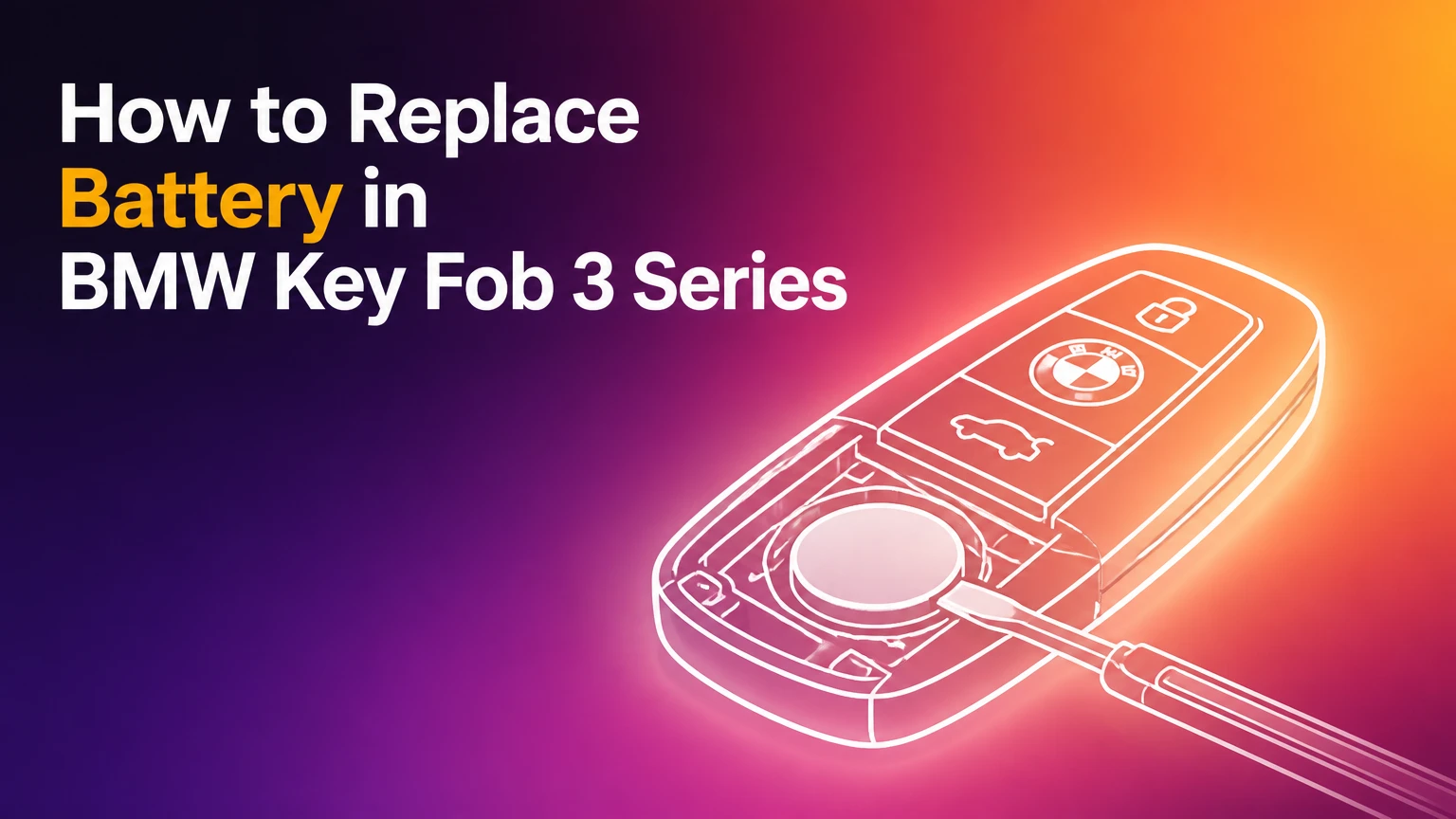
To replace the battery in a BMW 3 Series key fob, first identify the fob generation and whether its battery is removable. Most F-Series fobs use a CR2450, most G-Series fobs use a CR2032, and E-Series fobs use either a removable CR2032 or a soldered VL2020 rechargeable cell. The job usually takes 3-5 minutes.
Key Facts
BMW F30, F31, F34, and F80 blade-style key fobs typically use a CR2450 battery.
BMW G20, G21, and G80 key fobs typically use a CR2032 battery.
E90-E93 Comfort Access fobs generally use a replaceable CR2032.
Sealed non-Comfort Access E90-E93 fobs generally contain a rechargeable VL2020 cell.
A correctly fitted battery does not normally require key programming or synchronization.
The positive side marked with a plus sign normally faces outward in removable BMW fobs.
Which BMW 3 Series Key Battery Do You Need?
The correct battery depends on the key housing, not only the vehicle year. BMW 3 Series production overlaps across markets and equipment packages, so the fob’s shape and access cover provide a better identification method than registration date alone.
| 3 Series chassis | Typical production period | Fob appearance | Typical battery |
|---|---|---|---|
| E90/E91/E92/E93 Comfort Access | 2006-2011 | Black rectangular fob with battery door | CR2032 |
| E90/E91/E92/E93 standard key | 2006-2011 | Sealed black rectangular fob | VL2020 rechargeable |
| F30/F31/F34/F80 | 2012-2018 | Angular blade or trapezoid housing | CR2450 |
| G20/G21/G80 | 2019-present | Silver-trimmed or M-style housing | CR2032 |
A CR2032 and CR2450 are both 3-volt lithium coin cells, but they are different physical sizes. The CR2032 measures approximately 20 mm wide and 3.2 mm thick; the CR2450 measures approximately 24 mm wide and 5.0 mm thick. Substituting one for the other can prevent contact or damage the retaining clips.
How can you identify Comfort Access?
A BMW 3 Series with Comfort Access unlocks when you touch the exterior door handle while carrying the key. The key fob usually has a removable battery cover, while the standard E-Series fob is commonly sealed because its rechargeable cell charges through the vehicle.
Comfort Access failure alone does not prove the battery is dead. A weak antenna, damaged door-handle sensor, water intrusion, or a vehicle-side fault can produce the same symptom. Test the lock and unlock buttons from close range before buying parts.
What Should You Prepare Before Opening the Fob?
Prepare one verified replacement cell, a soft cloth, and a plastic pry tool or the emergency key blade. A small flat precision screwdriver can help with stubborn covers, but metal tools increase the chance of gouging the housing or touching the circuit board.
| Item | Quantity | Typical specification | Purpose |
|---|---|---|---|
| Replacement battery | 1 | CR2032, CR2450, or VL2020 | Matches the identified fob |
| Plastic pry tool | 1 | Nylon, 2-5 mm tip | Opens covers with less scratching |
| Soft microfiber cloth | 1 | 20 x 20 cm or larger | Protects the housing and work surface |
| Small precision screwdriver | 1 | 1.5-2.0 mm flat tip | Backup tool for retaining tabs |
| Nitrile gloves | 1 pair | Powder-free | Reduces oil on contacts and battery |
Typical DIY time is 3-5 minutes for an F-Series or G-Series removable battery. An E-Series sealed rechargeable fob can require 30-90 minutes for careful case opening and soldering, and a replacement shell may be needed afterward.
Do not stack batteries, bend circuit-board components, or use a knife near the radio board. The coin cell can short against metal tools, causing rapid discharge and localized heating.
How to Replace a BMW F30, F31, F34, or F80 Battery
BMW F-Series blade-style key fobs generally use a CR2450, and the battery is accessed through the rear cover after removing the emergency blade; F30, F31, F34, and F80 replacement details also explain key matching and programming. The positive side faces outward, and the battery must slide beneath the retaining tabs before it is pressed flat.
Step 1: Remove the emergency key blade
Press the ribbed release button on the rear or lower edge of the fob. Pull the metal emergency blade straight out and place it on the cloth.
You will know the blade is released when it slides out without force. Do not twist the blade against the housing because the internal release button can crack.
Step 2: Open the rear cover
Insert the tip of the removed blade into the small slot inside the empty blade cavity. Twist gently to lift the rear cover, working along the seam rather than forcing one corner upward.
A nylon pry tool is safer when the cover is tight. Stop if the plastic begins whitening, because that indicates excessive bending stress.
Step 3: Remove and inspect the CR2450
Lift the old CR2450 from the circular holder using a plastic tool or a clean fingernail. Note the orientation before removal, then inspect the spring contact and retaining tabs for distortion.
The old cell should not be thrown loose into a pocket or toolbox. Place it in a container for coin-cell recycling, because lithium button batteries can be dangerous when swallowed or shorted.
Step 4: Install the new battery
Slide one fresh CR2450 under the fixed retaining tab with the positive side facing up. Press the opposite edge down until the cell sits level and cannot move laterally.
You will know the installation is correct when the cell is flush with the holder and the rear cover closes without pressure. A battery that rocks, sits above the rim, or requires force is the wrong size or incorrectly positioned.
Step 5: Refit the cover and test the fob
Align the cover’s tabs with the housing, press around the perimeter, and reinstall the emergency blade. Test lock, unlock, trunk release, and panic functions from several metres away.
The first button press should produce a firm tactile response and a normal vehicle reaction. If only one button fails, the problem may be a worn membrane or circuit-board switch rather than the battery.
How to Replace a BMW G20, G21, or G80 Battery
BMW G-Series 3 Series key fobs generally use a CR2032, accessed by removing the emergency blade and releasing the rear cosmetic panel. The painted or silver-trimmed shell can scratch easily, so use the blade only at the designed release point.
Step 1: Release the mechanical key
Press the small release button on the side or lower edge of the fob. Pull the emergency key blade out in a straight line.
The blade also provides a way to unlock the driver’s door if the remote battery is completely depleted. Keep the blade available during the entire replacement.
Step 2: Unclip the rear shell
Look into the empty blade slot for the internal release point. Insert the end of the mechanical blade against that tab while lifting the rear panel gently.
The panel should release with a short snap. If it does not move, reposition the blade rather than prying along the silver trim, because trim clips can separate from the panel.
Step 3: Replace the CR2032
Remove the old cell and install the new CR2032 with the plus-marked face upward. Ensure the battery edge is fully under the retaining lip and that no protective film remains on either contact surface.
Premium Panasonic, Maxell, Energizer, or another reputable 3-volt lithium cell is preferable to an unbranded battery with uncertain storage history. A new cell should measure close to 3 volts under no load, although a voltage reading alone cannot prove adequate capacity.
Step 4: Close and test
Place the rear shell over the housing, align every clip, and press until the perimeter is flush. Reinsert the emergency blade, then test both remote buttons and passive entry if the vehicle has Comfort Access.
A G20 key fob does not normally need coding after a battery change. If the vehicle starts and the buttons operate, the radio key remains paired with the car.
How Do You Handle a Sealed E90-E93 Key Fob?
A sealed standard E90-E93 key fob contains a rechargeable VL2020 cell that is soldered to the circuit board, so it is not a normal coin-cell replacement. Opening the glued case requires cutting, desoldering, soldering a correctly tabbed cell, and resealing the housing.
| E-Series condition | Likely cause | Sensible action | Typical result |
|---|---|---|---|
| Remote range gradually declines | Aging VL2020 cell | Use an automotive locksmith or electronics specialist | Battery and shell inspection |
| Key works after dashboard slot charging | Weak rechargeable cell | Recharge temporarily, then arrange repair | Short-term operation |
| Housing is cracked | Physical damage | Replace shell while transferring electronics | New case, same key coding |
| Circuit board has corrosion | Water or battery leakage | Professional diagnosis | Repair may be uneconomical |
A soldering iron is appropriate only for someone experienced with small circuit boards and battery tabs. The replacement must match the original voltage, chemistry, dimensions, and pin orientation; a random CR2032 cannot replace a soldered rechargeable VL2020.
BMW’s standard key charging system is designed for the original rechargeable cell. Installing a disposable cell in that charging circuit can create a safety and reliability problem. For most owners, an independent BMW automotive locksmith is safer and less expensive than cutting the case at home.
Which Replacement Option Is Best?
DIY replacement is the fastest and least expensive option for removable batteries. A locksmith is the better choice for a sealed E-Series cell, damaged housing, lost keys, or a fob that still fails after a verified battery installation.
| Option | Typical cost in USA | Typical time | Best use | Main risk |
|---|---|---|---|---|
| DIY CR2032 or CR2450 | $3-$10 | 3-5 minutes | Removable-cover fob | Scratched clips or wrong cell |
| Independent BMW locksmith | $25-$75 | 15-45 minutes | Sealed cell or damaged key | Parts markup varies |
| BMW dealership visit | $50-$120 | 30-120 minutes | Owner wants OEM handling | Highest labor and appointment cost |
| Complete replacement key | $200-$500+ | 1-7 days | Lost or unusable key | Programming and proof-of-ownership requirements |
Prices are typical consumer ranges, not fixed BMW rates. Local labor, key availability, vehicle immobilizer generation, and proof-of-ownership requirements can change the final invoice.
A dealer battery swap is unnecessary for a normal removable CR2032 or CR2450. A locksmith becomes valuable when the battery is soldered, the key is water-damaged, or the car recognizes the transponder but does not receive button commands.
Why Does the BMW Key Fob Still Not Work?
A BMW 3 Series key fob that remains inoperative after a battery change usually has a contact, polarity, protective-film, wrong-size, or circuit fault. Check the simplest physical causes first, then compare the suspect key with the spare key before assuming the vehicle needs programming.
| Symptom after replacement | Most likely cause | Check | Corrective action |
|---|---|---|---|
| No buttons work | Wrong orientation or film | Plus side and battery surface | Reinstall or remove film |
| Fob cover will not close | CR2032 fitted in CR2450 holder | Battery thickness and diameter | Install specified cell |
| One button fails | Worn rubber membrane or switch | Compare button feel | Repair shell or circuit |
| Short operating range | Low-quality cell or antenna damage | Test close to vehicle | Use fresh branded cell |
| Comfort Access fails only | Door handle or passive-entry fault | Test remote buttons | Diagnose vehicle system |
| Car will not start | Weak key or backup reader issue | Use emergency start position | Check key and vehicle |
Check the battery film and contacts
Some replacement cells have a clear insulating film or packaging residue on one face. Remove all film, then inspect the metal contacts for dirt, flattening, or a contact tab trapped beneath the battery.
The contact should press against the battery firmly without puncturing its surface. Lift a bent contact only slightly with a plastic pick; excessive force can break the solder joint on the circuit board.
Check the emergency-start procedure
If the BMW 3 Series will not start after the remote battery dies, hold the key fob against the marked key symbol or backup-reader location specified for that chassis, then press the brake and the Start/Stop button. The immobilizer transponder can remain readable through the backup antenna even when the remote battery cannot transmit.
The precise backup-reader position varies by generation and market. Consult the vehicle owner’s manual if the steering-column location is not marked. This procedure does not repair a damaged key, but it can distinguish a depleted remote cell from an unrecognized immobilizer key.
Does a BMW key need reprogramming after a battery change?
A normal battery replacement does not erase the BMW key’s vehicle pairing, so reprogramming is generally unnecessary. The remote transmitter, immobilizer transponder, and battery are separate functions, and replacing the cell does not normally alter stored coding.
If the key stopped working before the battery was changed, or if buttons fail after a correct installation, the issue may involve water damage, a broken switch, a faulty antenna, or a vehicle-side control module. Repeated button sequences are not a substitute for diagnosis.
What Mistakes Damage BMW Key Fobs?
The most common BMW key-fob mistakes are fitting the wrong cell, forcing the wrong release point, reversing polarity, and treating a sealed rechargeable fob like a removable-battery design. Each mistake has a different recovery path, and forcing the case usually creates more damage than the original battery fault.
- Installing a CR2032 in an F-Series holder: The thinner cell may not reach the contacts. Replace it with a CR2450 rather than bending the holder.
- Using a CR2450 in a CR2032 housing: The larger cell may not fit and can deform the cover. Do not sand or crush the battery.
- Prying against painted trim: Scratches and broken clips can result. Use the emergency-key slot designed for cover release.
- Touching the battery terminals together: A short can discharge the new cell. Keep metal tools away from both terminals.
- Cutting open a sealed E-Series key without a replacement shell: The glued housing rarely reseals cleanly. Arrange the shell and correct VL2020 cell first.
- Assuming Comfort Access proves a bad battery: A door-handle sensor can fail independently. Test the ordinary lock and unlock buttons.
An important practitioner rule is to test the spare key before dismantling anything. If both keys show the same short range or warning, the vehicle may have a receiver, antenna, or charging-system issue rather than two simultaneous dead batteries.
Another useful rule is to replace a removable battery at the first low-battery warning, not after repeated failed starts. A weak cell can still unlock the car while lacking enough reliable range for passive entry.
How Much Does a BMW Key Battery Replacement Cost?
A removable BMW 3 Series key battery typically costs $3-$10 for one branded CR2032 or CR2450, while professional replacement commonly costs $25-$120 depending on the provider. A sealed VL2020 repair costs more because it includes case opening, soldering, testing, and possible shell replacement.
Battery prices vary by retailer and packaging quantity. A multi-pack can lower the per-cell cost, but unused lithium cells should remain in their original packaging at room temperature, away from keys, coins, and high heat.
The cheapest battery is not always the lowest-cost repair. A failed cell that causes repeated diagnosis, a damaged fob cover, or a lost key can exceed the price difference between a reputable cell and an unbranded one.
What If You Need to Enter or Start the Car With a Dead Fob?
A BMW 3 Series can usually be unlocked with the mechanical key and started using the vehicle’s backup key-reader position when the remote battery is dead. Remove the blade, expose the driver-door lock cylinder if necessary, and follow the owner’s manual for the emergency-start location.
Mechanical entry may trigger the alarm on some configurations until the vehicle recognizes the key. Keep the fob inside the cabin, press the brake, and hold it at the marked reader while pressing Start/Stop.
A dead remote battery does not automatically mean the immobilizer code is lost. If the backup-start procedure fails with both a fresh battery and a known-good spare, stop replacing batteries and arrange BMW immobilizer diagnosis.
Frequently Asked Questions
Can I use any 3-volt coin cell in a BMW key?
No. BMW key fobs require the specified physical size and, in sealed E-Series designs, the correct rechargeable chemistry and solder-tab layout. Use CR2032, CR2450, or VL2020 only when that type matches the housing and circuit design.
How long should a BMW key-fob battery last?
A removable lithium coin cell commonly lasts 1-3 years, depending on button use, passive-entry activity, storage temperature, and battery quality. A sealed E-Series VL2020 is rechargeable and its useful life depends on charging cycles and cell age rather than a simple replacement interval.
Will changing the battery erase my BMW key?
No, replacing a correctly installed removable battery normally does not erase the key’s pairing or immobilizer authorization. A key that remains unrecognized after replacement may have a damaged circuit, failed transponder, vehicle receiver fault, or a pre-existing programming problem.
Why does Comfort Access stop working before the buttons?
Comfort Access often needs a stronger or more continuous low-power signal than a close-range button press. A marginal battery may therefore disable passive locking first, although a failed door-handle antenna or Comfort Access sensor can produce the same symptom.
Can a locksmith replace a BMW rechargeable key battery?
Yes. An automotive locksmith or electronics specialist can open many sealed E-Series housings, replace the soldered VL2020 cell, inspect the board, and fit a replacement shell. Choose a provider experienced with BMW CAS and EWS keys rather than a general hardware-store key cutter.
Should I replace both BMW key batteries together?
Replace both batteries only if both keys show low range, similar age, or warning symptoms. Each key has its own cell, so changing a healthy spare provides no technical benefit, although keeping a fresh spare prevents an avoidable lockout.
The Bottom Line
To replace the battery in a BMW 3 Series key fob, identify the housing first: removable E-Series Comfort Access fobs usually take CR2032, F-Series blade fobs take CR2450, and G-Series silver-trimmed fobs take CR2032. Install the positive side outward, close the housing without force, and test every button.
Do not cut open a sealed E90-E93 standard key unless you have the correct VL2020 cell, soldering equipment, and a replacement shell. For a removable fob, DIY replacement is normally a 3-5 minute job; for a soldered rechargeable fob, a BMW automotive locksmith is the safer choice.