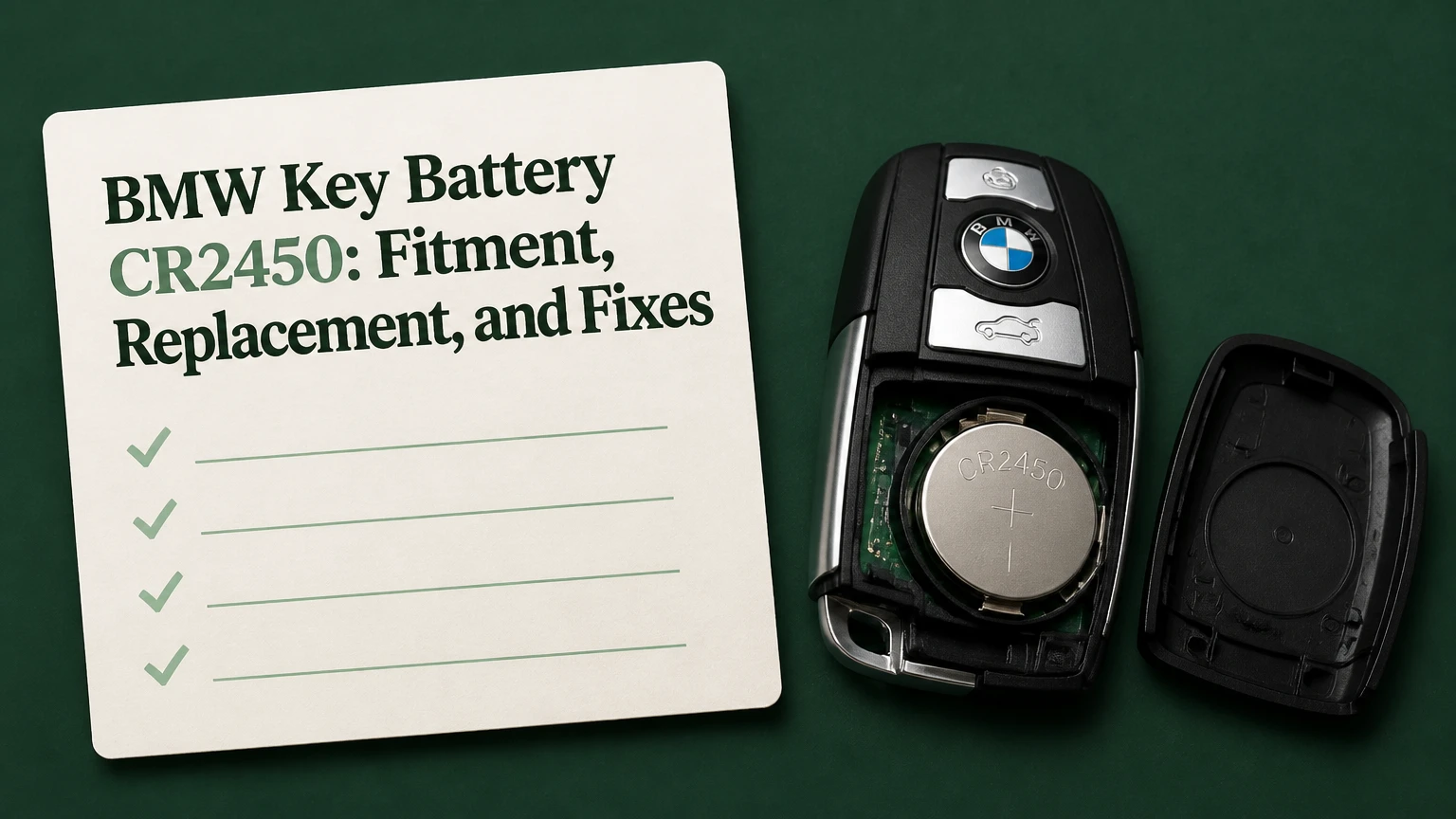
A BMW key battery CR2450 is a 3-volt lithium coin cell used in several removable-battery BMW smart keys, especially some F-Series and G-Series Comfort Access fobs. The battery measures approximately 24 mm wide and 5.0 mm thick, but BMW model year alone cannot confirm fitment. Open the fob or check its part number before buying.
Key facts
A CR2450 has lithium manganese dioxide chemistry, a 3.0-volt nominal rating, and dimensions of about 24 x 5.0 mm.
CR2032 and CR2430 cells have the same 24 mm diameter but are thinner and are not proper CR2450 substitutes.
Many removable BMW CR2450 batteries install with the positive side facing outward, but the original battery orientation is the final authority.
A typical replacement takes 2-5 minutes and needs the integrated emergency key or a plastic pry tool.
Some BMW keys contain rechargeable lithium-ion batteries and cannot be serviced by inserting a CR2450.
A persistent low-battery message can indicate poor contact, an incorrect cell, a damaged fob, or a vehicle-side fault.
What Is a CR2450 Battery?
A CR2450 is a round, 3-volt lithium manganese dioxide coin cell with a nominal diameter of 24 mm and thickness of 5.0 mm. The International Electrotechnical Commission naming convention uses “C” for lithium chemistry, “R” for round construction, “24” for approximate diameter, and “50” for approximate height in tenths of a millimeter.
The 3.0-volt rating describes nominal operating voltage, not a guaranteed multimeter reading under every condition. A fresh cell may measure above 3.0 volts without a load, while voltage can fall when the key transmits or when contact resistance increases.
CR2450 capacity is commonly listed around 500-620 mAh, but capacity depends on discharge current, cutoff voltage, temperature, and manufacturer testing. A key fob does not receive the same capacity as a laboratory test because wireless transmission, standby current, button presses, and temperature affect usable energy.
CR2450 specifications
| Attribute | Typical CR2450 value | Why it matters in a BMW key |
|---|---|---|
| Chemistry | Lithium manganese dioxide | Provides long shelf storage and low self-discharge |
| Nominal voltage | 3.0 V | Matches the electrical design of compatible fobs |
| Fresh open-circuit voltage | About 3.1-3.3 V | A voltage reading alone does not prove load performance |
| Diameter | About 24.5 mm maximum, 24 mm designation | Determines whether the cell fits the circular holder |
| Thickness | About 5.0 mm | Determines spring pressure and reliable terminal contact |
| Typical listed capacity | About 500-620 mAh | Varies by brand and discharge test |
| Storage life | Commonly 8-10 years | Applies to unused cells under specified storage conditions |
Does Every BMW Key Use a CR2450?
No. BMW uses different key designs, battery systems, and regional configurations, so a BMW model name does not establish CR2450 fitment. Some removable-battery Comfort Access fobs use a CR2450, while older keys may use CR2032 or CR2016 cells, and several rechargeable keys require a different service procedure.
The most reliable identification method is physical inspection. Remove the emergency key, open the housing only if it has a designed access seam, and read the code printed on the installed cell. A BMW dealer or parts catalog can also verify the key transmitter part number, but the vehicle’s year and series remain insufficient by themselves.
Common BMW key situations
| Key situation | Likely battery arrangement | Correct verification method |
|---|---|---|
| Removable-battery Comfort Access fob | Often CR2450 in compatible housings | Read the installed cell and inspect the holder |
| Older conventional diamond-shaped key | Frequently rechargeable or sealed | Check the key casing and owner’s manual |
| Slim newer BMW display or smart key | Rechargeable lithium-ion system may apply | Identify the transmitter part number |
| Basic remote key with thinner holder | CR2032 or CR2016 may apply | Match the printed cell code exactly |
| Key with no seam or battery hatch | Sealed or rechargeable design | Do not pry it open without a model-specific procedure |
The “Comfort Access” label also does not guarantee a CR2450. Comfort Access describes proximity entry and starting functions, while the physical transmitter housing determines battery size.
How Does a BMW Comfort Access Key Use the Battery?
A BMW Comfort Access key uses its battery for the transmitter, receiver, control electronics, and proximity functions. The vehicle and key exchange short-range radio and low-frequency signals when the key is near the car, while button presses require an active radio-frequency transmission.
The key does not necessarily send a full-power continuous signal every second. Modern systems use low-power standby behavior, wake-up events, proximity polling, and encrypted or rolling-code communication. Battery drain rises when the key is stored close to the vehicle, repeatedly awakened by the car, used frequently, or exposed to extreme temperatures.
A low-battery warning generally means the key’s measured performance has fallen below a vehicle-defined threshold. It does not identify the exact cause, and it does not prove that the coin cell is completely empty.
How Do You Replace a BMW CR2450?
Replacing a removable BMW CR2450 usually takes 2-5 minutes and requires the emergency key plus a plastic pry tool or fingernail; for 5 Series owners, BMW 5 Series battery replacement steps clarify the correct cell and opening sequence. The decisive factors are correct cell thickness, correct polarity, clean terminals, and gentle release of the housing clips.
Before you start
| Item | Typical requirement | Practical checkpoint |
|---|---|---|
| Replacement cell | 1 new CR2450 | Confirm the code says CR2450, not CR2032 or CR2430 |
| Time | 2-5 minutes | Allow extra time if the housing is tight |
| Tools | Integrated key, fingernail, or plastic tool | Avoid forcing a metal blade into the seam |
| Cost | About $2-$5 retail per cell | Dealer pricing is usually higher |
| Skill level | Basic hand maintenance | No coding is normally required for a battery-only change |
Step 1: Remove the emergency key
Press the release button on the side or rear of the BMW fob and slide out the metal emergency key. Keep the key aligned with the channel rather than twisting it against the plastic housing.
You will know the step worked when the emergency key comes out without resistance and exposes the recessed opening or release slot. The common mistake is prying around the outside seam before removing the emergency key, which can damage the case.
Step 2: Open the battery cover
Insert the end of the emergency key into the designated notch inside the exposed slot. Twist or lift gently according to the housing design, using controlled pressure at the release point rather than levering against the decorative shell.
You will know the step worked when the rear cover separates with a short snap and the circuit board remains seated. Stop if the cover bends significantly, because some BMW housings release from one end before the other.
Step 3: Record the original orientation
Look at the old battery before removing it. Photograph the cell in place if the polarity marking is unclear, because a few key designs differ in contact arrangement even when the replacement cell is the same size.
You will know the orientation is recorded when you can identify the side marked “+” and the terminal touching that face. The common mistake is assuming every BMW CR2450 holder places the positive side upward.
Step 4: Remove the old cell and inspect contacts
Slide the old coin cell out with a fingernail or plastic tool. Do not bridge both battery faces with metal tweezers, and do not bend the spring contacts while lifting the cell.
Inspect the holder for white residue, corrosion, bent clips, or a loose contact tab. A clean, spring-loaded terminal should press firmly against the cell without cutting into its edge.
Step 5: Install the new CR2450
Place the new CR2450 in the same orientation as the original, usually with the printed positive side facing outward. Slide the edge under the retaining clip first, then press the opposite edge down until the cell sits flat.
You will know the installation worked when the battery cannot rattle, the cover closes without pressure, and the contact clips remain visibly engaged. Do not stack two thinner cells to imitate CR2450 thickness. Stacking changes electrical and mechanical behavior and can damage the fob.
Step 6: Close the housing and test the key
Snap the rear cover fully into place, then return the emergency key to its channel. Test lock, unlock, trunk, and, if equipped, Comfort Access operation near the vehicle.
You will know the replacement succeeded when the buttons respond consistently and the car recognizes the key for starting. A key that works only when squeezed usually has a contact or housing problem, not a software synchronization problem.
Which CR2450 Battery Should You Buy?
Buy a fresh CR2450 from a reputable manufacturer or established battery retailer, prioritizing correct dimensions, recent production, intact packaging, and storage history. Panasonic, Murata, Energizer, and Duracell are reasonable choices when the cell is genuine and the package has not been exposed to heat or moisture.
Brand differences are usually less important than authenticity and contact quality in a low-drain key fob. Duracell’s bitter coating may improve child-deterrence characteristics, but any residue or film on a terminal can increase contact resistance; wipe the cell’s contact surfaces with a clean, dry lint-free cloth if the package instructions permit it.
| Brand example | Typical buying advantage | Possible limitation | Suitable buyer |
|---|---|---|---|
| Panasonic CR2450 | Broad industrial availability and consistent specifications | Local retail availability varies by country | Driver prioritizing established electronics supply |
| Murata CR2450 | Strong electronics-industry presence after Sony battery operations moved to Murata | May be less familiar in local stores | Buyer seeking a current Japanese electronics brand |
| Energizer CR2450 | Easy retail availability and published consumer specifications | Often costs more than generic multipacks | Driver needing a convenient, traceable purchase |
| Duracell CR2450 | Widespread retail distribution and child-deterrent packaging | Coating or packaging residue requires contact care | Buyer purchasing locally around children |
| Generic marketplace cell | Low upfront price | Greater risk of old, counterfeit, or poorly stored stock | Only when seller traceability is strong |
No manufacturer can guarantee a fixed one- or two-year life in every BMW key. Temperature, vehicle proximity, button use, key damage, and the transmitter’s standby design all influence the result.
Which Coin Cell Can Replace a CR2450?
No thinner coin cell is a proper direct replacement for a CR2450. CR2032 is approximately 3.2 mm thick, and CR2430 is approximately 4.0 mm thick, compared with the CR2450’s approximately 5.0 mm thickness; both may fit loosely or fail to maintain pressure.
The codes describe physical dimensions, not interchangeable capacity classes. All three cells are nominally 3 volts, but a BMW holder designed for a CR2450 relies on thickness to maintain spring tension and stable electrical contact.
| Cell | Nominal voltage | Approximate size | CR2450-holder suitability |
|---|---|---|---|
| CR2016 | 3.0 V | 20 x 1.6 mm | Wrong diameter and thickness |
| CR2025 | 3.0 V | 20 x 2.5 mm | Wrong diameter and thickness |
| CR2032 | 3.0 V | 20 x 3.2 mm | Wrong diameter and thickness |
| CR2430 | 3.0 V | 24 x 3.0 mm | Same general diameter, too thin |
| CR2450 | 3.0 V | 24 x 5.0 mm | Correct only when the fob specifies it |
A CR2430 is not the same as a CR2450. The shared “24” indicates similar diameter, while “30” and “50” indicate different thicknesses.
Why Does a BMW Key Battery Die Early?
A BMW key battery may die in less than a year when the key is stored close to the parked vehicle, repeatedly awakened by proximity communication, used heavily, or exposed to heat. A typical healthy removable-battery fob often lasts about 1-2 years, but that is a practical range rather than a BMW guarantee.
Heat accelerates chemical aging, while freezing temperatures temporarily reduce available current and can make a marginal cell appear dead. A key kept on a hook beside the garage wall can also experience more communication activity than a key stored farther from the vehicle.
Use these battery-life checks:
- Store the spare key several meters away from the vehicle when parked, especially overnight.
- Keep the key out of direct sunlight and avoid leaving it on a hot dashboard.
- Replace both frequently used and rarely used keys when one shows a low-battery warning only if the second key has similar age.
- Buy cells with intact packaging and a credible manufacturing or expiry date.
- Test the key after replacement before closing the case permanently.
Practitioner insight
A new battery that drains within days is a diagnostic clue. Replacing it repeatedly without checking the fob for moisture, a stuck button, corrosion, or a damaged transmitter wastes cells and can conceal a circuit-board fault.
Why Does the Low-Battery Warning Remain?
A BMW low-battery warning that remains after replacement usually results from poor terminal contact, incorrect polarity, a wrong battery code, a weak or counterfeit cell, or a fault in the key or vehicle receiver. Driving for 10-15 minutes may allow a vehicle system to update some status information, but it is not a universal reset procedure.
Follow this order:
| Check | Correct result | If it fails |
|---|---|---|
| Battery code | CR2450 printed on cell | Install the specified cell |
| Polarity | Matches the original orientation | Remove and reinstall correctly |
| Contact pressure | Clips touch both battery faces | Repair or replace damaged holder |
| Cell voltage | Typically above 3.0 V unloaded for a new cell | Try a known-good fresh cell |
| Key functions | Buttons and proximity work consistently | Diagnose transmitter or vehicle system |
| Second key | Second key works normally | Fault is likely isolated to first key |
A multimeter reading above 3.0 volts does not prove the battery can deliver current under load. Contact resistance and internal battery condition matter more than a single unloaded reading.
What If the BMW Key Stops Working Completely?
If the BMW key stops working after a battery change, first confirm polarity and terminal contact, then use the vehicle’s emergency start location. The emergency start method can allow the car to recognize a weak key, but it does not repair a broken transmitter or immobilizer component.
Place the key in the BMW location shown in the owner’s manual, often a marked pocket in the center console or a steering-column area, then press the brake or clutch and the Start/Stop button. Exact placement varies by generation, so do not assume the steering column is correct for every BMW.
If the emergency start works but remote buttons do not, inspect the battery holder, button switches, and fob casing. If neither key operates, investigate the vehicle battery, antenna system, fuse supply, or receiver rather than buying another coin cell.
Practitioner insight
A low-battery warning and a no-start condition are not interchangeable symptoms. The immobilizer transponder and remote-control battery functions can behave differently, so a dead remote battery does not automatically mean the vehicle has forgotten the key.
How Much Does BMW Key Battery Replacement Cost?
A DIY CR2450 replacement typically costs about $2-$5 per cell in the United States, with local prices varying by brand, pack size, taxes, and shipping, and the 3 Series CR2450 replacement steps begin with identifying the key generation. A dealer or locksmith may charge about $25-$75 for a battery service, while a complete key replacement can cost several hundred dollars.
| Service or purchase | Typical US cost | Typical time | What is included |
|---|---|---|---|
| Single branded CR2450 | $2-$5 | Immediate purchase | Battery only |
| Two-pack or multipack | $4-$15 | 2-5 minutes to install | Multiple cells, no diagnosis |
| Independent locksmith battery service | $10-$35 | 10-30 minutes | Battery and basic inspection |
| BMW dealer battery service | $25-$75 | 15-45 minutes | Battery, labor, possible test |
| Replacement programmed key | About $200-$600 or more | Hours to days | Key, coding, and vehicle-specific supply |
Prices in India, the United Kingdom, Australia, and other markets differ substantially. Programming is normally unnecessary for a simple battery replacement, but a new transmitter or sealed rechargeable key may require dealer or specialist procedures.
What If the Key Has a Rechargeable Battery?
A BMW key with a rechargeable battery is not a CR2450 replacement job. Rechargeable keys may receive energy from an induction pad, vehicle charging system, or dedicated charging arrangement, and opening the casing can damage the housing or circuit board.
Signs of a rechargeable or sealed key include no removable emergency-key access to a battery compartment, no coin-cell holder, a sealed case seam, or an owner’s manual instruction to charge or replace the entire key. Do not insert a CR2450 into a cavity that was not designed for a replaceable coin cell.
A rechargeable key that no longer holds charge needs model-specific diagnosis. The fault may involve the rechargeable cell, charging coil, circuit board, or key housing. A coin-cell installation cannot restore those functions.
Common Mistakes and Their Fixes
| Mistake | Result | Correct recovery |
|---|---|---|
| Installing CR2032 or CR2430 | Loose fit and intermittent contact | Use the exact specified thickness |
| Reversing polarity | Key remains inactive | Match the original “+” orientation |
| Shorting the cell with tweezers | Reduced charge or rapid drain | Install a fresh undamaged cell |
| Bending contact clips | Battery works only under pressure | Restore contact carefully or replace holder |
| Forcing the cover | Broken clips or cracked housing | Align release tabs before applying pressure |
| Buying an untraceable marketplace cell | Low capacity or early failure | Use a reputable seller and sealed package |
Do not clean terminals with aggressive solvents, scrape circuit-board traces, or bend spring contacts repeatedly. A small change in contact geometry can make a key unreliable even when the battery voltage is correct.
FAQ
Can I test a BMW CR2450 with a multimeter?
Yes, but a multimeter provides only a partial diagnosis. A fresh CR2450 commonly reads above its 3.0-volt nominal rating with no load, while a weak cell may still show acceptable voltage until the key transmits. If the key remains unreliable, test with a known-good cell and inspect terminal pressure.
Should I replace the BMW key battery before the warning appears?
Replace the battery when the vehicle reports a low-key-battery warning or when remote range becomes inconsistent. Preventive replacement every 12-18 months can be reasonable for a heavily used Comfort Access key, but calendar replacement is less useful than checking storage conditions and battery age.
Can I leave a spare CR2450 in the glove box?
You can carry a spare CR2450 in its original package, but prolonged heat inside a parked vehicle can shorten storage life. Keep the cell away from loose metal objects, direct sunlight, moisture, children, and pets. Do not carry an unprotected coin cell with keys or coins.
Does a new BMW key battery need coding?
A battery-only replacement normally does not require coding. Coding may be required when replacing the entire transmitter, initializing a new key, or repairing a vehicle communication fault. If a correctly installed CR2450 does not restore operation, diagnose the key and vehicle rather than attempting random initialization sequences.
Is CR2450N different from CR2450?
CR2450N generally refers to a CR2450 variant or manufacturer-specific designation, but the physical dimensions and terminal construction must match the BMW holder. Confirm the manufacturer data and the original cell marking. Do not rely on the letter “N” alone as proof of fitment.
Why does the BMW key work only when held against the car?
Emergency-start recognition can work at very short range even when the coin-cell-powered remote functions are weak. That symptom points toward a depleted cell, poor contact, damaged antenna, or remote transmitter problem. Replace and inspect the battery first, then test the other key to isolate the fault.
The Bottom Line
The BMW key battery CR2450 is correct only for BMW fobs whose holder specifies that exact 24 mm by 5.0 mm coin cell. Confirm the installed code, match the positive-side orientation, use a fresh branded battery, and inspect the clips before closing the housing. CR2032 and CR2430 cells are thinner and are not safe direct substitutes. A persistent warning or rapid drain after replacement indicates a contact, key, storage, or vehicle fault that requires diagnosis rather than another unverified battery.