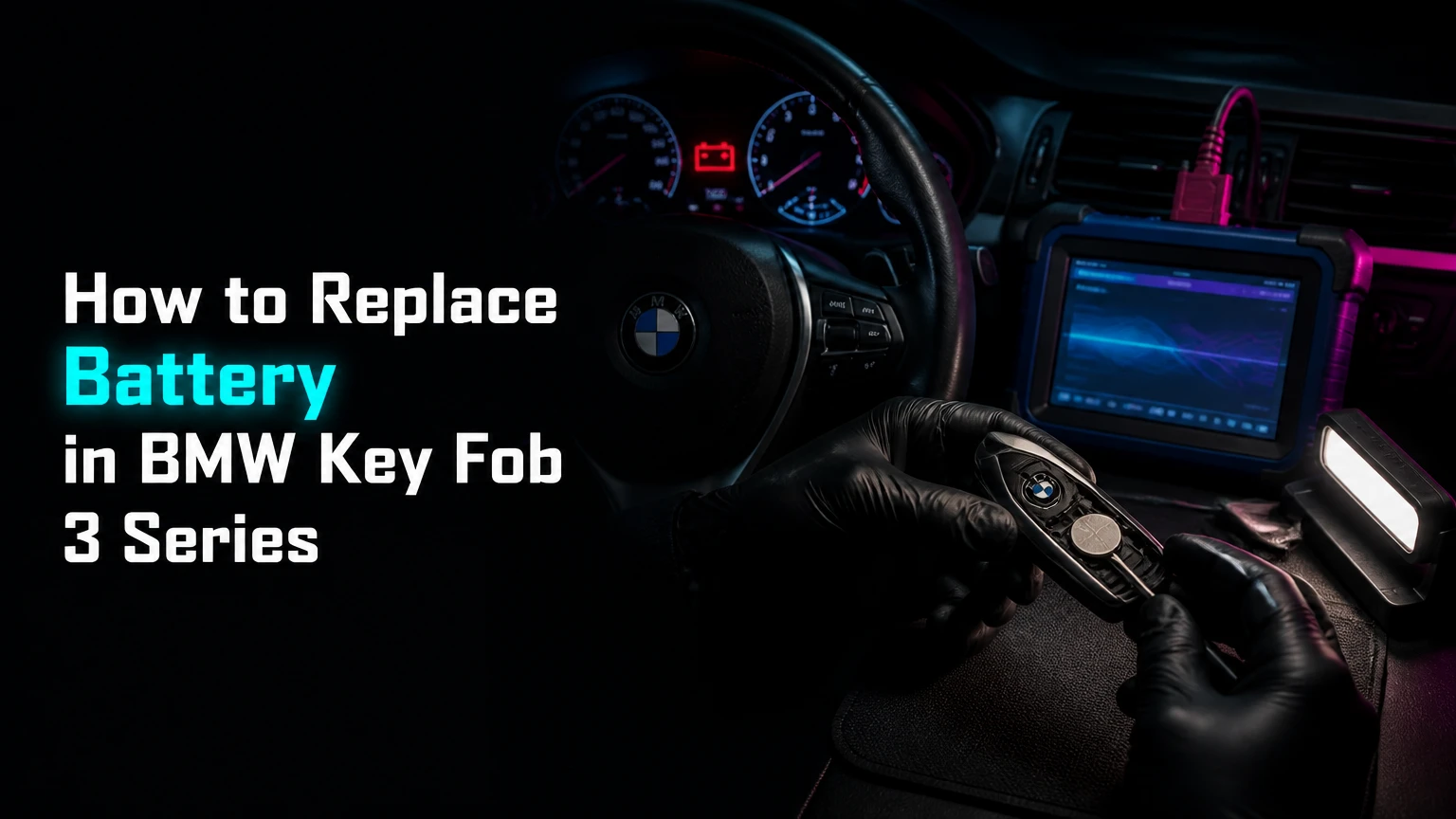
To replace the battery in a BMW 3 Series key fob, identify the key generation first, because G20 keys commonly use a CR2032, F30 keys commonly use a CR2450, and some E90 or E46 keys contain a soldered rechargeable VL2020. A removable-battery key usually takes 2-5 minutes and needs only a new cell plus a small pry tool.
Key Facts at a Glance
- A 2019-present BMW 3 Series G20 standard remote commonly uses a CR2032 lithium coin cell.
- A 2012-2018 BMW 3 Series F30 remote commonly uses a CR2450 lithium coin cell.
- An E90 Comfort Access key generally has a removable CR2032 battery door.
- Many non-Comfort Access E90 keys and E46 keys use a rechargeable VL2020 cell soldered inside the housing.
- Replacing a coin cell normally does not erase the key’s immobilizer programming.
- A new battery costs typically $3-$10, while a complete BMW replacement key can cost several hundred dollars.
Which Battery Does a BMW 3 Series Key Use?
The correct BMW 3 Series key-fob battery depends on the housing design and equipment, not solely on the vehicle badge or model year. Read the marking on the existing cell whenever possible, then match the replacement by chemistry, diameter, thickness, and voltage.
| 3 Series generation | Typical years | Key appearance | Typical battery | User-replaceable |
|---|---|---|---|---|
| G20 | 2019-present | Slim rectangular body, metal or black buttons | CR2032, 3 V | Yes |
| F30, F31, F34 | 2012-2018 | Curved body, plastic buttons | CR2450, 3 V | Yes |
| E90 Comfort Access | 2006-2011 | Rectangular remote with rear battery door | CR2032, 3 V | Yes |
| E90 standard remote | 2006-2011 | Sealed rectangular housing | VL2020, rechargeable | Usually no |
| E46 | 1998-2005 | Diamond-shaped integrated key | VL2020, rechargeable | Usually no |
These are typical configurations rather than a universal BMW parts catalog. Market, production date, Comfort Access equipment, and replacement-key history can change the battery specification. The printed designation on the old battery is the most reliable final check.
A CR2032 and CR2450 are both 3-volt lithium cells, but they are not interchangeable. The CR2450 has the same approximate diameter as a CR2032 and is substantially thicker, so installing the wrong size can prevent contact or stress the plastic retainer.
Before You Start
A removable-battery BMW 3 Series key normally requires one coin cell and one thin pry tool. Prepare the replacement before opening the housing so the circuit board is exposed for the shortest possible time.
| Requirement | Typical specification | Quantity or range | Why it matters |
|---|---|---|---|
| Replacement battery | CR2032 or CR2450, 3 V | 1 cell | Match the old marking |
| Pry tool | Existing valet key or plastic pick | 1 | Reduces housing scratches |
| Small flat screwdriver | 1-2 mm tip | 1 optional | Useful for a tight retainer |
| Clean work surface | Dry, nonmetallic surface | 1 area | Prevents lost springs or clips |
| Replacement time | Removable coin-cell key | 2-5 minutes | Includes testing |
| Typical DIY cost | Branded lithium cell | $3-$10 | Local retail estimate |
Use a reputable lithium coin cell from a manufacturer such as Panasonic, Energizer, Duracell, Sony, or Maxell. Do not use a rechargeable substitute in a compartment designed for a CR2032 or CR2450, and do not mix an old and new cell.
Remove the key from the ignition or keep the vehicle switched off. A BMW key fob contains a circuit board, buttons, antenna components, and an immobilizer transponder; avoid touching the board with metal tools or static-charged fingers.
How Do You Replace a BMW 3 Series Key Battery?
The procedure has four actions: remove the valet key, open the correct notch, install the matching cell with the positive side oriented correctly, and test every button. The opening method differs between G20, F30, and E90 Comfort Access housings, so use the generation-specific instructions below.
Step 1: Remove the Valet Key
Press the release button on the side or rear of the BMW 3 Series fob, then pull the metal emergency key from its slot. Place the metal key on the work surface instead of leaving it attached while prying.
The valet key is more than an emergency door key. On many G20 and F30 housings, its end also provides the correct leverage for the battery-cover notch.
Success checkpoint: The metal key slides out without force, and the remote body remains closed.
Common mistake: Do not pry in the deep channel from which the valet key was removed unless the housing specifically uses that opening. Some F30 covers use a separate shallow notch beside the key channel.
Step 2: Open the G20 Key Housing
Insert the tip of the valet key into the small release slot exposed after removing the metal key. Twist gently until the rear cover separates, then lift the cover away without bending the perimeter clips.
The standard G20 remote typically exposes a CR2032 coin cell beneath the rear cover. Some G20 vehicles also support BMW Digital Key or a display-style key, but those accessories may use a different service method and should not be treated as the standard rectangular remote.
Success checkpoint: The cover lifts with a controlled click, and no retaining tab remains bent.
Common mistake: A screwdriver inserted too deeply can contact the circuit board or mar the housing. Use shallow leverage and open the seam progressively rather than forcing one corner.
Step 3: Replace the G20 CR2032
Lift the old CR2032 from its retaining clips with a fingernail or plastic pick. Install the new CR2032 with the positive side facing the marked positive contact, which is commonly upward in the standard G20 housing.
Keep the cell flat. A coin cell installed at an angle can touch one side of the contact while leaving the opposite side open, producing intermittent locking or a short operating range.
Success checkpoint: The battery sits level, the retaining spring holds its edge, and the positive symbol is visible.
Common mistake: Do not push directly against a delicate spring contact. Lift the battery from its exposed edge, then slide the replacement under the fixed lip.
Step 4: Close and Test the G20 Remote
Hook any lower cover tabs into place first, then press around the perimeter until every clip clicks. Reinsert the valet key and test lock, unlock, trunk release, and panic functions where equipped.
Test the remote next to the vehicle before closing the driver’s door. If the range is short, remove the cover again and inspect the battery seating and contact pressure before assuming that programming failed.
Success checkpoint: The doors respond consistently from several metres away, and the trunk button operates without repeated presses.
Common mistake: Do not test only the lock button. A partially seated cell can power one command intermittently while failing the higher-current trunk-release command.
How Do You Replace the F30 Key Battery?
A BMW 3 Series F30 key commonly uses a CR2450, and its back cover opens through a shallow notch near the valet-key channel. Remove the key, lift the cover gently, replace the cell positive-side up, and close the lower tabs before snapping the upper edge.
Step 1: Find the Correct F30 Notch
Press the rear release and pull out the physical key. Inspect the exposed end of the fob for a shallow pry slot positioned perpendicular to the key channel.
The shallow slot is easy to confuse with the deeper opening that held the valet key. The correct slot normally accepts only the edge of the metal key or a thin plastic pick.
Success checkpoint: The cover begins separating along its seam with light leverage.
Common mistake: Twisting from the deep key channel can crack the housing or break the cover’s internal clips.
Step 2: Remove the CR2450
Use the valet key or plastic pick to lift the cover, then pry the old CR2450 from its circular retainer. Avoid levering against the circuit board and keep the battery orientation visible before removal.
The CR2450 is thicker than the CR2032. If a CR2032 was previously installed by mistake, the fob may work only when squeezed, because the thinner cell fails to maintain contact.
Success checkpoint: The replacement CR2450 sits firmly beneath the retaining lip without bulging the cover.
Common mistake: Never force a thicker cell into a retainer that does not match its diameter or depth. Verify the code printed on the old battery.
Step 3: Close the F30 Housing
Engage the bottom cover tabs first, then press the top edge down until the housing clicks shut. Reinsert the physical key and operate all remote buttons.
Success checkpoint: The seam is even on all sides, and the battery does not rattle when the key is lightly shaken.
Common mistake: Closing the top first can trap a lower tab outside its guide and permanently deform the cover.
What Changes for an E90 Key?
An E90 BMW 3 Series key with Comfort Access usually has a removable rear battery door and a CR2032. A standard E90 key without that door generally contains a rechargeable VL2020 soldered to the circuit board, so it is an electronics repair rather than a simple battery swap.
| E90 key condition | Visual identifier | Battery type | Recommended action |
|---|---|---|---|
| Comfort Access | Separate rear battery door | CR2032, 3 V | Replace at home |
| Standard sealed key | No battery door or service seam | VL2020 rechargeable | Use an electronics specialist |
| Damaged housing | Cracks, missing clips, loose buttons | Depends on board | Consider shell and battery repair |
| Replacement aftermarket key | Different logo or shell design | Read installed cell | Follow supplier instructions |
To service an E90 Comfort Access key, press the release and remove the valet key, open the dedicated rear battery door, and replace the CR2032 with its positive side in the same orientation as the old cell. Close the door firmly before testing passive entry and remote buttons.
A sealed E90 key charges its rechargeable cell while the key is inserted into the vehicle, according to the operating design described in BMW owner documentation for rechargeable remote keys. A standard CR2032 is not a safe replacement because it is non-rechargeable and has different electrical characteristics.
When Is a Sealed Key a Repair Job?
A sealed E46 or non-Comfort Access E90 key should go to a qualified automotive-electronics repairer when its rechargeable VL2020 has failed. Opening the plastic shell often requires cutting, and replacing the cell normally requires soldering the correct tab orientation without damaging the remote board.
The VL2020 is a rechargeable vanadium-lithium coin cell, not a disposable CR2032. Replacement cells may have 90-degree or straight tabs, and the tab geometry must match the original board layout.
Do not install an ordinary alkaline, CR2032, or CR2450 cell into a rechargeable-key circuit. A repair shop can test the board, charging path, buttons, and transponder before installing a new cell. That diagnosis matters because a dead remote may also result from water intrusion, cracked solder joints, or a failed antenna.
BMW E46 keys are particularly poor candidates for casual DIY opening because the integrated diamond-shaped housing was not designed around a user-accessible battery door. A replacement shell can restore appearance, but it does not automatically transfer the original immobilizer transponder or circuit board.
Does a New Battery Require Programming?
A battery replacement normally does not require BMW key programming because the immobilizer transponder and remote identity remain stored in the key electronics. Resynchronization may help when the remote buttons stop operating after prolonged battery depletion, but resynchronization cannot repair a damaged circuit board or create a new key.
Use this basic resynchronization sequence only when the vehicle manual for the specific generation supports it:
- Unlock the vehicle with the physical key if necessary.
- Enter the vehicle and close all doors.
- Insert the key into the ignition, switch it on briefly, then switch it off and remove it.
- Hold the unlock button, then press the lock button three times within approximately 10 seconds.
- Release the unlock button and test the remote.
The exact sequence varies by BMW generation and market. Push-button-start vehicles may use a different emergency-start procedure, such as holding the remote against the steering-column sensor or designated key-detection area.
Do not repeatedly perform random pairing sequences. If one remote works and another does not, a BMW diagnostic specialist can check whether the fault is the fob, antenna system, receiver, or vehicle battery.
What Should You Check Before Blaming the Battery?
A BMW 3 Series remote that remains unresponsive after replacement may have a contact, housing, receiver, or vehicle-voltage problem rather than a defective new cell. Check the battery code, polarity, seating, and remote range in that order because those tests require no programming equipment.
| Symptom after replacement | Likely cause | First check | Practical remedy |
|---|---|---|---|
| No buttons work | Wrong polarity or dead cell | Positive marking and voltage | Reinstall or replace cell |
| Lock works, trunk fails | Weak contact or low-quality cell | Cell seating and retainer | Clean contact and refit |
| Works only when squeezed | Incorrect thickness | CR2032 versus CR2450 | Install specified cell |
| Very short range | Dirty contact, shield damage, low car voltage | Test second key | Inspect fob and vehicle battery |
| Passive entry fails, buttons work | Comfort Access fault or vehicle setting | Door-handle response | Diagnose vehicle system |
| Both keys fail | Vehicle battery or receiver issue | Interior lights and starting | Test vehicle voltage |
Use a multimeter only if you know how to measure a coin cell safely. A fresh disposable lithium cell often measures close to 3.0 volts at rest, but resting voltage alone does not prove that the cell will maintain voltage under load.
A key that works after being squeezed has a mechanical contact problem. The correct fix is to restore retainer pressure or replace the damaged housing, not to add foil, adhesive, or a second battery.
How Much Does Replacement Cost?
DIY replacement typically costs $3-$10 and takes 2-5 minutes for a user-serviceable BMW 3 Series key. A local locksmith or independent BMW specialist may charge approximately $10-$30 for a coin-cell service, while a complete replacement key commonly costs $200-$500 or more, depending on model, region, coding, and Comfort Access equipment.
| Service option | Typical cost | Typical time | Best use |
|---|---|---|---|
| DIY CR2032 or CR2450 | $3-$10 | 2-5 minutes | Removable battery housing |
| Locksmith battery service | $10-$30 | 10-30 minutes | Damaged clips or uncertain opening |
| Independent BMW specialist | $15-$50 | 15-45 minutes | Battery plus diagnostic check |
| BMW dealer battery service | $20-$60 | 20-60 minutes | Convenience and official support |
| Complete replacement key | $200-$500+ | 1-7 days | Lost, damaged, or nonrepairable key |
Prices are typical consumer ranges, not fixed BMW charges. Dealer pricing varies by country, labor rate, key availability, and whether the vehicle requires a new immobilizer-authorized key.
A battery warning alone does not justify buying a new key. Replace the cell first if the housing opens normally, then pay for diagnosis only when the key remains defective or the vehicle cannot detect it.
Common Mistakes and How to Fix Them
Installing the Wrong Coin Cell
A CR2032 and CR2450 share a 3-volt rating but have different thicknesses. Remove the incorrect cell, inspect the retainer for distortion, and install the exact designation printed on the original battery.
Reversing Polarity
Most BMW remote housings place the positive side upward, but the existing orientation and molded symbols control the installation. If the fob is dead, remove the cell and check the plus sign before attempting resynchronization.
Breaking the Cover Clips
BMW plastic key housings open through controlled leverage, not force. If a tab breaks, replace the shell or have a locksmith transfer the original electronics; glue can interfere with future battery service and button movement.
Touching or Contaminating Contacts
Skin oil and dirt can increase resistance at the battery terminals. Handle the cell by its edges, and clean visibly dirty contacts with a small amount of electronics-safe isopropyl alcohol on a lint-free swab.
Assuming the Car Is at Fault
Test the replacement key near the vehicle and compare it with the spare. If both remotes fail simultaneously, inspect the vehicle battery and receiver system before purchasing another fob.
Treating a Sealed Key Like a Door-Cell Key
A sealed E46 or standard E90 key may need soldering and a rechargeable VL2020. Stop when there is no battery door, because cutting into the case can destroy the circuit board and transponder.
What Are the Alternatives to a Damaged Key?
A damaged BMW 3 Series key can sometimes be repaired with a replacement shell, a rechargeable-cell service, or a complete programmed key. BMW Digital Key may provide a phone-based alternative on compatible newer vehicles, but it does not replace every function of a physical key or solve a failed vehicle receiver.
| Alternative | Compatible situation | Typical cost | Main limitation |
|---|---|---|---|
| Replacement shell | Original board and transponder still work | $10-$40 | Requires careful transfer |
| VL2020 repair | Sealed rechargeable key | $30-$100 | Soldering and tab geometry |
| Independent replacement key | Lost or destroyed remote | $150-$350 | Coding and vehicle compatibility |
| BMW dealer key | New authorized key required | $250-$500+ | Highest typical cost |
| BMW Digital Key | Compatible G20 and phone | App and vehicle dependent | Not universal or fully equivalent |
A shell replacement is useful when buttons or plastic clips are damaged but the original electronics still function. It is not a battery replacement, and transferring the wrong board can leave the vehicle unable to recognize the key.
Frequently Asked Questions
How long should a BMW 3 Series key-fob battery last?
A disposable CR2032 or CR2450 commonly lasts about 2-4 years, depending on button use, passive-entry activity, temperature, and storage conditions. A rechargeable VL2020 can last several years, but its service life depends on charging cycles and the health of the key’s internal charging circuit.
Why does my BMW say the key battery is low after replacement?
A low-battery message after installation usually indicates incorrect battery orientation, poor contact, a weak replacement cell, or a warning that has not yet cleared. Confirm the cell code, inspect the retainer, test the remote, and drive normally before paying for programming.
Can I use a CR2032 instead of a CR2450?
A CR2032 should not replace a CR2450 in a BMW F30 housing. Both cells produce approximately 3 volts, but the CR2032 is thinner and may lose contact, causing intermittent operation or reduced range.
Does inserting the key into the ignition charge the battery?
In older BMW rechargeable-key systems, the vehicle can recharge the internal VL2020 while the key is inserted in the ignition. A disposable CR2032 or CR2450 is not rechargeable and must never be placed in a circuit designed to charge a VL2020.
Can I start my BMW if the key-fob battery is dead?
Yes, most BMW 3 Series vehicles have an emergency detection method that lets the vehicle read the immobilizer transponder even when the remote battery is depleted. The exact placement varies, so consult the owner’s manual for the steering-column sensor or key-detection location.
Should I replace both BMW key batteries at the same time?
Replace both batteries only when both keys show weak range or similar age. Each remote has its own cell, and replacing a healthy spare adds cost without improving the first key’s performance.
The Bottom Line
To replace the battery in a BMW 3 Series key fob, match the cell to the housing before opening it: use a CR2032 for most G20 remotes and E90 Comfort Access keys, a CR2450 for most F30 remotes, and a rechargeable VL2020 repair for sealed E90 or E46 keys. Open the correct notch gently, install the cell with the marked polarity, close every clip, and test all remote functions.