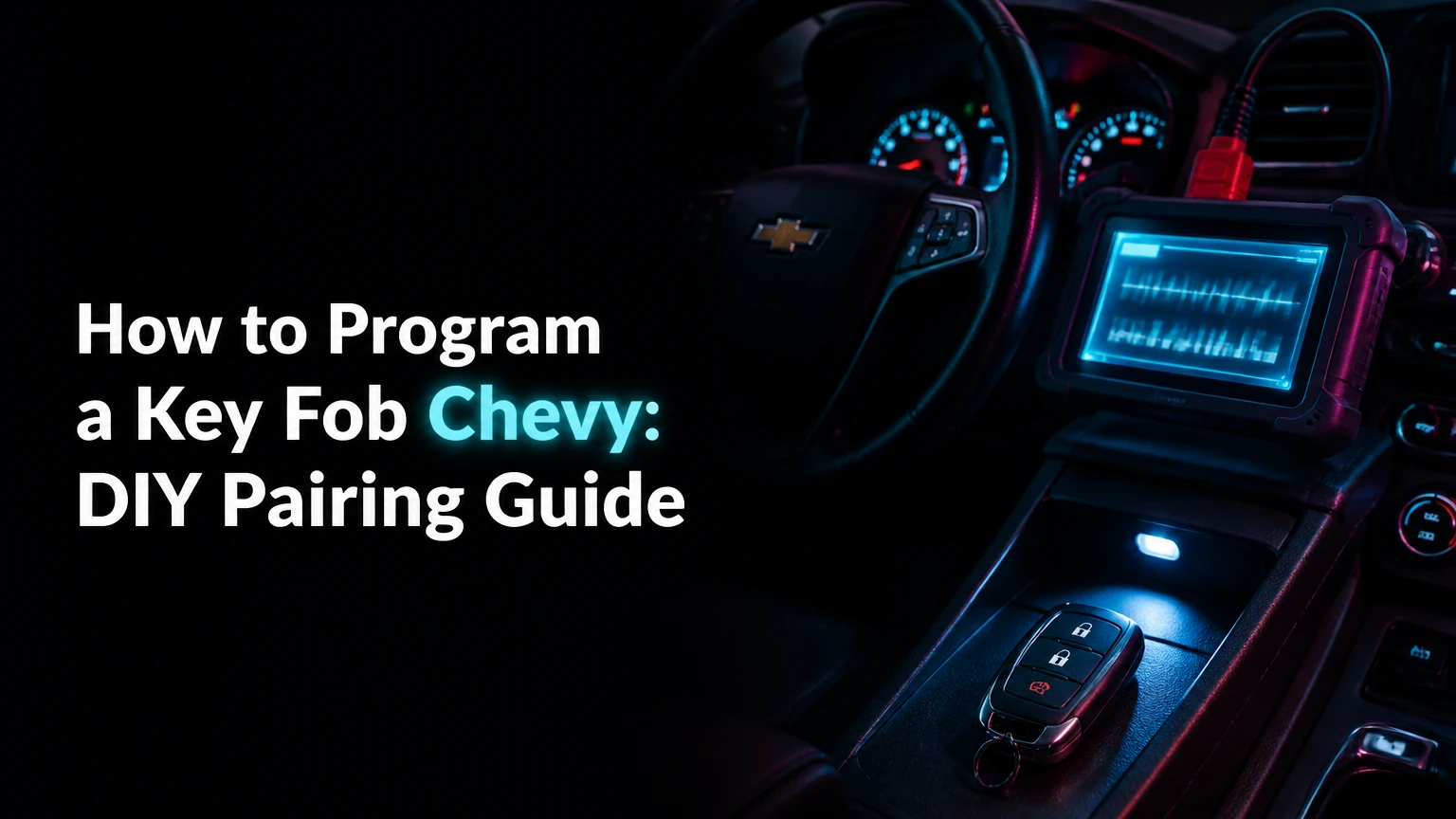
To program a Chevy key fob, first match the replacement remote to the vehicle’s year, model, FCC ID, and GM part number, then use the correct onboard learning sequence or a capable immobilizer scan tool. Older turn-key Chevrolets may pair in 2-5 minutes; newer proximity systems often require a recognized key, dealer, or automotive locksmith.
Key Facts at a Glance
Chevrolet key-fob programming is model-specific; no single sequence works for every Chevy.
A remote that locks doors is not automatically a programmed transponder key that can start the engine.
The common older GM sequence uses the driver-door Unlock switch and an On-Off-On-Off ignition cycle.
Push-button Chevrolet models may require a recognized fob, a backup transmitter pocket, and a dashboard learning prompt.
A generic OBD-II code reader usually cannot program a Chevrolet remote; the tool must support GM key or immobilizer functions.
Typical professional programming costs $90-$180 for a locksmith and $150-$350 or more at a Chevrolet dealership.
What Chevrolet Key-Fob Programming Actually Does
Chevrolet key-fob programming teaches the vehicle’s Remote Function Actuation system, Body Control Module, or related receiver to accept a transmitter’s security identity. The process pairs buttons such as Lock, Unlock, Panic, Liftgate, Trunk, and Remote Start with the vehicle, but it may not program the immobilizer chip that authorizes engine starting.
A Chevrolet remote normally uses a radio transmitter and rolling security codes. Common North American applications use 315 MHz, while many other markets and some replacement parts use approximately 433 MHz. Frequency is only one compatibility attribute. The FCC ID, GM part number, vehicle configuration, button layout, transponder type, and regional market must also agree.
That distinction prevents a common misdiagnosis. A fob can operate the door locks yet fail to start the vehicle because the immobilizer transponder remains unlearned. Conversely, a mechanical key can start some older vehicles while its remote buttons remain unpaired.
Which Chevy Fob Type Do You Have?
Identify the transmitter before choosing a programming method. The physical design gives a useful starting point, but the vehicle’s year and ignition system determine the actual procedure.
| Fob or key type | Typical Chevrolet examples | Identifying feature | Programming concern |
|---|---|---|---|
| Separate remote | Older Silverado, Tahoe, Impala | Clicker separate from ignition key | Remote pairing may be onboard |
| Integrated transponder key | Cobalt, Malibu, Silverado | Metal blade and chip in one head | Remote and engine immobilizer may use separate learning |
| Flip or switchblade key | Cruze, Equinox, Camaro | Blade folds into transmitter case | Correct blade profile and transponder matter |
| Proximity smart fob | Malibu, Equinox, Traverse, Tahoe | Push-button start, no ignition slot | Backup pocket and security access vary by model |
| Corvette transmitter | C5, C6, C7, C8 Corvette | Model-specific remote or smart key | Corvette procedures differ from mainstream GM trucks and SUVs |
Look for the FCC ID and part number on the original casing, circuit board, or seller’s compatibility listing. Do not rely on appearance alone. Two black three-button remotes can have different radio frequencies, immobilizer chips, button assignments, or vehicle software requirements.
What Information Should You Check First?
Record the Chevrolet model, model year, trim, ignition type, existing fob part number, FCC ID, and whether at least one working key remains. The VIN is the most reliable confirmation when the original remote label is missing.
| Verification item | Where to find it | Why it matters |
|---|---|---|
| Model year and trim | Registration, VIN, owner’s manual | GM changed receivers and learning procedures within model generations |
| FCC ID | Back of fob or internal circuit board | Identifies the radio transmitter design |
| GM part number | Back label, board, dealer catalog | Confirms vehicle-family and hardware compatibility |
| Frequency | Parts catalog or board specification | Prevents pairing an incompatible transmitter |
| Ignition type | Ignition cylinder or Start button | Separates turn-key, transponder, and proximity procedures |
| Existing working key | Vehicle and key ring | Determines whether onboard adding is possible |
The owner’s manual remains the controlling source for the exact sequence. Online instructions often combine procedures from Silverado, Tahoe, Corvette, and passenger-car platforms that look similar but use different BCM logic.
Which Chevy Fobs Can Be Programmed at Home?
Older turn-key Chevrolets are the best candidates for home programming when at least one valid ignition key works and the vehicle supports onboard transmitter learning. Newer smart-key systems, all-keys-lost situations, and vehicles with restricted security access usually require a compatible programmer, locksmith, or dealer.
Before You Start
| Requirement | Typical value | Why it matters |
|---|---|---|
| DIY time | 2-5 minutes | Onboard pairing is usually rapid once the vehicle enters learn mode |
| Scan-tool time | 5-15 minutes | Tool menus and security access add setup time |
| Replacement battery | CR2032 or CR2450 | Exact size depends on the fob design |
| Vehicle battery | Above 12.0 V at rest | Low voltage can interrupt BCM learning |
| Required key | One recognized ignition key for many onboard methods | Some procedures cannot begin without a valid key |
| Doors | All closed and latched | Door status can block programming mode |
Turn off the radio, climate fan, lights, and accessories. Keep every replacement remote intended for the vehicle within reach because some Chevrolet procedures erase previously learned transmitters or require all remotes to be learned in one session.
How to Program a Key Fob Chevy With the Older Onboard Sequence
The common older Chevrolet onboard method uses the driver-door Unlock switch, two rapid ignition cycles, and simultaneous Lock and Unlock buttons on the transmitter. The sequence is common on various turn-key GM vehicles, but the owner’s manual must confirm compatibility before you begin.
Step 1: Close Every Door
Sit in the driver’s seat and close all doors, the liftgate, and the trunk. Confirm that the dome light goes out or that the instrument panel recognizes the doors as closed.
You will know the vehicle is ready when the door locks respond normally to the driver-door switch. A damaged latch sensor can prevent programming even when the door appears shut.
Step 2: Hold the Driver-Door Unlock Switch
Insert the recognized mechanical key without turning it. Press and hold the physical Unlock button on the driver’s door panel, keeping the button depressed through the ignition cycles.
Do not substitute the fob’s Unlock button for the door-panel switch. The older sequence uses the vehicle’s interior switch to request transmitter-learning mode.
Step 3: Cycle the Ignition
Turn the ignition from Off to On, then back to Off, and repeat the same cycle once. The complete pattern is On-Off-On-Off, performed promptly without cranking the engine.
The On position powers the vehicle electronics without starting the engine. If the locks do not cycle after you release the door switch, stop and verify the model-specific sequence rather than repeatedly guessing.
Step 4: Release the Door Unlock Switch
Release the driver-door Unlock switch after the second Off position. On systems that support this method, the power locks cycle once, usually Lock followed by Unlock.
That lock movement is the success checkpoint for programming-mode entry. No lock cycle means the vehicle did not enter learn mode, so pressing the fob buttons will not pair the transmitter.
Step 5: Hold Lock and Unlock on the New Fob
Press and hold the replacement fob’s Lock and Unlock buttons at the same time for approximately 10-15 seconds. The locks should cycle again when the receiver accepts the transmitter.
Program additional remotes during the same session if the manual indicates that the vehicle clears earlier remotes. Test each button after the vehicle exits learning mode.
Step 6: Exit Learning Mode
Turn the ignition to On, then switch it off and remove the key. Lock and unlock the vehicle from several feet away, then test Panic, trunk, liftgate, and Remote Start if equipped.
A successful pairing means the intended buttons operate the vehicle consistently. It does not prove that an immobilizer chip or remote-start authorization is programmed.
How Do You Add a Push-Button Chevrolet Smart Fob?
A push-button Chevrolet smart fob can often be added only when one recognized transmitter remains, but the exact sequence and backup-pocket location vary by model year. Many systems use the vehicle’s information display, a hidden transmitter pocket, and a Start button without pressing the brake.
Recognized-Key Adding Procedure
- Place the working smart fob inside the passenger compartment.
- Put the new transmitter in the designated backup pocket. Locations may include the center-console storage area, cup-holder compartment, or a marked pocket under the console.
- Keep your foot off the brake pedal and press the Start button to enter accessory mode.
- Watch the Driver Information Center for a prompt such as “Ready for Remote” or “Ready for Remote X.”
- Press the Lock or Unlock button on the new transmitter when prompted.
- Wait for the display to confirm the remote number or learning status.
- Turn accessory power off, open and close the driver door, and test the new fob.
Do not assume the same pocket location applies to every Equinox, Traverse, Malibu, Tahoe, or Silverado. The owner’s manual identifies the correct cavity, and placing the fob elsewhere can make a good transmitter appear defective.
What If All Smart Keys Are Lost?
All-keys-lost programming is different from adding a spare smart fob. The vehicle may require a security reset, a timed immobilizer procedure, a GM-capable scan tool, or proof-of-ownership service from a locksmith or dealership.
A replacement smart fob can be cut or electronically programmed without the original in some cases, but a generic Bluetooth OBD adapter cannot perform that job. A qualified automotive locksmith can usually verify ownership, supply a compatible transmitter, program the immobilizer, and cut an emergency mechanical key at the vehicle.
Can an OBD-II Scanner Program a Chevy Remote?
Only a scan tool with GM-compatible key, immobilizer, and Remote Function Actuation capabilities can program many Chevrolet remotes through the OBD-II port. A basic emissions scanner can read engine fault codes, but it normally cannot access the BCM or perform security-authorized key learning.
The 16-pin OBD-II connector is usually under the driver-side dashboard near the pedals. Tool menus may include Immobilizer, Keys, Remote Controls, Remote Function Actuation, or Add Key, but menu names differ by manufacturer and software version.
| Tool route | Typical cost | Working-key requirement | Main limitation |
|---|---|---|---|
| Generic code reader | $20-$80 | Not relevant | Reads diagnostics, rarely programs keys |
| Single-vehicle kit | $40-$100 | Depends on kit | Often VIN-limited or subscription-limited |
| Professional locksmith tool | $1,000-$5,000 plus | Varies by vehicle | Requires training and security credentials |
| Chevrolet dealer scan system | $150-$350 service | Usually no working key required | Highest service price and appointment time |
Follow the tool’s exact prompts. Some procedures erase every stored remote before adding the new one, so have all available transmitters present. Maintain stable vehicle voltage with a suitable battery support device when the tool or vehicle manufacturer requires it.
Which Programming Method Should You Choose?
The best method depends on the ignition system, working-key status, replacement-fob compatibility, and access to security-capable equipment. DIY onboarding is cheapest, a locksmith is usually the practical all-keys-lost option, and a Chevrolet dealer is the safest route for unusual or warranty-sensitive systems.
| Situation | Best first choice | Typical cost | Typical time |
|---|---|---|---|
| Older turn-key Chevy, one working key | Onboard procedure | $15-$60 fob | 2-5 minutes |
| New spare smart fob, recognized key present | Manual learn or capable kit | $50-$150 | 5-20 minutes |
| All keys lost, vehicle immobilized | Mobile automotive locksmith | $90-$180 | 15-60 minutes |
| Rare model or uncertain compatibility | Chevrolet dealer | $150-$350+ | 1-2 hours |
| Remote works, engine will not start | Locksmith or dealer immobilizer service | $100-$350 | 30-120 minutes |
A replacement fob is not necessarily cheaper when its FCC ID is wrong. Confirm the part before buying, because an attractive used remote may be locked to another vehicle, damaged by water, or incompatible with the target BCM.
Is a Locksmith Better Than a Dealer?
A locksmith is usually faster and less expensive for an all-keys-lost Chevrolet, while a dealer is better for model-specific software problems, unusual security resets, or VIN-verified OEM parts. A locksmith cannot bypass ownership requirements, and a dealer cannot make an incompatible transmitter work.
Ask the locksmith whether the quoted price includes the remote, cutting, immobilizer programming, mobile travel, and a second key. Ask the dealer whether the estimate includes parts, diagnostic time, and removal of lost keys from the vehicle’s memory.
Why Does the Chevy Fob Fail to Program?
A Chevrolet fob usually fails because the vehicle never entered learn mode, the transmitter is incompatible, the battery is weak, or the chosen procedure belongs to another model or year. The fastest diagnosis is to inspect the checkpoint at which the sequence failed.
| Symptom | Most likely cause | Corrective action |
|---|---|---|
| Door locks never cycle | Wrong procedure, open-door signal, weak vehicle battery | Verify manual, latch status, and battery voltage |
| Locks enter mode but ignore fob | Wrong FCC ID, part number, frequency, or dead fob battery | Match transmitter identifiers and install a fresh cell |
| Lock and Unlock work, engine will not start | Immobilizer chip not programmed | Use key-learning service, not remote-only pairing |
| One fob works and another disappears | Learn session erased stored remotes | Relearn every available remote together |
| Range is only a few feet | Weak battery, damaged case, radio interference | Replace battery and inspect contacts |
| Start button says no key detected | Fob outside backup pocket or low battery | Use the manual pocket and replace the cell |
What Should You Check After a Failed Attempt?
Replace the fob battery with the correct cell and install it with the polarity shown inside the housing. Inspect spring contacts, water corrosion, cracked solder joints, and a loose rubber button mat before repeating the procedure.
Verify the vehicle battery has adequate charge. A voltage drop during BCM communication can interrupt learning, and repeated attempts with a weak battery can create unrelated warning messages.
Check the FCC ID, GM part number, frequency, button count, blade style, and vehicle market together. Frequency by itself is insufficient because the receiver may reject a transmitter with the correct MHz rating but the wrong protocol or identity.
An expert rule of thumb is simple: if the locks do not provide the expected checkpoint, stop entering button commands. The vehicle is not listening in the intended mode, and further button presses cannot correct an entry failure.
What Functions Need Separate Programming?
Remote buttons, the immobilizer transponder, and remote-start authorization can represent separate vehicle functions. A newly paired transmitter may lock the doors but still require additional programming for engine start or remote engine operation.
Remote Start also depends on vehicle conditions such as hood status, transmission position, fuel level, security status, and an active subscription or factory configuration on some newer models. A failed remote-start command does not automatically mean the fob pairing failed.
The passive keyless-entry antenna system is another separate consideration. A proximity fob may operate buttons while passive door-handle detection fails because of an antenna, low-voltage, or vehicle-network fault.
How Many Chevy Remotes Can You Program?
The maximum number of stored Chevrolet remotes depends on the BCM and vehicle generation, so the owner’s manual or scan-tool function list provides the authoritative limit. Many systems support several transmitters, but some learning routines number each remote and erase earlier entries during a new session.
Program every available remote during one session when the instructions say “learn remote” or “replace remote.” Otherwise, the final transmitter may work while an older spare stops responding because the learning cycle replaced the stored list.
Can You Program a Used Chevy Key Fob?
A used Chevrolet fob may work when its hardware, FCC ID, frequency, button layout, and vehicle system match, but some proximity transmitters cannot be reused reliably after being locked or previously paired. A used shell with a new compatible circuit board is different from a used electronic module.
Before purchasing a used remote, ask for the exact FCC ID and part number rather than a vehicle-year claim. Avoid listings that say “fits all Chevy models” without naming the transmitter identity, because Chevrolet changed remote hardware within the same model line.
Safety and Security Limits
Key programming should be performed only on a vehicle you own or are authorized to service. Keep registration, title, or other ownership evidence available for a locksmith or dealer, especially when all keys are missing.
Do not follow instructions that involve bypassing immobilizer security, disabling the alarm, or modifying BCM firmware outside an approved repair procedure. Remote pairing does not require defeating theft protection, and improper electrical work can disable the vehicle or create a costly module fault.
FAQ
How Much Does It Cost to Program a Chevy Key Fob?
DIY onboard pairing costs nothing beyond the replacement fob, typically $15-$60 for a compatible aftermarket transmitter. A capable single-vehicle programming kit commonly costs $40-$100, a mobile locksmith typically charges $90-$180, and Chevrolet dealer service commonly falls between $150 and $350 or more.
Can I Program a Chevy Fob Without the Original?
You can program some Chevrolet vehicles without the original through an immobilizer-capable scan tool, locksmith service, or dealer procedure. Older onboard methods commonly require a recognized ignition key, while all-keys-lost smart-key programming may require security access and ownership verification.
Will Changing the Battery Reprogram the Fob?
Changing a Chevrolet fob battery normally does not erase its pairing. Install the correct CR2032 or CR2450 cell with the correct polarity, then test the buttons; reprogramming is needed only if the remote remains unresponsive or the vehicle lost its stored transmitter identity.
Why Does My Chevy Key Fob Lock the Doors but Not Start the Car?
The remote buttons and engine immobilizer use different authorization functions on many Chevrolet vehicles. If door locking works but the engine will not start, the transponder chip may be unprogrammed, the key blade may be incorrect, or the vehicle may have a theft-deterrent fault.
Do I Need to Program a New Chevy Fob After Buying a Replacement Shell?
A replacement shell does not require programming when you transfer the original circuit board, battery contacts, and transponder components without damaging them. A new electronic board or complete transmitter does require compatibility verification and, in most cases, pairing with the vehicle.
What Is the Fastest Option When Every Key Is Gone?
A mobile automotive locksmith is usually the fastest practical option for an all-keys-lost Chevrolet because the technician can bring the transmitter, cut an emergency blade, and perform security programming at the vehicle. A dealership remains appropriate when the model requires unavailable software access or OEM-only service.
The Bottom Line
To program a key fob Chevy owners should first verify the model year, ignition type, FCC ID, GM part number, and presence of a working key. Use the older onboard sequence only when the vehicle supports it, use the backup pocket and dashboard prompts for an eligible smart-key system, and choose a GM-capable locksmith or dealer when all keys are lost or the engine immobilizer is involved. Testing the lock-cycle checkpoint, rather than repeating an incompatible sequence, is the fastest way to avoid wasted time and an unusable remote.