To program a push-start key fob, first verify that the replacement matches the vehicle’s exact part number, FCC ID, frequency, and immobilizer system. Some Ford and Lincoln vehicles support onboard pairing when two working smart keys are present, but most modern vehicles require an OBD-II immobilizer tool used by a qualified locksmith or dealership.
Key facts
A push-start vehicle has separate functions for remote locking and engine immobilizer authorization.
A replacement fob that locks the doors may still be unable to start the engine.
Onboard programming is vehicle-specific and cannot be safely generalized across all makes.
A programmed fob usually requires the correct FCC ID, frequency, transponder type, and hardware version.
Professional programming typically takes 15-60 minutes and costs about $150-$600 or more.
If every working key is missing, an automotive locksmith is often more practical than towing the vehicle to a dealer.
What Is a Push-Start Key Fob?
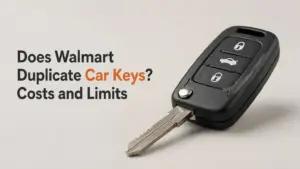
A push-start key fob, also called a proximity key, smart key, Intelligent Key, or passive-entry passive-start key, lets the vehicle unlock and authorize ignition without inserting a metal key. The car detects the fob nearby, confirms its identity, and permits the start button to operate when the security system accepts the electronic credential.
A proximity fob normally contains a coin-cell battery, radio transmitter, receiver or transponder circuitry, emergency mechanical key, and immobilizer data. The buttons operate functions such as lock, unlock, trunk release, panic alarm, and remote start where equipped.
The engine-start permission is different from button operation. A vehicle may accept the remote-control portion while rejecting the immobilizer portion, which explains why a replacement can lock the doors but display “No Key Detected” when the driver presses the brake.
How the System Works
The vehicle’s body control module uses low-frequency antennas to locate a nearby fob, while the fob replies over a manufacturer-specific radio channel such as 315 MHz or 433 MHz. The immobilizer system then validates cryptographic data before the vehicle enables the steering lock release, fuel injection, and starter authorization.
Exact frequencies vary by market and manufacturer. North American vehicles commonly use 315 MHz, while many European and other-market vehicles use 433 MHz or 434 MHz, but frequency alone does not establish compatibility.
The handshake is not a simple universal code copied from one remote to another. Vehicle modules, rolling or challenge-response credentials, transponder hardware, and secure seed-key procedures determine whether pairing succeeds.
Can You Program a Push-Start Fob Yourself?
You can program a push-start fob yourself only when the owner’s manual explicitly provides an onboard procedure for that vehicle. Most newer vehicles do not offer a universal button sequence, and “turn the ignition on and off eight times” instructions copied from another model generally apply to older metal-key remotes rather than proximity systems.
Before attempting DIY programming, confirm four conditions:
- The vehicle supports onboard smart-key registration.
- You have the required number of already-programmed keys.
- The replacement fob is new or accepted by that immobilizer system.
- The vehicle battery, fob battery, doors, and backup-slot components are ready.
A common Ford or Lincoln procedure uses two valid programmed smart keys, a backup slot, timed ignition cycles, and a third unprogrammed key. That sequence is not a Ford-wide rule. Year, trim, region, and security-module configuration can change the instructions, so the vehicle owner’s manual takes priority over a generic online sequence.
What Time and Tools Are Required?
A DIY attempt usually takes 10-20 minutes and requires the correct replacement fob, a fresh coin-cell battery, the owner’s manual, and access to the vehicle’s designated backup slot. Professional work normally takes 15-60 minutes, depending on security access, key count, and whether the vehicle must be recovered after an all-keys-lost event.
| Requirement | Typical value | Why it matters |
|---|---|---|
| DIY procedure time | 10-20 minutes | Covers preparation and timed pairing |
| Locksmith appointment | 15-45 minutes | Includes vehicle scan and key registration |
| Dealer appointment | 1-2 hours | May include security authorization and inspection |
| Fob coin cell | CR2032 or CR2025 | Exact battery depends on the fob |
| Vehicle battery target | About 12.4-12.7 V at rest | Low voltage can interrupt module communication |
| Required working keys | 0-2 keys | The number is dictated by the vehicle procedure |
Do not connect an OBD-II programmer casually. A failed battery, interrupted security session, incorrect vehicle selection, or incompatible tool can leave immobilizer modules in a non-starting state.
Which Replacement Fob Should You Buy?
Buy a replacement fob only after matching the original fob’s FCC ID, part number, frequency, button layout, transponder type, and vehicle application. Physical appearance is insufficient because visually identical shells can contain different radio boards or immobilizer chips.
| Compatibility item | Example value | Verification method |
|---|---|---|
| FCC ID | KR5TXN4 | Compare the label or internal circuit board |
| Radio frequency | 315 MHz | Confirm vehicle-market specification |
| Manufacturer part number | 164-R7987 | Check manual, dealer catalog, or VIN lookup |
| Battery | CR2032 | Read the existing cell or fob marking |
| Emergency blade | HU101 or equivalent | Compare blade profile and slot |
| Fob status | New, virgin, or reusable | Ask the seller or locksmith before purchase |
OEM fobs usually provide the most predictable fit and software compatibility, although they cost more. Aftermarket fobs can reduce hardware cost but may have inconsistent range, casing quality, or immobilizer support.
Used fobs require special caution. Some vehicles allow a locksmith to erase and reuse a fob, while others permanently bind the fob to the original vehicle or reject previously registered credentials. A replacement shell is not the same as a replacement electronic module.
What Do FCC ID and Frequency Tell You?
The FCC ID identifies a radio transmitter approval, but it does not prove that the immobilizer chip, blade, software version, or regional configuration matches your vehicle. Frequency is one compatibility attribute, not a complete programming specification.
Check the original fob, vehicle manual, VIN-based parts catalog, or an established automotive locksmith. Toyota, Subaru, Nissan, Honda, Ford, General Motors, BMW, Mercedes-Benz, and Volkswagen each use multiple smart-key families across years and trims.
Step-by-Step: How to Program a Push-Start Key Fob
The safest programming process has four stages: verify compatibility, prepare the vehicle, follow the exact model procedure, and test both remote and engine functions. Never substitute a generic timed sequence when the owner’s manual or manufacturer service information requires a diagnostic tool.
Step 1: Prepare the Vehicle
Park outside or in a well-ventilated area, keep the transmission in Park, close every door and the trunk, and switch off accessories. Install a fresh specified coin cell in the replacement fob, then confirm that the vehicle battery is adequately charged.
Remove other smart keys from the cabin during programming unless the instructions specifically require multiple programmed keys. Keep the owner’s manual open to the smart-key or immobilizer section.
You will know preparation is complete when the dashboard powers down normally, all doors report closed, and the backup slot is identified. A common mistake is pressing the brake pedal before the procedure calls for it, which starts the engine or exits accessory mode.
Step 2: Locate the Backup Detection Slot
Find the emergency backup location listed in the manual. Common locations include a center-console pocket, cupholder, glovebox, coin tray, or a position directly against the push-start button.
The backup slot uses a short-range coil to detect a fob with a weak battery or limited transmitter output. It does not automatically program every compatible key; it only gives the vehicle a reliable detection path for starting or registration.
Test the slot with a known working key if the manual permits it. If the vehicle still cannot detect that key, investigate the antenna, vehicle battery, or module before blaming the replacement fob.
Step 3: Use the Vehicle’s Onboard Procedure
Follow the exact sequence in the owner’s manual when the vehicle supports onboard smart-key registration. On certain Ford and Lincoln models, the procedure requires two working smart keys, placement in the backup slot, ignition cycles without pressing the brake, timed removal, and placement of the new key.
A representative sequence is:
- Sit in the driver’s seat with all doors closed and the vehicle off.
- Place working key 1 in the designated backup slot.
- Press the start button without pressing the brake to select ignition-on mode.
- Wait the period specified by the manual, often about five seconds.
- Switch the vehicle fully off and remove key 1.
- Place working key 2 in the same slot within the specified time.
- Repeat the ignition-on and ignition-off cycle.
- Place the new fob in the slot within the allowed time.
- Select ignition-on mode and wait for the confirmation signal.
Hazard-light flashes, a door-lock cycle, or a dashboard message can indicate registration. The exact confirmation varies, and failure to receive it means the key should not be assumed to be programmed.
Step 4: Test Both Fob Functions
Test lock, unlock, trunk release, passive entry, ignition-on authorization, and engine starting. The vehicle should start with the brake pedal pressed and the new fob inside the cabin, not merely beside the vehicle door.
Walk several feet away before testing passive locking so the vehicle can distinguish an outside key from an inside key. Confirm that the emergency blade fits the door cylinder if the fob includes one.
A successful result requires both remote operation and engine authorization. If only the buttons work, the immobilizer registration remains incomplete.
How Professional OBD-II Programming Works
Professional programming uses a manufacturer-approved or qualified aftermarket diagnostic tool connected to the vehicle’s OBD-II port, usually beneath the dashboard. The technician identifies the VIN and immobilizer configuration, obtains required security access, registers the fob, and verifies that the vehicle recognizes the new credential.
The workflow varies by manufacturer and tool:
| Programming stage | Typical action | Typical duration |
|---|---|---|
| Vehicle identification | Read VIN and select exact model | 2-5 minutes |
| Security access | PIN, online authorization, or timed wait | 5-30 minutes |
| Key registration | Add key or erase and relearn keys | 2-10 minutes |
| Fob confirmation | Place fob at backup coil or button | 1-3 minutes |
| Functional test | Start, lock, unlock, passive-entry test | 3-10 minutes |
“Add a Key” preserves existing registered keys when the system supports that function. “All Keys Lost” procedures may erase the current key list before registering replacements, so the technician must have every key that should remain active.
A reputable technician should verify ownership or possession rights, use a stable vehicle power supply when required, and explain whether lost keys will be deleted. Security access is deliberately restricted to reduce unauthorized vehicle entry and theft.
Locksmith, Dealership, or DIY?
DIY is the lowest-cost choice when the manual confirms onboard programming and two working keys are available. A mobile automotive locksmith is usually the practical choice for a replacement key, an all-keys-lost situation, or a vehicle that needs on-site immobilizer programming.
| Provider | Typical total cost | Typical time | Best fit |
|---|---|---|---|
| DIY onboard method | $50-$150 | 10-20 minutes | Supported vehicle with two working keys |
| Mobile locksmith | $150-$450 | 15-60 minutes | Lost key, mobile service, mixed key situations |
| Independent repair shop | $150-$350 | 20-60 minutes | Known vehicle with accessible programming |
| Franchised dealership | $300-$700+ | 1-2 hours | New vehicle, restricted system, OEM-only need |
Prices vary by region, vehicle security level, fob source, emergency timing, and whether cutting an emergency blade is included. A dealer is not automatically the only safe option, but certain locked systems require factory authorization or specialist equipment.
Modern Mercedes-Benz, BMW, Audi, Tesla, and some newer Japanese vehicles can impose manufacturer-specific restrictions. For these vehicles, a specialist locksmith or franchised dealer is safer than an unverified programmer advertised as universal.
What If Every Working Key Is Missing?
Call an automotive locksmith or dealership when every working fob is lost, because most vehicles cannot complete an onboard add-a-key sequence without an existing valid key. A mobile locksmith can often verify ownership, retrieve immobilizer data, erase missing credentials, and register a replacement at the vehicle’s location.
Ask these questions before authorizing service:
- Does the quoted price include the replacement fob?
- Will the technician delete the lost fobs from the vehicle?
- Is emergency blade cutting included?
- Does the vehicle require online manufacturer access?
- What identification and registration documents are required?
- What happens if the purchased fob is incompatible?
Do not advertise the vehicle identification number, key code, or immobilizer data publicly. Those details can make unauthorized duplication easier.
Common Mistakes and How to Fix Them
Wrong frequency or part number
A fob can look identical and still use a different radio board or transponder. Stop programming, compare the FCC ID and part number, and obtain a VIN-confirmed replacement.
Weak fob or vehicle battery
Replace the coin cell with the specified CR2032 or CR2025 and inspect its orientation. If the vehicle battery is low, charge or test it before repeating a security procedure, because voltage instability can interrupt registration.
Doors, trunk, or hood left open
Some vehicles refuse learning mode when a latch reports open. Close every opening, check the dashboard door indicator, and remove accessories that keep the trunk or interior awake.
Brake pedal pressed too early
A push-start vehicle may crank the engine instead of entering ignition-on mode. Restart the sequence from a fully powered-down state and follow the manual’s brake-pedal instruction exactly.
Buttons work but the engine will not start
Remote locking and immobilizer authorization are separate registrations. The vehicle may need a transponder-learning procedure, a valid backup-slot placement, or professional diagnostic programming.
“No Key Detected” appears
Place the fob directly against the push button or in the designated backup slot. If the known working fob also fails, inspect the vehicle antenna, 12-volt battery, and related fuse before buying another remote.
What Does Key-Fob Programming Cost?
Typical replacement and programming costs range from $50-$150 for a supported DIY procedure to $300-$700 or more at a dealership. The hardware, security system, key count, emergency dispatch, and regional labor rate create most of the variation.
A cheap online fob can become expensive when its FCC ID is wrong, the chip is locked to another vehicle, or the seller excludes programming. Confirm compatibility before purchase rather than treating the lowest hardware price as the lowest completed cost.
A locksmith quote should distinguish hardware, labor, mobile travel, cutting, security access, tax, and after-hours charges. Written itemization reduces surprises.
Frequently Asked Questions
Can I program a push-start fob without the original key?
Usually not through an onboard procedure. Many vehicles require one or two valid keys to authorize an add-a-key process, while all-keys-lost situations require immobilizer programming through a locksmith, dealership, or approved manufacturer system.
Does changing the battery reprogram the key fob?
No. Replacing a CR2032 or CR2025 restores electrical power but does not register the fob with the vehicle. A vehicle that stopped detecting the fob after a battery change may need correct battery orientation, passive backup-slot detection, or separate resynchronization instructions.
Can a universal key fob work with any push-start car?
No. Universal programmable fobs support selected vehicle platforms and require compatible hardware, frequency, software, and immobilizer data. A locksmith must first confirm that the universal device supports the exact VIN and security system.
How do I know whether my replacement fob is programmed?
The replacement fob is programmed when the vehicle accepts its immobilizer credential, starts normally, and operates the expected remote and passive-entry functions. Lock and unlock operation alone proves only that the remote transmitter portion works.
Should I buy an OEM or aftermarket smart key?
Choose OEM when compatibility certainty, warranty support, and long-term reliability outweigh the higher price. Choose aftermarket only when the FCC ID, part number, frequency, and immobilizer support are confirmed by a reputable seller or locksmith.
Will programming delete my existing keys?
An add-a-key procedure normally preserves existing keys when supported. An all-keys-lost or erase-and-relearn procedure may delete every stored credential, so bring every functioning fob to the appointment and ask the technician which procedure will be used.
The Bottom Line
How to program key fob push start depends on the vehicle’s immobilizer design, not merely on whether the fob looks correct. Check compatibility first, use the owner’s manual for any onboard sequence, and choose a qualified locksmith or dealer when the vehicle requires OBD-II security access or all working keys are missing.