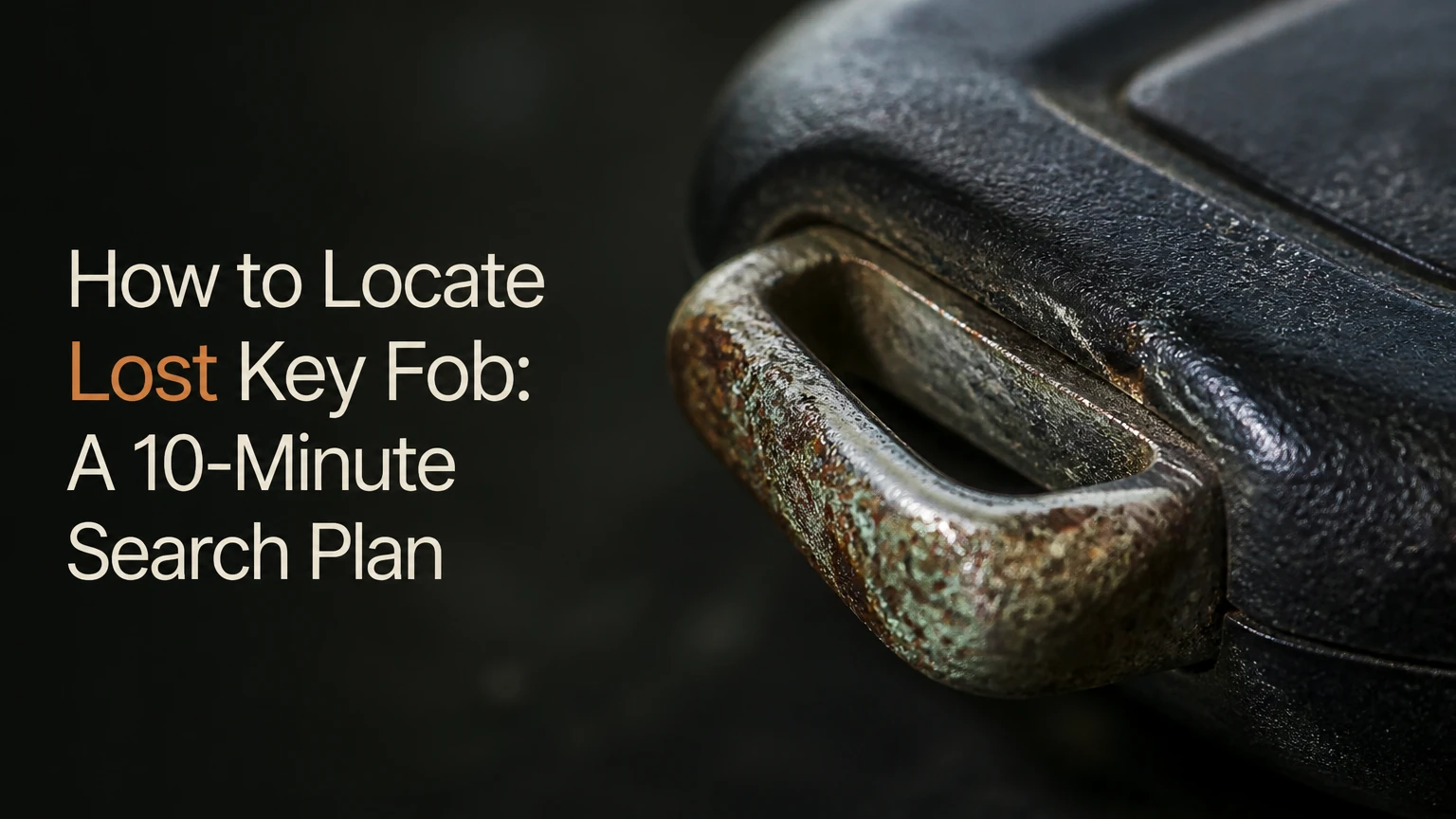
To locate a lost key fob, first check the vehicle and the places where you transferred belongings, then retrace your movements in reverse order. Use a connected Bluetooth or UWB tracker before disturbing rooms, and search bags, clothing, furniture gaps, and floor edges systematically. If the fob may be stolen, disable it through a dealer or automotive locksmith.
Key Facts at a Glance
A vehicle key fob can contain a remote transmitter, immobilizer transponder, passive-entry electronics, and a hidden mechanical key.
The fastest search begins with the vehicle cabin, pockets, bags, and transfer zones such as entry tables and kitchen counters.
A key-fob button signal is not a reliable long-distance locator unless a separate tracker is attached.
Passive keyless entry can help narrow a search, but door-handle behavior does not prove an exact one- or two-meter distance.
A replacement fob must match the vehicle’s year, make, model, market, part number, and programming system.
If the missing fob could be in the wrong hands, ask the programmer to remove the missing key from the vehicle’s authorized-key memory.
What Is a Key Fob?
A key fob is a compact electronic device that authorizes access to a vehicle and, in many models, permits the engine to start. The housing may contain lock and unlock buttons, a radio transmitter, an immobilizer chip, a passive-entry antenna, and a removable mechanical key blade.
Remote keyless-entry fobs transmit when a button is pressed. Smart keys also communicate with low-frequency vehicle antennas and may authenticate automatically when the driver touches a door handle or presses the start button. The exact functions depend on the vehicle manufacturer and model year.
The fob is not always the same thing as the immobilizer key. A remote can operate the locks while a separate transponder authorizes starting. Many modern designs combine both systems, which explains why a damaged button, dead coin cell, or missing blade can produce different symptoms.
What information should you record first?
Record the vehicle’s year, make, model, trim, VIN, and whether another key starts the car. Photograph the remaining fob, including its back label and FCC ID where present. These details prevent an expensive mistake if the physical search fails.
Also note where the fob was last confirmed, not merely where you first noticed it missing. “I unlocked the car at 8:00 a.m.” is stronger evidence than “I had it sometime this morning.”
How Does a Key Fob Communicate With a Vehicle?
A key fob communicates through short-range radio and, in smart-key systems, vehicle proximity antennas that authenticate an electronic credential. Common radio frequencies include approximately 315 MHz in North America and 433.92 MHz in many European applications, but frequency alone does not establish compatibility.
Modern vehicles generally use rolling or changing authentication codes rather than one reusable remote code. The vehicle and fob maintain synchronized security data, reducing the value of a recorded transmission. Immobilizer authorization is a separate security function from pressing the lock button.
Passive-entry systems often use low-frequency signals from antennas around the vehicle to detect a nearby credential, then use higher-frequency communication for authentication. Newer systems may add ultra-wideband, or UWB, to estimate distance and reduce relay-attack risk. The owner’s manual remains the authority for the specific system.
A practical limitation matters during a search: pressing the fob’s lock button usually cannot reveal its location. The vehicle may respond only within a limited range, and a button response confirms communication, not position.
Can the car help locate a missing fob?
A smart-key vehicle can provide clues, but it is not a precision locator. If the vehicle refuses to lock because a fob is detected inside, inspect the cabin and cargo area first. If a door handle unlocks, search near that vehicle side, but do not assume the fob is exactly one or two meters away.
Metal containers, concrete walls, other vehicles, body position, battery condition, and antenna layout alter the result. The “hold the fob against your chin” technique sometimes changes apparent range because the human body can alter antenna coupling, but it is an inconsistent emergency trick, not a locating method.
How to Locate Lost Key Fob in the Right Order
The most reliable method is a controlled search that begins with high-probability locations and then follows the last-confirmed timeline. A focused ten-minute sweep usually beats repeatedly checking the same table, because each area receives one deliberate inspection and a clear completion point.
Before You Start
| Item | Typical requirement | Why it matters |
|---|---|---|
| Search time | 10-20 minutes | Prevents rushed, repetitive checking |
| Lighting | 1 flashlight | Reveals dark floor edges and seat rails |
| Containers | 1 basket or tray | Holds searched items without mixing them |
| Timeline | Last 24-48 hours | Captures clothing, bags, and travel stops |
| Tracker app | 1 phone | Shows last location or triggers a sound |
| Replacement cost | $0 initially | Searching costs nothing before diagnosis |
Silence phone notifications, keep the vehicle key or spare in one known place, and avoid moving large objects before checking the obvious transfer zones. A second person can search a separate zone, but both people should mark completed areas.
Step 1: Search the Vehicle Cabin and Cargo Area
Search the driver’s seat, passenger seat, seatbelt gaps, floor mats, door pockets, center console, cup holders, glove compartment, and the space beside each seat rail. Then inspect the trunk, cargo side pockets, spare-tire well, child-seat area, and removable cargo tray.
Use your hand rather than only your eyes. A fob can slide beneath a seat bracket or sit under a rubber mat where a quick visual scan misses it. Check the exact location where you placed a phone, wallet, groceries, or coat when exiting.
You will know the vehicle sweep is complete when every compartment has been opened and every seat edge has been physically checked. The common mistake is searching only the driver’s seat because that is where the fob is normally used.
If the vehicle is unlocked, do not assume the fob is inside. A low battery, an unlocked setting, or a second key can produce the same observation.
Step 2: Check Transfer Zones
Inspect the entry table, kitchen counter, bathroom shelf, bedside table, desk, charging station, coat hook, shoe cabinet, and laundry hamper. Transfer zones matter because people commonly set down a fob while carrying groceries, mail, a phone, or work equipment.
Search at the height of the surface and the floor below it. Small fobs bounce under cabinets, roll behind baskets, and become hidden beneath mail or clothing. Lift objects individually instead of sliding a pile, which can push the fob farther away.
You will know a transfer zone is complete when the surface, underside, adjacent floor, and nearby containers have been checked. The common mistake is checking the tabletop while ignoring the bag or coat that was placed there.
Step 3: Retrace the Last Confirmed Route
Write the last confirmed use and walk backward through each stop. Include the driveway, parking space, office entrance, workplace desk, gym locker, restaurant, school pickup area, fuel station, store checkout, and any vehicle used during the period.
At each location, ask three questions: What did I carry? Where did I set it down? Did I remove or change clothing? Contact businesses promptly because cleaning staff, reception desks, and lost-and-found counters may retain a fob only briefly.
You will know the timeline is useful when each stop has a time, an item transferred, and a search action. The common mistake is relying on memory without distinguishing confirmed events from assumptions.
Step 4: Search Clothing, Bags, and Containers
Empty every pocket from the last 48 hours, including coats, trousers, uniforms, suits, gym clothes, and laundry. Turn backpacks, handbags, laptop cases, grocery totes, tool bags, camera bags, and sports equipment bags upside down over a clear surface.
Run a hand around internal seams and narrow bottle pockets. A key fob can sit behind a loose lining or beneath another object without making a noticeable sound. Check reusable shopping bags that were folded or stored after use.
You will know this step is complete when each bag has been emptied, shaken, and inspected at the seams. The common mistake is checking only the clothes worn on the last trip rather than every outfit used since the last confirmed sighting.
Step 5: Inspect Furniture Gaps and Floor Edges
Use a flashlight at floor level under sofas, recliners, beds, cabinets, appliances, and vehicle seats. Check between cushions, behind furniture legs, beneath rugs, beside baseboards, and in the gaps around refrigerators, washing machines, and dryers.
Search outward from the location where the fob may have fallen. A dropped object often travels toward a wall, furniture leg, or appliance edge rather than remaining directly below the person. Move one piece at a time and place checked items in a separate area.
You will know this step is complete when the light reaches every dark edge and the hand can reach every accessible gap. The common mistake is moving heavy furniture before checking the nearest visible floor perimeter.
Can a Tracker Find a Lost Key Fob?
A Bluetooth, GPS-connected, or UWB tracker can locate a key fob only if the tracker was attached, powered, and linked to the correct account before the loss. Open Apple Find My, Google Find My Device, Tile, SmartThings Find, or the manufacturer’s application and check the last recorded location before triggering an audible alert.
| Tracker type | Typical range or behavior | Best use | Main limitation |
|---|---|---|---|
| Bluetooth tracker | 30-100 meters in open conditions | Home, office, bags | Nearby phones may be needed for crowd location |
| UWB tracker | Usually under 10-30 meters for direction finding | Precise indoor search | Requires compatible phone and tracker |
| GPS tracker | Cellular location, often 5-30 meters outdoors | Vehicle or moving property | Larger hardware, subscription, battery drain |
| Built-in vehicle app | Vehicle status and last parking location | Confirming where the car was left | Usually cannot pinpoint a loose fob |
Move slowly while using the tracker’s directional mode. Search high shelves, drawers, couch cushions, and bags even when the map dot appears imprecise, because indoor reflections and walls distort location estimates. If the tracker shows a recent location away from home, contact the property or retrace that route before ordering a replacement.
What if the tracker battery is dead?
Use the last known location and the timestamp rather than repeatedly refreshing the app. Search the route between the last known point and the moment the key disappeared, then inspect the containers or clothing used during that interval.
What Should You Do If the Key Fob May Be Stolen?
Treat a fob as a security credential when it disappeared with a wallet, identification, address information, or house keys. Move the vehicle to a locked location if possible, remove valuables, and contact the vehicle manufacturer, dealership, or qualified automotive locksmith to ask whether the missing fob can be erased from the vehicle’s authorized-key memory.
A replacement fob does not automatically deactivate every lost fob. Some systems support deleting individual keys, while others require an all-keys-lost procedure or manufacturer security access. Ask specifically whether the old fob will still unlock doors, start the vehicle, or operate passive entry after programming.
If house keys were attached, secure the home separately. If the fob belongs to a rental car, company vehicle, apartment, office, or access-control system, report it to the responsible organization immediately because the administrator may disable the credential remotely.
What If the Fob Is Dead Rather Than Lost?
A dead key fob can look lost because the vehicle stops responding to button presses or passive entry. Replace the coin-cell battery with the type specified in the owner’s manual, commonly CR2032 or CR2025, while matching the polarity markings and avoiding damage to the circuit board.
| Symptom | Likely cause | Safe first action | When to escalate |
|---|---|---|---|
| No buttons work | Empty battery or damaged board | Install the specified coin cell | Fob remains dead after replacement |
| Works beside door only | Weak battery or interference | Replace battery and test outdoors | Range remains poor in several locations |
| Buttons work, passive entry fails | Passive-entry setting, antenna, or battery issue | Use manual procedure in owner manual | Vehicle reports key-not-detected |
| Car will not start | Immobilizer issue or missing authorization | Hold fob at designated backup reader | Dealer or locksmith diagnosis required |
| Case is cracked or wet | Physical or water damage | Remove battery if safe and dry externally | Board corrosion or intermittent operation |
The hidden mechanical blade can unlock many vehicles when the fob battery or vehicle battery is flat. Push-start vehicles often include a backup reader location, such as a marked console pocket or the start button itself, but the location varies by model.
Do not pry open a sealed fob with a metal screwdriver against the circuit board. Use the notch or seam intended by the manufacturer, and confirm the replacement battery number in the manual rather than relying on a visually similar cell.
How Much Does a Replacement Key Fob Cost?
A replacement typically costs about $50-$150 for a basic compatible remote, $150-$400 for many transponder or smart keys, and $300-$800 or more for luxury vehicles, all-keys-lost situations, or restricted systems. Programming, emergency travel, cutting, towing, taxes, and the vehicle’s model year can change the final price substantially.
| Replacement route | Typical hardware and service cost | Typical time | Best fit |
|---|---|---|---|
| Mobile automotive locksmith | $120-$450 | 30-120 minutes | Locked out or need on-site programming |
| Authorized dealership | $250-$800+ | Same day to 5 business days | New, luxury, or security-restricted vehicle |
| Online compatible fob | $30-$180 hardware | 2-7 shipping days plus programming | Exact part verified before purchase |
| Hardware-chain service | $60-$250 | 20-60 minutes | Supported older or common models |
| Used OEM fob | $40-$200 hardware | Programming availability varies | Budget buyer with verified compatibility |
These are typical United States consumer ranges, not guaranteed quotations. A locksmith may refuse customer-supplied hardware, and some used fobs cannot be reused because they remain locked to another vehicle.
Locksmith or dealership: which is better?
A mobile automotive locksmith is usually faster and less expensive for common vehicles, especially when the vehicle is at home or roadside. A dealership is the safer route for brand-new models, luxury vehicles, restricted immobilizer systems, warranty concerns, or cases where the locksmith cannot obtain the required security credentials.
| Decision factor | Mobile locksmith | Dealership | Online seller |
|---|---|---|---|
| On-site service | Usually available | Rarely available | No |
| Typical arrival or fulfillment | 30-120 minutes | 1-5 business days | 2-7 shipping days |
| Programming expertise | Mainstream models | Brand-specific systems | Usually none |
| Ownership proof | ID, registration, VIN | ID, registration, VIN | Usually not verified |
| Lost-key deletion | Often available | Often available | Not available |
| Compatibility risk | Medium | Low | High |
Call at least two providers and ask for a complete price including travel, cutting, programming, taxes, and emergency fees. Give the year, make, model, trim, VIN availability, and whether any working key remains.
How Do You Choose the Correct Replacement Fob?
Match the exact vehicle application, FCC ID or equivalent regulatory identifier, part number, button layout, frequency, blade style, immobilizer type, and programming method. A shell that looks identical can contain a different circuit board, frequency, encryption system, or transponder.
Use the remaining fob’s label and the vehicle owner’s manual as starting points. Confirm the part against a dealer parts department or a reputable locksmith before purchasing. “Fits 2015-2020 vehicles” is insufficient when markets, trims, and production changes use different keys.
Do not assume a replacement can be self-programmed. Some older remotes support a vehicle-specific button sequence, while many transponder and proximity keys require diagnostic equipment, security credentials, or an existing authorized key.
What documents should you bring?
Bring government-issued identification, vehicle registration or title, the VIN, and any remaining key. A professional should verify ownership before cutting a blade or programming an immobilizer credential.
Common Mistakes and How to Fix Them
Buying a visual match
Failure: The case shape matches, but the FCC ID, part number, frequency, or transponder differs.
Fix: Verify all identifiers before payment and confirm programming support in writing.
Towing before checking mobile service
Failure: The vehicle is transported to a dealership even though an on-site locksmith could have programmed the key.
Fix: Call a qualified mobile automotive locksmith first, except when the vehicle requires dealer-only security access.
Forgetting to delete the missing key
Failure: The replacement starts the car, but the missing credential remains authorized.
Fix: Ask the technician to test whether the lost fob has been removed from the vehicle memory.
Replacing the fob for a battery problem
Failure: A new fob is purchased when a CR2032 or CR2025 battery was the only fault.
Fix: Test a correctly installed battery and use the vehicle’s backup-start procedure.
Repeating the same visual scan
Failure: The searcher checks the same table several times while ignoring bags, clothing, and floor edges.
Fix: Use a written zone list and move completed items into a searched basket.
What Should You Do in Common Situations?
If you are locked out and have no spare
Call roadside assistance or a mobile automotive locksmith, then provide identification, registration, and the VIN. Ask whether the service includes door entry, mechanical-key cutting, immobilizer programming, and removal of the missing key.
Do not force a window or use improvised tools. Modern vehicles contain airbags, weather seals, wiring, and delicate lock mechanisms that can cost more to repair than professional entry.
If you have a working spare
Use the spare to secure and move the vehicle, then arrange a second programmed key before another emergency occurs. Programming a duplicate while one authorized key remains is often simpler than an all-keys-lost procedure, although the exact difference depends on the vehicle.
Store the spare away from the primary key, not in the same bag or drawer. Test both keys twice a year and replace weak batteries before travel.
If the fob was lost at work, school, or a store
Contact security, reception, transportation staff, and lost-and-found departments with the vehicle make, model, color, and approximate time. Avoid publishing a photograph that exposes the VIN, address, or identifying registration details.
If the fob returns after a replacement has been programmed, ask whether it can be added again. Some systems permit reauthorization, while others require a new credential.
If the vehicle is a luxury or newly released model
Start with the authorized dealer or a locksmith who explicitly supports that manufacturer and model year. Restricted systems may require online security access, brand-specific software, or a complete vehicle network procedure that generic programming tools cannot perform.
FAQ
Can I start my car without the key fob?
Many vehicles allow emergency starting with a dead fob battery by placing the fob in a designated backup pocket or holding it against the start button. The correct location varies by manufacturer, so use the owner’s manual rather than guessing.
Will a key fob work if the car battery is dead?
The remote buttons may still transmit, but the vehicle cannot unlock electrically or authenticate a start when its 12-volt battery is discharged. Use the hidden mechanical blade for entry, then follow the manufacturer’s jump-start procedure.
Can someone drive my car with my lost key fob?
A person with an authorized fob may be able to unlock and start the vehicle, depending on the model. If the fob could be stolen, have a dealer or locksmith erase it from the vehicle’s memory and secure the vehicle until that work is complete.
How long does key-fob programming take?
Programming a common vehicle through a mobile locksmith often takes 30-90 minutes, including cutting and testing. Dealer work can take longer when the correct part must be ordered or manufacturer security access is required.
Can I program a replacement fob myself?
Some older remote-only systems permit owner programming, but many modern proximity and transponder keys require diagnostic equipment or security credentials. Verify the exact year, make, model, and procedure before buying an unprogrammed fob.
Is an aftermarket key fob safe to use?
An aftermarket fob can work safely when its part number, frequency, transponder, and programming method match the vehicle. The main risks are incorrect compatibility, poor case quality, unreliable buttons, and the absence of a programming or operational warranty.
The Bottom Line
To locate a lost key fob, search the vehicle, transfer zones, route, clothing, bags, furniture gaps, and floor edges in that order, using a tracker before starting a wider sweep. If the fob remains missing, compare a mobile automotive locksmith with the dealership, verify every replacement identifier, and delete the lost credential when security is a concern. Keep that procedure with the spare key so the next search begins with a plan.