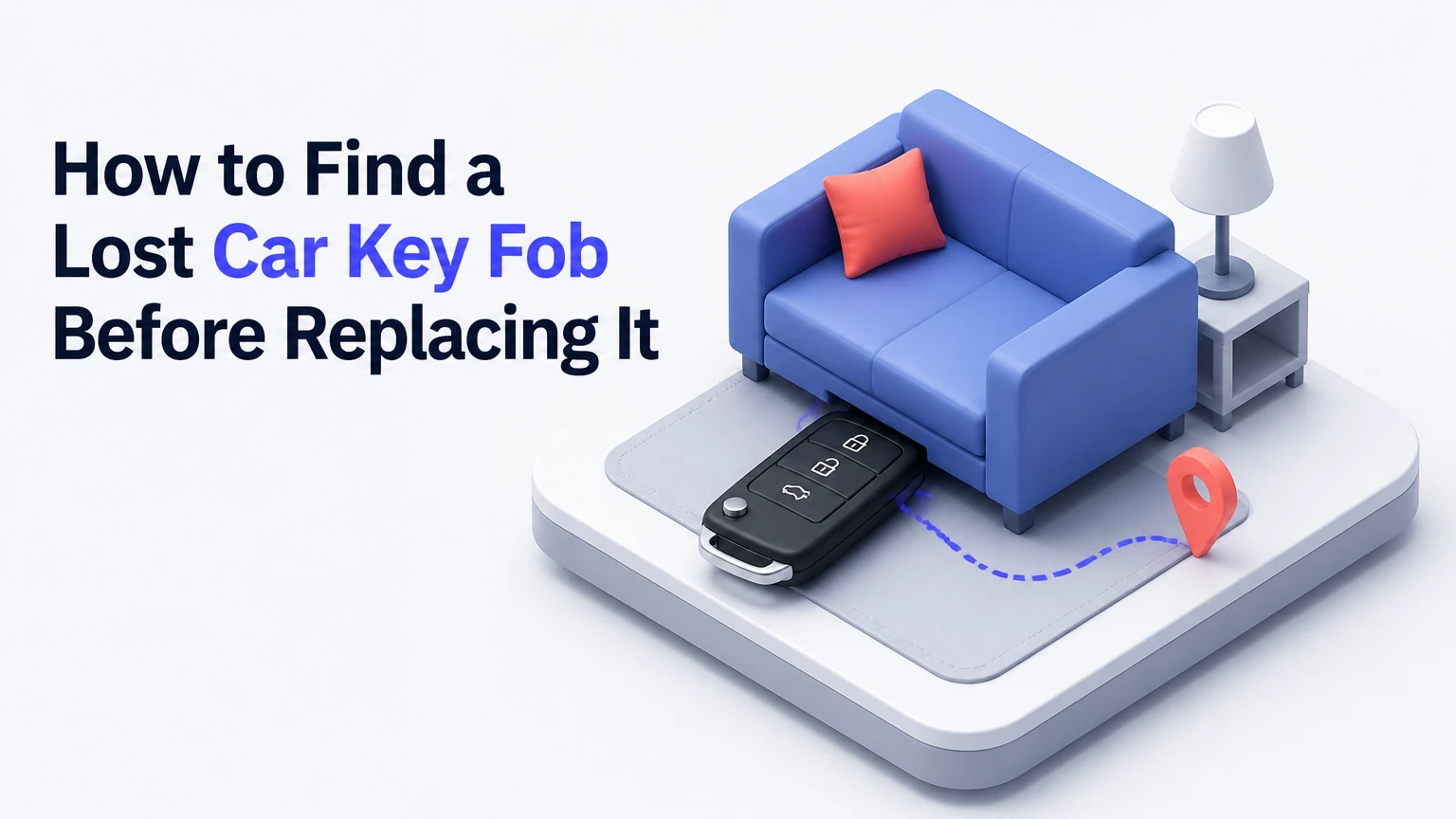
To find a lost car key fob, retrace the last few hours in reverse, inspect clothing, bags, entryways, and every vehicle compartment, then use a connected tracker if available. If the fob remains missing, identify the vehicle’s key type, gather the VIN and spare-key details, and choose a locksmith or dealer based on programming requirements.
Key Facts at a Glance
- A car key fob may control the locks without being the device that authorizes the engine to start.
- A passive-entry vehicle can detect a fob inside the cabin, but detection behavior varies by make and model.
- A Bluetooth tracker can show a recent location, not necessarily the fob’s current position.
- A replacement fob usually requires programming, and all-keys-lost situations normally require professional equipment.
- Typical United States replacement costs range from about $75 for a basic remote to more than $800 for some luxury smart keys.
- Ask whether the technician can remove or disable the missing fob from the vehicle’s authorized-key memory.
What Does a Car Key Fob Actually Do?
A car key fob is a small electronic transmitter that sends an authenticated command to a vehicle receiver. Depending on the vehicle, the fob may lock doors, unlock doors, open the trunk, trigger an alarm, authorize ignition through a transponder, or permit passive entry and push-button starting.
A remote-control fob and an immobilizer key are related but not identical. The lock buttons typically send a radio-frequency command, while a separate transponder chip proves that the key is authorized to start the engine. A smart key may contain both systems in one housing.
Modern remote-entry systems commonly use rolling or changing codes to prevent simple replay of a previously captured unlock signal. The exact frequency, encryption method, and programming process vary by manufacturer and market. The common North American and European frequencies cited for older remote systems are approximately 315 MHz and 433.92 MHz, but frequency alone does not prove compatibility.
A dead coin-cell battery often stops buttons and passive-entry detection, yet some vehicles can still start after the fob is placed in a designated backup location. The backup location may be a center-console slot, cup holder, steering-column area, or directly against the start button. The owner’s manual takes priority over generic instructions.
How to Find a Lost Car Key Fob
Finding a lost car key fob works best as a controlled search, not a random hunt. Start with the last confirmed use, search one zone completely before moving, and avoid repeatedly checking the same visible surfaces while ignoring pockets, liners, and vehicle gaps.
Before You Start
| Requirement | Typical value | Why it matters |
|---|---|---|
| Initial search time | 15-30 minutes | Covers the most likely recent locations |
| Search area | Last 4-8 hours of movement | Limits memory-based wandering |
| Useful tools | Flashlight, vacuum, phone, tracker app | Reveals dark gaps and recent tracker signals |
| Replacement budget | $75-$800+ | Depends on key type and programming |
| Vehicle information | VIN, year, make, model | Prevents incompatible orders |
| Proof of ownership | Registration or title plus identification | Often required for key programming |
Step 1: Reconstruct the Last Confirmed Timeline
Write down where the fob was definitely present, then move forward through every stop in order. Include the driveway, garage, workplace, gym, restaurant, school pickup, shopping cart, fuel station, and any vehicle used during the period.
Search backward from the last confirmed use, but inspect each location systematically. At every stop, check the ground near doors, counters, seats, restroom shelves, checkout areas, and surfaces where you placed a phone or wallet.
You will know the step worked when you have a written route with named locations rather than a vague memory such as “I had it earlier.”
Common mistake: searching only the home. A fob left at a store, office, or friend’s house will not be found by reorganizing the kitchen counter.
Step 2: Search Drop Zones Completely
Inspect entry tables, key bowls, kitchen counters, bathroom shelves, bedside tables, sofa cushions, laundry hampers, and the floor beside doors. Use a flashlight at a low angle because black fob housings disappear against dark furniture.
Move objects instead of looking over them. Check under mail, reusable shopping bags, pet bedding, children’s toys, couch throws, and items placed on top of the fob after you set it down.
You will know the step worked when each drop zone has been cleared and its contents have been returned, rather than visually scanned from standing height.
Common mistake: assuming the fob is in the usual key bowl. People often change routines when carrying groceries, packages, sports equipment, or a child.
Step 3: Inspect Every Pocket and Bag Layer
Empty every garment worn during the search window, including coats, work trousers, gym shorts, robes, and yesterday’s clothing. Feel the pocket corners because a fob can slide behind the pocket lining without being visible.
Unpack purses, backpacks, laptop bags, grocery totes, camera bags, and tool bags onto a clear surface. Check beneath removable inserts, inside zippered compartments, between laptop sleeves, and under the rigid base.
You will know the step worked when every compartment has been emptied and shaken over a visible surface.
Common mistake: checking only the bag’s largest compartment. Small electronic keys frequently settle beneath liners or inside narrow side pockets.
Step 4: Search the Vehicle’s Hidden Compartments
Check under both front seats, between each seat and the center console, beneath floor mats, inside door pockets, in cup holders, under the rear bench edge, and in the cargo area. Use a phone camera or flashlight to inspect gaps that cannot be seen without moving the seat.
If the vehicle has a conventional remote fob, the car may lock even when the fob is inside. If the vehicle has passive entry, the car may refuse to lock when it detects an authorized fob inside, but that behavior is not universal and may fail when the fob battery is weak or the signal is shielded.
Inspect the trunk separately. A fob may be inside luggage, beneath the cargo floor, beside the spare tire, or in a shopping bag. Do not close the trunk until you have confirmed where the mechanical emergency key is located if the vehicle is already unlocked.
You will know the step worked when seats, mats, console gaps, trunk compartments, and bags inside the vehicle have all been physically checked.
Common mistake: treating a successful lock as proof that the fob is not inside. Many vehicles do not provide a reliable interior-fob warning under every condition.
Step 5: Check Unusual Transfer Points
Search places where the fob could have moved without your noticing. Common transfer points include a child’s backpack, a partner’s coat, a pet’s bedding, a laundry basket, a grocery bag, a delivery box, and the gap between a car seat and the vehicle bench.
Ask other household members when they last saw the fob. Check coat hooks, shared desks, charging stations, and surfaces near the garage door. If the fob has a detachable key ring, search for the ring separately because it may have broken.
You will know the step worked when each person and object that could have carried the fob has been checked directly.
Common mistake: assuming the fob stayed attached to your keys. A split ring or worn clip can separate the electronic housing from the rest of the key set.
Step 6: Use a Bluetooth Tracker Correctly
Open the AirTag, Tile, Samsung SmartTag, or other tracker application if one is attached. Use the nearby sound function when the app reports a close range, then walk slowly through the suspected area because walls, metal cabinets, vehicles, and appliances can weaken Bluetooth signals.
A tracker’s map usually shows a last reported location, not a guaranteed live location. Apple’s Find My network, Tile’s network, and Samsung’s Galaxy Find network depend on nearby compatible devices and recent contact, so an old timestamp narrows the search but does not prove the fob remains there.
You will know the step worked when the tracker gives either a current audible response or a recent location that matches your written timeline.
Common mistake: assuming no signal means the fob is far away. A tracker can be silent because of a depleted battery, shielding, or an incompatible phone nearby.
Which Type of Key Fob Do You Have?
Identifying the key system determines whether you can buy a shell, replace a battery, order a remote, or arrange full key programming. The visible shape matters less than whether the vehicle uses a mechanical ignition, immobilizer transponder, remote buttons, passive entry, or all four.
| Key system | Visible features | Starting method | Replacement implication |
|---|---|---|---|
| Metal key with separate remote | Blade plus detached transmitter | Mechanical ignition, sometimes transponder | May need a cut blade and programmed remote |
| Integrated transponder key | Fixed blade in plastic housing | Blade enters ignition | Chip programming may be required |
| Flip or switchblade key | Folding blade and button housing | Blade or transponder ignition | Correct shell, blade, chip, and remote matter |
| Smart proximity key | No exposed blade during normal use | Push button with fob nearby | Programming and emergency-start procedure vary |
A vehicle can use a remote that locks doors but still require a transponder for starting. Conversely, a basic metal key may start an older vehicle without a remote at all. Ask for the exact function you lost rather than ordering “a key fob” from a generic listing.
What Information Is Needed for a Replacement?
A replacement provider normally needs the vehicle identification number, exact year, make, model, trim, and the number of working keys remaining. A photo of the existing spare, including its FCC ID, part number, button layout, and blade style, reduces compatibility errors.
The VIN is a 17-character identifier found on the driver-side dashboard, driver-door label, registration, insurance documents, and title; if buying a vehicle, use it to check whether a car is stolen before paying. Do not post the full VIN publicly. Give it directly to a verified dealer or locksmith who can confirm ownership.
The FCC ID identifies a radio device, but a matching FCC ID does not guarantee a functioning replacement. The circuit board, immobilizer chip, frequency, vehicle region, button configuration, and programming procedure must also match. A replacement listing that says “fits many models” requires additional verification.
Dealer or Locksmith: Which Replacement Option Is Better?
A mobile automotive locksmith is usually the fastest and least expensive option for a stranded driver, while a dealership is the safer choice when the vehicle uses proprietary security credentials or the locksmith cannot support that model. DIY ordering is practical mainly when a working key remains and the vehicle permits owner programming.
| Replacement route | Typical United States cost | Typical time | Best fit | Main limitation |
|---|---|---|---|---|
| Basic aftermarket remote | $25-$80 plus programming | 30-90 minutes | Older remote-entry vehicle | Compatibility and quality vary |
| Mobile automotive locksmith | $120-$450 | 30-120 minutes onsite | Stranded or all-keys-lost driver | Some luxury systems unsupported |
| Dealership replacement | $200-$800+ | Same day to 3 days | New, luxury, or proprietary system | Highest price and possible towing |
| Online OEM or aftermarket fob | $40-$300 before labor | 1-7 days delivery | Owner with verified compatibility | May arrive unprogrammable |
| Insurance or roadside assistance | Policy-dependent | 30-180 minutes | Covered lockout or key service | Coverage limits and deductibles apply |
When Is a Mobile Locksmith the Better Choice?
Choose a mobile automotive locksmith when the vehicle is accessible, the provider supports the make and model, and you need cutting or programming at the vehicle’s location. A qualified technician can often supply a key, pair it, test the immobilizer, and avoid a dealership tow.
Ask for the total price before dispatch. Confirm the service call, labor, key, programming, after-hours fee, travel charge, and warranty. A legitimate provider should explain what identification and ownership documents the technician will require.
When Is the Dealership Worth the Extra Cost?
Use the dealership when the vehicle uses encrypted key data, a subscription-backed authorization system, a newer luxury platform, or a model that local locksmiths cannot program. Dealer pricing is higher, but the parts and programming path are usually unambiguous.
A dealership may require the vehicle at its service department. Ask whether a mobile dealer service exists, whether the vehicle can be transported with roadside assistance, and whether all existing keys must be presented during registration.
Can You Program an Online Fob Yourself?
You can sometimes program a compatible replacement remote when the vehicle supports an owner sequence and at least one working key remains. Many newer vehicles require a diagnostic tool, security PIN, two-key procedure, or online authorization, so generic instructions such as cycling the ignition five times are not broadly reliable.
Do not buy an online fob until the seller confirms the part number, FCC ID, vehicle region, button layout, transponder type, and return policy. A remote that locks the doors may still fail to start the engine because its immobilizer chip is absent or unpaired.
What Does Replacement Usually Cost?
Typical United States replacement costs range from $75-$150 for an older remote or transponder key and $200-$800 or more for a smart proximity key. The largest price drivers are vehicle security architecture, whether all keys are lost, OEM versus aftermarket hardware, emergency labor, and whether the vehicle must be towed.
| Vehicle situation | Parts estimate | Labor or programming | Typical total |
|---|---|---|---|
| Older separate remote | $25-$70 | $25-$80 | $50-$150 |
| Transponder key with cut blade | $40-$120 | $50-$150 | $90-$270 |
| Common proximity smart key | $100-$300 | $75-$200 | $175-$500 |
| Luxury or encrypted smart key | $250-$600 | $150-$400 | $400-$1,000+ |
| Emergency after-hours visit | Standard price | Add $50-$200 | Provider-dependent |
These are planning ranges, not quoted prices. A dealer in a high-cost metropolitan area may exceed them, while a routine locksmith appointment for an older vehicle may cost less. Ask whether the quoted key is new, refurbished, aftermarket, or an OEM part.
What Should You Do If All Keys Are Lost?
If every key is missing, secure the vehicle first and call a mobile automotive locksmith or the manufacturer’s dealer. Do not assume an inexpensive online fob can be programmed without an existing key, because all-keys-lost procedures often require immobilizer access, vehicle-specific credentials, or diagnostic equipment.
Prepare the VIN, registration, identification, exact location, vehicle condition, and proof that the vehicle is yours. Tell the provider whether the steering wheel is locked, whether the trunk is accessible, whether the key was stolen, and whether the vehicle is blocking traffic.
If the fob may have been stolen rather than misplaced, request an authorized-key audit. Some vehicles can erase all existing keys and add only newly supplied keys; others cannot delete one lost fob individually. A technician should explain which operation the vehicle supports before charging for it.
Should a Lost Fob Be Deleted From the Vehicle?
A lost fob should be removed from the vehicle’s authorized-key memory when theft or unauthorized access is plausible and the vehicle supports that function. Reprogramming a replacement does not always erase every previously paired key, so ask specifically whether the old fob remains authorized.
Deleting a key may require all legitimate keys to be present, a dealer security code, or a specialized diagnostic tool. Some systems use rolling authentication and do not offer a simple owner-accessible delete command. The dealer or locksmith should document how many keys are currently recognized after service.
Until the key is disabled, reduce exposure by parking in a locked garage, using a steering-wheel lock, keeping the vehicle away from doors and windows, and removing valuables. These steps reduce opportunity but do not replace electronic key management.
What If You Found the Fob but It Does Not Work?
A nonworking car key fob usually needs a fresh coin-cell battery, clean battery contacts, or re-synchronization, but a damaged circuit board, failed button, vehicle receiver fault, and expired authorization can produce similar symptoms. Test the spare key if available to separate a fob problem from a vehicle problem.
Dead-Fob Recovery Checklist
- Install the battery type printed in the owner’s manual or on the old cell, such as CR2032 or CR2025. Match polarity and avoid bending the contacts.
- Test lock and unlock from several feet away. A weak range often indicates a battery or case-contact issue.
- Use the hidden mechanical key blade to unlock the driver’s door if the vehicle has one.
- Place the fob in the manufacturer’s backup-start location. Common locations include a console slot, cup holder, steering-column pocket, or against the start button.
- If buttons remain unresponsive, inspect for water damage, cracked solder joints, corrosion, or a broken housing.
- Have a locksmith or dealer test the fob frequency, transponder, and vehicle receiver before purchasing another key.
Holding a dead fob against the start button works on some push-button vehicles, not all of them. The owner’s manual is the controlling source, and forcing the fob against the button can damage the housing if the vehicle uses a separate backup pocket.
Common Mistakes and How to Fix Them
| Mistake | Why it fails | Correct recovery |
|---|---|---|
| Ordering by vehicle year alone | One model year can use multiple key systems | Match part number, FCC ID, chip, and region |
| Assuming a locked car proves the fob is absent | Interior detection varies by model and battery condition | Search the cabin manually |
| Buying a shell as a complete key | A shell may contain no circuit board or chip | Confirm whether the listing includes electronics |
| Towing immediately to a dealer | A mobile provider may program onsite | Call roadside assistance and two qualified locksmiths |
| Ignoring proof of ownership | Programming providers must protect vehicle access | Prepare registration, title, and identification |
| Failing to report a stolen key | The missing fob may remain authorized | Request an all-keys audit or deletion procedure |
One practitioner rule is worth remembering: never compare a $40 online listing with a $400 dealer quote until you confirm whether both prices include cutting, immobilizer programming, remote pairing, ownership verification, and warranty coverage.
What Changes in Common Situations?
If You Are Stranded Away From Home
Move to a safe, well-lit location if the vehicle can be driven, or remain in a public area if it cannot. Call roadside assistance, your insurer, or a verified mobile locksmith, and give the exact parking level or landmark so the technician can find the vehicle quickly.
If the Vehicle Is a Rental
Contact the rental company before ordering a replacement. Rental contracts often specify the approved locksmith, replacement fee, towing process, and responsibility for lost smart keys. A generic replacement may not satisfy the company’s return requirements.
If the Fob Is Locked Inside the Vehicle
Do not use improvised wedges, coat hangers, or force against window seals. Request vehicle lockout service, use the manufacturer’s connected-app unlock function if already configured, or use the mechanical emergency blade if the door can be opened without damage.
If the Fob Fell Into Water
Remove the battery immediately and do not press the buttons. Dry the housing with airflow, not high heat, then have the circuit board inspected; a water-damaged fob may work temporarily and fail later because corrosion continues beneath components.
How Can You Prevent Another Lost Fob?
Attach a tracker before the next loss, use a bright case that contrasts with furniture and vehicle interiors, and keep a spare key in a secure location rather than inside the vehicle. Record the spare fob’s part number and photograph its label for future ordering.
Do not store the spare in an unsecured outdoor box beside the vehicle. A better arrangement is a locked home cabinet, a trusted relative’s secure location, or a manufacturer-approved digital-key backup where the vehicle supports it.
Replace weak fob batteries proactively according to the owner’s manual. A battery that still unlocks the vehicle from close range may already be too weak for reliable passive entry, and intermittent detection creates unnecessary lockout risk.
FAQ
Can I find a car key fob by pressing the panic button?
Only if the fob is close enough for you to hear the alarm and its battery still works. A car cannot normally locate a lost fob through its rolling-code radio signal, and pressing the vehicle’s panic button does not make the missing fob transmit a return signal.
How far can a key fob be from the car and still work?
A conventional remote fob commonly operates from roughly 30-100 feet in open conditions, while walls, metal, vehicles, and low battery voltage reduce range. Passive-entry systems may detect a fob within a few feet of an exterior handle, but manufacturer specifications differ.
Can someone drive my car with a lost key fob?
A person generally cannot start a modern immobilizer-equipped vehicle without an authorized transponder or smart key, but a lost fob may still unlock doors or permit entry. If theft is possible, secure the vehicle and ask whether the missing key can be removed from authorized memory.
Does a new key fob erase the old one?
Adding a new fob does not universally erase the old one. Some vehicles support complete key-memory resets, some require every valid key to be present, and some systems use procedures that vary by model year. Ask the technician to identify the old key’s post-service status.
Is a key fob covered by car insurance?
Coverage depends on the policy, deductible, roadside plan, and reason for the loss. Some insurers cover lockout service but not replacement programming, while comprehensive coverage may apply after theft subject to conditions. Check the policy before authorizing an expensive dealer replacement.
The Bottom Line
To find a lost car key fob, reconstruct the last confirmed route, clear every drop zone, inspect clothing and bags, search the complete vehicle interior, and use a tracker with attention to its timestamp and signal limits. If the search fails, gather the VIN and spare-key information, compare a mobile locksmith with the dealer, and ask whether the missing fob can be removed from the vehicle’s authorized memory. Planning the replacement around the actual key system prevents the most expensive mistake: buying a compatible-looking remote that cannot unlock, start, or be programmed to your car.