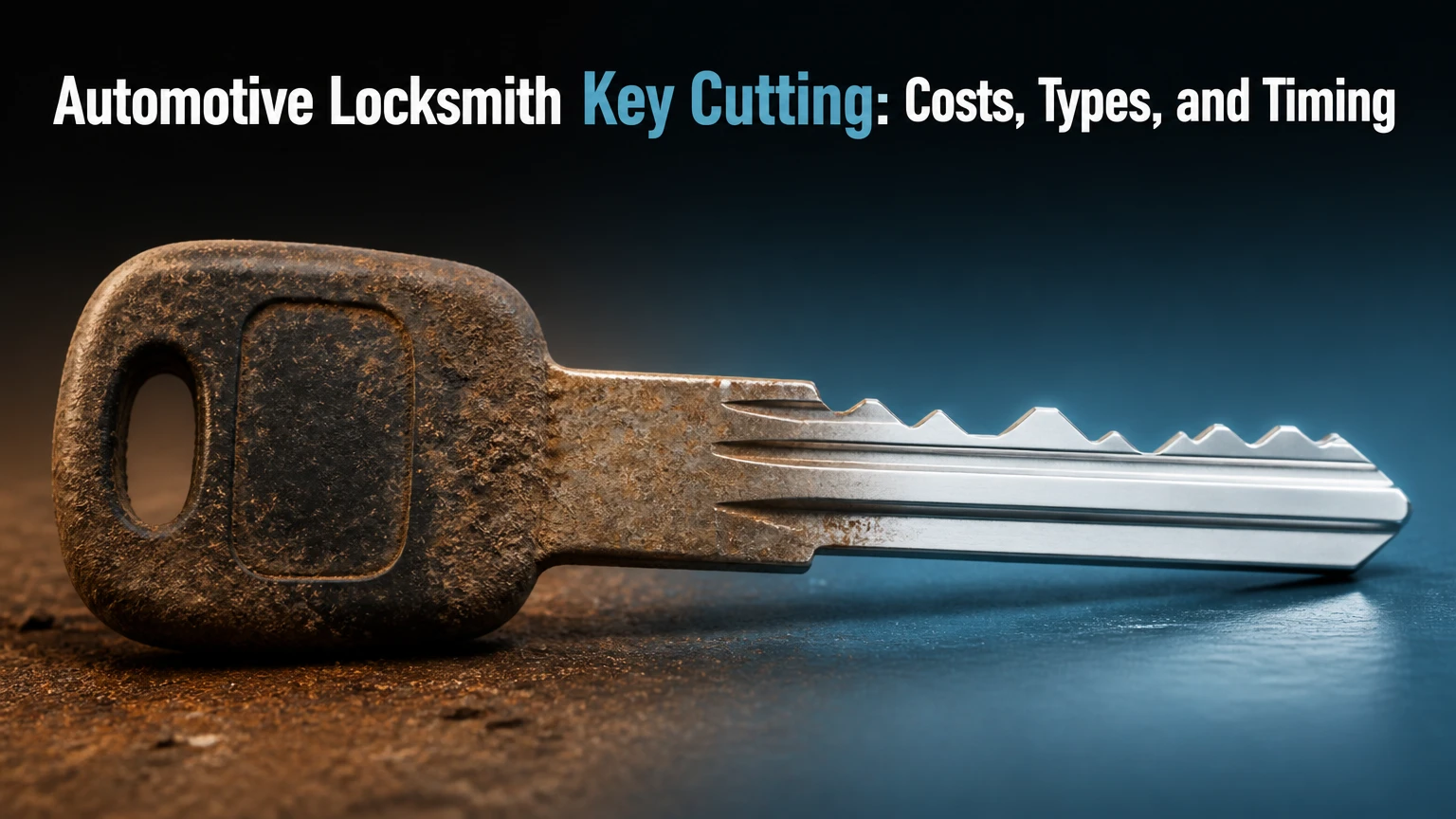
Automotive locksmith key cutting is the professional process of creating a vehicle key blade that matches its lock cylinder, then programming an electronic transponder or smart-key system when the vehicle requires it. Cutting handles the physical lock; programming authenticates the key to the immobilizer, so a mechanically perfect key may still fail to start the engine.
Key Facts at a Glance
- A replacement vehicle key can require mechanical cutting, remote pairing, immobilizer programming, or all three.
- Typical cutting time ranges from 5-10 minutes for a basic edge-cut key to 15-30 minutes for a high-security blade.
- Typical total replacement prices range from about $10 for a basic duplicate to more than $600 for some proximity fobs.
- A VIN may help a qualified locksmith obtain factory key information, but access, proof-of-ownership rules, and vehicle coverage vary.
- A key that turns the ignition but does not start the engine usually has an immobilizer or transponder issue, not a blade-cutting issue.
- A smart fob’s hidden emergency blade must be cut and tested separately from its buttons and proximity functions.
What Does Automotive Locksmith Key Cutting Include?
Automotive locksmith key cutting includes identifying the vehicle, selecting a compatible blank, determining the blade’s bitting pattern, cutting the metal, removing burrs, and testing the finished key in the relevant locks. Modern service often adds transponder programming or remote and proximity-fob configuration.
The physical cut is only one layer of a car-key replacement. A traditional key may operate a door and ignition with metal alone, while a transponder key contains a passive chip that must be recognized by the vehicle’s immobilizer. A smart key may have no exposed ignition blade at all, yet still contain a mechanically cut emergency insert.
A professional quote should therefore distinguish between blade-only cutting, key duplication, immobilizer programming, remote-button pairing, and proximity-key registration. Those are related services, but they use different equipment and can fail independently.
Mechanical Cutting Versus Electronic Programming
Mechanical cutting determines whether the blade can enter and rotate the lock cylinder. Electronic programming determines whether the vehicle permits the engine to run or accepts wireless commands from the key.
The immobilizer does not usually “start” the engine by itself. Instead, the vehicle’s security system verifies an authorized transponder or smart-key credential and permits the engine-control system to continue operation. A cut key can turn the ignition while the engine remains disabled if that authorization is missing.
How Does a Locksmith Determine the Key Cuts?
A locksmith determines the bitting pattern by tracing a usable key, retrieving an authorized key code, decoding a lock, or removing and reading a lock cylinder. The best method depends on whether a working key exists, whether the original is worn, and whether the vehicle’s code information is available.
Method 1: Duplicate a Working Key
A duplicator or electronic cutter reads an existing key and reproduces its profile on a compatible blank. This is the fastest method when the original key is genuinely accurate and shows limited wear.
A worn key creates a hidden problem. Copying the worn profile can transfer incorrect depths to the new blade, producing a duplicate that works poorly or accelerates cylinder wear. An experienced technician may decode the lock or use factory code data instead of blindly copying a damaged original.
Method 2: Cut by Key Code
A key code represents the sequence of cut positions and depths required by a particular lock system. A locksmith may obtain the code through an authorized manufacturer or industry database, a code tag, or vehicle documentation, subject to regional access and ownership verification.
A VIN identifies the vehicle, but it is not automatically a public key code. Some manufacturers associate VIN records with key data, while others restrict access, require a dealer channel, or provide only limited information. A locksmith should never promise a VIN cut without first checking the year, market, lock configuration, and available database coverage.
Method 3: Decode the Lock
When every key is lost, a trained automotive locksmith may decode a compatible door or ignition lock with a purpose-built decoder, such as a Lishi-style tool. The tool allows the technician to interpret the positions inside the lock without immediately disassembling the vehicle.
Decoding is not universal. Wafer design, restricted keyways, damaged cylinders, electronic locks, and newer vehicle architectures can prevent reliable reading. A decoded door lock may also differ from an ignition cylinder that was previously replaced, so the technician must confirm that the cylinders share the same key system.
What Happens During Professional Key Cutting?
Professional automotive locksmith key cutting normally follows six stages: vehicle and ownership verification, blank selection, code or pattern determination, machine cutting, mechanical testing, and electronic programming when required. A straightforward duplicate may take 5-15 minutes, while an all-keys-lost smart-key job often takes 30-90 minutes.
Step 1: Verify the Vehicle and Ownership
The technician records the vehicle identification number, year, make, model, market, and sometimes trim or immobilizer generation. A driver’s license plus registration, title, insurance record, or another accepted ownership document is commonly required.
This safeguard protects owners and prevents unauthorized key creation. A legitimate mobile locksmith should also document the service address and avoid cutting a key solely from an unsupported verbal claim.
Step 2: Select the Correct Blank
Blank selection involves more than matching the plastic shape. The technician checks blade length, thickness, shoulder position, keyway or side-groove profile, cut style, transponder type, frequency, button layout, and compatibility with the vehicle’s programming system.
Aftermarket blanks can reduce price, but compatibility is inconsistent. A physically similar blank may have the wrong chip, frequency, blade track, or shell geometry. The result can be a key that fits the lock but cannot be programmed or does not remain durable in daily use.
Step 3: Obtain or Read the Bitting
The technician traces a sound original, enters a verified code, or decodes a lock. A code cutter can position each cut precisely, while a duplicator follows the original blade’s existing profile.
The method matters most when the original key is badly worn or missing. A professional should explain whether the new key is copied from the customer’s blade or generated from a code, because those methods carry different accuracy risks.
Step 4: Cut and Deburr the Blade
A machine cuts an edge profile or mills a central track into a high-security blade. The finished blade is brushed or lightly finished to remove burrs that could catch in a lock, but excessive filing can alter the bitting and make the key inaccurate.
The technician then tests the key in the driver’s door, ignition, trunk, or emergency lock as applicable. The key should insert fully, rotate without unusual force, and release smoothly. A remote test alone does not prove that the emergency blade works.
Step 5: Program the Transponder or Smart Key
If required, the technician connects an approved diagnostic device through the vehicle’s diagnostic port or uses a manufacturer-specific procedure. The device registers the transponder credential, remote functions, or proximity key with the vehicle’s security system.
Programming requirements vary sharply. Some vehicles allow an additional key when one authorized key remains; others require an all-keys-lost procedure, security-code access, or dealer-level credentials. Programming can also erase previously registered keys on certain systems, so the owner should ask whether existing keys will remain active.
Step 6: Perform a Complete Handover Test
The final test should cover every function the customer purchased: door operation, ignition rotation, engine authorization, lock and unlock buttons, trunk release, panic function, proximity detection, and emergency-blade entry.
A key is not finished when the remote buttons flash. It is finished when the mechanical and electronic systems work in the vehicle conditions that matter.
Which Types of Vehicle Keys Need Cutting?
Vehicle keys fall into four practical groups: edge-cut keys, high-security or laser-style keys, transponder keys, and smart or proximity keys. The categories overlap because a transponder chip can be installed in either an edge-cut or high-security blade.
| Key type | Physical design | Electronic requirement | Typical cutting time | Typical replacement range |
|---|---|---|---|---|
| Edge-cut metal key | One-sided or double-sided teeth | None on older vehicles | 5-10 minutes | $10-$30 |
| High-security blade | Center track or sidewinder-style groove | None or transponder | 15-30 minutes | $40-$120 |
| Transponder key | Metal blade with coded chip | Immobilizer registration | 20-45 minutes total | $75-$250 |
| Smart or proximity fob | Fob with hidden emergency blade | Remote and proximity registration | 30-90 minutes | $180-$600+ |
Edge-Cut Keys
Edge-cut keys use visible teeth along one or both blade edges. They remain common on older vehicles and some fleet, utility, and basic-trim models because the blade is inexpensive and easy to duplicate.
Their lower physical security does not mean every replacement is trivial. The technician still needs the correct keyway, bitting, and, on later vehicles, a compatible transponder chip.
High-Security and Laser-Style Keys
High-security keys use a thicker blade with a milled track, often down the center or along a side surface. The phrase “laser-cut” describes a style of manufacture, not a guarantee that a laser performed the cutting.
High-security profiles generally require specialized tooling and accurate calibration. Their geometry can resist some simple picking and unauthorized duplication, but no blade profile makes a vehicle immune to attack. The vehicle’s immobilizer remains a separate security layer.
Transponder Keys
A transponder key combines a mechanical blade with a passive chip. The chip normally receives energy from the vehicle’s antenna and returns an identification credential, so it does not depend on the small battery used for remote buttons.
A transponder key can unlock the door and rotate the ignition while failing the engine authorization test. The immobilizer warning lamp, a brief crank followed by shutdown, or a no-start condition can point toward programming, chip compatibility, antenna, or vehicle-security faults.
Smart and Proximity Fobs
Smart fobs communicate wirelessly with the vehicle for keyless entry and push-button starting. Many include a removable emergency blade for opening the door when the fob battery or vehicle battery is depleted.
The emergency blade does not replace electronic registration. A locksmith must cut it to the correct mechanical pattern, test it in the physical lock, and separately pair the fob’s remote and proximity functions.
How Do the Key Options Compare?
The most suitable key option is determined by the vehicle’s factory system, not by a preference for the cheapest blade. Edge-cut keys minimize duplication cost, high-security blades require more specialized equipment, transponder keys add immobilizer security, and smart fobs provide convenience at the highest replacement cost.
| Decision factor | Edge-cut key | High-security blade | Transponder key | Smart fob |
|---|---|---|---|---|
| Typical blade cost | $10-$30 | $40-$120 | $30-$100 | $20-$80 emergency blade |
| Electronic pairing | 0 minutes on older cars | 0-20 minutes | 10-30 minutes | 20-60 minutes |
| Main failure risk | Worn cut or cylinder | Incorrect track geometry | Unprogrammed chip | Battery, damage, or lost registration |
| Duplicate difficulty | Low | Medium-high | Medium | High |
| Backup recommendation | Two spare blades | One coded spare | One programmed spare | One programmed spare plus tested blade |
A hardware-store kiosk may duplicate a basic metal blade, but it generally cannot provide vehicle-specific immobilizer programming. A dealership may provide factory-supported keys and software, while an automotive locksmith may offer mobile service, lock decoding, and lower labor costs. The correct choice depends on the vehicle system and the provider’s equipment.
How Much Does Automotive Locksmith Key Cutting Cost?
Automotive locksmith key cutting typically costs $10-$30 for a basic metal duplicate, $75-$250 for a transponder key, and $180-$600 or more for a smart fob. Emergency dispatch, after-hours labor, rare parts, all-keys-lost programming, and luxury-vehicle software can increase the final invoice.
| Service scenario | Typical price | Typical time | Main price variable |
|---|---|---|---|
| Basic duplicate with working key | $10-$30 | 5-15 minutes | Blank and local labor rate |
| High-security blade only | $40-$120 | 15-30 minutes | Profile and machine requirement |
| Transponder key, cut and programmed | $75-$250 | 20-45 minutes | Chip, security access, and key count |
| Smart fob, cut and programmed | $180-$600+ | 30-90 minutes | OEM versus aftermarket fob |
| All keys lost, modern vehicle | $150-$700+ | 45-120 minutes | Immobilizer procedure and credentials |
| After-hours mobile callout | Add $75-$200+ | Dispatch dependent | Time, distance, and urgency |
These are typical planning ranges, not guaranteed quotes. Prices vary by country, city, vehicle market, fob source, programming method, and whether the customer has an authorized key. Ask for a written total that separates parts, cutting, programming, travel, taxes, and emergency fees.
Should You Use a Locksmith or a Dealership?
An automotive locksmith is usually the practical first option for a standard duplicate, a lost key, a lockout involving key creation, or a vehicle that needs on-site cutting and programming. A dealership becomes more suitable when the vehicle requires restricted factory credentials, a replacement module, a rare OEM fob, or a procedure the local locksmith cannot support.
Ask the locksmith these questions before authorizing work:
- Does the quoted price include cutting and immobilizer programming?
- Will the technician work from the VIN, an original key, or a lock decode?
- Is the replacement part OEM, refurbished, or aftermarket?
- Will existing keys remain programmed?
- Can the technician cut and test the hidden emergency blade?
- What documents must be shown to verify ownership?
- What happens if the supplied key cannot be programmed?
A low quote can exclude programming or use a shell without a compatible chip. A high quote can include unnecessary replacement of functioning locks or control modules. The invoice should identify the exact service.
What Problems Occur After a New Key Is Cut?
Most post-service problems fall into four categories: incorrect mechanical cuts, unsuitable blanks, failed immobilizer programming, and remote or proximity pairing errors. Troubleshooting begins by separating physical lock behavior from engine authorization and wireless-button behavior.
| Symptom | Probable system | Likely cause | Correct next action |
|---|---|---|---|
| Key will not enter fully | Mechanical blade | Wrong profile, burr, or incorrect blank | Stop forcing it; have the blade inspected |
| Key enters but will not rotate | Lock and bitting | Incorrect cuts, worn cylinder, or steering load | Test another lock and request code verification |
| Key rotates but engine will not run | Immobilizer | Unprogrammed, wrong, or damaged transponder | Recheck chip compatibility and programming |
| Buttons work but blade fails | Emergency blade | Incorrect cut or untested insert | Decode or recut the physical blade |
| Proximity start fails intermittently | Smart-key system | Weak fob battery, interference, or registration issue | Replace battery and perform system diagnosis |
| Existing key stopped working | Vehicle registration | All-keys-lost procedure erased prior key | Ask whether old keys were deleted |
Do not sand a new automotive key casually or force it through an ignition. Removing metal can destroy an otherwise recoverable cut, while force can damage a delicate lock cylinder. Return to the technician for measured inspection and code comparison.
What Should You Do If All Keys Are Lost?
If all keys are lost, secure the vehicle, gather proof of ownership, and provide the locksmith with the VIN, exact location, year, make, model, and any information about previous lock or ignition replacement. The technician will determine whether to decode a lock, obtain authorized code data, or use a supported immobilizer procedure.
All-keys-lost work takes longer because there is no known-good key for comparison. Some systems require security access, a PIN, a token, a battery-maintained vehicle, or the registration of every replacement key during one session. A locksmith may also need to create a mechanical key before attempting electronic programming.
The owner should ask whether the service will preserve existing keys, because certain procedures delete keys that are not present during programming. Once the replacement works, order a second programmed spare before the remaining key is lost.
How Can You Avoid a Bad Replacement Key?
Use a locksmith or dealer that identifies the exact vehicle system, names the replacement part, and tests every purchased function before payment. The most common avoidable failures are buying an incompatible online key, copying a worn original, and assuming remote-button pairing proves engine authorization.
Practitioner Rules That Prevent Repeat Visits
- Keep a spare transponder key before the only programmed key fails.
- Replace a badly worn original by code or lock decode, not by direct duplication.
- Treat the fob shell, battery, chip, remote frequency, and emergency blade as separate compatibility checks.
- Photograph the key label or retain the part number for future ordering.
- Test the emergency blade during routine service, not during a dead-battery lockout.
- Request the vehicle’s key count after programming and confirm which keys remain active.
An aftermarket fob can be perfectly acceptable when its frequency, chip, and vehicle coverage are verified. It is a poor purchase when the seller lists only the shell shape or button count.
What Is the Best Backup Strategy?
For an older metal-key vehicle, keep two accurately cut duplicates in separate secure locations. For a transponder vehicle, keep one additional programmed key, because all-keys-lost service is usually slower and more expensive than adding a spare while an authorized key still operates.
Smart-fob owners should store the spare fob away from moisture, heat, strong physical impact, and unnecessary battery drain. The emergency blade should be cut and tested at the same time. Owners of vehicles with push-button starting should also learn the manufacturer’s backup-fob starting position, because many vehicles provide a low-battery detection method.
Luxury vehicles and newer immobilizer systems deserve an additional check. Ask whether the provider supports the vehicle’s exact model year and market, rather than relying on a general claim that the technician programs “all cars.”
Frequently Asked Questions
Can a locksmith make a car key without the original?
Yes, a qualified automotive locksmith can often create a key without the original by using authorized key-code information, decoding a compatible lock, or following a supported immobilizer procedure. The locksmith still needs vehicle identification and ownership documentation, and some newer systems require dealer credentials or manufacturer-supported security access.
Does a key cut by VIN always work?
No. A VIN can identify the vehicle and may help an authorized provider retrieve key information, but it does not guarantee a matching cut. Replaced door or ignition cylinders, regional variations, restricted databases, and incomplete manufacturer records can produce a mismatch, so the finished blade must be tested in the vehicle.
Can I program a transponder key myself?
Sometimes, but only when the vehicle manufacturer provides an onboard procedure and the correct key is already available. Many vehicles require diagnostic equipment, a security PIN, or a dealer-authorized platform. Remote-button instructions found online may pair the buttons without registering the immobilizer transponder.
Why does my replacement key unlock the door but not start the car?
The blade is probably mechanically correct, while the transponder is unprogrammed, incompatible, damaged, or not detected by the vehicle’s immobilizer antenna. A locksmith should verify the chip type, programming result, security indicator, and vehicle fault codes rather than recutting the blade automatically.
Is a laser-cut key more secure than a standard key?
A high-security, laser-style profile can make casual duplication and some basic picking methods more difficult, but it does not independently prevent vehicle theft. The immobilizer, alarm, remote-security design, and vehicle software provide additional protection, while poor cutting or an incompatible blank can still make the key unusable.
Should I buy an OEM or aftermarket car key?
Choose OEM when the vehicle has restricted programming, a rare proximity system, warranty concerns, or a history of aftermarket compatibility problems. Choose a reputable aftermarket key when the supplier confirms the exact part number, frequency, chip, blade profile, and programming coverage, and when the price difference is meaningful.
The Bottom Line
Automotive locksmith key cutting creates the correct mechanical blade, but modern vehicles frequently require a second service: transponder, remote, or proximity-key programming. Confirm the vehicle details, ownership documents, key type, replacement part, total price, programming coverage, and emergency-blade test before work begins. A properly cut and programmed backup key is cheaper and less disruptive than an all-keys-lost emergency.