To get a duplicate car key, identify the vehicle’s key type, provide proof of ownership, have a compatible blade cut, and program the transponder or smart fob when required. A working original usually makes the job faster and less expensive, while a lost-key job may require security-code retrieval, immobilizer access, or module reprogramming.
Key Facts
A metal blade can unlock a door without being authorized to start the engine.
A transponder key needs immobilizer programming even when the blade is cut perfectly.
Remote lock buttons and engine-start authorization are separate systems on many vehicles.
Typical U.S. duplication costs range from $10-$50 for a basic key and $200-$600 or more for a smart fob.
An automotive locksmith is often less expensive than a dealer, but compatibility depends on the vehicle year, software, and security system.
Bring every working key to programming because some vehicles erase previously stored keys during enrollment.
How Duplicate Car Keys Work
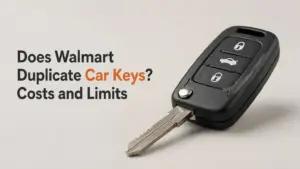
A duplicate car key has up to three separate functions: mechanical access, remote control, and engine authorization. The blade operates a lock cylinder, the remote transmitter operates entry features, and a transponder or proximity credential communicates with the vehicle immobilizer.
Older vehicles may need only a metal copy. Many vehicles built from the late 1990s onward use a passive transponder embedded in the plastic head, remote-head housing, or smart-key circuit board. The immobilizer antenna reads that chip when the key enters the ignition or approaches a permitted start zone. The engine control or body control system then checks whether the credential belongs to the vehicle.
The remote’s radio frequency is not the same thing as the transponder’s security identity. A correct FCC ID and frequency can make the buttons compatible, but those details alone do not guarantee engine-start authorization. Vehicle-specific encryption, part numbers, regional configuration, and programming status also matter.
A useful practitioner rule is simple: a key that turns is not necessarily a key that starts. Cutting reproduces the physical pattern; programming establishes electronic permission.
What Should You Gather Before Ordering?
Gather the VIN, registration or title, driver’s license, current key, key-fob markings, and vehicle details before contacting a provider. The VIN identifies the factory configuration, while the existing key and fob markings help determine the correct mechanical and electronic parts.
The 17-character VIN usually appears through the windshield on the driver’s side dashboard, on the driver’s door-jamb label, and on registration documents. A dealer or locksmith may use it to identify the original key system, but the VIN does not always reveal every aftermarket modification or replacement module installed during the vehicle’s life.
Look for the FCC ID, part number, frequency, manufacturer logo, and board markings on the current fob. Do not order by appearance alone. Two visually identical Toyota, Ford, Honda, or Chevrolet fobs can use different part numbers or regional frequencies.
A mechanical key code may appear on an original key tag or in manufacturer records, but the common claim that every vehicle has an easily retrievable four-to-six-digit code is inaccurate. Some key codes require a dealer or locksmith database lookup, and some newer systems use electronic credentials rather than a traditional published blade code.
Before You Start
| Requirement | Typical value | Why it matters |
|---|---|---|
| Vehicle identification | 17-character VIN | Matches year, model, trim, and factory key system |
| Ownership documents | Registration or title | Supports lawful key cutting and programming |
| Personal identification | Valid driver’s license | Confirms the requester’s identity |
| Existing key | 1 functioning key, if available | Allows faster decoding, cloning, or enrollment |
| Vehicle battery | Approximately 12.4-12.7 V at rest | Reduces programming interruption risk |
| Appointment time | 15-60 minutes | Depends on blade, transponder, fob, and software |
How to Get a Duplicate Car Key in Six Steps
Step 1: Identify the Key System
Determine whether the vehicle uses a mechanical key, transponder key, remote-head key, or proximity smart fob. Check whether the car starts with a metal ignition blade, a push button, or a key inserted into a slot.
Use the owner’s manual and the original key markings to confirm the system. A hidden emergency blade inside a smart fob does not mean the fob itself is mechanically sufficient for starting. Conversely, a vehicle with a push button may still require a physical emergency blade for door access.
Success checkpoint: You can describe the key as mechanical, transponder, remote-head, or proximity.
Common mistake: Ordering a shell or uncut blade when the vehicle needs a complete programmed fob.
Step 2: Verify Compatibility and Ownership
Give the provider the VIN, year, make, model, trim, location, and whether a working key is available. Send photographs of the current key only through a reputable provider’s secure process, and never omit the FCC ID or part number.
Ask whether the quoted part is OEM, aftermarket, refurbished, or a cloned key. Ask whether the price includes cutting, programming, emergency service, taxes, a blade, a battery, and a warranty.
Success checkpoint: The provider confirms the exact part number or an explicitly compatible replacement.
Common mistake: Buying a key based only on the vehicle’s year and model.
Step 3: Have the Blade Cut
A locksmith or dealer can duplicate an edge-cut blade from the working key, decode the lock, use a supplied key code, or mill a high-security blade with a code-specific machine. High-security keys often have a central track or side-milled pattern rather than ordinary edge cuts.
The provider should test the duplicate in the driver’s door and ignition, if fitted, before completing electronic programming. A blade that binds can damage a lock cylinder or leave you with a key that works only intermittently.
Success checkpoint: The blade enters, turns, and retracts smoothly without forcing the cylinder.
Common mistake: Treating lubricant as a solution to a badly cut key. Dry graphite may help an aged cylinder, but a duplicate that catches should be inspected and recut.
Step 4: Program the Transponder or Smart Fob
Electronic programming enrolls the replacement credential in the vehicle’s immobilizer or body-control system. Depending on the model, the technician may use manufacturer software, an approved scan tool, a security-code process, or a key-cloning method that copies data from the existing key.
An OBD-II connection is common, but it is not universal and does not mean every key can be programmed with a generic scanner. Some manufacturers require online authorization, timed security access, a PIN, or a gateway unlock procedure. European vehicles such as BMW, Mercedes-Benz, Audi, and Land Rover can have especially strict system and credential requirements.
Keep the vehicle battery stable during this step. Programming should stop if voltage falls outside the manufacturer’s permitted range, because interrupted communication can create a no-start condition or require additional module recovery.
Success checkpoint: The immobilizer indicator behaves normally and the engine starts with the duplicate.
Common mistake: Assuming that remote-button pairing also programmed the immobilizer.
Step 5: Pair the Remote Functions
Remote lock, unlock, trunk release, panic, alarm, and proximity detection may require a separate enrollment sequence. Some vehicles permit owner-level remote synchronization, while others require diagnostic programming.
Confirm that the replacement fob has a compatible frequency, FCC ID, part number, button layout, and regional configuration. A used fob may remain locked to its original vehicle even when its casing and frequency appear correct.
Success checkpoint: Every intended button works from the expected distance, and the vehicle recognizes passive entry if equipped.
Common mistake: Testing only the lock button and missing a failed trunk, panic, or proximity function.
Step 6: Test Every Function Before Paying
Test the duplicate in a logical order: driver’s door lock, ignition or start authorization, remote buttons, trunk release, emergency blade, key warning, and passive-entry behavior. Start the vehicle twice, including after locking and unlocking it, because an intermittent enrollment problem may not appear on the first attempt.
Bring every existing key to the appointment. Some vehicles add a key without deleting others, but certain systems erase stored credentials during an all-keys programming routine. A key left at home may stop starting the car after the new programming session.
Success checkpoint: The new key starts the car, operates the locks, and performs every advertised remote function.
Common mistake: Leaving before testing the emergency blade and all existing keys.
Which Key Type Do You Need?
The key type determines the cutting method, programming requirement, price, and appointment length. The following figures are typical U.S. consumer ranges, not fixed manufacturer prices; luxury models, emergency callouts, scarce parts, and dealer labor can exceed them.
| Key type | Physical design | Electronic work | Typical price | Typical time |
|---|---|---|---|---|
| Mechanical key | Metal blade, no chip | None | $10-$50 | 5-10 minutes |
| Transponder key | Blade with coded chip | Immobilizer enrollment | $75-$250 | 15-30 minutes |
| High-security key | Sidewinder or center-track blade | Often transponder programming | $150-$300 | 20-40 minutes |
| Remote-head key | Blade integrated with buttons | Immobilizer and remote pairing | $150-$400 | 20-45 minutes |
| Proximity smart fob | Push-to-start credential with emergency blade | Proximity and immobilizer enrollment | $200-$600+ | 30-90 minutes |
The ranges vary because the same model can use different keys by trim, market, and production date. A 2018 vehicle may also have different software requirements from a 2017 vehicle with the same nameplate.
Which Provider Should You Choose?
An automotive locksmith is usually the practical first choice when a working key remains and the locksmith confirms coverage for the exact vehicle. A dealer is the safer route for restricted systems, warranty-sensitive work, or vehicles requiring factory online access.
| Provider | Typical price for a programmed key | Typical availability | Best fit | Main limitation |
|---|---|---|---|---|
| Mobile automotive locksmith | $75-$450 | Same day in many areas | Working-key duplicates and roadside service | Coverage varies by brand and model |
| Authorized dealership | $150-$700+ | Appointment often required | OEM parts and restricted systems | Higher labor and towing costs |
| Hardware store or kiosk | $10-$80 | Usually immediate | Mechanical keys and selected older models | Limited transponder and high-security support |
| Online DIY kit | $50-$350 | Shipping plus setup time | Supported vehicles with a working key | Wrong part or failed programming risk |
| Vehicle manufacturer service | $200-$800+ | Dealer-dependent | Brand-specific credential recovery | May require proof, transport, and ordered parts |
Automotive Locksmith
A mobile locksmith can cut the blade at the vehicle and use brand-capable diagnostic equipment without requiring a tow. The best providers state supported makes, model years, key types, and whether they can handle all-keys-lost situations.
Ask for a written total. A low advertised price may exclude the fob, programming, emergency callout, or service-area fee.
Authorized Dealer
A dealer generally has direct access to OEM parts and manufacturer procedures. That advantage matters when the vehicle uses encrypted smart keys, gateway security, rolling credentials, or a replacement module that cannot be learned by independent equipment.
The dealer is not automatically the best option for every duplicate. A routine transponder key may cost substantially more there than at a qualified locksmith.
Hardware Store or Kiosk
A kiosk is appropriate for a plain metal duplicate and selected supported transponder models. The machine may cut a blade accurately while lacking the equipment or authorization to enroll the chip.
Ask specifically, “Will this key start my exact vehicle?” A statement that the store can copy the blade does not answer that question.
Online DIY Kit
A DIY kit can reduce cost on supported vehicles, particularly when one working key remains and the kit includes the correct programmer. Follow the manufacturer’s compatibility list rather than relying on a marketplace title or photograph.
DIY is a poor choice when the vehicle has no working keys, a weak battery, a security warning, an unknown replacement module, or a high-cost smart fob. A failed attempt can leave the car immobilized and remove the easy programming route.
How Much Does a Duplicate Car Key Cost?
A duplicate car key typically costs $10-$50 for a mechanical copy, $75-$250 for a transponder key, $150-$400 for a remote-head key, and $200-$600 or more for a proximity fob. The largest price difference comes from electronic credential type and whether a working key is available.
| Situation | Typical cost | Typical time | Main cost driver |
|---|---|---|---|
| Mechanical duplicate with original | $10-$50 | 5-10 minutes | Blade material and cutting |
| Transponder duplicate with original | $75-$250 | 15-30 minutes | Chip, software, and enrollment |
| Smart-fob duplicate with original | $200-$600+ | 30-90 minutes | OEM or aftermarket proximity fob |
| Broken key with readable original | $75-$300 | 30-90 minutes | Extraction, decoding, and replacement |
| All keys lost | $200-$1,000+ | 1-4 hours | Security access, recovery, towing, and programming |
All-keys-lost work costs more because the provider cannot simply read or clone a functioning credential. The technician may need to decode the lock, obtain security data, reset a module, or complete a manufacturer-authorized procedure. The exact process varies sharply by make and model.
A 2023 Consumer Reports survey on vehicle ownership costs does not establish a universal key price, so provider quotations remain more useful than a single national average. Treat the figures above as planning ranges, and request a model-specific quote before approving work.
What If You Have No Working Key?
Call an automotive locksmith or dealer and state clearly that the situation is “all keys lost.” Do not describe it as an ordinary duplicate, because the provider needs different tools, security access, and possibly a tow or vehicle-location service.
Have the VIN, registration, title, driver’s license, and the vehicle’s exact location ready. Some providers can create a key on site; others need the car at a dealer because the immobilizer requires factory authorization or a module reset.
If the key was stolen, ask whether the provider can erase the missing credential from the vehicle’s memory. A replacement key that starts the car does not necessarily invalidate a stolen key unless the old credential is removed or the system is reconfigured.
What If the Key Is Broken, Damaged, or Water-Exposed?
A broken blade, damaged shell, or weak fob battery does not always require a full replacement; broken key loop repair may involve a cover, shell swap, or temporary epoxy. A locksmith may extract the blade, transfer a functioning circuit board into a new shell, cut a new blade, or replace the coin cell without changing the immobilizer credential.
Water exposure is different. A fob can continue operating the locks while its immobilizer or proximity circuit deteriorates. If the vehicle displays a key-not-detected warning, test with the emergency-start location described in the owner’s manual and obtain a replacement before the damaged key fails completely.
Do not glue a cracked blade and continue forcing it in the ignition. Adhesive can alter the blade’s dimensions and leave fragments inside the cylinder.
Why Does a New Key Turn but Not Start the Car?
A duplicate that turns the ignition but will not start usually has a correct mechanical cut and an unrecognized or unprogrammed transponder. Remote buttons can work at the same time because keyless-entry authorization and engine immobilizer authorization often use separate circuits.
Check the immobilizer warning light, battery condition, chip placement, and programming status. A blank shell with no transponder, an incompatible chip, or a fob programmed only for remote entry will produce this symptom.
Do not keep cycling the ignition repeatedly if the security indicator remains active. Return to the provider and request a transponder enrollment test.
Why Do the Buttons Work but the Engine Will Not Start?
Working lock and unlock buttons do not prove that the key can start the engine. The buttons use a radio transmitter and rolling or synchronized remote code, while the immobilizer uses a separate credential checked by the vehicle’s start authorization system.
The provider should test both systems independently. If the key starts the engine but the buttons fail, the issue is likely remote compatibility, pairing, battery condition, antenna range, or a faulty transmitter. If the buttons work but the engine does not start, focus on the transponder and immobilizer.
What Mistakes Cause Duplicate-Key Failures?
The most expensive errors happen before cutting begins. Verify compatibility, voltage, ownership, and programming scope before paying for a key.
- Matching by appearance: Confirm FCC ID, part number, frequency, blade profile, and vehicle compatibility.
- Buying a shell instead of a key: A shell may contain no chip, circuit board, or emergency blade.
- Ignoring all existing keys: Bring every key because some enrollment routines delete unpresented credentials.
- Programming with a weak battery: Stabilize the vehicle battery according to the technician’s procedure.
- Using a generic scanner: OBD-II access alone does not provide immobilizer authorization.
- Accepting an incomplete quote: Confirm cutting, programming, taxes, callout fees, battery, warranty, and failed-programming policy.
Expert Rules of Thumb
First, test start authorization before blaming the blade. If the key turns smoothly but the security light remains on, recutting will not solve the electronic failure.
Second, compare total price rather than advertised starting price. A $49 key may become $180 after the blank, programming, travel, and service charges are added.
Third, create the spare before the original fails. A working key gives the provider a reference, a possible cloning route, and a simpler recovery path.
How Should You Choose Between OEM and Aftermarket?
Choose an OEM key when the vehicle has restricted programming, a high-value smart fob, warranty concerns, or a history of unreliable aftermarket electronics. Choose a reputable aftermarket key when the provider confirms compatibility, offers programming support, and the price difference is meaningful.
Aftermarket quality varies by chip, circuit board, battery contact, shell, and software compatibility. The lowest-cost online listing may be new, refurbished, locked to another vehicle, or missing the correct immobilizer transponder.
Ask whether the replacement is guaranteed to start the vehicle, whether the guarantee includes programming, and what happens if the key is incompatible. Those answers matter more than the label “OEM-compatible.”
FAQ
Can a hardware store copy a car key?
A hardware store can usually copy a plain mechanical blade and may support a limited range of transponder keys. Many stores cannot program high-security keys, proximity fobs, or vehicle-specific immobilizer credentials. Ask whether the completed key will start the exact year, make, model, and trim before purchasing.
Can I get a duplicate car key without the original?
Yes, but the process becomes a replacement or all-keys-lost service rather than a simple duplicate. A locksmith or dealer can use the VIN, lock decoding, manufacturer records, or security programming tools, provided you prove ownership. Expect higher cost and longer service time than copying a working key.
Is a VIN enough to order a replacement key?
A VIN helps identify the factory key system, but it is not always enough to select a compatible replacement. Trim, production date, region, immobilizer generation, FCC ID, part number, and previous module changes can affect compatibility. A provider should verify the complete vehicle and key configuration.
How long does car key programming take?
Programming a duplicate usually takes 15-45 minutes after the correct key is available. Smart fobs, encrypted systems, online authorization, or all-keys-lost situations can take 30 minutes to several hours. Waiting for an ordered OEM part adds a separate delay that programming time does not include.
Will a duplicate key erase my original key?
A standard add-key procedure usually preserves existing keys, but some vehicles use an enrollment routine that erases keys not present during programming. Bring every working key and ask the technician whether the specific vehicle procedure is additive or a complete re-enrollment.
Should I use a locksmith or a dealership?
Use a qualified automotive locksmith for a routine duplicate when the locksmith confirms exact model coverage and provides a complete written quote. Use a dealership for restricted smart-key systems, complicated European vehicles, warranty-sensitive work, or cases where the independent provider cannot access the required manufacturer security system.
The Bottom Line
To get a duplicate car key, gather the VIN and ownership documents, identify the exact key system, verify the replacement part, have the blade cut, program the immobilizer and remote functions separately, and test every key before leaving. The best route depends on whether a working key remains, whether the vehicle uses a smart fob, and whether the provider has the correct manufacturer-level equipment. Create the spare while the original still works, because a working reference key typically reduces both cost and programming difficulty.