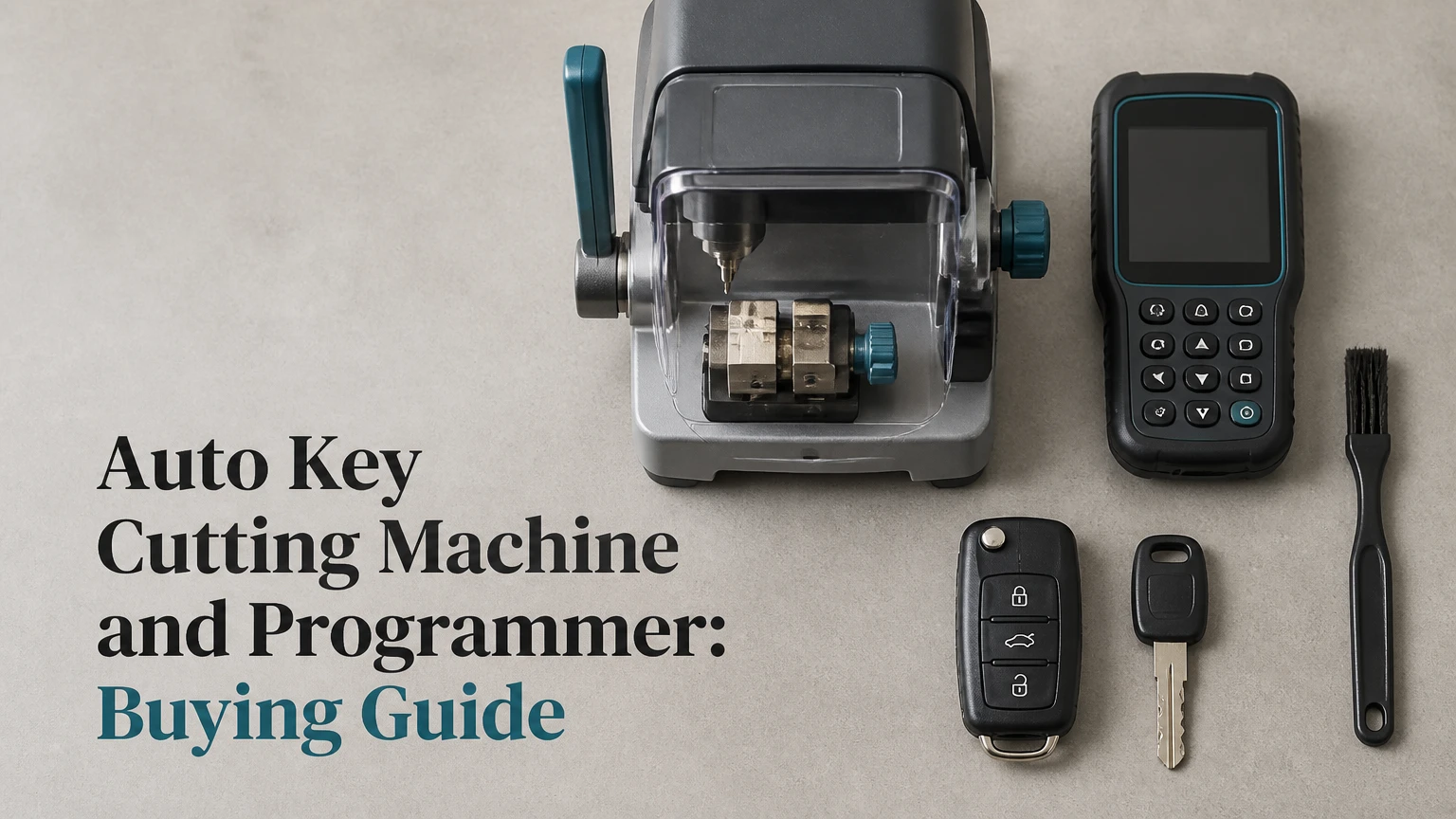
An auto key cutting machine and programmer combines two separate automotive locksmith functions: shaping a physical blade and pairing an authorized transponder or smart key with a vehicle’s immobilizer system. The cutter handles mechanical lock access, while the programmer communicates with supported vehicle modules through approved diagnostic procedures.
Key facts at a glance
A key cutter cannot program an immobilizer, and a programmer cannot create accurate blade cuts.
Automotive key systems contain separate mechanical, transponder, remote, and immobilizer functions.
Typical mobile locksmith hardware costs $1,500-$4,000 before blanks, subscriptions, tokens, and training.
OBD programming is vehicle-specific; some vehicles require security credentials, a gateway procedure, bench work, or EEPROM access.
A stable power supply around 13.2-14.7 volts during programming reduces module-reset and communication risks.
Vehicle coverage, supported key types, software renewal costs, and technical support matter more than cutter speed alone.
What Is an Auto Key Cutting Machine and Programmer?
An auto key cutting machine and programmer is a two-part equipment system for producing and authorizing replacement vehicle keys. The cutting unit duplicates or originates a blade, while the immobilizer tool identifies the vehicle procedure, writes the compatible key data, and verifies whether the vehicle accepts the key.
A complete automotive key may contain several independent components:
| Component | Physical role | Electronic role | Typical failure symptom |
|---|---|---|---|
| Blade | Turns a lock cylinder | None | Key will not enter or rotate |
| Transponder chip | Sits inside the head or shell | Authorizes engine start | Engine cranks but does not start |
| Remote PCB | Operates locks and trunk | Sends lock or unlock commands | Vehicle starts, buttons fail |
| Smart-key module | Enables proximity functions | Exchanges encrypted presence data | No-key warning or passive entry failure |
| Immobilizer system | Vehicle-side security controller | Validates the key identity | Security lamp remains active |
A correctly cut blade does not prove that the key is usable. Conversely, a successfully programmed transponder does not compensate for a blade that binds, fails to turn the ignition, or does not operate the door lock.
What the system does not do
A combined setup does not automatically cover every make, model, year, or key technology. Vehicle databases differ by manufacturer, region, model year, immobilizer generation, and software version, while aftermarket keys may use incompatible chips or incomplete remote electronics.
The programmer also does not universally bypass security. On newer vehicles, authorized access may require an online account, a security password, a gateway unlock, a time-limited token, or an original-equipment procedure. EEPROM work can require module removal, a wiring harness, a bench adapter, and specialist recovery knowledge.
How Does an Auto Key Cutting Machine and Programmer Work?
An auto key cutting machine and programmer completes two linked but separate operations: it creates the mechanical key and then authorizes the electronic identity. A normal job begins with vehicle and key identification, proceeds through decoding and cutting, and ends with programming, testing, and documentation.
How does the cutting machine create the blade?
The cutter uses a jaw, tracer or probe, cutting spindle, and vehicle-specific database. Depending on the model, the operator can duplicate an existing key, decode a key, or enter a bitting code to originate a key when no usable original exists.
The main cutting styles are:
| Key style | Cutting method | Common application | Typical machine requirement |
|---|---|---|---|
| Edge-cut | Cuts along one or both blade edges | Older cars, vans, utility vehicles | Standard automotive jaw and tracer |
| Laser or sidewinder | Mills a serpentine track on the blade face | Many modern vehicles | Sidewinder cutter, suitable clamp, depth control |
| Dimple | Cuts angled or vertical pockets | Selected European and specialty locks | Dimple jaw and dedicated cutter |
| Tibbe or track-specific | Uses a manufacturer-specific profile | Certain Ford and Jaguar applications | Compatible jaw, software, and cutter |
| Code-originated | Uses numerical bitting data | Lost-key and replacement work | Code database or verified manufacturer code |
The operator must select the correct blank, jaw position, reference shoulder, and cutting profile. A 1.5 mm cutter is not interchangeable with every automotive application, and spindle speeds differ by machine, blank material, and manufacturer instructions.
How does the programmer authorize the vehicle key?
The programmer connects through the diagnostic port, a vehicle-specific cable, a bench harness, or a module interface. The tool then identifies the immobilizer system, checks the supported procedure, and guides the operator through an add-key, replacement-key, or all-keys-lost operation.
The exact sequence varies significantly:
- Confirm ownership or documented customer authorization.
- Identify the vehicle by VIN, model, year, immobilizer generation, and existing-key status.
- Check the key blank, transponder type, remote frequency, and battery.
- Connect a regulated battery maintainer and the approved diagnostic cable.
- Follow the tool’s guided procedure, which may require a PIN, security credential, gateway unlock, or online authorization.
- Add or learn the key according to the vehicle’s procedure.
- Test starting, remote buttons, passive entry, warning lamps, and all supplied keys.
A transponder’s operating frequency is not the same as the vehicle’s remote-control frequency. Remote systems commonly use regional bands such as 315 MHz or 433.92 MHz, but immobilizer chips communicate through a separate low-frequency or vehicle-specific authentication process. The key shell, chip, remote board, and vehicle region must all match.
Which Equipment Configuration Fits the Job?
The best configuration depends on vehicle volume, mobility, security depth, and whether cutting or programming creates most of the revenue. A mobile locksmith usually benefits from a portable cutter plus a separate tablet programmer, while a high-volume shop may justify a dedicated CNC machine and multiple programming platforms.
| Configuration | Typical hardware cost | Best application | Main limitation |
|---|---|---|---|
| Manual duplicator plus entry programmer | $300-$1,200 | Older edge-cut keys and low-volume work | Limited code cutting and high-security coverage |
| Portable electronic cutter plus programmer | $1,500-$4,000 | Mobile locksmith and roadside work | Battery runtime, software fees, and limited advanced coverage |
| CNC cutter plus professional IMMO tablet | $4,000-$9,000 | Established automotive locksmith shop | Higher training and maintenance requirements |
| Premium cutter plus dedicated programmer | $8,000-$15,000+ | High-volume shop and dealership alternative | Recurring subscriptions, tokens, and specialist support |
| Dealer software plus outsourced cutting | $500-$3,000 initial tool cost | Repair shops with occasional key jobs | Slower scheduling and dependence on a locksmith partner |
Portable cutters
Portable machines such as the Xhorse Dolphin XP-005L focus on battery operation, compact transport, and edge, laser, or selected specialty profiles. Their value comes from reducing travel between the vehicle and shop, not from replacing a full production machine in a busy key center.
Dedicated electronic cutters
Silca Futura Auto and Keyline Ninja-class machines provide more rigid frames, broader jaw systems, code databases, and repeatable production. These machines suit fixed workbenches where cutting accuracy, noise control, and daily throughput outweigh battery operation.
Diagnostic programmers
Tools such as the Autel MaxiIM IM508S, Autel IM608 II, Advanced Diagnostics Smart Pro, and OBDSTAR X300 DP Plus vary in brand coverage, guided procedures, EEPROM support, online functions, and update policy. A more expensive tablet is not automatically better for a particular vehicle because coverage is determined by the tool’s software and the immobilizer generation.
Which Specifications Matter Most?
Vehicle coverage and procedure support should receive more weight than maximum spindle speed or screen size. A buyer should verify key profiles, supported models, security-gateway access, update terms, power requirements, jaw compatibility, and recovery support before comparing headline features.
| Specification | Typical range or value | Why it matters |
|---|---|---|
| Cutting time, standard key | 1-3 minutes | Measures production speed after setup |
| Cutting time, sidewinder key | 3-8 minutes | Includes clamping, decoding, and finishing |
| Portable battery | 24 V lithium-ion pack | Determines field autonomy and charging needs |
| Cutter diameter | 1.5, 2.0, or 2.5 mm | Must match profile and manufacturer instructions |
| Programmer connection | OBD-II, CAN, K-Line, USB, bench | Determines vehicle and module access |
| Programming voltage | Approximately 13.2-14.7 V maintained | Reduces low-voltage interruptions |
| Remote frequency | Often 315 or 433.92 MHz | Must match regional vehicle specification |
| Update model | Annual subscription or token credits | Changes operating cost and coverage |
A code database is particularly valuable for all-keys-lost work because the operator may not have an original blade to trace. Code cutting still requires a verified code, the correct lock system, and a blank with the correct shoulder, track, or tip geometry.
How Much Does a Complete Setup Cost?
A realistic mobile setup usually costs $1,500-$4,000 for hardware, then adds recurring software, blanks, batteries, adapters, and training expenses. The initial purchase price is therefore only one part of the equipment’s operating cost.
| Cost item | Entry setup | Mobile professional setup | Advanced shop setup |
|---|---|---|---|
| Electronic cutter | $300-$900 | $1,200-$3,000 | $3,500-$8,000 |
| Key programmer | $300-$1,000 | $800-$2,500 | $2,000-$6,000 |
| Software updates | $0-$300/year | $200-$800/year | $800-$1,500/year |
| Tokens or online functions | $0-$200/year | $200-$1,000/year | $500-$2,000/year |
| Blank and shell inventory | $250-$700 | $800-$2,500 | $2,000-$6,000 |
| Cables, adapters, maintainer | $100-$350 | $300-$900 | $700-$2,000 |
| Training and recovery reserve | $0-$500 | $500-$1,500 | $1,000-$4,000 |
Typical cutting time is 1-3 minutes for a familiar standard profile and 3-8 minutes for many high-security blades. Programming commonly takes 5-20 minutes when the vehicle is supported and the correct key is ready, but security credentials, gateway access, lost-key situations, or module work can extend the job to an hour or more.
What Is the Safest Operating Workflow?
The safest workflow treats cutting and programming as separate verification stages, uses documented customer authorization, and protects vehicle voltage throughout the diagnostic session. The operator should never begin an all-keys-lost procedure solely because a menu option appears available.
Step 1: Identify the vehicle and key system
Record the VIN, market, model year, immobilizer generation, existing-key count, and customer objective. Confirm whether the request is for a spare key, replacement key, remote-only repair, or an all-keys-lost job.
Checkpoint: The tool database identifies the same vehicle details shown on the vehicle documentation.
Common mistake: Selecting a similar model with a different immobilizer generation.
Step 2: Validate the blank and electronics
Match the blade profile, transponder family, remote frequency, shell design, battery type, and button layout. Use a chip typifier or manufacturer documentation where available, because visual similarity does not prove electronic compatibility.
Checkpoint: The blank, chip, and remote board correspond to the vehicle’s regional specification.
Common mistake: Installing a generic chip that can be cut correctly but cannot complete the immobilizer handshake.
Step 3: Decode or obtain the cut code
Clamp the original key according to the machine manual, or enter a verified bitting code for code-originated work. Check shoulder alignment, jaw selection, tip direction, and reference position before starting the spindle.
Checkpoint: The decoded cuts form a plausible profile and the blank sits squarely in the same reference position.
Common mistake: Using the wrong jaw side or clamping the blank at an incorrect depth.
Step 4: Cut and inspect the blade
Use the manufacturer’s speed and depth settings for the blank material. Remove burrs, clean the blade, and compare the finished profile against the original or code specification before inserting it into the vehicle.
Checkpoint: The blade enters and rotates the relevant lock smoothly without excessive force.
Common mistake: Treating a fast cut as a finished cut when burrs or incorrect shoulder dimensions remain.
Step 5: Stabilize vehicle power
Connect a suitable battery maintainer before programming. A vehicle battery may show more than 12 volts at rest yet fall sharply when modules wake, so voltage must remain stable during the complete procedure.
Checkpoint: The maintainer shows stable output and no active vehicle battery fault.
Common mistake: Using a small trickle charger that cannot support diagnostic loads.
Step 6: Run the authorized programming procedure
Connect the programmer and follow the exact vehicle-specific instructions. The process may require a security PIN, online account, gateway authorization, ignition cycling, a working key, or a secure bench connection.
Checkpoint: The tool reports successful key learning, and the vehicle’s security indicator behaves normally.
Common mistake: Disconnecting the cable or switching ignition states before the tool confirms completion.
Step 7: Test every function
Test engine authorization, remote locking, trunk release, passive entry, emergency blade operation, warning messages, and every original key. Record the final key count and any functions that the vehicle does not support.
Checkpoint: The engine starts and all promised functions operate consistently.
Common mistake: Returning a key after checking only whether the engine starts.
OBD Programming or EEPROM Work: Which Is Appropriate?
OBD programming is the first choice when the vehicle and tool support a documented diagnostic procedure, while EEPROM or bench work is a specialist method for vehicles that restrict standard access or require module-level data handling. EEPROM access is not a universal upgrade because it introduces module-removal, wiring, data-integrity, and recovery risks.
| Method | Access point | Typical use | Main risk |
|---|---|---|---|
| OBD add-key | Vehicle diagnostic port | Supported spare-key procedures | Incorrect security or key selection |
| OBD all-keys-lost | Diagnostic port and vehicle modules | No working key available | Lockout, credential, or gateway failure |
| Bench programming | Removed or isolated module | Restricted immobilizer systems | Pin, wiring, or module damage |
| EEPROM reading | Memory chip or processor interface | Advanced recovery and data operations | Corrupted security data |
| Dealer online procedure | Authorized manufacturer platform | Newer secured vehicles | Account, subscription, and scheduling limits |
A programmer that advertises EEPROM capability may still require separate adapters, soldering equipment, wiring diagrams, and a stable backup strategy. Beginners should not open an immobilizer module merely because OBD communication failed.
What Are the Most Common Failures?
Most automotive key failures originate from wrong vehicle identification, incompatible electronics, unstable voltage, poor mechanical alignment, or incomplete final testing. The blade and programmer should be diagnosed independently because a mechanical fault can look like an electronic fault.
| Symptom | Likely cause | Corrective action |
|---|---|---|
| Cutter breaks bits | Wrong jaw, excessive depth, incorrect speed | Recalibrate, verify jaw position, reduce load |
| Cut key binds | Wrong blank, shoulder, or bitting | Compare profile, recut the correct blank |
| OBD communication fails | Fuse, cable, gateway, low voltage | Check port power, cable, battery, and security access |
| Engine cranks but will not start | Wrong chip or failed transponder learning | Verify chip type and repeat supported procedure |
| Remote buttons fail | Wrong frequency, board, or battery | Match regional frequency and test battery voltage |
| Existing keys stop working | Erase-all procedure selected | Relearn every authorized key in one session |
| Security lamp remains active | Programming incomplete or unsupported | Stop repeated attempts and verify vehicle coverage |
A cigarette-lighter fuse may affect diagnostic-port power on some vehicles, but the fuse location and circuit vary by model. Disconnecting an aftermarket radio can help isolate interference, yet replacing fuses repeatedly without finding a short creates a separate electrical hazard.
Which Setup Should You Choose?
A mobile locksmith should prioritize a portable cutter, broad vehicle coverage, a regulated power supply, and technical support. An automotive repair shop with occasional key work may obtain better economics by buying a programmer and outsourcing precision cutting, while a high-volume locksmith shop benefits from a dedicated cutter and overlapping programmer coverage.
| User situation | Recommended setup | Typical budget | Reasonable limitation |
|---|---|---|---|
| Personal vehicle owner | Professional locksmith service | $150-$600 per job | No equipment ownership |
| Beginner locksmith | Entry cutter plus supported IMMO tool | $1,000-$2,500 | Limited newer-vehicle coverage |
| Mobile locksmith | Portable CNC cutter and tablet programmer | $1,500-$4,000 | Battery and update management |
| Repair workshop | Programmer plus outsourced cutting | $800-$3,000 | Dependence on an external cutter |
| High-volume shop | Production cutter and two programming platforms | $6,000-$15,000+ | Training, inventory, and recurring fees |
The Xhorse Dolphin line is practical where portability matters. Autel MaxiIM tools offer broad guided diagnostics across many applications but require careful review of software renewal and advanced-procedure coverage. Silca Futura Auto and Keyline machines suit businesses that value cutter rigidity, database depth, and established technical support.
No platform reliably covers 100% of vehicles. Premium European vehicles, newer encrypted systems, region-specific remotes, and manufacturer security gateways often require additional subscriptions or dealer-supported workflows.
Is Buying the Equipment Better Than Using a Locksmith?
Buying equipment makes financial sense only when expected job volume justifies hardware, software, inventory, training, and failed-job risk. A shop performing two key jobs monthly may spend less by outsourcing, whereas a mobile operator completing 10-20 supported jobs monthly can recover a $3,000 setup more quickly.
Use this simple calculation:
Break-even jobs = total setup cost divided by net equipment savings per job.
For example, a $3,000 setup that saves $100 per supported job requires about 30 jobs before consumables, software, travel, and errors are included. The calculation must exclude vehicles outside the tool’s coverage and jobs requiring dealer credentials.
When outsourcing is the better choice
Outsource cutting or programming when the vehicle is outside confirmed coverage, the job is an all-keys-lost case with no recovery plan, the customer cannot provide authorization, or the module requires EEPROM work beyond the operator’s training. Protecting a vehicle control module is more valuable than completing one uncertain job.
How Should You Maintain the Equipment?
Maintenance protects cutting accuracy and programming reliability. Calibrate the cutter according to its service interval, clean metal chips from the jaw and spindle, inspect probes and cutters, charge batteries under manufacturer guidance, and keep programming software current before accepting unfamiliar vehicles.
Maintain a written inventory of:
- Cutter diameters and replacement dates
- Jaw types and reference blanks
- Key shells, chips, remotes, and batteries
- Cables, adapters, and bench harnesses
- Software expiry dates and token balances
- Battery-maintainer output and inspection records
- Vehicle procedures that have been successfully verified
A spare cable and regulated power supply often prevent more downtime than an additional screen or faster spindle. The most expensive failure is frequently an avoidable interruption during immobilizer writing.
Frequently Asked Questions
Can a key-cutting machine program a car key?
A key-cutting machine alone cannot program a car key because cutting equipment shapes metal while immobilizer authorization requires a diagnostic programmer or approved manufacturer system. A combined package can perform both functions only when the cutter, programmer, key electronics, and vehicle procedure are mutually compatible.
Can I program a key without cutting it first?
A transponder or smart key can sometimes be programmed before its blade is cut, but the vehicle still requires a correctly cut blade for ignition or emergency-lock operation. Testing electronic authorization separately can help diagnose faults, although the final key must pass both mechanical and electronic tests.
What is the difference between a transponder key and a remote key?
A transponder key contains an immobilizer chip that authorizes engine starting, while a remote key contains radio electronics for locking functions. Some keys include both components, but remote buttons may work even when the transponder is unprogrammed, and the engine may start when the remote battery is weak.
Do all car keys use 315 MHz or 433 MHz?
Many vehicle remotes use 315 MHz in some North American applications and 433.92 MHz in many European and Asian applications, but regional exceptions exist. The remote frequency does not identify the immobilizer chip by itself, so the vehicle market, key part number, board, and programming procedure must also match.
Why did programming erase my original key?
Some immobilizer procedures use an erase-and-relearn sequence rather than an add-key sequence. When that mode is selected, every key must be present and relearned during the same session. The operator should confirm the procedure and final key count before writing data to the vehicle.
Is EEPROM programming safe for beginners?
EEPROM programming is not a suitable beginner task because it can involve module removal, delicate wiring, security-data backups, and irreversible corruption. Beginners should use a supported OBD procedure, obtain training, or refer the vehicle to a specialist when the diagnostic tool identifies a bench or EEPROM requirement.
The Bottom Line
An auto key cutting machine and programmer is best understood as a mechanical production system paired with an immobilizer-authorizing system, not as a single universal device. Choose equipment by confirmed vehicle coverage, key-profile support, security access, recurring costs, power stability, and technical recovery options. For most mobile businesses, a portable electronic cutter plus a supported professional programmer offers the most balanced starting point, while advanced EEPROM work should remain within trained, authorized workflows.