The Autel MaxiIM IM608 II Pro is the best broad-coverage key programming machine for professional locksmiths, but no device programs every car. Vehicle security gateways, encrypted immobilizers, model-year software, regional variants, blank-key compatibility, and manufacturer authorization determine whether any programmer can add or recover a key.
Key Facts
The Autel MaxiIM IM608 II Pro is the strongest single-tool choice for mixed domestic, Asian, and European vehicle work.
No aftermarket programmer provides universal coverage for every make, model, year, key type, and security condition.
OBD programming commonly takes 5-30 minutes for a supported add-key job, while bench or EEPROM work can take 1-3 hours.
A stable battery maintainer, a correctly matched blank key, and current software are as important as the tablet.
Xhorse is particularly useful for transponder work, remote generation, and specialist European workflows.
Annual updates, tokens, cables, adapters, OEM subscriptions, and key stock can materially exceed the tool’s purchase price.
Which Is the Best Key Programming Machine for All Cars?
The Autel MaxiIM IM608 II Pro is the best overall choice when one tool must cover many vehicle brands, support immobilizer functions, and also perform advanced diagnostics. The recommendation changes for narrow use cases: Xhorse is stronger for key generation and cloning, XTool can reduce recurring software friction, and Autel IM508S costs less for common OBD jobs.
The phrase “for all cars” needs a technical qualification. A programmer’s real coverage depends on the exact vehicle identifier, immobilizer generation, region, key frequency, security gateway, and whether the vehicle permits OBD access. A 2020 Ford, a 2020 BMW, and a 2020 Toyota can require entirely different authorization paths.
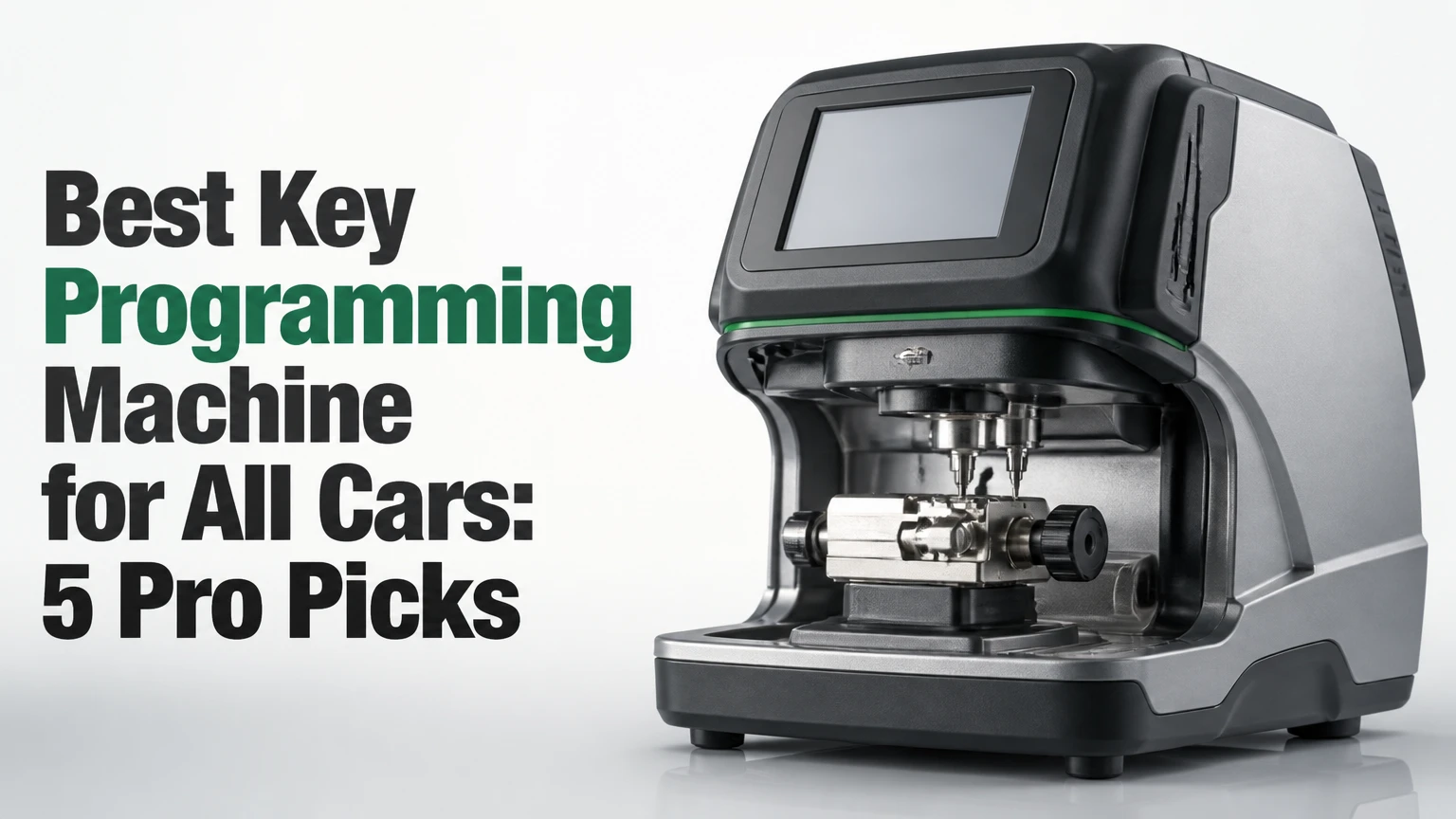
The IM608 II Pro combines an Android diagnostic tablet, a wireless vehicle communication interface, and the XP400 Pro key and chip programmer. That combination gives a locksmith more coverage than a small handheld unit, especially when a job moves from ordinary OBD learning to transponder identification or supported EEPROM work. It does not remove the need for OEM subscriptions, security credentials, special cables, or model-specific procedures.
Quick verdict by user type
| User | Best fit | Why | Main limitation |
|---|---|---|---|
| Professional locksmith | Autel IM608 II Pro | Broad diagnostics and IMMO coverage | High purchase and update cost |
| General repair shop | XTool AutoProPAD G3 | Strong mixed-service capability | Coverage still varies by vehicle |
| European key specialist | Xhorse VVDI Key Tool Plus | Remote generation and transponder tools | Less convenient as a general scan platform |
| Occasional DIY owner | Autel IM508S | Lower entry price for supported jobs | Advanced chip work may need accessories |
| Mobile technician | Topdon T-Ninja 1000 | Compact, focused key functions | Narrower deep-diagnostic capability |
How We Evaluated Key Programming Machines
The ranking weighs verified vehicle coverage, immobilizer depth, chip and remote capability, security-gateway support, diagnostic functions, update economics, field portability, and recovery risk. A tool that covers fewer cars but clearly identifies unsupported procedures is safer than a tool that claims universal programming without explaining its boundaries.
Manufacturer coverage lists should be checked by VIN or exact model before purchase. Product families also change: an IM508S is not an IM608 II Pro, and a key-generation platform is not automatically a replacement for a full diagnostic tablet.
The most important distinction is between coverage and completion. Coverage means the software contains a function for a vehicle family. Completion also requires a compatible key, correct frequency, valid security access, stable voltage, an operational communication path, and sometimes an online account.
1. Autel MaxiIM IM608 II Pro: Best Overall Coverage
The Autel MaxiIM IM608 II Pro is the strongest single-platform choice for a locksmith who works across many makes and needs diagnostics, immobilizer functions, and chip programming in one system.
Key capabilities
| Attribute | Typical IM608 II Pro position |
|---|---|
| Platform | Android diagnostic tablet with wireless VCI |
| Key hardware | XP400 Pro programmer |
| Main workflow | OBD immobilizer work, transponder and smart-key functions |
| Advanced work | Supported EEPROM and chip operations, vehicle dependent |
| Best environment | High-volume locksmith or repair business |
| Cost position | Approximately $3,000-$4,500 before local taxes and extras |
The IM608 II Pro earns the top position because it reduces tool switching. A technician can identify the vehicle, scan immobilizer status, check communication, perform supported key learning, and inspect related modules from one ecosystem. The XP400 Pro adds chip identification and programming capabilities that entry-level scanners lack.
The platform is especially useful when a simple “add key” becomes a diagnostic problem. A missing key may actually involve a dead vehicle battery, an immobilizer fault, a damaged antenna ring, a locked gateway, or an incompatible aftermarket fob. Diagnostic access helps separate those causes.
Autel’s weakness is ownership complexity. Update pricing varies by market and package, and some newer vehicles require online authorization or paid security access outside the tablet subscription. The IM608 II Pro is also excessive for an owner who programs one compatible key every five years.
Choose this if: you need the widest practical mixed-brand coverage and can justify professional software costs.
Skip it if: your work is limited to one make, ordinary add-key procedures, or occasional personal repairs.
2. XTool AutoProPAD G3: Best for Mixed Repair Shops
The XTool AutoProPAD G3 is a strong choice for a repair shop that wants immobilizer programming alongside full vehicle diagnostics without building its business around locksmith work.
Key capabilities
| Attribute | Typical G3 position |
|---|---|
| Platform | Android tablet with vehicle diagnostic interface |
| Core strength | General diagnostics plus key programming |
| Suitable users | Repair shops and mobile technicians |
| Programming scope | OBD and selected advanced procedures by vehicle |
| Cost position | Approximately $2,000-$4,000, depending on package |
| Recurring concern | Coverage and update terms vary by region |
The G3 makes sense when key work is one service among brake, engine, electrical, and body diagnostics. Its broader repair orientation can produce better value than buying a dedicated key platform and a separate diagnostic scanner.
Some sellers emphasize the absence of mandatory annual tokens or expiration restrictions, but buyers should verify the current regional policy in writing. Software access, cloud functions, cables, and security authorization can follow different rules from the basic tablet update.
The G3 is not a guarantee of success on European secure-gateway vehicles or every all-keys-lost situation. A shop should test its highest-volume VINs before purchase, especially if its business depends on BMW, Mercedes-Benz, FCA/Stellantis, or late-model Ford work.
Choose this if: general diagnostics produce most of your revenue and key work is an important secondary service.
Skip it if: transponder generation, remote cloning, or specialist bench work is your primary workload.
3. Xhorse VVDI Key Tool Plus: Best for Key Generation
The Xhorse VVDI Key Tool Plus is the best fit for technicians who prioritize transponder identification, remote generation, key learning support, and specialist European key workflows.
Key capabilities
| Attribute | VVDI Key Tool Plus position |
|---|---|
| Main strength | Transponder, remote, and smart-key operations |
| Hardware | Integrated key-programming and testing functions |
| Common focus | European vehicles and Xhorse universal products |
| Diagnostic depth | Less comprehensive than a top diagnostic tablet |
| Cost position | Approximately $1,500-$3,000, package dependent |
| Best pairing | Full diagnostic platform or OEM software |
Xhorse’s ecosystem is valuable because key programming is not only a vehicle communication task. The technician may need to identify a chip, generate a compatible remote, test a frequency, prepare a universal smart key, or manage key data before the vehicle learning step.
The platform becomes more useful when the business already understands Xhorse remotes, transponder families, and token or file workflows. Beginners can make expensive mistakes by selecting a visually similar key with the wrong chip, frequency, button layout, or region specification.
VVDI Key Tool Plus should not be treated as a universal substitute for an advanced diagnostic scanner. Its specialist strengths are real, but a repair shop that needs engine, ABS, airbag, body, and gateway diagnosis may require another platform.
Choose this if: you make and prepare many keys, particularly European or Xhorse-compatible products.
Skip it if: you want one tablet for broad mechanical diagnostics and every immobilizer procedure.
4. Autel MaxiIM IM508S: Best Lower-Cost Professional Option
The Autel MaxiIM IM508S is the best lower-cost choice for common supported OBD programming when the user accepts narrower hardware and software capability than the IM608 II Pro.
Key capabilities
| Attribute | IM508S position |
|---|---|
| Platform | Compact Android immobilizer and diagnostic tablet |
| Best task | Supported add-key and selected all-keys-lost jobs |
| Chip work | May require a separate XP400-series accessory |
| Suitable user | Small shop, technician, experienced enthusiast |
| Cost position | Approximately $800-$1,500 before accessories |
| Main limitation | Less complete advanced-key hardware package |
The IM508S can provide substantial value for domestic and Asian vehicles commonly seen by independent shops. It is easier to carry than a larger tablet and costs considerably less than the IM608 II Pro.
The lower price reflects more than screen size. Advanced chip reading, EEPROM procedures, and certain key-generation workflows may require additional hardware, cables, adapters, or a separate platform. Those accessories narrow the apparent price gap once the user expands beyond ordinary OBD operations.
The IM508S is also a poor choice when a business advertises universal all-keys-lost recovery without first checking vehicle coverage. Secure gateway access, module replacement, and newer encrypted systems can exceed its practical capability even when basic diagnostic communication works.
Choose this if: you handle a known list of supported vehicles and want professional functions at a lower entry price.
Skip it if: you need one purchase to support heavy European, EEPROM, and advanced locksmith work.
5. Topdon T-Ninja 1000: Best Focused Entry Tool
The Topdon T-Ninja 1000 is a sensible focused tool for users who need common immobilizer functions but do not need the full diagnostic and chip-programming breadth of a premium tablet.
Key capabilities
| Attribute | T-Ninja 1000 position |
|---|---|
| Design | Handheld or compact key-programming platform |
| Best task | Fast supported OBD procedures |
| Best user | New mobile technician or occasional shop user |
| Advanced scope | More limited than IM608 II Pro |
| Cost position | Approximately $700-$1,500, package dependent |
| Buying risk | Vehicle coverage must be checked precisely |
A focused key tool can be faster to deploy because the interface concentrates on immobilizer menus rather than a large diagnostic catalogue. That simplicity helps a technician who performs repetitive supported jobs and already owns a separate scan tool.
The trade-off appears at the edges. A failed key job may require module identification, body-control diagnostics, network testing, or chip preparation that a focused device cannot complete alone. The tool therefore works best as part of a defined workflow rather than as a promise of universal capability.
Topdon product names and bundles change across markets. Confirm the exact model, included cables, update term, and supported makes before comparing a T-Ninja package with a tablet platform.
Choose this if: your work is mostly common OBD key procedures and price or portability matters.
Skip it if: you expect frequent secure-gateway, EEPROM, or complex European bench jobs.
Comparison Table: Which Tool Has the Best Value?
No programmer wins every category. The IM608 II Pro leads breadth, Xhorse leads key preparation, XTool suits mixed repair operations, and the smaller Autel and Topdon units reduce initial investment.
| Tool | Broad coverage | Chip capability | Diagnostic depth | Typical purchase range | Best use |
|---|---|---|---|---|---|
| Autel IM608 II Pro | Highest practical single-tool breadth | XP400 Pro included | Advanced | $3,000-$4,500 | Dedicated locksmith |
| XTool AutoProPAD G3 | High mixed-brand coverage | Advanced functions vary | Advanced | $2,000-$4,000 | General repair shop |
| Xhorse VVDI Key Tool Plus | Strong specialist coverage | Strong transponder and remote work | Moderate | $1,500-$3,000 | Key-generation specialist |
| Autel IM508S | Moderate supported coverage | Accessory dependent | Moderate | $800-$1,500 | Small shop and known vehicle list |
| Topdon T-Ninja 1000 | Common OBD coverage | Limited compared with premium tools | Focused | $700-$1,500 | Entry mobile service |
What does ownership really cost?
A realistic first-year budget includes the machine, software updates, security access, cables, battery support, key inventory, and training. A $900 scanner can become a $1,500 setup after a chip adapter, cable kit, stable power supply, and legitimate software access are included.
| Expense | Typical range | When it applies | Buying implication |
|---|---|---|---|
| Entry programmer | $700-$1,500 | Focused OBD work | Lowest initial cost |
| Advanced tablet | $3,000-$4,500 | Broad professional coverage | Highest capability |
| Annual software update | $700-$1,200 | Newer vehicle coverage | Verify local renewal terms |
| Battery maintainer | $150-$500 | Almost every programming job | Prevents voltage-related failure |
| OEM security subscription | $40-$200 per session or period | Secure gateway and authorization | Separate from tool software |
| Key and remote inventory | $500-$5,000 | Locksmith operations | Working capital requirement |
Prices are typical US-market ranges, not fixed manufacturer prices. Regional taxes, distributor bundles, exchange rates, update promotions, and included accessories can change the total substantially.
How Does Car Key Programming Work?
A car key programmer communicates with the immobilizer, identifies the vehicle’s security state, and teaches an authorized transponder or smart key to the vehicle. The remote buttons, transponder immobilizer, and mechanical blade are separate functions, so a working lock button does not prove that the engine-start authorization succeeded.
A typical supported OBD workflow is:
- Verify ownership and vehicle identity. Record the VIN, year, model, region, key type, and the number of working keys.
- Match the replacement key. Confirm chip family, frequency, button layout, region, and whether the key is new, locked, or previously used.
- Stabilize voltage. Connect a regulated battery maintainer and disable unnecessary electrical loads.
- Check communication. Inspect the OBD fuse, connector pins, ignition state, gateway status, and VCI connection.
- Scan the immobilizer. Read system status and identify whether the vehicle supports add-key or all-keys-lost programming.
- Obtain authorized security access. The machine may calculate data locally, require an online account, or direct the technician to OEM service software.
- Perform the guided learning procedure. Follow the exact prompt for ignition, proximity position, or key placement.
- Verify every function. Test starting, immobilizer warning behavior, remote lock and unlock, trunk operation, and the remaining keys.
A technician should not improvise security bypasses or erase keys without confirming the owner’s authorization. All-keys-lost procedures can remove every previously learned key, and some vehicles impose timed security delays.
OBD, Bench, EEPROM, and OEM Software: What Is the Difference?
OBD programming is the fastest method when the vehicle exposes a supported immobilizer function, while bench, EEPROM, and OEM workflows exist because many vehicles restrict or encrypt normal diagnostic access. The correct method follows the vehicle’s security design, not the tool’s advertised feature count.
| Method | Connection point | Typical time | Typical requirement | Main risk |
|---|---|---|---|---|
| OBD add-key | Vehicle diagnostic port | 5-15 minutes | Working key or supported access | Lost communication |
| OBD all-keys-lost | Vehicle diagnostic port | 10-60 minutes | Security authorization | Erasing valid keys |
| Bench programming | Removed module or harness | 1-3 hours | Wiring and module knowledge | Module damage |
| EEPROM work | Memory chip or board | 1-3 hours | Microsoldering and backup | Corrupted data |
| OEM online procedure | OBD plus manufacturer server | 20-90 minutes | Account and paid access | Session interruption |
EEPROM work should not be the default response to every failed OBD attempt. A secure gateway, incorrect vehicle selection, dead battery, or missing authorization can mimic a tool limitation. Reading and backing up original data before writing is a professional rule, not an optional precaution.
What Features Matter Before You Buy?
Vehicle-specific coverage, security access, key preparation, stable power support, and update economics matter more than processor speed or screen size. Buyers should build a list of their ten highest-volume VIN families and confirm each procedure with the manufacturer or authorized distributor before paying.
Check these attributes:
- Exact coverage: Confirm year, region, immobilizer generation, add-key, all-keys-lost, and module-replacement support.
- Security gateway access: Determine whether FCA/Stellantis, Renault, Mercedes-Benz, BMW, Volkswagen Group, or other gateways need credentials.
- Key hardware: Check whether the package includes a chip programmer, frequency tester, infrared support, or smart-key adapter.
- Blank-key compatibility: Verify supported transponder types and whether universal keys require an ecosystem token.
- Update terms: Ask what continues working after a subscription expires and what becomes unavailable.
- Power protection: Use a regulated maintainer rated for the vehicle and programming load, not a weak trickle charger.
- Documentation and support: Prefer VIN-specific coverage databases, procedure notes, warranty terms, and responsive technical support.
- Training: Bench and EEPROM functions require electronics skills that software menus cannot supply.
Practitioner rules that prevent expensive failures
A successful remote test is not a successful key test. The remote can operate at the correct radio frequency while the immobilizer transponder remains unlearned or physically misplaced in the shell.
Battery voltage is a process variable. A vehicle that reads 12.4 volts at rest can still collapse under module wake-up load. Monitor voltage during the entire security procedure, especially on vehicles with multiple control modules active.
The replacement key is often the real failure. A wrong frequency, locked transponder, used smart key, or incorrect regional part can make a capable programmer appear defective. Test the key identity before starting learning.
What Are the Most Common Programming Failures?
Most failed key jobs result from incorrect key data, unstable power, unsupported security access, or communication faults rather than a defective tablet. Recovery should begin with diagnosis and documentation, not repeated programming attempts that can increase lockout time or overwrite data.
| Symptom | Likely cause | First check | Safe response |
|---|---|---|---|
| No ECU communication | Blown OBD fuse or gateway sleep | OBD power and ignition state | Repair communication before learning |
| Security access denied | Missing online authorization or lockout | Tool status and OEM requirement | Wait or obtain legitimate access |
| Remote works, engine does not | Transponder not learned or misplaced | Chip type and shell position | Recheck immobilizer procedure |
| New key rejected | Wrong frequency or locked chip | Key identification report | Replace with verified compatible key |
| Existing keys stop working | Keys erased during AKL | Number of keys learned | Relearn all authorized keys |
| Module becomes unresponsive | Voltage loss or interrupted write | Battery voltage and event log | Stop; use qualified module recovery |
Do not disconnect the battery for an arbitrary period as a universal fix. Some vehicles need a timed lockout procedure, while others can lose learned settings or create additional faults. Follow the vehicle-specific service instructions and preserve scan reports.
Which Tool Should You Choose?
The right programmer depends on vehicle mix, job frequency, technical depth, and whether key work or general diagnostics pays the bills. The Autel IM608 II Pro is the safest broad recommendation, but a narrower tool can produce better return on investment when the target fleet is known.
Choose the IM608 II Pro for broad locksmith coverage
Select the IM608 II Pro when you handle domestic, Asian, and European vehicles, perform all-keys-lost work, and need chip-programming hardware in the same ecosystem. Budget for updates, OEM access, a regulated power supply, cables, training, and a second solution for unsupported specialist cases.
Choose the XTool G3 for a repair-first business
Select the G3 when engine, body, ABS, and network diagnostics are primary services and immobilizer work is a profitable addition. Confirm update and token policies for your country rather than relying on a distributor’s older comparison page.
Choose Xhorse for key preparation and European specialization
Select VVDI Key Tool Plus when your workflow includes universal smart keys, transponder identification, remote generation, and specialist European vehicles. Pair it with a diagnostic platform if you need broad module-level troubleshooting.
Choose IM508S or T-Ninja for a defined fleet
Choose the IM508S or T-Ninja 1000 when you can name the supported vehicle families you will service and do not need advanced chip work every week. A lower-cost tool is rational when coverage is verified; it is false economy when one failed high-security job forces a second purchase.
FAQ
Can a locksmith use one programmer for every car?
No. A professional can cover a very large range with a platform such as the Autel IM608 II Pro, but no aftermarket machine supports every vehicle. Manufacturer encryption, secure gateways, regional software, key availability, online authorization, and module condition create unavoidable limits.
Is a key programmer the same as a key-cutting machine?
No. A programmer pairs the electronic key with the immobilizer, while a key-cutting machine creates the mechanical blade or laser track. A complete locksmith operation may need both machines, plus key identification, frequency testing, transponder preparation, and vehicle diagnostics.
Is all-keys-lost programming safe for a DIY owner?
All-keys-lost work is high risk for inexperienced owners because the process can erase existing keys, require security credentials, or become unrecoverable after a voltage interruption. A verified replacement key and stable power are minimum requirements, but complex vehicles are better handled by a qualified locksmith.
Do newer cars require an internet connection?
Some newer vehicles require online security authorization, manufacturer credentials, or a cloud-based calculation even when the tool connects through the OBD port. Internet access alone is insufficient because the account, subscription, vehicle identity, and authorization level must also be valid.
How long does car key programming usually take?
A supported add-key procedure commonly takes 5-15 minutes, while all-keys-lost work often takes 10-60 minutes after security delays and preparation. Bench, EEPROM, and European module procedures typically take 1-3 hours, excluding key cutting and module repair.
Should I buy a universal smart key with the programmer?
Buy a universal smart key only after confirming the vehicle’s frequency, transponder family, region, button configuration, and compatibility list. Universal does not mean globally compatible, and an incorrect or previously locked key can fail even when the programming machine supports the vehicle.
Conclusion
The Autel MaxiIM IM608 II Pro is the best key programming machine for all cars in the practical professional sense because it offers the broadest combination of diagnostics, immobilizer functions, and chip-programming hardware. It still cannot program every vehicle, so verify exact VIN coverage, security authorization, key compatibility, update cost, and backup procedures before purchase.