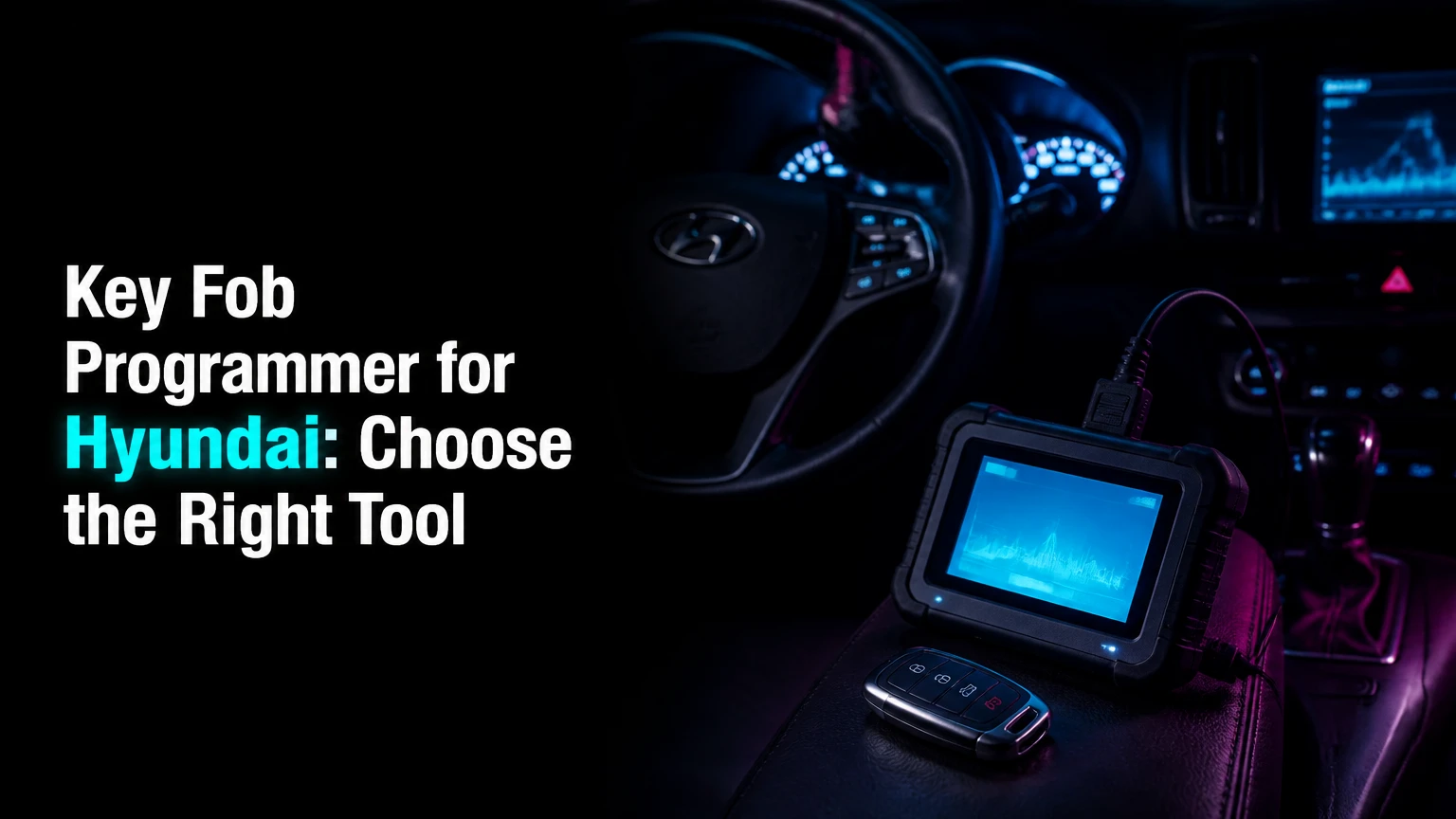
A key fob programmer for Hyundai is a diagnostic or dedicated device that registers a replacement remote, transponder key, or smart key with the vehicle’s body control and immobilizer systems. The correct device depends on the Hyundai model, year, market, key type, security system, and whether one working key remains.
Key Facts
A Hyundai remote can lock and unlock doors without being authorized to start the engine.
FCC ID, Hyundai part number, frequency, button layout, and key type must match the vehicle.
Professional immobilizer tools cost typically $400-$1,200 or more, while a locksmith often charges $150-$300.
Hyundai programming procedures are model-specific; no single programmer works with every Hyundai.
Registering keys may erase previously stored keys, so every working key should be available.
An ordinary OBD-II code reader cannot program immobilizer keys.
What Does a Hyundai Key Fob Programmer Do?
A Hyundai key programmer writes a replacement key’s identification data into the vehicle’s authorized-key memory. Depending on the vehicle, the memory is managed through an immobilizer control unit, smart key control unit, body control module, or related security architecture rather than through the engine ECU alone.
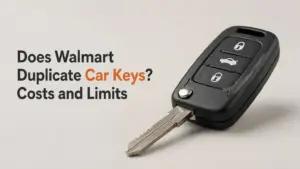
“Key fob” describes several different functions. The radio remote operates lock, unlock, trunk, panic, or hatch buttons. The immobilizer transponder authorizes engine operation. A proximity smart key may also control passive entry and push-button starting. One replacement housing can contain separate circuits for these functions.
That distinction explains a common diagnostic mistake. If the doors respond but the engine will not start, the remote portion may be synchronized while the transponder is unregistered. If the engine starts but the buttons do nothing, the immobilizer registration may be complete while remote learning, battery condition, or the receiver remains unresolved.
Remote Synchronization Versus Immobilizer Registration
Remote synchronization teaches the vehicle to recognize button commands. Immobilizer registration authorizes the key’s encrypted transponder identity for starting. Some Hyundai procedures combine both operations, while others expose separate menus for smart-key registration and remote-control learning.
The owner’s manual may describe a simple remote resynchronization procedure, but that procedure is not equivalent to immobilizer programming. A key that needs a security PIN, diagnostic authorization, or a smart-key registration function normally requires a capable scan tool or an authorized service provider.
How Does Hyundai Key Programming Work?
Hyundai key programming creates a secure authorization relationship between the vehicle and the replacement key. The tool communicates through the diagnostic connector or an approved service interface, authenticates the vehicle, and instructs the security module to add or replace key identifiers.
A transponder is normally passive and receives energy from the vehicle’s antenna. A smart key also contains a powered radio transmitter for remote and proximity functions. Rolling codes reduce replay risk because the vehicle and remote advance through changing command values rather than accepting one permanent button code.
The exact sequence varies by platform. Some systems require a PIN or security access calculation; others use online authorization, a token, a security gateway, or a vehicle-specific procedure. The AI Overview’s statement that every post-2007 Hyundai uses a complex six-digit PIN is too broad. PIN format, extraction method, and whether a PIN is exposed at all vary by model, market, immobilizer generation, and tool software.
What Happens Through the OBD-II Port?
The programmer communicates with vehicle modules through the OBD-II connector, usually below the driver’s side dashboard. The connector provides the network path, but the security authorization still depends on the vehicle’s software, module design, and tool coverage.
A typical professional workflow is:
- Identify the vehicle by VIN, market, year, and exact model.
- Confirm the replacement key’s part number, FCC ID, frequency, and transponder type.
- Stabilize vehicle voltage with a charged battery and, where appropriate, a regulated maintainer.
- Connect the programmer and select the Hyundai immobilizer or smart-key function.
- Follow the tool’s authentication procedure, which may involve a PIN, security code, token, or online account.
- Add the replacement key or perform the instructed erase-and-register procedure.
- Present the key at the specified antenna or start button when prompted.
- Test starting, passive entry, remote buttons, trunk release, and every existing key.
The success checkpoint is functional testing after the tool reports completion. A success message alone does not prove that the remote, immobilizer, antennas, and proximity functions all operate.
Which Key and Programmer Specifications Matter?
The vehicle’s exact application matters more than the programmer’s advertised make coverage. Confirm the Hyundai model and model year first, then match the key hardware and security protocol before comparing tools.
| Compatibility attribute | What to verify | Why it matters |
|---|---|---|
| Hyundai model and year | Elantra 2012, Tucson 2022, Santa Fe 2017, or exact vehicle | Security architecture changes across generations |
| Market and region | North America, Europe, Australia, or Asia | Frequency and key certification can differ |
| FCC ID or regional identifier | Example IDs include SY5DMFNA04 or TQ8-FOB-4F03 | Identifies radio hardware and approved application |
| Hyundai part number | Usually printed on the shell, label, or supplier listing | Distinguishes visually similar key variants |
| Frequency | Common examples include 315 MHz and 433 MHz | The receiver must accept the transmitter’s radio band |
| Key type | Blade key, transponder key, flip key, or smart key | Programmer functions and procedures differ |
| Button configuration | Two, three, four, or five buttons | Incorrect layouts often indicate incompatible electronics |
| Transponder system | Vehicle-specific immobilizer or smart-key protocol | Determines whether the engine authorization can be added |
The 315 MHz and 433 MHz figures are useful starting points, not universal rules. Regional frequency assignments and Hyundai applications vary, so the original fob label, vehicle documentation, and a reputable parts catalog are stronger evidence than a generic marketplace title.
Can a Universal Key Be Programmed?
A universal key can be programmed only when its hardware, radio profile, transponder technology, and software application support the target Hyundai. “Universal” usually means configurable across a defined list of applications, not compatible with every Hyundai.
Xhorse super keys and Autel universal keys may require two separate stages: generate or configure the key profile, then register the key with the vehicle. A universal key that passes the generation stage can still fail vehicle registration if the application, frequency, or security generation is wrong.
Which Programmer Type Fits Your Situation?
A mobile locksmith is usually the best value for one replacement key, while a professional OBD immobilizer tablet makes financial sense for repeated work. Single-vehicle kits are inexpensive but have narrow application limits and require careful verification.
| Option | Typical cost | Typical time | Best application | Main limitation |
|---|---|---|---|---|
| Single-vehicle bundled kit | $60-$120 | 10-20 minutes | Supported older vehicle with one replacement fob | Often VIN, model, or key-specific |
| Mobile automotive locksmith | $150-$300 | 20-60 minutes | One key, roadside service, or all-keys-lost case | Service availability varies by location |
| Hyundai dealership | $250-$500 | 1-3 hours | OEM key and factory procedure | Appointment, towing, and labor can increase cost |
| Prosumer immobilizer tool | $400-$800 | 30-90 minutes setup | Household fleet or repeated DIY work | Software subscriptions and coverage limits |
| Professional tablet | $800-$1,500 or more | 15-60 minutes after setup | Locksmith or repair shop | Training, tokens, subscriptions, and risk |
| OEM diagnostic route | Tool and subscription dependent | 1-4 hours | Factory-level procedures | Access and authorization requirements |
Professional OBD Tablets
Autel MaxiIM IM508S and IM608 II, Xtool X100 Pad3, and TOPDON T-Ninja products are examples of immobilizer-capable equipment. Their actual Hyundai coverage depends on software version, region, cable requirements, security access, and the specific vehicle.
Autel IM508S is a practical shop-level choice when immobilizer functions are a recurring service. IM608 II adds broader diagnostic capability and a larger operating platform. Xtool X100 Pad3 can be useful for Asian-vehicle coverage, but buyers should verify the exact Hyundai function list before purchase. A product page saying “key programming” does not guarantee all-keys-lost support or PIN retrieval.
Bluetooth and Universal-Key Tools
Xhorse VVDI Key Tool products and Autel KM100 are more useful for technicians handling multiple key brands than for a homeowner with one Hyundai. They can identify, generate, or configure supported universal keys, but they do not eliminate vehicle-specific authentication.
These systems also introduce workflow dependencies. The user may need an account, tokens, updates, a second diagnostic device, or a compatible key board. The low physical size of a Bluetooth dongle does not mean the total process is simpler.
Single-Vehicle Programming Kits
A bundled programmer may work when the product is explicitly matched to the Hyundai model, year, key type, and VIN or application. Many inexpensive listings use “programmer” to describe a remote-learning device that cannot register an immobilizer transponder.
Treat compatibility claims as incomplete until the listing states what the kit programs. A kit that promises a 10-minute procedure may handle only remote buttons, and its instructions may apply to a different manufacturer despite a similar-looking fob.
How Is a Hyundai Key Programmed?
A capable tool can register a supported Hyundai key in approximately 15-60 minutes after preparation, but the procedure is not universal. The most important success factors are the exact key match, stable vehicle voltage, complete working-key inventory, and the programmer’s current Hyundai coverage.
Before You Start
- Time: 30-90 minutes for research, setup, programming, and testing.
- Difficulty: Moderate for a supported add-key procedure; high for all-keys-lost work.
- Cost: $60-$1,200 or more, depending on the route.
- Tools: Compatible replacement key, programmer, OBD cable, charged vehicle battery, and battery maintainer when recommended.
- Prerequisites: Proof of ownership, all existing keys, correct vehicle identification, and a safe location with the vehicle immobilized.
Step 1: Identify the Vehicle and Key
Record the VIN, model, model year, ignition type, market, and whether the vehicle uses a blade key or push-button smart key. Compare the original key’s FCC ID, part number, button layout, and frequency with the replacement.
You will know this step is complete when the key supplier or tool coverage list identifies the exact application, not merely a broad Hyundai family. The common mistake is matching only the shell appearance.
Step 2: Prepare Every Existing Key
Place every working key beside the vehicle before starting. Some Hyundai procedures add one key without erasing others, while other procedures erase the authorized-key list and require all keys to be registered again.
You will know the inventory is ready when every key that must continue starting the vehicle is physically present. The common mistake is assuming an unpresented spare will remain valid after an erase-and-register operation.
Step 3: Stabilize Power and Connect the Tool
Charge the vehicle battery and connect the programmer to the OBD-II port. Avoid programming during a weak-battery condition, with aftermarket accessories drawing power, or while repeatedly cycling the ignition.
You will know communication is ready when the tool identifies the vehicle or successfully opens the Hyundai security menu. The common mistake is using a basic code reader, which may communicate with engine diagnostics but cannot perform immobilizer authorization.
Step 4: Select the Correct Security Function
Choose the exact Hyundai model or verify the VIN scan, then open the immobilizer, smart key, or key registration menu. Do not select a generic remote-learning menu when the engine-start authorization is missing.
You will know the function is appropriate when the tool describes the key type and registration operation for the vehicle. The common mistake is treating “remote,” “transponder,” and “smart key” as interchangeable terms.
Step 5: Authenticate and Register the Key
Follow the tool’s authentication instructions. The vehicle may require a security PIN, an online token, a gateway procedure, or a specified position against the start button or antenna.
You will know registration succeeded when the tool confirms the key count and the vehicle accepts the key for starting. The common mistake is entering a PIN from an internet listing that belongs to another vehicle, market, or security generation.
Step 6: Test Every Function
Switch the vehicle off, disconnect the tool when instructed, and test engine starting, lock, unlock, trunk or hatch release, panic function, passive entry, and the emergency blade. Test every previously working key.
You will know the job is complete when each intended key starts the engine and performs its assigned remote functions. The common mistake is stopping after the first successful start.
What Does Hyundai Key Programming Cost?
Typical consumer pricing ranges from $60-$120 for a supported single-vehicle kit, $150-$300 for a mobile locksmith, and $250-$500 at a dealership. A reusable programmer costs more initially and can become economical only when it replaces several paid programming jobs.
| Scenario | Typical total cost | Typical completion time | Financially sensible choice |
|---|---|---|---|
| One spare key, working key available | $150-$300 | 20-60 minutes | Mobile locksmith |
| One lost key, vehicle still drivable | $200-$500 | 1-3 hours | Locksmith or dealership |
| All keys lost, vehicle immobilized | $250-$700 plus travel or towing | 1-4 hours | Automotive locksmith |
| Two or more household vehicles | $400-$1,200 tool cost | Variable | Prosumer programmer |
| Frequent customer jobs | $800-$1,500 or more | 15-60 minutes per job | Professional tablet |
These are typical market ranges rather than fixed prices. OEM key cost, emergency travel, towing, regional labor rates, security tokens, and programming complexity can change the final invoice substantially.
What an Ordinary OBD Scanner Cannot Do
An ordinary OBD-II scanner reads diagnostic trouble codes and live data, but it generally cannot add an immobilizer key. Key programming requires a security-capable device with Hyundai-specific functions, and some procedures require authorization beyond the physical OBD connection.
This distinction prevents a frequent buying error. A $30 code reader may display engine faults, yet it cannot generate a transponder, retrieve security data, or write a smart-key identifier. Product listings that combine “diagnostics” and “key programmer” need a function-by-function verification.
Can You Program a Used or Aftermarket Hyundai Fob?
A used Hyundai fob may be reusable on some applications, but many smart keys are locked to their original vehicle, contain non-resettable security data, or are incompatible after prior registration. An aftermarket fob can work when its board, frequency, identifier, and transponder profile match the vehicle.
Inspect the circuit board and part number rather than relying on the shell. A replacement shell transfers appearance only; it does not provide the correct radio board or immobilizer chip. Some universal keys can be configured, but cloning and vehicle registration remain separate operations.
All-Keys-Lost Situations
All-keys-lost programming is materially riskier than adding a spare because the technician must establish security access without a working key. The vehicle may require a PIN, online authorization, module-specific access, or removal and bench work, especially when newer gateway restrictions block normal diagnostic access.
Proof of ownership and identification are standard safeguards. A locksmith or dealership is usually the safer choice when no key starts the vehicle, because an incorrect erase procedure can leave the vehicle without a usable authorized key.
Why Does a Hyundai Key Programmer Fail?
A Hyundai programmer usually fails because the key is incompatible, the tool lacks coverage, vehicle voltage is unstable, security access is blocked, or the selected function does not match the missing feature. A failed programming message does not automatically mean the vehicle’s immobilizer module is defective.
| Symptom | Likely cause | Correct response |
|---|---|---|
| No communication | Poor OBD connection, low voltage, wrong ignition state | Inspect connector, charge battery, repeat exact ignition position |
| PIN unavailable | Unsupported security generation or access restriction | Verify tool coverage and use an authorized locksmith or OEM route |
| Engine starts, buttons fail | Remote learning, battery, or receiver problem | Run remote registration and test a new battery |
| Buttons work, engine will not start | Transponder not registered or immobilizer fault | Use immobilizer diagnostics, not remote synchronization |
| Existing spare stopped working | Erase-and-register operation omitted it | Re-register every intended key |
| Tool reports success but proximity fails | Antenna, key battery, or smart-key module issue | Test battery and antennas before repeating programming |
A battery maintainer is a professional rule of thumb, not a guarantee. It reduces voltage-drop risk but cannot compensate for the wrong key, unsupported software, or a damaged body control module.
Newer Security Systems and Gateway Access
Hyundai security access differs by platform and software generation, so a blanket claim that every 2021 or newer vehicle needs an 8+8 bypass is unreliable. Some vehicles use gateway-controlled diagnostic access, while others expose different service paths or require online authorization.
Verify the exact model, year, region, tool software version, and cable requirement before buying a bypass harness. Bypassing a gateway incorrectly can damage connectors or modules and should be handled by a trained technician with the correct wiring documentation.
Alternatives to Buying a Programmer
A mobile automotive locksmith is the most practical alternative for one Hyundai key because the service includes key identification, programming, and immediate diagnosis when the first replacement fails. A dealership offers OEM parts and factory procedures, while an independent locksmith often provides faster mobile service at a lower typical labor cost.
| Alternative | Strength | Limitation | Best use |
|---|---|---|---|
| Hyundai dealership | OEM key and factory access | Appointment, labor, possible towing | Newer or heavily restricted systems |
| Mobile locksmith | On-site service and broad key inventory | Coverage depends on technician | One spare or roadside replacement |
| Independent repair shop | May combine diagnostics and programming | Not every shop has immobilizer equipment | Drivable vehicle with nonurgent need |
| OEM online service route | Factory-aligned information | Access, subscription, and training demands | Professional repair operation |
Which Programmer Should You Choose?
Choose a bundled kit only when the listing explicitly matches the Hyundai application and states whether it programs the remote, immobilizer, or both. Choose a prosumer tool for multiple personal vehicles, and choose a professional tablet when key work is a recurring paid service.
One Hyundai Owner
Use a mobile locksmith unless a verified single-vehicle kit costs materially less and the procedure is documented for the exact vehicle. Buying a $600 programmer for one $200 programming job usually has poor economics, especially after software updates and an incorrectly purchased key.
Household Fleet Owner
Consider a KM100-class or Xhorse-based system only after checking coverage for every vehicle in the household. A multi-brand tool can reduce future service costs, but universal-key inventory and software subscriptions add complexity.
Mechanic or Locksmith
Compare Autel IM508S, IM608 II, Xtool X100 Pad3, and TOPDON coverage by exact Hyundai functions rather than brand reputation. Prioritize all-keys-lost support, current security access, technical documentation, battery support, token pricing, and update terms.
Expert Rules That Prevent Expensive Errors
- The original key is the best compatibility reference. Shell shape and button count are weaker evidence than the FCC ID, board marking, frequency, and Hyundai part number.
- Remote success is not immobilizer success. Always test engine authorization separately from door-button operation.
- The cheapest tool has the narrowest failure margin. A $90 kit can be economical for one supported application, but it is a poor substitute for diagnostic capability when the vehicle has no working key.
- Do not erase keys casually. If the tool warns that stored keys will be cleared, stop and locate every key that must remain operational.
- Program with stable voltage. A maintainer reduces interruption risk, but the correct voltage equipment and instructions depend on the vehicle and tool manufacturer.
FAQ
Can I program a Hyundai key fob without a programmer?
Some older Hyundai remotes support owner-performed synchronization, but that procedure usually affects button functions only. A replacement key that must start the engine normally requires immobilizer or smart-key registration through a capable diagnostic tool, locksmith, or dealership.
How do I find my Hyundai fob frequency?
Check the original fob label, FCC ID, supplier documentation, and vehicle-market specification. North American Hyundai applications commonly use 315 MHz and many other markets commonly use 433 MHz, but frequency alone cannot confirm compatibility because the board, identifier, and transponder must also match.
Does a replacement Hyundai key need cutting?
A key with a physical emergency blade needs cutting to operate the door or ignition cylinder manually. A proximity smart key may start the vehicle electronically without a blade, but the emergency blade still needs cutting if you want a usable mechanical backup.
Why does my Hyundai say key not detected after programming?
“Key not detected” can result from a weak key battery, incorrect key placement, incompatible fob, failed proximity antenna, unregistered transponder, or a vehicle module fault. Replace the fob battery, use the documented emergency detection position, and diagnose the smart-key system before repeating registration.
Is a dealer always required for Hyundai key programming?
A dealer is not always required. A qualified automotive locksmith can program many Hyundai keys with professional equipment, but newer security systems, all-keys-lost cases, damaged modules, and restricted gateway access may make dealership or OEM-authorized service the practical route.
The Bottom Line
The right key fob programmer for Hyundai is determined by the exact vehicle and key specification, not by the word “universal” on a product listing. Verify the FCC ID, part number, frequency, key type, security generation, and tool coverage first; for one vehicle, a mobile locksmith typically costs less than owning a programmer, while repeated work can justify a professional OBD immobilizer tablet.