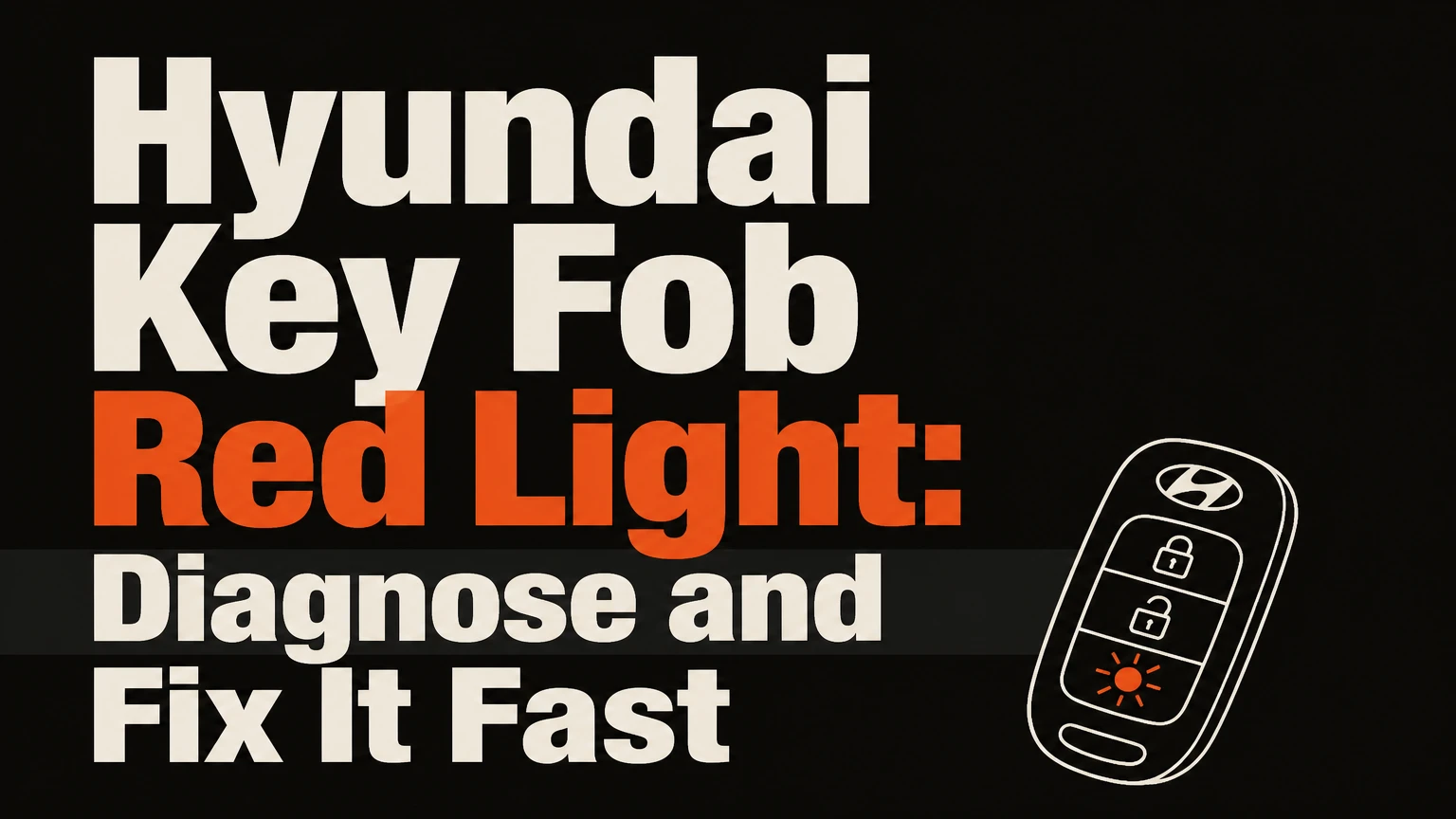
A Hyundai key fob red light usually means the fob is transmitting, a remote-start command failed, or the vehicle’s immobilizer cannot recognize the key. The light’s location determines the diagnosis: a small LED on the remote indicates fob activity, while a car-and-key symbol on the dashboard concerns authorization to start the engine.
Key Facts at a Glance
- A quick red flash on a Hyundai key fob during lock or unlock usually indicates radio transmission.
- A red remote-start result commonly means the vehicle rejected a starting condition, not automatically that the battery is low.
- A flashing car-and-key indicator means the Hyundai immobilizer may not be recognizing the transponder key.
- A dead fob battery does not always prevent push-button starting because many Hyundai models provide a backup reader position.
- Hyundai battery type, polarity, programming, and emergency-start position vary by model and year.
- A replacement fob must match the Hyundai part number, FCC ID, frequency, transponder system, and vehicle compatibility.
What Does a Hyundai Key Fob Red Light Mean?
A red light on the Hyundai remote itself usually shows that the transmitter is sending a signal. The same color can indicate a failed remote-start request on fobs with two-way feedback, while no LED response suggests a discharged battery, damaged switch, poor battery contact, or a fob design without an indicator.
The Hyundai remote-control LED does not diagnose every vehicle fault. It reports what the fob is doing, not whether the car accepted the command. A conventional one-way fob can flash when transmitting even when the vehicle is out of range or its receiver has a problem.
Identify the light location first
| Light location | Pattern or symbol | Most likely meaning | First action |
|---|---|---|---|
| Fob case | One quick red flash | Command transmitted | Check whether the car responds |
| Fob case | Repeated red remote-start feedback | Start request rejected | Close hood, doors, and trunk; confirm Park |
| Fob case | No LED response | Battery, contact, switch, or circuit fault | Open fob and inspect battery |
| Instrument cluster | Car with key symbol flashing | Immobilizer or key-recognition problem | Try backup key-reading procedure |
| Instrument cluster | Symbol briefly appears at ignition | Normal self-check on many models | Start vehicle and monitor behavior |
Hyundai owner manuals describe the immobilizer indicator as a status signal for the coded key system, although symbol color and display behavior vary across markets and model years. The owner’s manual for the specific VIN outranks a generic battery chart or online resynchronization recipe.
Why Does Remote Start Flash Red?
A Hyundai remote-start fob flashes red when the vehicle receives or reports a rejected start request on supported systems. Typical rejection conditions include an open hood, door, liftgate, or trunk, the transmission not being in Park, the ignition already being on, an alarm condition, or the vehicle being beyond the usable radio range.
Remote-start feedback is model-specific. Some Hyundai systems use green for successful confirmation, while others show hazard-light flashes or provide no two-way result. A red flash therefore requires a condition check rather than an immediate battery replacement.
Remote-start rejection checklist
- Press the Lock button once, then hold the Remote Start button for the duration specified by the fob or manual.
- Stand within a short, unobstructed range. A typical practical test is 20-30 feet, although the rated range differs by system.
- Confirm every door, the hood, and the liftgate or trunk is fully latched.
- Confirm the transmission is in Park and the parking brake or electronic parking brake is set where required.
- Check whether the engine is already running, the key is inside the vehicle, or the alarm is active.
- Watch for hazard-light confirmation instead of relying only on the fob LED.
Expert insight: Remote-start failure after a recent oil change or service often comes from a hood-switch condition. Technicians may leave a latch slightly misaligned, so the vehicle acts as though the hood is open even when the hood looks closed.
Remote start is also restricted by fuel, coolant, emissions, and security logic on some configurations. The red LED cannot distinguish those conditions. If lock and unlock work normally but remote start fails, investigate vehicle interlocks before buying a new fob.
What Does the Dashboard Key Light Mean?
The red car-and-key symbol on a Hyundai dashboard relates to the immobilizer, which verifies the electronic transponder associated with the key. A brief lamp during startup can be a normal system check, but a flashing indicator combined with “Key not detected,” cranking failure, or immediate engine shutdown indicates a recognition or authorization fault.
A remote fob contains separate functions: button-operated radio transmission and an immobilizer transponder. Replacing the coin cell can restore buttons, but it cannot repair a damaged transponder or erase a vehicle-side immobilizer fault.
Dashboard light patterns
| Dashboard behavior | Starting symptom | Likely area | Recommended response |
|---|---|---|---|
| Brief key symbol at ignition | Engine starts normally | Normal self-check | No repair required |
| Flashing key symbol | Engine will not start | Key recognition or immobilizer | Use backup key position |
| “Key not detected” message | Push button does nothing | Fob location, battery, antenna, or key | Move fob away from phone and retry |
| Light remains after successful start | Vehicle runs normally | Cluster or stored fault | Scan system if persistent |
| Both keys fail | Same no-start condition | Vehicle battery, antenna, immobilizer module | Test vehicle electrically and scan codes |
Hyundai manuals commonly state, “The immobilizer indicator blinks when the key is not recognized,” but the exact wording and indicator color differ by model. That distinction matters: a dashboard immobilizer lamp is not the same component as the tiny red LED on the remote.
Can You Start a Hyundai With a Dead Fob Battery?
Many push-button Hyundai models can start with a dead smart-key battery by placing the fob directly against the Start/Stop button or in the vehicle’s designated backup pocket. The immobilizer transponder can often be read at close range without relying on the coin cell, but the exact location depends on the model and year.
Backup-start procedure
- Enter the vehicle with the mechanical emergency key if remote unlocking fails.
- Remove the fob from a metal case, crowded key ring, or signal-blocking pouch.
- Press the brake pedal, then hold the Hyundai fob against the Start/Stop button, or place it in the documented backup slot.
- Press the Start/Stop button once.
- If the engine starts, replace the coin cell promptly and test locking, unlocking, and starting.
Success checkpoint: The engine starts and the dashboard no longer displays a key-recognition fault.
Common mistake: Holding the fob several inches from the button can fail because the backup antenna requires close coupling. A phone, second transponder key, or metal wallet can also interfere with the read.
Keyed-ignition Hyundai vehicles generally require a recognized transponder in the key blade or head. A drained remote battery may leave the immobilizer function unaffected, but a damaged or incorrectly cut key will not.
Which Battery Does a Hyundai Smart Key Use?
The correct Hyundai smart-key battery is the exact coin-cell designation printed on the existing battery or specified in the owner’s manual. CR2032 is common, but some older or different fobs use CR2025, and those cells are not interchangeable recommendations simply because they have the same diameter.
| Battery | Nominal voltage | Thickness | Typical Hyundai application | Substitution guidance |
|---|---|---|---|---|
| CR2032 | 3 volts | 3.2 mm | Many smart keys and remote fobs | Use only when specified |
| CR2025 | 3 volts | 2.5 mm | Some older or thinner fobs | Do not assume equivalent |
| CR2016 | 3 volts | 1.6 mm | Occasional specialized electronics | Verify manual and holder |
| Two-cell holder | 6 volts total | Model-specific | Uncommon aftermarket design | Match both cells exactly |
Coin-cell names describe dimensions and chemistry, not universal Hyundai compatibility. A thinner CR2025 may make poor contact in a holder designed for a CR2032, while forcing a thicker cell can deform the case or contact spring.
How Do You Replace the Fob Battery?
Replacing a Hyundai fob battery usually takes 2-5 minutes and costs about $3-$10 for a quality coin cell. The required tools are the mechanical key or a small flat screwdriver, a clean work surface, and the specified battery; the most important success factor is installing the correct cell with the correct polarity.
Before you start
| Requirement | Typical value |
|---|---|
| Time | 2-5 minutes |
| Difficulty | Easy, with moderate care around clips |
| Battery cost | $3-$10 per cell |
| Tools | Mechanical key, plastic pry tool, or small flat screwdriver |
| Prerequisite | Confirm battery number and polarity |
Step 1: Remove the mechanical key
Slide or press the release latch and pull out the emergency key. Examine the fob for a molded split line or pry slot. Do not insert a screwdriver into the button membrane because the rubber switch can tear.
Step 2: Open the case carefully
Insert the mechanical key or a plastic pry tool into the designated slot and twist gently. Work around the case rather than bending one corner sharply, since older plastic clips become brittle after repeated opening.
Step 3: Replace the cell
Lift the old battery from the retaining clip without bending the terminal. Install the specified battery in the same orientation, usually with the positive side facing upward, but copy the original position because some housings differ.
Step 4: Close and test the Hyundai fob
Snap the case together, reinstall the mechanical key, and test lock, unlock, panic, and trunk functions from several feet away. Then use the backup-start test only if the vehicle previously reported a key-recognition fault.
Common mistake: Touching both faces of a new lithium coin cell with wet or greasy fingers can leave contamination on the contacts. Hold the battery by its edge and wipe a dirty contact with a clean, dry swab.
Replacing the cell normally does not erase the fob’s identity. If the buttons remain dead after a correctly installed battery, inspect the spring contacts, button board, water damage, and case alignment before attempting programming.
Does a Hyundai Fob Need Resynchronizing?
A Hyundai key fob does not have one universal owner-performed resynchronization procedure. Some older Hyundai systems support a manual registration sequence, while many newer smart keys require model-specific diagnostic equipment, an authorized dealer, or an automotive locksmith with compatible programming software.
Online instructions that say to turn the ignition to ACC and hold Unlock for 10-20 seconds may apply to particular older vehicles, aftermarket systems, or other manufacturers. Applying that sequence to every Hyundai can waste time and may not program a modern immobilizer key.
Safe diagnostic order
- Install the correct battery and verify polarity.
- Test the fob beside the vehicle, then test the spare fob.
- Check whether the mechanical key unlocks the door and whether the vehicle starts using the backup reader.
- Consult the model-year owner’s manual for a documented transmitter procedure.
- Obtain programming service if the manual provides no procedure or all keys are unrecognized.
Expert insight: Remote-button programming and immobilizer-key programming are separate operations on many vehicles. A fob can lock the doors yet fail to authorize engine starting, or it can start the engine while its buttons need separate attention.
How Can You Isolate the Fault?
The fastest fault isolation method is a controlled comparison using the spare key, a fresh battery, and the vehicle’s backup-start position. If both fobs fail identically, the vehicle receiver, antenna, body-control module, or vehicle battery becomes more likely than two simultaneous remote failures.
| Test result | Most likely diagnosis | Next test | Usual repair path |
|---|---|---|---|
| One fob works, one fails | Original fob battery or circuit | Fresh cell and contact inspection | Battery, case repair, or replacement |
| Lock works at 2 feet only | Weak cell or damaged antenna | Fresh cell and second location | Battery or fob replacement |
| Buttons fail, backup start works | Remote transmitter problem | Test spare remote | Fob repair or programming |
| Both fobs fail, car battery weak | Low vehicle voltage | Measure battery voltage | Charge or replace vehicle battery |
| Both fobs fail, car battery healthy | Receiver or immobilizer issue | Scan security system | Dealer or qualified locksmith |
| Remote start fails, lock works | Interlock or remote-start condition | Check hood and Park status | Switch adjustment or diagnosis |
A practical workshop rule is to test the vehicle’s 12-volt battery before condemning the immobilizer. Low system voltage can create multiple warning lights and communication faults, especially after the vehicle has sat for weeks.
Why Does Hyundai Say Key Not Detected?
Hyundai displays “Key not detected” when the vehicle cannot receive or authenticate the smart key at the expected time. Common causes include a weak fob battery, excessive distance, radio interference, a metal container, a second key touching the fob, a discharged vehicle battery, or a failed antenna.
Try the fob in the backup position before assuming the key is permanently damaged. Keep the key away from wireless charging pads, smartphones, laptops, toll tags, and other transponders during the test.
Water exposure deserves special attention. A fob that was washed, dropped, or crushed may have corroded contacts or a fractured circuit board even when its LED still flashes, because the LED and immobilizer circuitry do not prove that every function remains healthy.
What Should You Do If the Car Will Not Start?
If a Hyundai will not start and the dashboard key symbol flashes, use the backup fob-reading procedure, test the spare key, and check vehicle-battery voltage before repeatedly pressing the Start button. Repeated button presses do not bypass the immobilizer and can drain the 12-volt battery further.
Use the mechanical key to access the vehicle, remove nearby electronics, and hold the fob directly against the Start/Stop button or place it in the specified pocket. If neither key works, stop forcing the ignition sequence and arrange a diagnostic scan or roadside service.
Situations requiring professional help
- Both programmed keys fail after fresh batteries.
- The key was lost, stolen, submerged, or physically broken.
- The immobilizer lamp remains active after a successful backup start.
- The vehicle has a recent alarm, remote-start, stereo, or body-control installation.
- A replacement fob has the wrong FCC ID, frequency, blade, or transponder.
- The car has no electrical power or multiple communication warnings.
A locksmith can often come to the vehicle, verify key compatibility, cut a blade, and program a replacement. A dealer is preferable when the vehicle has a warranty-related electronic fault, an unusual new security platform, or no surviving programmed key.
How Much Does Repair or Replacement Cost?
Typical US pricing ranges from $3-$10 for a battery, $100-$250 for many locksmith-supplied replacement keys, and $250-$600 or more through a dealership when cutting, programming, and emergency access are included. Prices vary by model, region, key availability, whether one working key remains, and whether towing is required.
| Service path | Typical parts cost | Typical total price | Timeframe | Best fit |
|---|---|---|---|---|
| DIY coin-cell replacement | $3-$10 | $3-$10 | 2-5 minutes | Dead or weak remote battery |
| Mobile locksmith | $60-$180 | $120-$300 | 30-90 minutes | One key lost or damaged |
| Hyundai dealer, one key | $150-$350 | $250-$600 | 1-4 hours | OEM key and supported programming |
| Online fob plus programming | $40-$180 | $100-$300 | 2-7 days | Correct part verified in advance |
| All keys lost with towing | $150-$400 | $400-$900+ | Same day to several days | No usable key remains |
Ask whether the quote includes the fob, blade cutting, immobilizer programming, remote-button setup, emergency service, taxes, and deletion of a stolen key. A low advertised price may cover only an unprogrammed shell.
Which Replacement Option Makes Sense?
A mobile automotive locksmith is usually the value choice when one key remains and the locksmith confirms compatibility. A Hyundai dealer offers the most predictable OEM sourcing, while an online fob is economical only when the exact part number, FCC ID, frequency, transponder, and programming policy have been verified.
| Buying detail | Why it matters | Failure if mismatched | Verification source |
|---|---|---|---|
| Hyundai part number | Identifies vehicle-specific hardware | Fob may not pair | Original fob and dealer catalog |
| FCC ID | Identifies radio transmitter family | Buttons may never work | Fob label or regulatory marking |
| Frequency | Must match receiver region | No reliable signal | Original fob and vehicle market |
| Blade profile | Determines mechanical door fit | Key will not unlock or turn | Existing emergency key |
| Transponder type | Controls engine authorization | Car may remain immobilized | Locksmith or dealer VIN lookup |
Do not buy solely by appearance. Hyundai uses visually similar remotes across model years, but similar housings can contain different frequencies, button layouts, transponders, and encryption systems.
Common Mistakes and How to Fix Them
Assuming every red flash means low battery
A red flash can be normal transmission or a rejected remote-start command. Replace the cell when range has declined, the LED is weak or absent, or the vehicle reports key detection problems, then test the result.
Installing CR2032 by habit
CR2032 is common, not universal. Read the existing cell and manual, inspect the holder, and match polarity; a wrong thickness can create an intermittent contact fault.
Programming a mismatched online fob
FCC ID alone may not prove full compatibility. Confirm the Hyundai part number, frequency, blade, transponder, and VIN support before paying for programming.
Repeating a generic resync sequence
A 10-20 second Unlock procedure is not a universal Hyundai standard. Follow the vehicle manual, and use a locksmith or dealer when immobilizer registration is required.
Ignoring the vehicle battery
A weak 12-volt battery can mimic a security fault. Measure voltage with the vehicle off, charge or test the battery, and scan for body-control communication codes when both keys fail.
The Bottom Line
The meaning of a Hyundai key fob red light depends on location and pattern. A quick LED flash on the remote commonly means transmission, a remote-start red result usually means a rejected operating condition, and a flashing car-and-key dashboard symbol points toward immobilizer recognition.
Start with the least expensive controlled test: install the exact specified coin cell, inspect its contacts, try the backup reader, and compare the spare key. If both keys fail, the vehicle battery, receiver, antenna, or immobilizer system needs diagnosis rather than another battery.
Frequently Asked Questions
Will a Hyundai key fob work after changing only the battery?
Yes, a Hyundai remote normally retains its programming after a routine coin-cell replacement. Confirm the battery designation, polarity, and contact pressure first. If the buttons remain inactive, the problem may involve a damaged circuit board, worn switch, water intrusion, or vehicle-side receiver rather than lost synchronization.
How long should a Hyundai key fob battery last?
A typical Hyundai coin cell lasts 1-3 years, depending on button use, temperature, passive-entry activity, and storage distance from the vehicle. Short range, inconsistent locking, or a dim LED indicates replacement time. Cold weather can temporarily reduce available voltage and expose a marginal battery sooner.
Can a phone interfere with a Hyundai smart key?
Yes, a phone, wireless charger, laptop, toll device, metal wallet, or second transponder key can interfere with detection in specific situations. Move the Hyundai fob by itself to the backup reader and retry. If the isolated fob works, change how the keys and electronics are stored.
Does a red fob light prove the battery is healthy?
No. A red LED proves only that some fob circuit is operating and attempting to transmit. The signal may be weak, the battery may be near exhaustion, or the vehicle may reject the command for another reason. Button range and backup-start behavior provide stronger diagnostic evidence.
Can a locksmith program every Hyundai key?
No. Locksmith capability depends on the model year, security system, region, available software, key stock, and whether a programmed key remains. Ask for VIN-based compatibility confirmation before dispatch. A dealer may be necessary for new platforms, all-keys-lost situations, or unresolved immobilizer faults.
Should you replace the fob or the Hyundai car battery first?
Replace the fob battery first when one remote has weak range and the vehicle otherwise operates normally. Test the vehicle’s 12-volt battery when both fobs fail, the starter clicks, interior lights dim, or several dashboard systems reset. The two batteries power separate systems and require different tests.