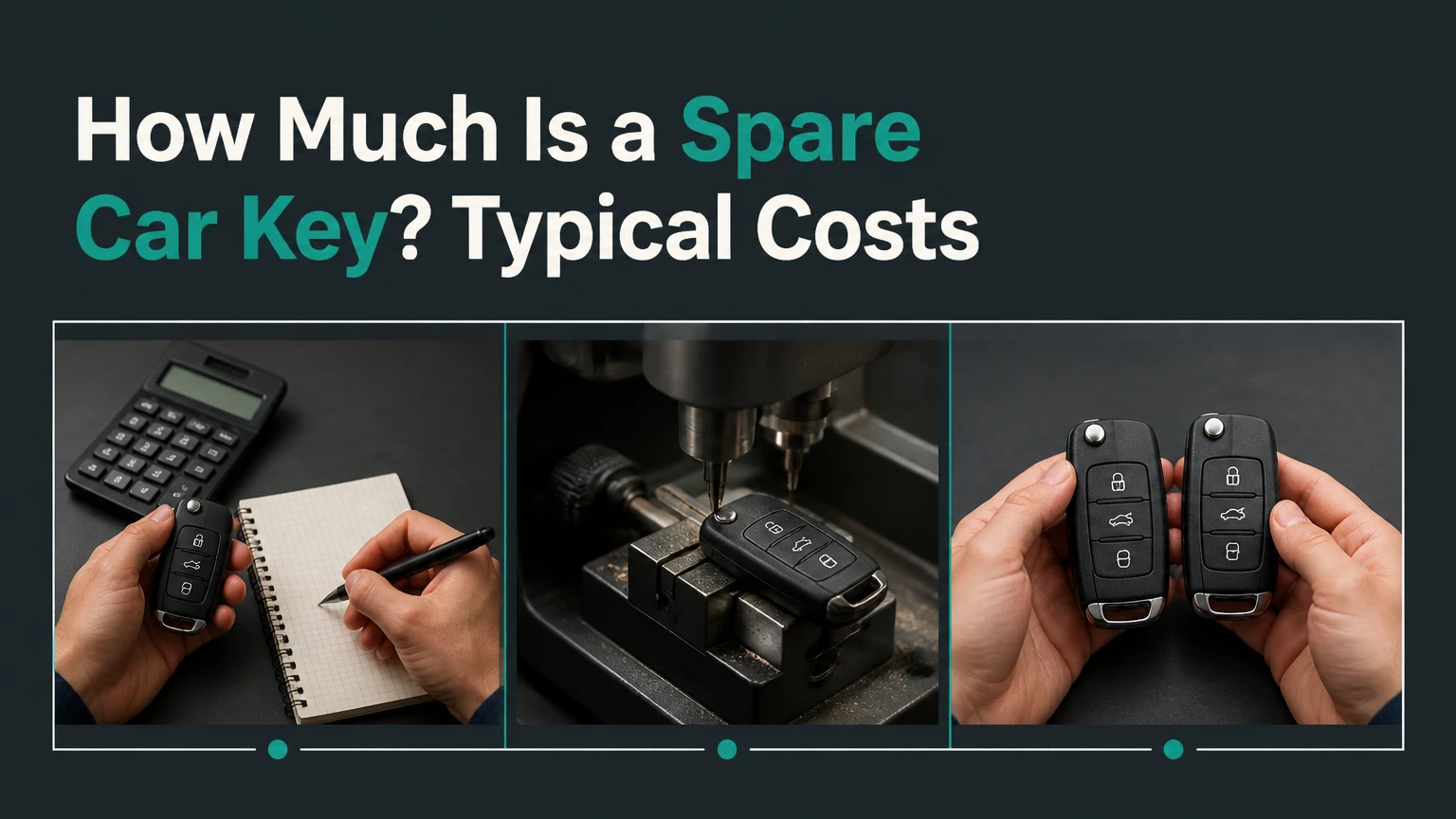
A spare car key typically costs $10-$35 for a mechanical duplicate, $70-$175 for a transponder key, $150-$400 for a remote or switchblade key, and $250-$600 or more for a smart key fob. The final price depends on the vehicle’s year, key technology, provider, whether one working key remains, and local labor rates.
Key Facts at a Glance
- A basic mechanical car key usually costs $10-$35 and may not require electronic programming.
- A transponder key generally costs $70-$175, including typical cutting and programming.
- A remote-head or switchblade key commonly costs $150-$400.
- A push-button smart key usually costs $250-$600 or more, especially through a dealership.
- Making a spare while one working key remains is usually cheaper than replacing the only lost key.
- A remote that locks the doors is not necessarily programmed to authorize engine starting.
How Much Is a Spare Car Key?
A spare car key costs about $10-$600 or more in the United States, depending mainly on whether the key contains an immobilizer chip, remote transmitter, or proximity electronics. A locksmith often charges less than a dealership, while an OEM smart fob, luxury vehicle, emergency visit, or all-keys-lost situation increases the total.
Typical prices include the key hardware, mechanical cutting, electronic programming, and labor, but providers do not package those components consistently. A $40 online key may become a $140 finished key after cutting and programming. A dealer quote may combine a $250 fob, a $100 programming charge, and a separate service fee.
A working original key is the biggest price advantage. The locksmith can usually decode or duplicate the existing blade and use the vehicle’s current key data. If every key is gone, the technician may need to verify ownership, retrieve security information, create a new key from the vehicle, and remove missing keys from memory.
Typical total prices by situation
| Situation | Typical total cost | Typical time | Main price driver |
|---|---|---|---|
| Mechanical duplicate with working key | $10-$35 | 5-10 minutes | Blade material and cutting |
| Transponder spare with working key | $70-$175 | 15-30 minutes | Chip type and programming |
| Smart-fob spare with working key | $250-$600 | 30-60 minutes | Proximity fob and security access |
| All keys lost, standard vehicle | $150-$450 | 45-120 minutes | Vehicle entry and key generation |
| All keys lost, luxury vehicle | $400-$1,200+ | 1-4 hours | Proprietary immobilizer systems |
These are typical US consumer ranges, not guaranteed quotes. Rural travel, after-hours service, imported vehicles, unusual keyways, and model-specific security systems can move the price outside the table.
Which Key Type Changes the Price?
Key technology determines most of the spare-key price because each electronic layer adds hardware, programming, and compatibility requirements. A metal-only key needs cutting, while a modern fob may require a transponder, encrypted remote commands, proximity detection, and vehicle security authorization.
| Key type | Identifying feature | Typical spare price | Typical service time |
|---|---|---|---|
| Traditional mechanical key | Metal blade, no chip | $10-$35 | 5-10 minutes |
| Transponder key | Chip in plastic key head | $70-$175 | 15-30 minutes |
| Remote-head key | Blade plus lock/unlock buttons | $150-$350 | 20-45 minutes |
| Switchblade key | Folding blade and remote housing | $175-$400 | 20-45 minutes |
| Smart or proximity fob | Push-button start and passive entry | $250-$600+ | 30-60 minutes |
A transponder key can look almost identical to a basic key, but its embedded chip must exchange an accepted identification code with the immobilizer. The engine may crank or turn over differently by model, but the vehicle will not remain running unless the immobilizer accepts that code.
A smart key adds proximity sensors and low-frequency vehicle antennas. The hidden emergency blade may unlock the door, but it normally cannot start a push-button vehicle by itself.
What Are You Paying For in a Modern Car Key?
A modern car key combines physical access, engine authorization, and remote convenience, so a spare may contain several separately serviceable functions. The mechanical blade opens a lock, the transponder authorizes starting, and the radio transmitter operates remote locking or trunk-release functions.
Rolling-code systems change the transmitted command after button presses, reducing the value of a captured radio signal. Passive-entry systems detect a fob near the vehicle and may require a separate interior antenna to confirm that the fob is inside before allowing the engine to start.
Those functions can fail independently. A weak coin-cell battery may stop remote buttons while the transponder still starts the car. Conversely, a remote can be synchronized correctly while the immobilizer chip remains unprogrammed, producing a key that locks doors but cannot start the vehicle.
The four cost-producing components
- Blade: The locksmith cuts an edge-cut, laser-cut, or side-milled pattern. Laser-cut and high-security blades require specialized equipment.
- Transponder: The immobilizer chip stores or presents credentials recognized by the vehicle’s security module.
- Remote transmitter: Buttons send commands for locks, trunk release, alarm, or remote start where equipped.
- Proximity fob: Passive-entry hardware communicates with antennas and may use a secure rolling or encrypted protocol.
A practitioner rule is simple: count the functions the original key performs, not the shape of its plastic shell. A visually similar fob with the wrong chip, frequency, FCC identification, or vehicle protocol may never become a usable key.
How Is a Spare Car Key Made?
A spare car key is normally made in five stages: vehicle identification, compatible hardware selection, blade cutting, electronic programming, and functional testing. A locksmith or dealer needs the exact make, model, year, trim when relevant, and proof that the customer is authorized to possess the vehicle.
Step 1: Identify the vehicle and key system
Record the vehicle identification number, ignition style, existing key markings, and whether the car uses a physical ignition cylinder or push-button start. The VIN helps identify factory configuration, but it does not always identify every regional frequency or later replacement module.
Bring the registration, title, insurance card, and government-issued identification when requesting service. Requirements vary by provider and jurisdiction.
Step 2: Match the hardware
The replacement may be OEM, aftermarket, refurbished, or a compatible universal product. Check the part number, blade profile, button layout, transponder type, operating frequency, and FCC ID where applicable.
A used fob can be a poor bargain. Some vehicles permanently bind a fob to another car, while others permit reprogramming only through specialized equipment. Ask the provider to confirm whether the supplied hardware is new, reusable, or locked to a previous vehicle.
Step 3: Cut the blade
The technician can copy the existing key, decode its cuts, or obtain a cut code through an authorized source. A VIN does not automatically give every locksmith permission to retrieve a manufacturer’s key code.
The finished blade should turn smoothly in the door and ignition without force. Never file a new key casually or use a wire brush to “fix” a bad cut. Burrs, incorrect depths, or a wrong keyway require recutting or replacement, and forcing the blade can damage a lock cylinder.
Step 4: Program the immobilizer and remote
Programming may use an onboard procedure, a diagnostic scan tool connected to the OBD-II port, or a manufacturer server. The method varies by brand, year, immobilizer generation, and the number of keys already stored.
Remote synchronization and transponder programming are separate operations on many vehicles. Request confirmation that both the lock functions and engine authorization were tested.
Step 5: Test every function
Test door locks, trunk release, panic alarm, remote start if equipped, the emergency blade, passive entry, and engine starting. Test the spare with the original key removed from the vehicle because some proximity systems can mask a faulty spare when two fobs are present.
You know the job is complete when the spare starts the vehicle independently, operates the intended remote functions, and opens the driver’s door manually if an emergency blade is included.
Is a Locksmith or Dealership Cheaper?
An automotive locksmith is usually the lower-cost option for standard domestic vehicles, while a dealership offers the most predictable OEM sourcing and manufacturer-specific programming. The better choice depends on the key system, urgency, vehicle location, warranty requirements, and whether the vehicle is a newer luxury model.
| Provider | Typical hardware range | Typical total range | Best use case |
|---|---|---|---|
| Hardware retailer only | $15-$300 | $15-$300 before service | Owner already has compatible programming access |
| Independent locksmith | $40-$400 | $70-$600 | Most standard cars and mobile service |
| Dealership parts and service | $100-$500 | $200-$800+ | OEM fobs and proprietary systems |
| Emergency mobile locksmith | $50-$400 | $150-$700 | Locked-out or after-hours situations |
Ask every provider for an itemized quote covering hardware, cutting, programming, travel, tax, and emergency fees. “Key replacement” can mean a cut metal blade, a complete programmed fob, or an all-keys-lost service.
Dealerships are often appropriate for newer BMW, Mercedes-Benz, Audi, some Land Rover models, and vehicles with security modules that require factory authorization. Independent locksmiths can handle many such vehicles, but capability varies by model and local equipment.
What should you ask before booking?
- Does the quoted price include cutting and immobilizer programming?
- Is the replacement OEM, aftermarket, refurbished, or universal?
- Will the technician erase a lost key from the vehicle’s memory?
- Can the provider service the exact model year and trim?
- Is mobile travel included in the quoted amount?
- Will the new key come with a warranty?
- What proof of ownership is required?
The cheapest quote is not the lowest total cost if an incompatible fob requires another appointment. Compatibility confirmation has more value than a low advertised hardware price.
Can You Buy and Program a Key Online?
You can buy some car-key hardware online, but online purchase is safest when the exact part number, frequency, chip, blade profile, and programming method have already been confirmed. Online hardware alone does not guarantee a working spare, and many vehicles still require professional programming.
Older vehicles may support an owner-programming sequence when two recognized keys are already available. The vehicle’s owner manual is the controlling source. A procedure that works on one Ford, Chevrolet, Chrysler, or Toyota model may fail on another year or trim.
Online buying is a poor choice when the vehicle has push-button start, a restricted smart key, a European immobilizer, no working key, or an uncertain fob part number. Some shops will cut customer-supplied blanks, but others refuse them because defective hardware creates diagnostic disputes.
Do not repeatedly try random programming sequences or unverified scan tools. Incorrect procedures can add failed keys, drain the battery, or leave the customer unable to distinguish a dead fob from an immobilizer fault.
What Does a Spare Cost if All Keys Are Lost?
Replacing a spare when all keys are lost typically costs $150-$450 for many standard vehicles and $400-$1,200 or more for luxury vehicles. All-keys-lost work costs more because the technician must gain vehicle access, create a key without an original, and often secure the vehicle against the missing key.
A locksmith may decode the lock, retrieve an authorized key code, generate a transponder credential, and program the vehicle through diagnostic equipment. A dealer may require the vehicle at its facility, which adds towing when the car cannot be driven.
Ask for lost-key deletion. Removing missing keys from the immobilizer or key-memory list prevents a found or stolen key from starting the vehicle, although deleting remote access and changing mechanical lock cylinders are separate matters on some cars.
Spare versus all-keys-lost pricing
| Service condition | Typical labor complexity | Security action | Typical price |
|---|---|---|---|
| One working key present | Low to moderate | Add a key | $70-$600 |
| Two working keys present | Low | Add a key or owner-program | $10-$400 |
| One key lost, one remains | Moderate | Add key, optional deletion | $100-$650 |
| No working keys, vehicle accessible | High | Generate and program key | $150-$900 |
| No working keys, vehicle locked | High | Entry, generation, programming | $250-$1,200+ |
A spare made before the last key disappears is therefore a security and cost-control measure. It also avoids making a nonworking vehicle the location where the replacement decision must be made.
Can Insurance Pay for a Spare Car Key?
Insurance may pay for a lost or stolen car key only when the policy includes key replacement, roadside assistance, comprehensive coverage, or a dedicated vehicle-protection benefit. Standard collision coverage usually does not pay for an ordinary duplicate made for convenience.
Coverage differs sharply by insurer and policy. A benefit may have a $100-$500 limit, a per-claim deductible, a limit on annual claims, or an exclusion for a spare key that was never lost. Roadside assistance may cover lockout service without paying for the replacement fob.
Check the policy declarations page and ask the insurer:
- Is lost-key replacement covered?
- Does the benefit include programming and mobile labor?
- Does a deductible apply?
- Is OEM hardware required?
- Must the claim be approved before service?
- Is theft documentation required?
- Is the benefit limited to one claim per policy year?
Keep the invoice, proof of ownership, police report if theft occurred, and details of any deleted key. An insurer may reject a claim when the customer cannot show that the key was connected to the covered vehicle.
Why Does a New Key Not Work?
A new car key that does not work usually has a compatibility, programming, battery, blade-cut, or vehicle-antenna problem. The symptom identifies the likely layer: remote failure points toward the fob battery or synchronization, while a remote that works but cannot start the engine points toward immobilizer programming.
| Symptom | Likely cause | Safe first check | Likely remedy |
|---|---|---|---|
| Buttons do nothing | Dead coin-cell battery | Install specified battery | Resynchronize or replace fob |
| Remote works, engine will not start | Transponder not accepted | Test with original key | Reprogram immobilizer |
| Engine starts then stops | Anti-theft authorization failure | Watch security indicator | Diagnose and program chip |
| Blade will not turn | Wrong keyway or cut | Stop forcing cylinder | Rec ut or replace blade |
| Passive entry fails | Battery, antenna, or sleep mode | Test emergency blade and battery | Wake, program, or diagnose fob |
| One function works only | Incomplete programming | Test every button separately | Repeat correct procedure |
“Remote works but car will not start” is one of the most common misleading outcomes. Lock-button synchronization can succeed even when the transponder credential was never added to the engine immobilizer.
A smart-key fob that appears dead may need a new CR2032 or CR2025 battery, depending on the manufacturer. Use the specified battery and correct polarity. If a new battery changes nothing, the fob may be damaged, unprogrammed, locked to another vehicle, or outside the vehicle’s detection range.
Which Option Fits Your Situation?
The best spare-key route changes with the vehicle and the owner’s risk tolerance. A standard turn-key car with one working key usually suits an independent locksmith, while a newer proximity vehicle with a restricted security system may justify dealership service.
Budget-conscious owner
Choose a reputable automotive locksmith and request a compatible aftermarket or OEM-equivalent key with a written total price. This route often saves $100-$300 compared with a dealership for standard vehicles, but confirm that the technician supports the exact model year.
New-car or warranty owner
Choose the dealership when the vehicle is under a manufacturer warranty, the fob is proprietary, or the dealer is the only local source with confirmed programming access. The premium buys documented OEM sourcing and a clear chain of responsibility.
Luxury or European vehicle owner
Obtain quotes from both a dealer and a specialist locksmith with model-specific equipment. Do not assume every mobile locksmith can program encrypted security modules, and do not buy a used fob until the provider confirms that the fob can be reset.
Fleet and rideshare operator
Keep at least two independently tested keys for each vehicle and label them by vehicle identification number. A fleet should also document who holds each key and request deletion of any missing credential immediately.
Owner with one remaining key
Make the duplicate now. Waiting until the remaining key breaks, becomes water-damaged, or disappears converts a routine duplication into an emergency all-keys-lost job.
What Mistakes Increase the Final Cost?
The most expensive mistakes are ordering by appearance, confusing remote synchronization with engine programming, and postponing duplication until no working key remains. These errors create repeat labor, incompatible hardware, towing, or security work that a correctly specified spare would have avoided.
- Ordering by year alone: The same model can use different frequencies, chips, button layouts, and proximity systems across trims or markets.
- Choosing the cheapest unbranded fob: A low-cost shell may contain an incompatible or non-resettable circuit board.
- Ignoring the hidden blade: A smart fob should manually unlock the driver’s door before an emergency occurs.
- Failing to test with the original key away: Two nearby fobs can conceal a weak proximity signal or programming failure.
- Forcing a rough blade: Mechanical resistance can damage an ignition or door cylinder. Request a corrected cut instead.
- Not deleting a lost key: A found key may continue to unlock or start the vehicle if the system retains its credential.
One practical rule is to preserve the original until the new key passes every test. Do not allow a technician to leave after checking only the lock button.
How Long Does Spare-Key Service Take?
A spare car key usually takes 5-10 minutes for a mechanical duplicate, 15-45 minutes for a transponder or remote key, and 30-60 minutes for a smart fob when the correct hardware and a working key are available. All-keys-lost service commonly takes 45 minutes to four hours.
The appointment may take longer when the technician must order hardware, obtain security authorization, decode a high-security blade, remove a lost key, or troubleshoot a vehicle module. Dealer appointments often add waiting time even when the programming itself takes less than an hour.
| Task | Typical duration | Delay risk |
|---|---|---|
| Mechanical key cutting | 5-10 minutes | Wrong keyway or worn original |
| Transponder duplication | 15-30 minutes | Restricted chip or failed scan tool |
| Remote-head programming | 20-45 minutes | Incorrect frequency or fob lock |
| Smart-fob programming | 30-60 minutes | Factory authorization or multiple keys |
| All-keys-lost recovery | 45-240 minutes | Vehicle entry, security data, towing |
The Bottom Line
A spare car key costs $10-$35 for a metal duplicate, $70-$175 for a transponder key, $150-$400 for a remote or switchblade key, and $250-$600 or more for a smart fob. A working original key, accurate vehicle information, and an itemized locksmith quote usually produce the lowest safe total.
The exact answer to how much is a spare car key depends less on the metal blade than on the vehicle’s immobilizer and proximity technology. Confirm cutting, remote synchronization, engine authorization, emergency-blade operation, and lost-key deletion before accepting the job.
Frequently Asked Questions
Can a locksmith make a spare car key without the original?
A locksmith can make many spare car keys without the original by using the VIN, lock decoding, manufacturer key codes, and diagnostic programming equipment. The provider must verify ownership, and the job generally costs more because the technician creates the key from vehicle data rather than copying an existing blade.
How often should a car key fob battery be replaced?
A car key fob battery commonly lasts one to three years, but heavy button use, extreme temperatures, and passive-entry polling can shorten that period. Replace the specified coin cell when range decreases or the vehicle reports a low-key battery, then test remote and proximity functions separately.
Can a used key fob be reprogrammed to another car?
A used key fob can be reprogrammed on some vehicles, but many manufacturers permanently lock the fob to its original vehicle or require a reset that independent shops cannot perform. Confirm the exact part number, frequency, FCC ID, and reset capability before buying used hardware.
Is a spare car key covered by roadside assistance?
Roadside assistance commonly covers lockout entry or towing, but it does not automatically cover the replacement key, fob hardware, cutting, or programming. Review the plan’s dollar limit and claim rules before authorizing service, because a roadside benefit may pay only for access to the locked vehicle.
Should I keep two spare keys?
Keeping two spare keys is worthwhile for vehicles shared by multiple drivers, fleets, and cars with expensive smart fobs. Store one separately from the daily key and test both periodically. A second spare prevents a single lost key from becoming an immediate all-keys-lost emergency.