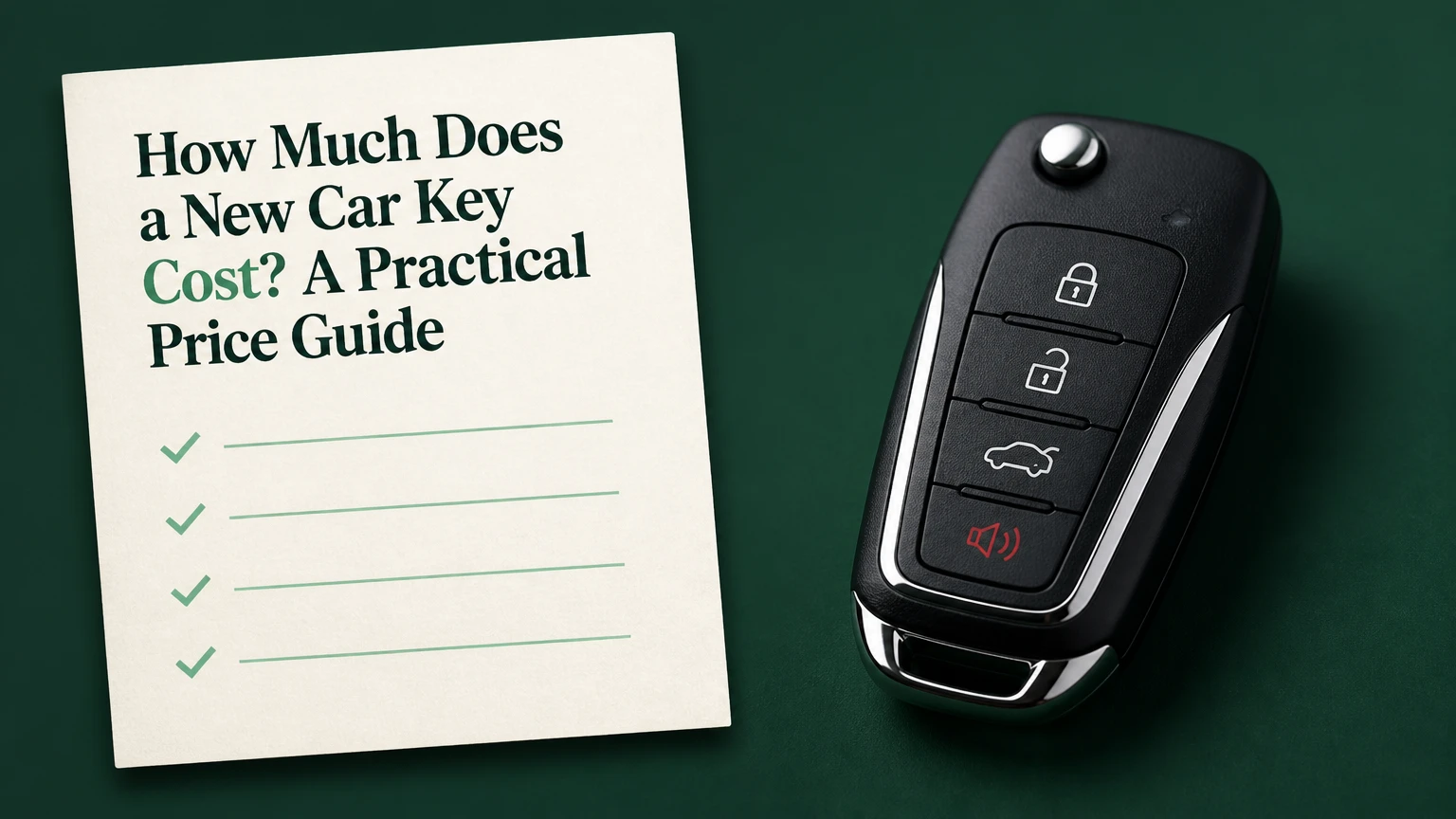
A new car key typically costs $10-$500 or more in the United States, with basic metal keys at the low end and proximity fobs for luxury or newer vehicles at the high end. The final price depends on the key type, vehicle year and model, whether a working key remains, programming requirements, provider, and emergency travel or towing fees.
Key Facts
A basic mechanical car key usually costs $10-$50 and may take 5-10 minutes to cut.
A transponder-key replacement commonly costs $50-$175, including typical cutting and programming.
A remote-head key or key-fob combination commonly costs $100-$250.
A proximity or smart key generally costs $200-$500 or more, with some luxury replacements exceeding $600.
A mobile automotive locksmith often completes standard replacements in 20-60 minutes, while a dealer may require an appointment and vehicle delivery.
A dead fob battery can cost about $5-$15 to replace, so diagnosis should come before buying a new fob.
How Much Does a New Car Key Cost?
The typical replacement price is $10-$500+, but most everyday replacements fall between $75 and $300. A 1990s vehicle with a mechanical key can be copied cheaply, whereas a 2020s push-button-start vehicle may require a coded fob, immobilizer authorization, security credentials, and brand-specific software.
Published consumer estimates support the wide range. Kelley Blue Book describes proximity keys as electronic devices that allow a vehicle to recognize an authorized fob nearby, while AutoZone’s replacement guidance places simple key replacements far below advanced key-fob systems. Those sources describe different key technologies, so their prices should not be treated as one universal average.
The quote should separate the blank key or fob, blade cutting, programming, labor, mobile attendance, tax, and possible towing. A low online price often covers only an uncut shell or blank, not a working security device.
Typical Replacement Prices by Key Type
| Key type | Hardware price | Programming and cutting | Typical total | Typical time |
|---|---|---|---|---|
| Mechanical metal key | $5-$20 | $5-$30 | $10-$50 | 5-10 minutes |
| Transponder key | $20-$70 | $30-$105 | $50-$175 | 20-40 minutes |
| Remote-head key | $60-$160 | $40-$100 | $100-$250 | 30-45 minutes |
| Laser-cut or sidewinder key | $80-$200 | $70-$150 | $150-$300 | 30-60 minutes |
| Smart or proximity fob | $120-$400 | $80-$200 | $200-$500+ | 45-90 minutes |
These are typical U.S. consumer ranges, not guaranteed quotes. Taxes, regional labor rates, key availability, security access, and the vehicle’s exact trim can move the total outside the table.
What Type of Car Key Does Your Vehicle Use?
The key type determines whether a copy needs only a cutting machine or also requires immobilizer and remote programming. A visible metal blade does not prove that the key is mechanical, because many transponder keys contain a small chip inside a plastic head.
Mechanical Keys
A mechanical key has a cut metal blade and no immobilizer transponder or remote circuit board. These keys remain common on older cars, work trucks, some fleet vehicles, and basic door or trunk locks.
A locksmith or hardware store can often duplicate one from an existing key in 5-10 minutes. If every key is lost, a locksmith may use the vehicle identification number, decode a lock, or remove a cylinder to determine the correct cuts. VIN-based cutting still requires proof of ownership.
Mechanical keys are inexpensive, but they do not authenticate electronically. A vehicle can still have other anti-theft features, but the key itself does not prevent an unauthorized person from turning a compatible ignition cylinder.
Transponder Keys
A transponder key contains a passive electronic chip that communicates with the vehicle’s immobilizer system. The engine control module permits starting only after the vehicle recognizes an enrolled chip, which prevents many hot-wiring attempts.
A transponder key usually requires both blade cutting and chip programming. Some older vehicles support an owner-performed procedure when two programmed keys already exist, but many vehicles require a diagnostic tool, a security PIN, or manufacturer authorization.
Remote-Head Keys
A remote-head key combines a conventional blade, an immobilizer chip, and buttons for locking, unlocking, or panic activation. The vehicle may use separate procedures for the immobilizer and the remote buttons, so a key can start the engine while its lock buttons remain unpaired.
Water intrusion, cracked cases, worn buttons, and damaged solder joints are common failure points. Replacing only the shell can fix physical damage when the original circuit board still works.
Laser-Cut or Sidewinder Keys
A laser-cut, high-security, or sidewinder key has a more complex blade profile than a conventional edge-cut key. The term describes the blade and cutting method, not automatically the presence of a transponder or remote.
A sidewinder blade generally needs specialized equipment and an accurate key code. The blade may still contain a transponder, making the final price higher than the cutting charge alone. The popular claim that every laser-cut key is impossible to pick is overstated; the design increases duplication difficulty but does not create absolute theft protection.
Smart and Proximity Fobs
A smart key or proximity fob lets the vehicle authenticate an authorized device without inserting a blade into the ignition. Push-button vehicles commonly use low-frequency vehicle antennas to detect proximity and encrypted radio communication to authorize locking, unlocking, or starting.
Smart fobs do not simply emit one constant rolling-code signal. Modern systems use challenge-response or encrypted authentication, and vehicle designs differ by manufacturer. Replacement can require a brand-specific scan tool, online security credentials, or a dealer connection.
Which Costs Are Included in a Car-Key Quote?
A car-key quote should identify five separate cost components: the blank, cutting, programming, labor, and travel or towing. Asking for a total installed price prevents an online $30 blank from being compared with a dealer’s programmed OEM fob.
| Quote component | Typical amount | Applies to | What to verify |
|---|---|---|---|
| Mechanical blank | $5-$20 | Metal keys | Correct blade profile and key code |
| Transponder or remote blank | $20-$160 | Coded keys and remotes | New, refurbished, or cloned condition |
| Smart-fob hardware | $120-$400 | Push-button vehicles | OEM part number and FCC ID |
| Blade cutting | $5-$60 | Keys with physical blades | Laser-cut surcharge and code source |
| Programming labor | $30-$200 | Transponder, remote, smart systems | All-key memory procedure included |
| Mobile service | $0-$150 | Locksmith visits | Night, distance, and emergency charges |
| Towing | $75-$200+ | Dealer or immobile vehicle | Whether roadside coverage pays |
Aftermarket hardware can lower the parts price, but compatibility is not determined by appearance. The FCC ID, part number, frequency, immobilizer generation, button layout, and vehicle region must match the application.
Should You Use a Locksmith or a Dealership?
An automotive locksmith is usually the lower-cost and faster option for ordinary transponder keys, remote-head keys, and many smart fobs. A dealership is usually the safer choice when the manufacturer restricts programming, the vehicle needs an OEM-only component, or the locksmith cannot confirm coverage for the exact year, trim, and security system.
| Provider | Typical total | Typical turnaround | Best use case | Main limitation |
|---|---|---|---|---|
| Automotive locksmith | $100-$250 | 20-60 minutes | Mobile replacement and all-keys-lost jobs | May lack proprietary software |
| Dealership | $200-$500+ | Same day to 1-3 days | OEM fobs and restricted systems | Higher labor and towing cost |
| Online blank plus locksmith | $50-$180 | 1-3 days plus appointment | Cost-conscious spare keys | Wrong parts may be nonreturnable |
| Hardware store | $10-$50 | 5-20 minutes | Purely mechanical keys | Usually cannot program immobilizers |
| DIY programming | $30-$150 | 30-120 minutes | Supported older vehicles | Failure can require professional recovery |
A reputable locksmith should ask for the VIN, vehicle location, proof of ownership, exact key symptoms, and whether a working key remains. A provider who quotes a firm price without those details may be estimating the wrong system.
When Is a Dealership Worth the Extra Cost?
A dealership is worth considering for a newer BMW, Mercedes-Benz, Audi, some Lexus models, and vehicles with restricted security credentials or integrated digital-key systems. The dealer can verify the VIN, order the correct part, register the key through the manufacturer’s system, and provide an OEM warranty.
The dealer is not automatically required for every smart key. Many independent locksmiths program common Toyota, Honda, Ford, Chevrolet, Hyundai, and Nissan systems, although coverage changes by model year and region. Call with the exact VIN and ask whether the quoted price includes programming and key-memory deletion.
How Does Car-Key Replacement Work?
Car-key replacement normally follows four stages: vehicle identification, key selection, blade cutting, and electronic programming. A standard job takes about 20-60 minutes when a compatible blank is available, while an all-keys-lost or restricted luxury vehicle can require longer preparation, security authorization, or towing.
Step 1: Gather Vehicle and Ownership Information
Prepare the VIN, year, make, model, trim, registration or title, and government-issued identification. The VIN appears at the lower windshield, on the driver-door label, and on registration documents, although locations vary.
Tell the provider whether the key is lost, stolen, damaged, intermittently recognized, or simply missing from a key ring. Explain whether one working key remains and whether the vehicle is locked, drivable, or immobilized.
Step 2: Confirm the Exact Key Specification
Match the replacement against the original part number, FCC ID, frequency, blade profile, button count, transponder type, and model-year application. A visually identical fob can fail because North American and European versions may use different frequencies or security protocols.
Ask whether the replacement is OEM, aftermarket, refurbished, or a shell-only product. A shell has no usable electronics unless the original circuit board and transponder are transferred.
Step 3: Cut the Physical Blade
The provider cuts the blade from an existing key, a decoded lock, or a manufacturer key code. A VIN can identify the factory cut code, but the locksmith still needs to verify that the locks and ignition have not been replaced during the vehicle’s life.
The blade should turn the door and ignition smoothly before electronic programming is considered complete. A key that starts the engine but does not operate the driver’s door may have correct electronics but an incorrect blade or changed lock cylinder.
Step 4: Program the Immobilizer and Remote
The provider connects a diagnostic tool, often through the OBD-II port, and enrolls the transponder or smart fob. Remote buttons may require a separate pairing routine, and some systems require a security token obtained through manufacturer software.
Bring every existing key to the appointment. Some vehicles erase previously enrolled keys during an all-key programming session, so a spare left at home can stop starting the car until it is reprogrammed.
Step 5: Test Every Function
Test engine start, remote lock and unlock, panic operation, trunk release, passive entry, backup starting method, and the mechanical emergency blade. Test the new key from outside the vehicle and with the fob battery removed if the manufacturer specifies a backup starting location.
The job is complete only when every requested function works. A programming receipt should identify the key type, part number, labor, warranty, and whether lost keys were removed from vehicle memory.
What If All Car Keys Are Lost?
All-keys-lost replacement typically costs $150-$500+, because the provider must create a key without copying a working one and may need to erase missing keys from the immobilizer memory. A mobile locksmith is often cheaper than towing an inoperable vehicle to a dealer, but advanced systems can still require dealership service.
| Situation | Typical cost | Typical time | Likely requirement |
|---|---|---|---|
| One working mechanical key remains | $10-$50 | 5-15 minutes | Key duplication |
| One working transponder key remains | $50-$150 | 20-40 minutes | Clone or enroll spare |
| One working smart fob remains | $150-$350 | 45-90 minutes | Add and test new fob |
| All keys lost, common vehicle | $150-$350 | 45-120 minutes | Mobile programming and security access |
| All keys lost, luxury or restricted model | $300-$700+ | 1-3 days | OEM order or dealer credentials |
| Stolen key requiring deletion | $150-$500+ | 1-3 hours | Reprogramming and key-memory removal |
If a key was stolen rather than misplaced, request deletion of the missing key from the vehicle’s authorized-key list. Physical door locks may still need rekeying, because electronic deletion does not change the metal key cuts.
How Can You Lower the Replacement Price?
The lowest safe price usually comes from ordering the correct compatible hardware and using a qualified independent locksmith, provided the vehicle supports third-party programming. Do not optimize for the cheapest blank alone, because a failed fob can add shipping, return, diagnostic, and emergency labor costs.
Use these cost-control steps:
- Check the fob battery before replacing the entire unit.
- Make a duplicate while one working key remains.
- Request a written mobile-locksmith quote that includes programming.
- Compare OEM, reputable aftermarket, and refurbished options.
- Verify FCC ID, part number, frequency, button layout, and model year.
- Ask whether the provider guarantees programming before purchasing an online blank.
- Check roadside assistance, comprehensive insurance, vehicle warranty, and key-replacement coverage.
- Keep the new spare in a separate secure location.
Insurance can help after theft or under a dedicated key-cover policy, but a claim may involve a deductible that exceeds a $100 replacement. Roadside assistance often pays for lockout service, not the replacement key itself, so confirm the benefit before authorizing work.
What Are the Most Common Car-Key Problems?
The most common replacement mistake is treating a battery, shell, remote, transponder, and complete smart fob as the same component. Diagnosis prevents unnecessary programming and identifies whether the vehicle or the key is actually failing.
Dead Fob Battery
A weak CR2032 or CR2025 battery can cause short range, intermittent locking, or a “key not detected” warning. Replace the battery using the polarity marked inside the fob, then test the remote and backup-start procedure before ordering hardware.
A dead fob battery usually does not erase the immobilizer’s stored authorization. The vehicle may still start when the fob is held against a designated backup antenna or starting area.
Incorrect Frequency or Part Number
A fob with the wrong radio frequency may look perfect and still never communicate with the receiver. Frequency alone is not enough, because immobilizer data, firmware, FCC ID, regional coding, and button configuration can also prevent pairing.
Online marketplaces frequently list broad vehicle compatibility. Use the vehicle manufacturer’s part number and a seller with a written return policy.
Damaged Shell or Buttons
A cracked plastic case does not necessarily require a new electronic key. If the circuit board, transponder, and buttons function, a replacement shell may cost $10-$40, compared with $100-$500 for a complete programmed unit.
Shell replacement is not suitable when the board has water damage, the transponder is missing, or the key intermittently loses vehicle recognition. A locksmith can test the original electronics before transferring them.
A Spare Key Stops Working
Some programming procedures erase all enrolled keys rather than adding one key to the existing list. Give the technician every spare, including a rarely used valet or emergency key, and confirm that each starts the vehicle before leaving.
This rule varies by manufacturer and procedure. It is a frequent practical failure, not a universal behavior of every car.
The Car Starts but the Buttons Do Not Work
Engine starting and remote access can use separate systems. A newly cut transponder may start the engine while the lock buttons need a second synchronization procedure, a fresh battery, or a compatible remote board.
If the vehicle starts but the buttons fail, ask for remote pairing rather than paying for another immobilizer key.
Which Replacement Route Fits Your Situation?
A working spare, an emergency lockout, and a stolen smart fob require different decisions. The best provider depends on whether speed, OEM security, mobility, or minimum cost matters most.
| Driver situation | Preferred route | Expected total | Reason |
|---|---|---|---|
| Older car, mechanical key | Hardware store or locksmith | $10-$50 | Cutting is the main task |
| Older transponder vehicle with spare | Independent locksmith | $50-$150 | Fast programming and lower labor |
| New push-button commuter car | Locksmith with confirmed coverage | $150-$350 | Mobile service avoids towing |
| BMW, Mercedes-Benz, or restricted system | Dealer or specialist locksmith | $300-$700+ | Proprietary credentials may apply |
| Key stolen from home | Dealer or qualified locksmith | $150-$500+ | Delete missing key and assess locks |
| Stranded with no key | Mobile automotive locksmith | $150-$500+ | Avoids a typical $75-$200 tow |
The “online blank plus DIY” route is appropriate only when the owner has verified the exact part and the vehicle supports owner programming. It is a poor choice for a stranded driver, an all-keys-lost luxury vehicle, or a car whose only key has already failed.
What Should You Ask Before Authorizing Work?
Ask for the complete out-the-door price, not a parts-only number. The provider should state whether the quote includes cutting, immobilizer programming, remote pairing, mobile attendance, tax, emergency hours, key-memory deletion, and a workmanship warranty.
Use this checklist:
- What is the exact year, make, model, trim, and VIN?
- Is the key OEM, aftermarket, refurbished, or shell-only?
- Does the price include blade cutting and every programming step?
- Will all existing keys remain active?
- Can the provider remove a stolen or lost key from memory?
- Is mobile travel, night service, or parking access extra?
- What happens if the supplied key fails to program?
- Does the warranty cover the blade, buttons, battery, and electronics?
- Will the provider test passive entry, remote functions, and backup starting?
A legitimate provider will verify ownership before making a security key. Refusal to request identification is a warning sign, even if the quoted price is attractive.
FAQ About New Car-Key Costs
Can a dealership make a key without the car present?
Usually, a dealership can order a key using the VIN and ownership documents, but programming commonly requires the vehicle or a specialized immobilizer procedure. If all keys are lost, ask whether the car must be towed in and whether the dealer can provide a mechanical emergency key separately.
Is an aftermarket car key reliable?
An aftermarket key can be reliable when its part number, FCC ID, frequency, transponder system, and firmware match the vehicle. Quality varies widely, so buy from a seller offering compatibility support and returns, then have a professional test every function before the return period expires.
Does a new car key need to be programmed?
A purely mechanical key does not need electronic programming. A transponder key, remote-head key, or smart fob usually needs immobilizer enrollment, remote pairing, or both. The vehicle’s year and security system determine whether the owner can complete the procedure or needs diagnostic equipment.
How long does a replacement car key take?
A mechanical duplicate can take 5-10 minutes, a transponder key commonly takes 20-40 minutes, and a smart-fob replacement often takes 45-90 minutes when the correct part is in stock. Dealer orders for restricted or unavailable keys may take one to three days.
Can roadside assistance pay for a replacement key?
Roadside assistance commonly covers lockout help or towing, but replacement-key coverage varies by plan. Confirm the maximum benefit, deductible, mobile-service rules, and whether programming is included before approving a locksmith or dealer invoice.
The Bottom Line
A new car key costs $10-$50 for a mechanical key, $50-$175 for a transponder key, $100-$250 for a remote-head key, and $200-$500+ for a smart or proximity fob. A working spare usually lowers the price and time, while all-keys-lost, stolen-key deletion, luxury systems, towing, and emergency service increase the bill.
For an ordinary vehicle, compare a qualified mobile automotive locksmith with the dealership using the exact VIN and a complete installed price. Diagnose the battery or shell first, verify the key’s part number and frequency, and bring every remaining key to programming. Those steps provide the clearest answer to how much does a new car key cost for your specific vehicle.